South-Carolina
South Carolina community left without police after entire P.D. resigns


The entire police department of a small South Carolina town resigned en masse, leaving the area without its own dedicated police force.
Chief Bob Hale of the McColl Police Department announced his resignation on November 21 in a social media post, citing a “hostile work environment perpetuated by a specific Councilman.”
“For months, I have endured unwarranted and malicious behavior aimed at undermining my integrity and leadership,” Hale wrote. “These actions have not only affected me personally but have also created a toxic atmosphere that has hindered the department’s ability to function effectively.”
The chief also said his department’s resources had been severely cut. The four officers under his command quickly resigned as well.
“At the end of the day, I have a family. And when my job is constantly getting threatened and certain things are getting said I’m not going to stay somewhere and tolerate that,” former McColl investigator Courtney Bulusan told WRAL.
“I’m not going to stay where I’m tolerated,” Bulusan said. “I’m going to go where I’m celebrated.”
As the town seeks new officers, the Marlboro County Sheriff’s Office will fill in for the department police force, according to South Carolina Public Radio.
The town has gone through six chiefs in the past four years. Hale’s tenure in the position lasted little over a year.
“I feel unsafe. Very unsafe,” resident Lisa Bowen told local outlet WPDE. “Because anytime anybody could do anything.”
“They jump ship back and forth all the time,” Mayor George Garner told the Post and Courier newspaper. “This is nothing new.”
The paper reported that the councilman in question denied he had harassed any of the officers and told the paper the allegations were “hearsay.”
Such mass resignations, while uncommon, are not unprecedented.
The entire police force of Geary, Oklahoma, resigned earlier this month, Fox News reports.



In Laurens County, a dual-sided historic marker stands next to a mailbox off the side of the road. The name Jonathan Downs was commemorated on one side, while the other side was signed with the story of Lindley’s Fort in the American Revolution.
The Battle of Fort Lindley took place July 15, 1776, some 1,800 feet away from the modern-day historic marker. Private farmland now sits where the battle ensued, but physical pieces of history and oral retellings of the battle have continued to propel the story in Laurens County lore.
Loyalists to the British crown and Cherokee citizens planned an attack on a group stationed at the fort. The Little River Regiment used the fort as their base. Loyalist Capt. David Fanning described the scene as a “fort built with logs” in his autobiographical retelling of the Revolutionary War.
Cherokee land had continually been encroached on, which pushed members of the tribe to retaliate.
The loyalists who joined in the attack were dressed as Native Americans. They – along with other South Carolina backcountry loyalists – were referred to as Scopholites. The group took action at midnight for what became a two-hour fight in one of the first conflicts of the Cherokee War of 1776.
Historian Durant Ashmore said the crux of the battle was a clash of culture and a fundamental lack of understanding among the groups.
“One thing that has been very important to understand is the conflicts between cultures – the misunderstandings between cultures – and the deadly consequences that can result from that,” he said.
Luis-Alfredo Garcia
/
South Carolina Public Radio
Troops at the fort had at first not believed word of the upcoming attack when informed by a group of soldiers, according to a pension application of Matthew Brown, who was a 16-year-old boy stationed at a fort about 20 miles away from Fort Lindley. The men were drunk from a night of indulging in rum, which Ashmore said was a common occurrence during the war.
“The Little River Regiment did not believe them. They actually even leveled their guns at them, saying, ‘Who’s telling you such lies as this?’” he said.
Maj. Downs, however, prepped the troops for defense. Downs was a previous member of the First Provincial Congress, Second Provincial Congress, and South Carolina General Assembly.
A sizable chunk of the Patriot troops had already experienced fighting Cherokee citizens during the Anglo-Cherokee War that lasted from about 1758-1761. Soldiers at Fort Lindley responded to the attack by sending out troops in lines of 10. Eventually, the loyalists and Cherokee citizens retreated.
The patriot victory boosted local morale and belief in their cause, but for some unscathed loyalists and Cherokee citizens, the aftermath’s impact trumped the actual battle loss in consequences.
The morning after the battle, troops from the fort found about 30 horses at a campsite. One saddlebag contained the commission papers of Capt. James Lindley. Lindley was a staunch loyalist and the eponymous owner of Fort Lindley.
Six months prior to the battle, he had been captured at the Battle of Great Cane Break. Lindley had promised to not take up arms against patriot forces again, or he would face death. Although he was not captured in the midnight battle, he did succumb to patriot troops at the Battle of Kettle Creek and was hanged for breaking his parole.
As for the Cherokee citizens, their land was further encroached upon and people killed; about 2,000 were killed during the Cherokee War of 1776.
Ashmore said the consequences from escalating conflict were terrible.
“Patriots gathered together with the idea of a plan, the goal of eliminating the Cherokees. Genocide,” he said. “That’s what was preached to the backcountry settlers along with the ability to make their own decisions. A primary motivating factor in the American Revolution is the right of self-determination.”
Luis-Alfredo Garcia
/
South Carolina Public Radio
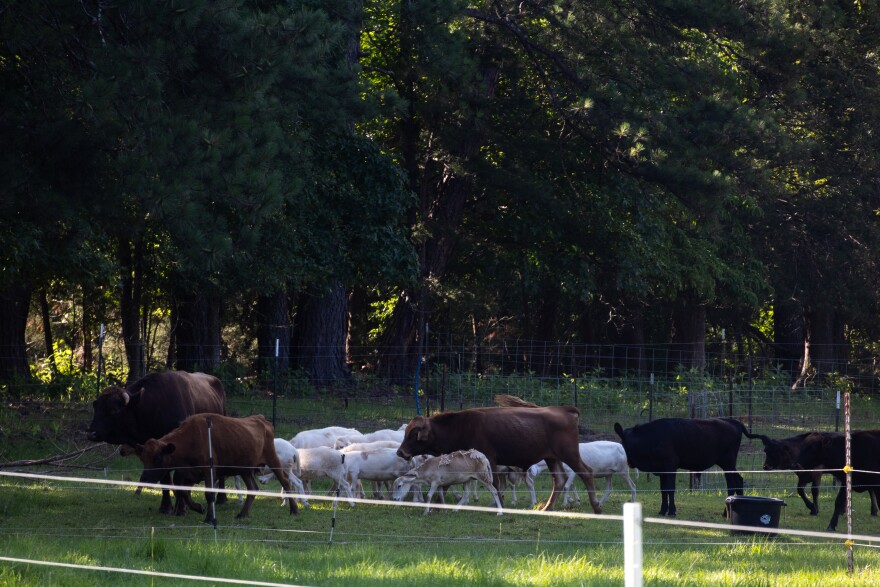
Now, private land with cows and sheep sits on the area where the fort once stood. Ashmore said he gives tours just during the winter to avoid the risk of ticks. The area where trenches once helped shield soldiers are still visible.
Some remnants from the fort now reside at the Laurens County Museum in the city of Laurens’ downtown area. The objects, although not individually labeled, will be part of an upcoming opening collection.

Luis-Alfredo Garcia
/
South Carolina Public Radio
Museum docent Julia Sermons said being informed of local history helps shape modern decisions.
“You have to know where you’re coming from to know where you’re going,” she said.
Ashmore, too, saw the same value.
“We are all in the middle of this,” he said. “This history – the important role that South Carolina played in the Revolution.”
An estimated 14 battles took place in Laurens County, according to Ashmore. He has been keeping track of local history for about 6 years. He said the county has set a 50-year plan to help with future record keeping.

Luis-Alfredo Garcia
/
South Carolina Public Radio


Video of SCHSL 5A Division 1 Upper State track and field championships
Here’s video of some of the action from the SCHSL Class 5A Division 1 Upper State boys and girls track and field championships held May 8 at Dorman.
Riley Vaughn of Spartanburg girls Track and Field was named the 2025-26 South Carolina girls Gatorade Player of the Year.
Vaughn won the shot put and discus events at the Class 5A-D1 state championships. She nailed a 13.1 meters on the shot and 41.77 meters on the discus. Her 14.41 in the shot at the region meet was the state’s best for 2026.
The 5-foot-10 junior helped lead Spartaburg to a fifth-place team finish. Vaughn had also competed on the national stage after taking third place in the shot put event at the Under Armour Nationals.
“Unbeaten in the discus throw on home state soil this year, Vaughn achieved success in both throws, but really sparkled in the shot put circle,” PrepCalTrack editor, Rich Gonzalez, said. “Her season-best there was the state’s top mark in the event in seven years and moved her to No. 4 on South Carolina’s all-time list.”
Vaughn is now part of an elite group of athletes who have won the prestigious award, including four-time Olympic gold medalist Sydney McLaughlin, five-time Olympic medalist Sanya Richards, and 11-time Olympic medalist Allyson Felix.
Vaughn was also named to the Greenville News’ All-Upstate First Team in girls’ Track and Field for the second consecutive season.
Kamryn Jackson covers high school and college sports for the Spartanburg Herald-Journal, Greenville News, Anderson Independent Mail, and the USA TODAY Network. Please email her at KEJackson@gannett.com and follow her on X @KamxJack (formerly Twitter).

-
Business6 seconds ago
Snap sued by parents of girl who was raped by man she met on Snapchat
-
 Entertainment5 minutes ago
‘The Bear’ at closing time: Ayo Edebiri and Jeremy Allen White reflect on five seasons
-
 Lifestyle12 minutes ago
L.A. Affairs: After decades of near-misses, I finally told him: ‘I’m not leaving here without you’
-
 Politics15 minutes ago
Trump budget request omits funds for L.A. fire relief, prompting criticism from senators
-
 Science20 minutes ago
EPA touts crackdown on smuggled pesticides in L.A. visit
-
 Sports28 minutes ago
Commentary: Did Padres curse themselves by messing with that anti-Dodgers FTD burger?
-

 World35 minutes ago
Copernicus lead warns extreme heat measures needed or deaths to ensue
-

 News1 hour ago
“It’s blood money”: Family of exonerated man in Texas yogurt shop murders speaks out after settlement

