Miami, FL
As America says no to War, this Miami suburb hopes for strikes on Maduro


In Doral, a suburb just west of Miami where nearly 40 percent of residents trace their roots to Venezuela, a bust of Simón Bolívar sits mostly unnoticed beside a strip mall parking lot, one block from the popular café El Arepazo. Bolívar, the 19th-century independence hero, has long been claimed by Venezuela’s socialist regime as the ideological father of its “Bolivarian Revolution.” But in Doral—often dubbed “Doralzuela”—exiles have tried to reclaim him as their own.
The city is part of a much larger diaspora: more than 545,000 Venezuelan-born residents now live in the United States, according to U.S. Census estimates. About one-fifth of them are concentrated in Florida, but Doral has become more than a hub—it’s a kind of exile capital, where politics spill over into everyday life.
Inside El Arepazo, one of the city’s best-known gathering spots, the energy has shifted. The tables where exiles once argued over elections and strategies for change now feel subdued. Near the entrance hangs a poster of Venezuelan opposition leader María Corina Machado, who was awarded the Nobel Peace Prize in November. No one points to it. No one brings her up. Conversations have turned elsewhere.
Staff glance up when unfamiliar faces enter. “People just don’t talk anymore,” one employee told Newsweek. “They look around before answering even small questions.” Some regulars have stopped coming altogether—and when they do, it’s just to watch the Real Madrid matches. Many fear that speaking openly about Venezuela could endanger relatives or jeopardize their immigration cases, especially after President Trump’s rollbacks of Temporary Protected Status, or TPS —a program that lets eligible migrants live and work legally in the U.S.—and humanitarian parole.
That silence has deepened over the past month, as Trump intensified military operations in the Caribbean. On Tuesday, he announced that land strikes on Venezuelan targets would begin “very soon,” marking the sharpest escalation yet in a campaign that has already included weeks of covert naval maneuvers and more than 20 boat strikes—operations the White House says are targeting drug routes protected by Nicolás Maduro’s regime.
Most Americans don’t seem convinced about this growing drumbeat of war. National polls show broad opposition to military intervention in Venezuela. A CBS News/YouGov poll released November 23 found that most Americans disapprove of military strikes in Venezuela, citing doubts over whether they would reduce drug trafficking or improve U.S. security.
But in Doral, the sentiment is starkly different. Many see the escalation not just as justified—but long overdue.
“We’ve tried everything,” said one man outside El Arepazo, who declined to give his name. “We voted. We marched. We begged. Nothing changed.” For many Venezuelan exiles in the city, Trump’s threat isn’t seen as provocation. It’s viewed as the last remaining option.
Eduardo Gamarra, a political science professor at Florida International University who has tracked Latino voting trends for over three decades, said the divide reflects the diaspora’s lived experience. “There’s a segment that still believes Trump and Rubio were serious when they said the goal was to topple Maduro,” Gamarra told Newsweek.
Backing Trump, Despite the Past
Even as legal protections unravel and fear grows across immigrant neighborhoods, many Venezuelans in South Florida still view Trump as their best—and perhaps only—hope to oust Maduro. That contradiction doesn’t erode their support. It complicates it.
Trump’s threat of military action has rekindled support among those who believe regime change is long overdue. “Even if he hurt us with TPS, if he gets rid of Maduro, we’ll forgive him,” said Felipe, a longtime Doral resident and former Trump campaign volunteer now facing possible deportation. He said the sentiment is common in a city where Trump flags once bloomed across lawns and pro-Trump caravans jammed streets during the 2024 election.

“Trump’s message of anti-socialism, especially when paired with the idea of using force against Maduro, resonated with the older Venezuelan electorate in a way no other candidate could,” Gamarra said. “He became the symbolic figure of the fight against Chavismo [the socialist political ideology associated with Maduro’s predecessor, Hugo Chavez].”
Meanwhile, repression inside Venezuela has only intensified. According to the human rights group Foro Penal, more than 800 people remain imprisoned for political reasons, and over 18,000 have been detained arbitrarily since 2014. Even private messages criticizing the government have led to lengthy prison sentences under Venezuela’s sweeping anti-hate laws.
For many exiles watching from afar, that escalating crackdown only deepens the urgency. Even voters burned by past promises—Trump’s failed embrace of opposition leader Juan Guaidó, the rollback of TPS, or stalled sanctions—cling to a belief that this time will be different. “There’s disappointment, yes,” said one longtime Doral resident. “But there’s also trust. We think he’s the only one who has the guts to do something.”
That loyalty runs deep. In 2024, Trump won more than 60 percent of the vote in Doral, helping flip Miami-Dade County red for the first time since 1988. His promises to “crush socialism” and “liberate Venezuela” electrified Venezuelan voters, who mobilized with rallies, caravans and lawn signs in ways that set them apart from other conservative Latino blocs in Florida.
And by November, according to FIU’s latest survey, half of Trump’s Venezuelan supporters in Florida still stand by their vote, bolstered by his recent stance on Venezuela.
‘Not Like Us’
The political divide among the exiles of Doral runs deep, rooted in the timelines of departure and the reasons people left in the first place.
Two waves of Venezuelan migration have shaped this community. The first began in the early 2000s as Chávez consolidated power. Many who fled during that period were part of the professional class—lawyers, business owners, engineers—with the resources and documentation to resettle through legal channels. They became homeowners, built businesses and aligned quickly with South Florida’s Republican establishment. Their opposition to Chavismo was unwavering—shaped by the sense of what they lost and what they rebuilt.
A second, larger wave followed in the wake of Venezuela’s economic collapse under the Maduro regime. This migration was born not from politics but desperation. Venezuela’s GDP has contracted by more than 80 percent since Maduro took office in 2013, according to the International Monetary Fund. As food shortages, hyperinflation and state violence spiraled, families fled in droves. Many arrived without papers or long-term visas, relying instead on temporary measures like TPS or humanitarian parole. They were younger, often working class, and took up the jobs that now sustain much of South Florida’s service economy—construction, delivery, restaurant work.

The gap between the two groups remains visible, and at times, tense. In interviews and focus groups conducted by Gamarra’s team, earlier arrivals often draw sharp distinctions. “They’re not like us,” some said—describing the newcomers as less educated or, in some cases, suggesting they had once supported the very regime they later escaped.
According to FIU data, roughly 70 percent of Venezuelan Americans in Doral arrived before 2014—most during the early Chávez years—and it is this group that now forms the backbone of Trump’s support. Many no longer rely on immigration protections like TPS or humanitarian parole. In fact, some openly support ending those programs, arguing they’ve been misused or abused by newer arrivals.
But for those who came more recently, the rollback of those protections has been nothing short of devastating. Trump’s post-election decision to cancel TPS and parole for Venezuelan migrants stripped legal safeguards for hundreds of thousands. At the time, more than 320,000 Venezuelans across the U.S.—many of them in Florida—were living under those temporary protections, according to Department of Homeland Security estimates.
Among these newer arrivals, the mood is different. Many are more cautious—worried both about family back home and the impact of losing legal protections—and their support for Trump is softer than that of earlier exiles.
‘The shot clock is running’
Not everyone in Doral is convinced that regime change is imminent. For all the support Trump commands, doubts linger. “We’ve heard this story before. What if this is just another show? What if we’re left with nothing—again?” said Victor, a 34-year-old Uber driver and asylum seeker.
Military analysts say time is running short. “There’s no strategic rationale for sending the [USS Gerald R.] Ford to the region unless it’s intended for use,” said Mark Cancian, a senior adviser at the Center for Strategic and International Studies, in an interview with Newsweek. “The shot clock is now running. They’ll either need to act or redeploy it, and pulling back would amount to backing off.”
Trump recently designated the Cartel of the Suns—a shadowy network of military-linked traffickers—as a foreign terrorist organization, paving the way for expanded U.S. military authority in the region. The move, while largely symbolic, lays legal groundwork for targeted strikes beyond traditional anti-narcotics operations.
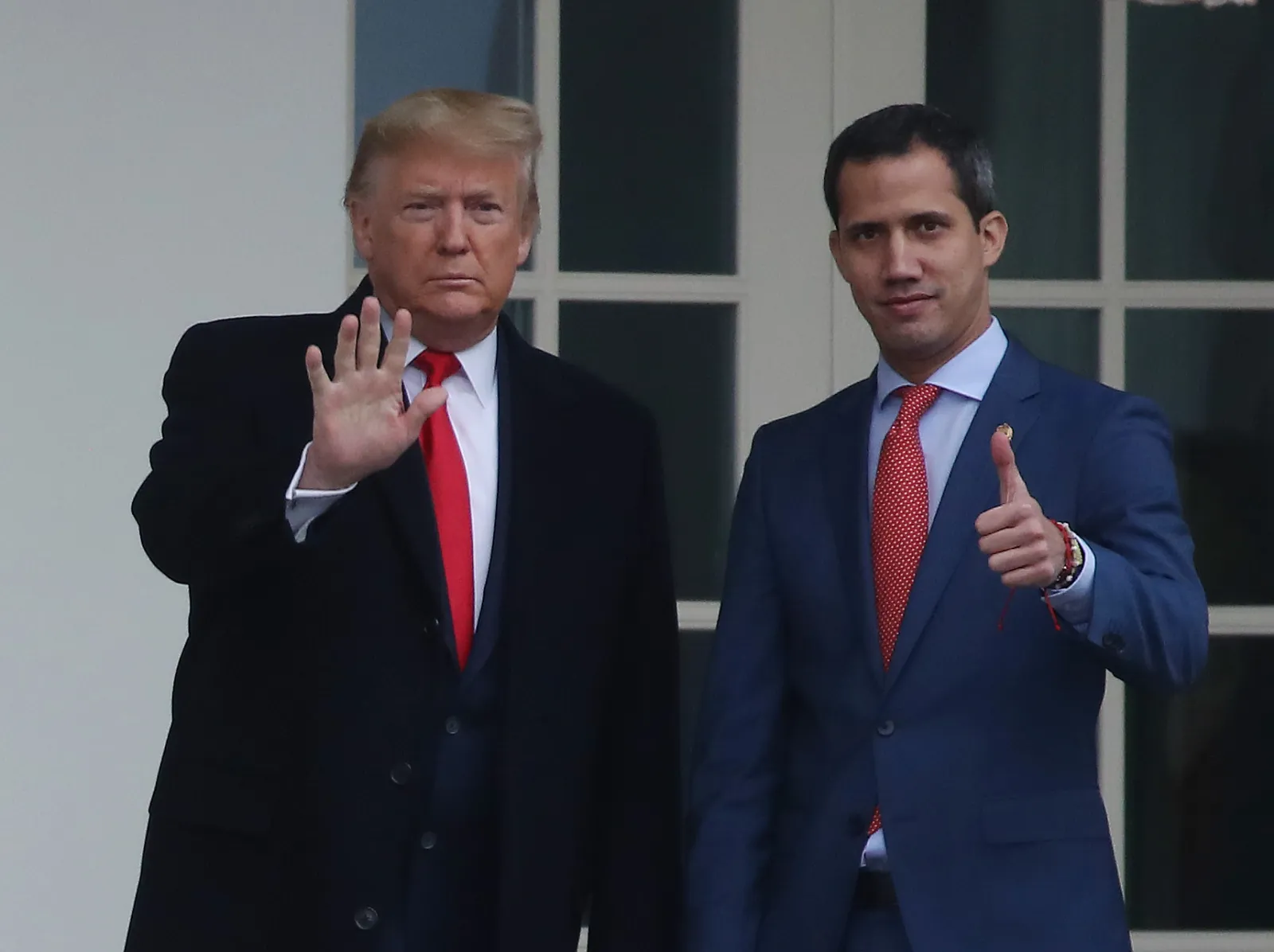
Such uncertainty is familiar to many in Doral who feel bruised by memories of broken promises. They recall the fanfare around Guaidó’s rise, his White House visits, the bipartisan ovation at the State of the Union. Then came sanctions, more speeches, a new election, and eventually, silence. “Venezuelans haven’t forgotten what happened last time,” Gamarra said. “They were promised protection, support, regime change. Instead, they saw deals, delays, and now—deportations.”
Florida GOP Representative María Elvira Salazar, one of Venezuela’s most vocal critics in Congress, framed the administration’s latest moves as a necessary correction. “Thanks to Trump, who has the internal fortitude to do what’s right,” she told Newsweek. Still, she acknowledged the weight of the moment. “We are in a battle for the Western Hemisphere,” said Salazar, a Cuban-American and former news anchor. “And the people of Venezuela are watching.”
In Doral, many are more than watching. They are waiting for what comes next. An armada of U.S. warships sit just off their homeland’s coast. And in the city that many Venezuelans now call home, some believe those ships could finally bring the change they’ve long hoped for. But they also know it could come with a cost.
“My family is still there. I can’t say anything. Not even in the U.S.,” said a woman inside El Arepazo, declining to give her name.
Fear continues to shape daily life for those with relatives in Caracas, as well as for anyone wary of drawing attention to their immigration status. Still, many support the military buildup. While much of the U.S. views the warships as a provocation—or the start of another overseas quagmire—in this city shaped by exile, they’re seen differently: the only option left.



Miami, FL
I went to 2 famous Miami restaurants, a flashy steakhouse and a Cuban hot spot. Here’s how they compared.

Café La Trova celebrated the city’s Cuban heritage through live music, warm hospitality, and dishes that felt deeply rooted in local culture.
Papi Steak, meanwhile, embraced Miami’s flashy, see-and-be-seen reputation with theatrical presentations, celebrity appeal, and an atmosphere that often felt more like a nightclub than a standard steakhouse.
Despite Papi Steak’s over-the-top reputation, nearly every dish I tried — from the wagyu pastrami to the hamachi crudo — was thoughtfully prepared and tasted just as good as it looked. If you’re looking for an indulgent, special-occasion dinner where the spectacle is part of the fun, it’s easy to understand why the restaurant has become such a phenomenon.
Still, if I could only recommend one restaurant to a first-time visitor, I’d choose Café La Trova.
While Papi Steak offered the more decadent, once-in-a-lifetime meal, Café La Trova delivered a more authentic Miami experience, pairing outstanding food and cocktails with a genuine sense of the city’s history and culture.
Miami, FL
7 more women arrested at southwest Miami-Dade massage parlors, accused of prostitution in undercover sting

Seven more women have been arrested at massage parlors across Miami-Dade, following a wave of arrests in an undercover prostitution sting operation run by the Miami-Dade Sheriff’s Office.
All seven women appeared in bond court facing prostitution charges as well as running a massage business without a license. The arrests come a day after seven other women were arrested at massage parlors in southwest Miami-Dade. Those locations were closed after the first round of arrests.
According to arrest reports, the women would offer sexual acts to an undercover detective after a massage. They would also charge, according to the reports, prices ranging from $50 to $150.
The women’s ages ranged from 46 to 67 years old:
- Yaoying Lin, 58
- Xiufen Lin, 51
- Yan Xi, 48
- Zixuan Wang, 46
- Mei Hui Lin, 49
- Quirong Xu, 67
- Hongli Ren, 63
Judge Mindy Glazer presided over the bond court appearances. During the proceedings, she referenced charges of “committing a lascivious act and engaging in prostitution,” according to CBS News Miami’s reporting from the courthouse.
Yaoying Lin’s attorney, Paul Petruzzi, persuaded the judge to reduce her charge from a felony to a misdemeanor.
“She’s resided in Miami for many years. Married. And has never failed to appear,” Petruzzi said.
“They had my client held overnight. She was charged with a felony unfairly. To the point where a judge on her own dismissed it. It’s either real bad, bad, bad police work. Or it’s something else. A little bit more nefarious. I’m afraid the latter,” Petruzzi said.
The Miami-Dade Sheriff’s Office said that they will not be providing any interviews regarding this undercover sting at this time.

This is the eighth edition of Miami Hurricanes on SI’s breakdown of each team on the 2026-27 Miami Hurricanes football schedule.
Miami, to this point, is coming off its biggest test of the year against Pitt. Now they will turn their attention to Bill Belichick and what he has accomplished to this point in his second season as a college football head coach.
North Carolina should be better than last season after a disappointing 4-8 2025 outcome. However, the Hurricanes also understand that this is the ideal trap game before they head on the road to face Notre Dame in one of the biggest games of the season, which could hold massive playoff implications.
Miami can’t look forward. All eyes will be on what the new season and another fun home game against a rising contender.
Here’s everything you need to know about UNC and its 2026 unit.
The Offense
Petrino03 | USA TODAY Network via Reuters Connect
Thursday 17, 2014
After coming off one of the worst offensive outputs in the country last season, Belichick knew that he needed to make a move quickly. It started with hiring veteran coach Bobby Petrino as the teams offensive coordinator.
It won’t be the 126th ranked offense, but how much better could it get with Petrino making the calls? The Tar Heels will also have a new quarterback under center, but so far, no one knows who exactly it will be.
The most talented player in the quarterback room is Travis Burges. A 6-foot-4 freshman dual-threat quarterback with unlimited potential, but they also went into the transfer portal and landed some experience in former Wisconsin QB, Billy Edwards Jr., is expected to start, but the change could be made halfway through the season if things don’t work.
Two new starting receivers also entered from the transfer portal, but the consistency in the room was provided by Jordan Shipp. Last season, he led the team in receiving yards (671) and touchdowns (6), even with how bad the team was at scoring.
UNC’s rushing attack was also highlighted by returning sophomore Demon June. He rushed for nearly 500 yards in his limited snaps, averaging 5.5 yards a carry with two touchdowns.
Defense
Defense should be the calling card of the Tar Heels next season, led by their star pass rusher, Melkart Abou-Jaoude. The 6-foot-5, 260-pound rusher totaled 10.5 sacks and 47 tackles last season. Another year learning under Belichick would likely push him to be a first or second round pick in the 2027 Class, one that the Canes are paying close attention to.
Moreover, some familarity will be on the sideline and a likely starter during his freshman year in Keton Dopson, the former Miami Hurricanes commit. He reclassifed to the 2026 class, and flipped his commitment knowing that there is a better chance to get on the field quicker at UNC than the depth that he would have had to wait behind at least for this season.
UNC’s secondary is one of the more sound groups in the country compared to the rest of its roster. However, their linebacking core who rack up tackles, are transfers who have to learn the Belichick system.
Schedule
Schedule-wise, this game is the biggest trap game of the season for the Canes. If Miami finds its way past Pitt, it will be 7-0, and this game stands between the Canes and a rematch with the Fighting Irish.
This is the perfect time for Belichick to get his first signature win against a returning program like Miami, which puts a ton of pressure on the Canes to get the job done. However, the Canes can’t afford it, knowing what is coming next.
Moreover, this is the perfect chance for Darian Mensah to have a better game than last season’s outing against the Tar Heels. His one touchdown performance was one of his weaker games of the season, but it could be a step for him to get control of the Heisman conversation.
Outlook
MIami will be favored in this game, similar to how it will be for the rest of the season. UNC will give the Canes one of the better defensive matchups this season that will also test the offense.
Miami’s history against UNC in the Mario Cristobal era has shown it can have a high-flying offense but has to avoid self-inflicted wounds.
The Game
Date: October 31
Time: TBA
TV: TBA
Location: Hard Rock Stadium
Series History: UNC leads 16-11
Last Meeting: 2023
The Team
The Coach: Bill Belichick
Offensive Coordinator: Bobby Petrino
Defensive Coordinator: Steve Belichick
2025 Record: 4-8
2025 Rankings: 126th Total Offense, 70th Total Defense
Players to Watch: Melkart Abou-Jaoude, R-Sr, EDGE
Top Newcomer: C.J. Sadler, WR, Freshman
Biggest Question: How will Belichick adjust in his second year as a college football head coach?
The School
Location: Chapel Hill, North Carolina
Founded: 1789
Enrollment: 32,099
Nickname: Tar Heels
Colors: Power Blue and White
Mascot (Symbols): Rameses the Live Ram
The Program
Last Win in the Series: 2023
Last ACC Title: 1980
National Championships: NA
Playoff Appearances: NA
Last missed bowl season: 2025
Heisman Trophies: NA
The Schedule
October 31, Time TBA, Pitt Panthers @ Miami Hurricanes
This is the eighth story in Miami Hurricanes on SI’s early preview series of all 12 regular-season opponents for Miami football in 2026.
Follow all social media platforms to stay up to date with everything Miami Hurricanes- Twitter, Facebook, Instagram, Youtube, and BlueSky.
 Add us as a preferred source on Google
Follow
-

 Ohio5 minutes ago
Feeling itchy? Ohio leads nation with 6 cities on Orkin’s 2026 bed bug list
-

 Oklahoma8 minutes ago
Oklahoma’s Brent Venables named to 2026 Dodd Trophy Preseason watch list
-

 Oregon13 minutes ago
Ryan Reynolds-backed Aviation Gin shutters Oregon distillery
-

 Pennsylvania20 minutes ago
PA state rep. wants to force the York State Fair to change its name
-

 Rhode Island23 minutes ago
R.I. leading multi-state lawsuit against Trump administration housing policy – The Boston Globe
-

 South-Carolina28 minutes ago
SC is at the top for food waste in the nation. How you can make changes
-

 South Dakota35 minutes ago
Petition to clarify South Dakota proof of citizenship law shot down over technicality
-

 Tennessee38 minutes ago
Tennessee State men’s hockey cancels 2026-27 inaugural season for second straight year

