Louisiana
U.S. court to review civil rights lawsuit alleging environmental racism in a Louisiana parish


From left, Myrtle Felton, Sharon Lavigne, Gail LeBoeuf and Rita Cooper conduct a livestream video on property owned by Formosa on March 11, 2020, in St. James Parish, La. LeBoeuf, a co-founder of Inclusive Louisiana, has liver cancer, which she acknowledged can’t be traced back to petrochemical plant pollution with certainty, but said it can’t be ruled out either. Gerald Herbert/Associated Press file
NEW ORLEANS — A federal appellate court is set to hear oral arguments Monday in a civil rights lawsuit alleging a south Louisiana parish engaged in racist land-use policies to place polluting industries in majority-Black communities.
The Fifth Circuit Court of Appeals in New Orleans is reviewing a lawsuit filed by community groups claiming St. James Parish “intentionally discriminated against Black residents” by encouraging industrial facilities to be built in areas with predominantly Black populations “while explicitly sparing white residents from the risk of environmental harm.”
The groups, Inclusive Louisiana, Rise St. James and Mt. Triumph Baptist Church, seek a halt to future industrial development in the parish.
The plaintiffs note that 20 of the 24 industrial facilities were in two sections of the parish with majority-Black populations when they filed the complaint in March 2023.
The parish is located along a heavily industrialized stretch of the Mississippi River between New Orleans and Baton Rouge, Louisiana, known as the Chemical Corridor, often referred to by environmental groups as “Cancer Alley” because of the high levels of suspected cancer-causing pollution emitted there.
The lawsuit comes as the federal government has taken steps during the Biden administration to address the legacy of environmental racism. Federal officials have written stricter environmental protections and committed tens of billions of dollars in funding.
In the Louisiana case, U.S. District Judge Carl Barbier of the Eastern District of Louisiana in November 2023 dismissed the lawsuit largely on procedural grounds, ruling the plaintiffs had filed their complaint too late. But he added, “this Court cannot say that their claims lack a basis in fact or rely on a meritless legal theory.”
Barbier said the lawsuit hinged primarily on the parish’s 2014 land-use plan, which generally shielded white neighborhoods from industrial development and left majority-Black neighborhoods, schools and churches without the same protections. The plan also described largely Black sections of the parish as “future industrial” sites. The plaintiffs missed the legal window to sue the parish, the judge ruled.
EPA Administrator Michael Regan stands near the Marathon Petroleum Refinery as he tours neighborhoods that abut the refinery, in Reserve, La., on Nov. 16, 2021. A lawsuit filed by residents of a Louisiana parish located in the heart of a cluster of polluting petrochemical factories raises allegations of civil rights, environmental justice and religious liberty violations. Gerald Herbert/Associated Press file
Yet the parish’s land-use plan is just one piece of evidence among many revealing ongoing discrimination against Black residents in the parish, said Pamela Spees, a lawyer for the Center of Constitutional Rights representing the plaintiffs. They are challenging Barbier’s ruling under the “continuing violations” doctrine on the grounds that discriminatory parish governance persists, allowing for industrial expansion in primarily Black areas.
The lawsuit highlights the parish’s decision in August 2022 to impose a moratorium on large solar complexes after a proposed 3,900-acre solar project upset residents of the mostly white neighborhood of Vacherie, who expressed concerns about lowering property values and debris from storms. The parish did not take up a request for a moratorium on heavy industrial expansion raised by the plaintiffs, the lawsuit states.
These community members “have tried at every turn to simply have their humanity and dignity be seen and acknowledged,” Spees said. “That’s just been completely disregarded by the local government and has been for generations.”
Another part of the complaint argues the parish failed to identify and protect the likely hundreds of burial sites of enslaved people by allowing industrial facilities to build on and limit access to the areas, preventing the descendants of slaves from memorializing the sites. The federal judge tossed out that part of the lawsuit, noting the sites were on private property not owned by the parish.
At its core, the complaint alleges civil rights violations under the 13th and 14th amendments, stating the land-use system in the parish allowing for industrial buildout primarily in majority-Black communities remains shaped by the history of slavery, white supremacy and Jim Crow laws and governance.
Lawyers for St. James Parish said the lawsuit employed overreaching claims and “inflammatory rhetoric.” St. James Parish did not respond to a request for comment.
“The Civil War ain’t never been over,” said lifelong St. James Parish resident Gail LeBoeuf, 72, a plaintiff in the case who co-founded the local environmental justice organization Inclusive Louisiana. “They’re trying to destroy the Black people in this country in any way they can.”
LeBoeuf, who lives 1 mile (1.6 kilometers) from an alumina plant, was diagnosed with cancer in 2022 and blames her illness on the high levels of industrial pollution she has been exposed to for decades. She acknowledges the link cannot be proven but counters there is no way to prove industrial pollution was not the reason.
The U.S. Environmental Protection Agency found in a 2003 report that St. James Parish ranked higher than the national average for certain cancer deaths. In August, a federal judge barred the EPA from using the Civil Rights Act to fight industrial pollution alleged to have disproportionately affected minority communities in Louisiana.
Besides a moratorium on industrial expansion in the parish, LeBoeuf’s organization calls for real-time air monitoring of pollution and buffer zones around residential areas.
Community groups have battled for years against plans by Taiwanese company Formosa to build a $9.4 billion plastics plant near a predominantly Black town in the parish.
LeBoeuf and other prominent, local environmental activists met with White House officials in September to discuss the Biden administration’s progress in responding to concerns raised by United Nations human rights experts over industrial expansion in the Chemical Corridor.
LeBoeuf said she had rescheduled a doctor’s appointment to meet with White House officials. She believes her advocacy for environmental justice is just as important a cure for her community as her ongoing chemotherapy treatment is for her body.
“Both are medicine,” LeBoeuf said. “Fighting is medicine.”


BATON ROUGE, La. (WAFB) – A 53-year-old Louisiana man will serve 22 years in prison following a child sex crimes case that included possession of handmade childlike sex dolls — items that state lawmakers have since moved to ban.
Sabine Parish prosecutors say Yancy Elie Normand was sentenced after investigators received a tip that he forced someone to view child sexual abuse material. A search of his home allegedly uncovered more than 200 illegal files — including child sexual abuse material and bestiality — along with two handmade childlike sex dolls.
New state law bans child sex dolls
Louisiana lawmakers passed a law banning the possession, trafficking, and importation of child sex dolls statewide in 2024. State Sen. Beth Mizell said the push began after conversations with Homeland Security about human trafficking during the Super Bowl in New Orleans, at a time when the state had no specific law covering the dolls. The measure passed with near-unanimous support.
“I think the importance is that it’s a precursor to actual crimes against children,” Mizell said.
Mizell said the issue extends well beyond Louisiana’s borders.
“It’s a nationwide problem…when you look at just the volume of child abuse cases, to the point where our Attorney General now has multiple task forces in place all over the state,” Mizell said.
Task force expands statewide reach
The Louisiana Attorney General’s Office says protecting children remains the focus of its Louisiana Internet Crimes Against Children Task Force. Supervisory Special Agent Chris Masters leads the group, which now includes more than 80 agencies and 250 detectives.
Masters said the dolls are often misunderstood by the public.
“When people hear sex doll, they think of the blow-up thing. These things are thousands of dollars, and they’re anatomically appropriate to a child,” Masters said. “They’re gonna look like a child. It’s not just what you think on TV.”
Masters said coordination across agencies is essential to the task force’s work.
“It’s completely impossible if law enforcement is not together on the same page with the same type of training, the same access, the same type of equipment,” Masters said. “We can tend to continue expanding our partnerships until there is no safe haven for any sex predator or child predator in this state.”
Lawmakers urge parents to monitor children’s online activity
Mizell said the volume of harmful material accessible online makes parental awareness critical.
“You have access to abhorrent material online in your hand all day, every day,” Mizell said. “Pay attention. Don’t be afraid to look at your child’s phone.”
Click here to report a typo. Please include the headline.
Click here to subscribe to our WAFB 9 News daily digest and breaking news alerts delivered straight to your email inbox.
Watch the latest WAFB news and weather now.

MONROE, La. (KNOE)—Over the past week, average gas prices in Louisiana have fallen 6.8 cents. That averages to $3.41/g today, according to a survey of 2,436 stations conducted by ‘GasBuddy’.
Compared to a month ago, prices in Louisiana are 45.3 cents lower per gallon. The lowest price of gas in Louisiana was $2.59/g on Sunday, with the highest being $4.99/g.
For reference, the national average price of gas has fallen 6.9 cents per gallon in the last week, which averages to $3.78/g, and is down 55.6 cents per gallon from a month ago.
On this date for the past five years, here’s how Louisiana’s gas prices compare to the nation’s average:
June 29, 2025: $2.75/g (U.S. Average: $3.14/g)
June 29, 2024: $2.93/g (U.S. Average: $3.48/g)
June 29, 2023: $3.02/g (U.S. Average: $3.51/g)
June 29, 2022: $4.37/g (U.S. Average: $4.85/g)
June 29, 2021: $2.76/g (U.S. Average: $3.12/g)
Copyright 2026 KNOE. All rights reserved.

BATON ROUGE, La. (WAFB) – Julia Letlow and Jamie Davis will face off this fall for U.S. Sen. Bill Cassidy’s seat after winning their respective party runoffs Saturday night.
Letlow won the Republican runoff over John Fleming with 57% of the vote, less than an hour after polls closed on June 27. Davis won the Democratic nomination in a landslide, securing 80% of the vote over Gary Crockett.
Letlow, Davis claim victories
“I’ll fight for our families, I’ll fight for our farmers. I’ll fight for our teachers. I will fight for our parents. I’ll fight for our law enforcement. I will fight for everyone in this room, and we are just getting started,” Letlow said.
Davis said the issues driving his campaign cross party lines.
“Everybody wants better healthcare. Everybody wants better education for their children. Everybody wants a leg up with affordability. And everybody wants the Constitution to be upheld. Those issues are nonpartisan. I don’t have to change nothing but keep working,” Davis said.
Low turnout, Trump endorsement shaped Republican race
Estimated turnout was about 18% of registered voters. Political analyst Jim Engster said the low turnout actually benefited Fleming, who captured 43% of the vote, but was not enough to overcome President Trump’s endorsement of Letlow.
“He really had the 8 ball against him when President Trump endorsed Julia Letlow. President Trump is Hercules of Republican politics, and he’s carried this state three times by about 60 percent of the votes each time,” Engster said.
Engster said the results reflect the broader political landscape in Louisiana.
“It says that it’s more of the same. We’re a Republican state, and until further notice, we vote red in major elections,” Engster said.
New closed primary system draws scrutiny
Saturday’s election was the first major cycle under Louisiana’s new closed party primary system, in which Democratic voters could only choose Democratic candidates and Republican voters could only choose Republican candidates.
Engster said the change had a significant impact on participation, pointing to Cassidy’s vote totals as an example.
“Bill Cassidy might very well have held onto his seat in an open primary. After all, in the last open primary, he got 1,228,000 votes. This time he got 99,000 votes, so that’s a big difference,” Engster said.
Engster said critics of the closed primary system will use the turnout figures to make their case.
“It’ll be a case in which those who are against the closed primary will make the case that ‘The open primary may have its flaws, but more people participate. And after all, that is what we want. We want more people voting in our elections,” Engster said.
Road to November 2026
History suggests Republicans hold the advantage heading into the general election. Engster noted that Louisiana’s last elected Democratic senator was Mary Landrieu in 2008.
“It would really be a political miracle for Jamie Davis to win. Those things happen, but right now it’s a long shot, and there’s a lot of heavy lifting for him to do and for the Democratic Party to do to try to make up the inherent gap that is evident in Louisiana politics,” Engster said.
Letlow and Davis will face off in the general election on November 3.
Click here to report a typo. Please include the headline.
Click here to subscribe to our WAFB 9 News daily digest and breaking news alerts delivered straight to your email inbox.
Watch the latest WAFB news and weather now.
-
 Entertainment3 minutes ago
Alannah Keyser is latest fired ‘Love Island USA’ contestant to apologize for using a racist slur
-

 Lifestyle10 minutes ago
Chanel’s Bruno Pavlovsky on Reengineering an Iconic Brand
-
 Politics13 minutes ago
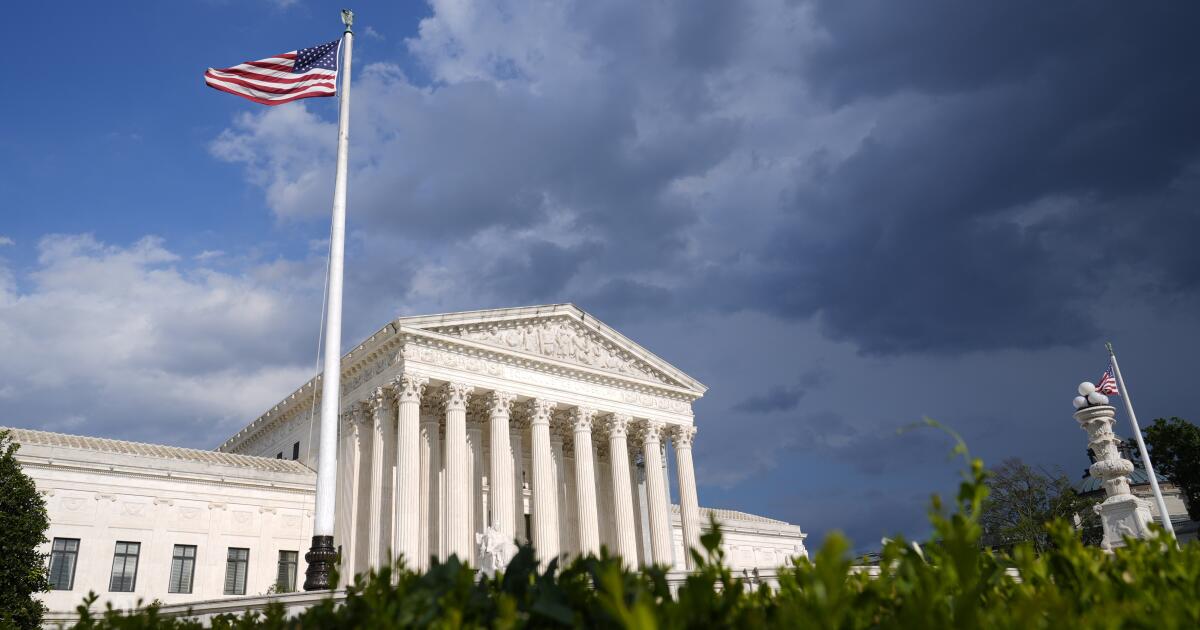
Supreme Court limits police use of cellphone data to find crime suspects
-
 Sports25 minutes ago
Teoscar Hernández returns, and Dodgers unleash 17-hit barrage in win over Athletics
-

 World33 minutes ago
DR Congo says 1,307 Ebola cases confirmed, including 377 deaths
-
 News58 minutes ago
Michigan governor threatens to pull troops from D.C. if used for Trump task force
-

 New York2 hours ago
Metropolitan Diary Challenge Day 2: How to Write Your N.Y. Story
-

 Los Angeles, Ca2 hours ago
Company has weeks to complete cleanup of Boyle Heights warehouse fire, officials announce

