Louisiana
The Vanishing Coast of Louisiana


Explore
Along the bayous of Louisiana, south of New Orleans, five Native American settlements are clinging to disappearing earth. Their homes outline the narrow strips of land deposited by the Mississippi Delta like the fingers of a skeletal hand disappearing into the Gulf of Mexico.
Southeast Louisiana is losing this land at an alarming rate—approximately a football field of land every 100 minutes—mostly due to human impacts of oil and gas extraction, subsidence, sea level rise, and increasingly damaging hurricanes brought by climate change. The people who make their homes here are continually seeking and finding creative solutions. A role they’ve taken on for centuries.
Many can trace their roots in the area to the 18th and 19th centuries, when a small number of Choctaw, Chitimacha, and other Native Americans—including some of my maternal ancestors—survived the vagaries of colonial settlement, wars, and waves of Indian removal policies in the remote coastal marshes of southeast Louisiana.
Over generations, they formed unique communities descended from a handful of shared Native American ancestors who intermingled with French and other European settlers. Here they farmed, raised animals, trapped, fished, and grew into large families for generations—until massive coastal erosion began eating away at the land.
ADVERTISEMENT
Log in
or
Join now
.
I have been photographing two of these communities, Isle de Jean Charles and Pointe-aux-Chenes, since 2005. In 2024, I returned to the project after a 12-year hiatus. In many cases, I ended up photographing the same location with more than a decade between each image.
Most of the residents of Isle de Jean Charles—which was featured in the 2012 film Beasts of the Southern Wild—have recently relocated together to a new community called New Isle, 33 miles farther inland. As a result, the community is far less inhabited now than it was when I last visited—I see plants and animals filling in the spaces that humans have vacated.
In this selection of photographs, I attempt to crystalize changes happening at both a geological and a human time scale so that they are more observable. The cycles of storm damage and recovery, erosion and displacement, are becoming more visible by the year. Developing relationships with people and landscape, I have come to see the fluid and powerful dynamics of loss and adaptability, the fragility and the strength of humans and a rapidly shifting ecosystem.
ADVERTISEMENT
Log in
or
Join now
.
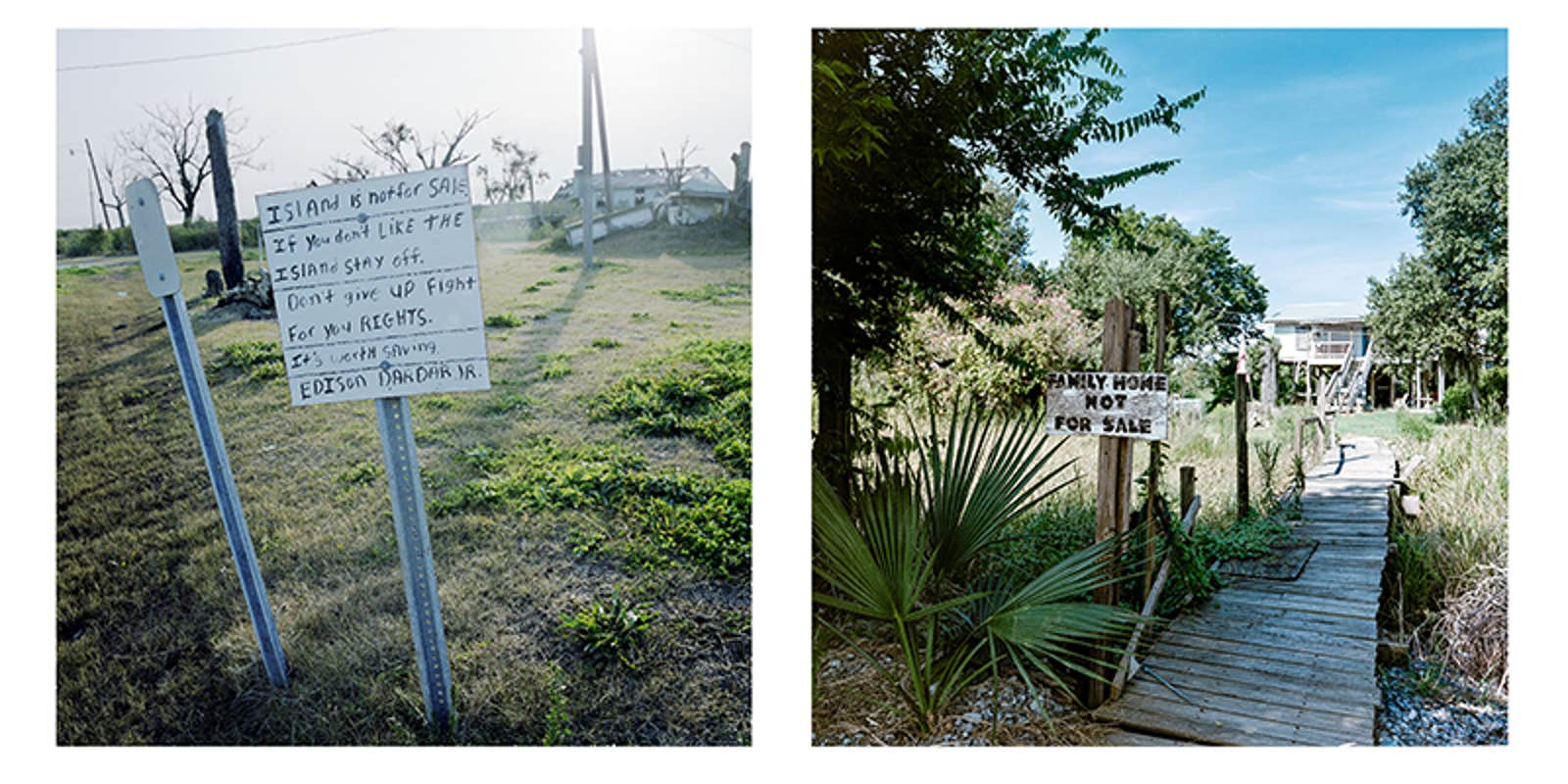
Left: January 2009
Sign at the entrance to Isle de Jean Charles.
Right: August 2024
Sign in front of a house on Island Road, Isle de Jean Charles.

Left: August 2010
Susie Danos in her garden on Isle de Jean Charles where she grew melons, cucumbers, beans, and okra. After years of storm flooding, some residents fear that the soil is contaminated by residue from offshore oil drilling. Frequent salt water intrusion kills plants and trees like the dead oak tree visible in the background.
ADVERTISEMENT
Log in
or
Join now
.
Right: September 2024
The site of Susie Danos’ gardens in 2024, marked by alligator tracks in the mud left by Hurricane Florence in 2018. Susie has left the island to live with her daughter’s family farther inland.
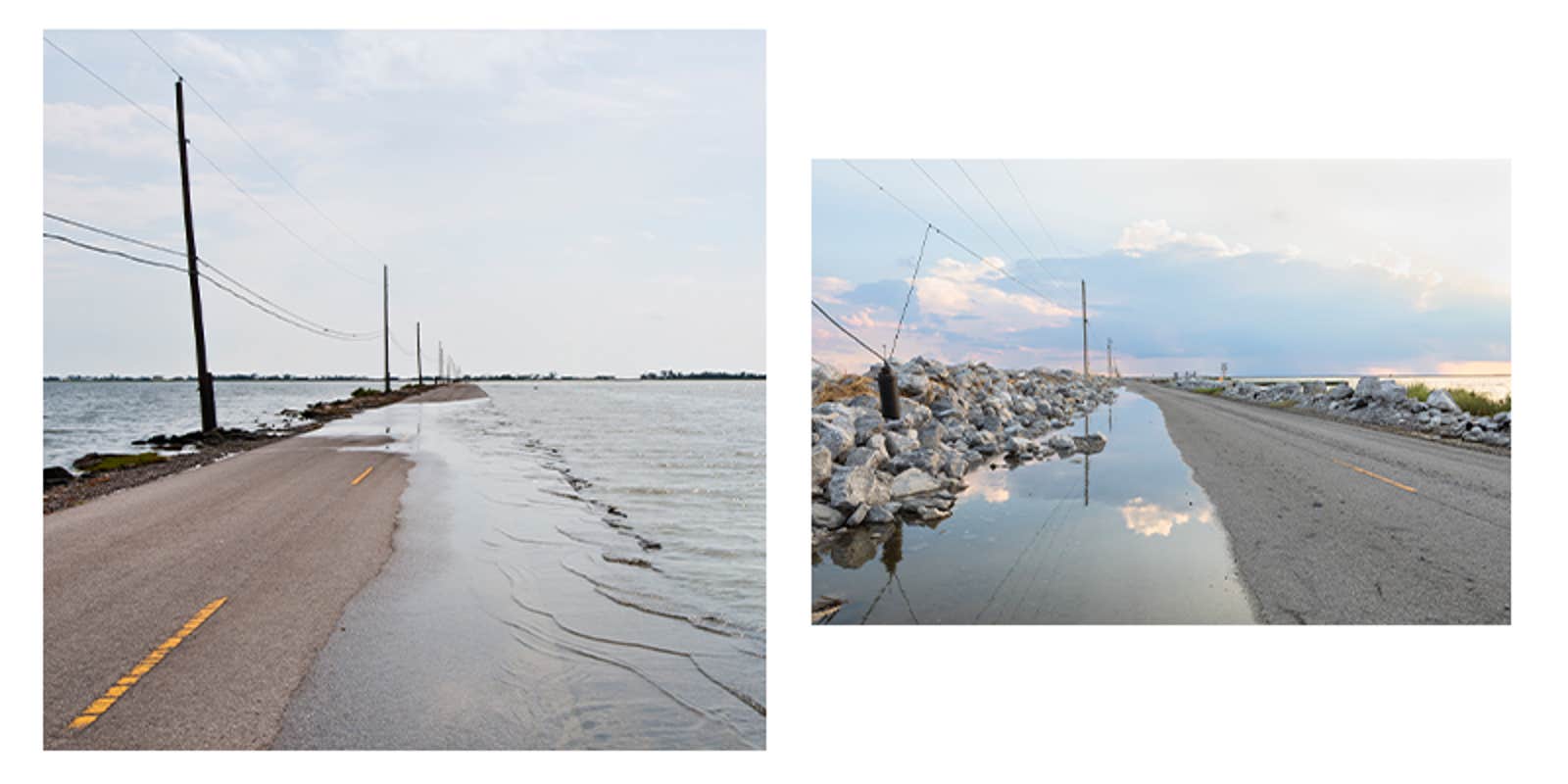
Left: September 2008
The single road that connects Point-aux-Chenes to Isle de Jean Charles. The road often floods and is in need of frequent repair due to coastal erosion.
Right: September 2024
The single road that connects Point-aux-Chenes to Isle de Jean Charles after Hurricane Francine, looking east. The road has been reinforced with riprap. Drainage pipes have been installed to allow water to recede after flooding.
ADVERTISEMENT
Log in
or
Join now
.
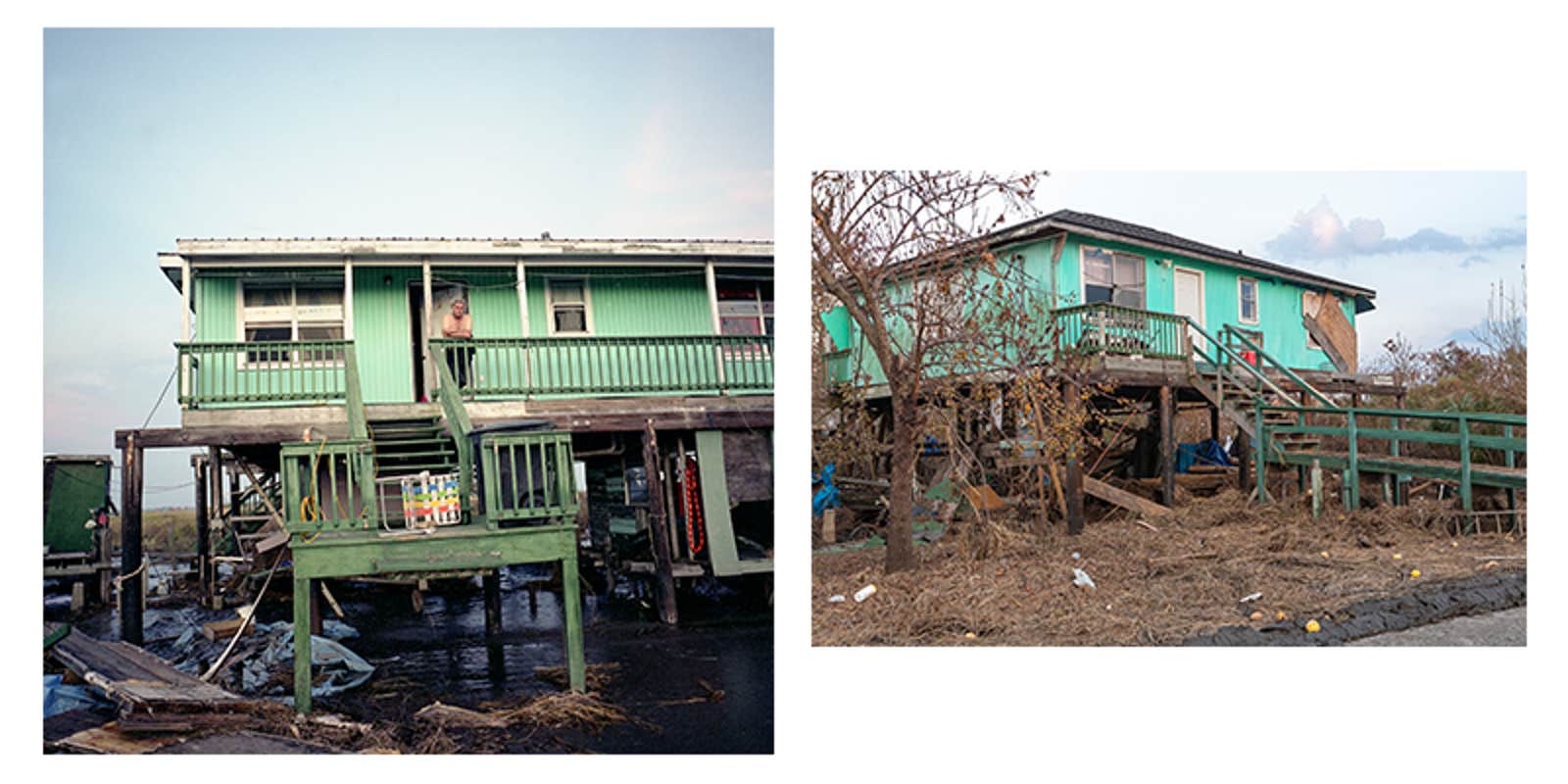
Left: November 2009
Edison Dardar, Sr. on his porch in Isle de Jean Charles pictured after flooding receded from the island. Dardar cast for shrimp with a net nearly every day, just a few hundred meters from his house. He was vocal about not wanting to live anywhere other than his home on Isle de Jean Charles.
Right: September 2024
The house of Edison Dardar, Sr. on Isle de Jean Charles pictured after Hurricane Francine hit this year. Dardar died in December 2023 at age 74. He never left his island home.

ADVERTISEMENT
Log in
or
Join now
.
Left: January 2010
A dead oak tree, known as a “skeleton tree” en route to Isle de Jean Charles and Pointe-aux-Chenes. Dead oak trees are a common sight along the eroding coastline of Louisiana. As salt water encroaches, trees and other fresh water flora are dying.
Right: August 2024
The same tree. 
Lead photo by Kael Alford / Panos Pictures
ADVERTISEMENT
Log in
or
Join now
.
Published in partnership with:
Get the Nautilus newsletter
Cutting-edge science, unraveled by the very brightest living thinkers.

Louisiana
Leadership Louisiana Health Fellows Welcomes Inaugural Class – Leaders for a Better Louisiana

Nearly 40 years after launching Louisiana’s premier statewide leadership development program, Leaders for a Better Louisiana is proud to announce the inaugural class of Leadership Louisiana Health Fellows, marking an important new chapter in the organization’s longstanding commitment to developing informed, connected leaders equipped to address the state’s most pressing challenges.
Building on the proven model and legacy of Leadership Louisiana, the Health Fellows program brings together leaders from across healthcare, business, public policy, higher education, philanthropy, and community organizations to gain a deeper understanding of the systems, opportunities, and challenges shaping health outcomes across Louisiana. Throughout the year, fellows will participate in immersive sessions across the state, engaging directly with healthcare providers, researchers, policymakers, workforce leaders, and innovators while exploring the issues that influence the health and well-being of Louisiana’s people and communities.
“The strength of Leadership Louisiana has always been its ability to bring together accomplished leaders from different sectors and regions to learn from one another while developing a broader understanding of our state,” said Sheree Blanchard, Director of Leadership Louisiana. “The Health Fellows program extends that tradition by focusing on one of Louisiana’s most significant opportunities for improvement. We are excited to welcome this outstanding inaugural class.”
The inaugural class represents a broad cross-section of Louisiana’s healthcare and civic leadership, with participants serving in hospitals, health systems, higher education, business, nonprofit organizations, public agencies, and community-based organizations throughout the state. Together, they bring diverse expertise and perspectives that will strengthen dialogue and collaboration around Louisiana’s health challenges and opportunities.
“From the beginning, our vision was to create a program that mirrors the excellence and impact of Leadership Louisiana while taking a comprehensive look at the many factors that influence health outcomes,” said Blanchard. “This first class reflects the caliber of leadership we hoped to attract, and we look forward to watching these fellows build lasting relationships and develop new ideas that will benefit communities across Louisiana.”
Leadership Louisiana has graduated more than 1,600 leaders over nearly four decades, creating one of the state’s strongest cross-sector leadership networks. Leadership Louisiana Health Fellows builds on that foundation by providing participants with a focused exploration of Louisiana’s healthcare landscape while reinforcing the program’s longstanding commitment to collaboration, informed leadership, and service to the state.
The 2027 Health Fellows class will begin its yearlong experience this summer with sessions held in multiple regions of Louisiana.
View the complete roster of the Leadership Louisiana Health Fellows inaugural class.

NEW ORLEANS, La (WVUE) – A new education center in the town of Jean Lafitte is giving visitors a chance to learn about south Louisiana’s coast.
Dave McNamara explores how the center combines history, culture, science, and a walk through a cypress swamp in the heart of Louisiana.
For more, visit the Heart of Louisiana archive here.
See a spelling or grammar error in our story? Click Here to report it. Please include the headline.
Subscribe to the Fox 8 YouTube channel.
Copyright 2026 WVUE. All rights reserved.

Luxury resort in Sarasota County ranked among South’s best new hotels
Luxury resort in Sarasota County ranked among South’s best new hotels
When you think of resorts, you probably think of hotels with expansive grounds, upscale amenities and all-inclusive packages.
While these types of resorts can surely be found in major-destination cities and foreign countries, Louisiana has its own resorts that are just as nice.
At Louisiana’s resorts, you can enjoy all the same amenities and stay at locations that are just as luxurious.
Plan your stays with Booking.com
Why these 6 resorts are the best in Louisiana for 2026
Travel US News has ranked the six best resorts in Louisiana based on hotel class rating, property type and guest reviews.
1. L’Auberge Casino Resort in Lake Charles
L’Auberge Casino Resort in Lake Charles is the best resort to stay in Louisiana, with a guest rating of 8.7 out of 10. More than just a nice place to stay, this resort offers premiere casino games, plenty of shopping, golfing opportunities, a spa, relaxing cabanas and upscale restaurants. The hotel also has business and fitness centers, and the rooms are in the modern arts and crafts style.
2. Caesars in New Orleans
Caesars in New Orleans is the second-best resort in Louisiana and has a guest rating of 7.9 out of 10. This resort has a great location within the Central Business District, making it near all the top attractions in the Crescent City. Here, there are plenty of dining and gambling opportunities. The rooms are equipped with standard amenities and are in a Louisiana-inspired style.
3. Margaritaville Resort Casino in Bossier City
Margaritaville Resort Casino in Bossier City is the third-best resort in Louisiana, with a guest rating of 8.7 out of 10. Strategically located across the Red River from Shreveport, this resort offers plenty to do, like testing your luck at the casino, spending a day by the pool, relaxing at the spa, eating delicious food at one of the restaurants or enjoying live entertainment at the performance hall.
4. Bally’s Casino & Hotel in Shreveport
Bally’s Casino & Hotel in Shreveport is among the best resorts in Louisiana and has a guest rating of 7.6 out of 10. Bally’s offers plenty of casino games and dining opportunities, and you can keep the night going with drinks and dancing at one of the lounges. The hotel offers business and fitness centers and the rooms come with standard amenities, like flat-screen TVs and minifridges.
5. Nottoway Plantation Resort in White Castle
Nottoway Plantation Resort in White Castle is one of the best resorts in Louisiana, as it is among the 4.0 star hotel class. This historic antebellum plantation, originally constructed in 1859, includes nine Acadian-style cottages, a salon, an outdoor pool, a fitness center and tennis courts. Visitors can tour the plantation house itself and embark on a guided tour of the on-site museum.
6. Cypress Bend Resort, a Wyndham Hotel in Many
Cypress Bend Resort, a Wyndham Hotel in Many is among the best resorts in Louisiana, with a guest rating of 7.7 out of 10. This hotel features two restaurants, a golf course, fitness center indoor and outdoor pools, as well as a bar and lounge. Belonging to the 3.0 star hotel class, this casual resort is the perfect spot for a quick getaway, as it’s set on 600 acres on Toledo Bend Lake.
Presley Bo Tyler is the Louisiana Deep South Connect Team for USA Today Network. Find her on X @PresleyTyler02 and email at PTyler@Gannett.com
-

 Maine1 minute ago
Graham Platner says he’ll withdraw from Senate race in Maine
-

 Maryland8 minutes ago
Maryland man sentenced to 15 years for attempting to join ISIS
-

 Michigan11 minutes ago
Sherrone Moore’s former assistant sues University of Michigan over alleged FOIA violations
-

 Massachusetts16 minutes ago
Max McColgan and Joseph Lenane share stroke play medals at 118th Massachusetts Amateur Championship – The Boston Globe
-

 Minnesota23 minutes ago
Man seriously injured in north Minneapolis shooting; no arrests
-

 Mississippi26 minutes ago
Ben Crump seeks independent autopsy in Nolan Wells death
-

 Missouri31 minutes ago
Missouri politicians champion unity, diversity on America’s 250th
-

 Montana38 minutes ago
Montana signs onto data center energy cost protection pledge

