Louisiana
How Louisiana Is Coping With Flooding In Cemeteries


This article is part of The State of Science, a series featuring science stories from public radio stations across the United States. This story, by Eva Tesfaye, was published in collaboration with WWNO.
Emily Dalfrey lives across the street from Niblett’s Bluff Cemetery, where generations of her family are buried, in Vinton, Louisiana.
In 2016, a period of prolonged rainfall caused flooding so severe that people could drive boats over the cemetery. The water put so much pressure on the graves that some of the vaults, which are located near the surface, popped open. Some of Dalfrey’s own family members’ caskets were carried away and deposited in her yard.
Unsure how to restore the cemetery, the community contracted Gulf Coast Forensic Solutions, a company that helps people locate and rebury loved ones after natural disasters damage cemeteries.

“We truly would have not gotten it done if we would not have had that guidance and that help,” Dalfrey says of Gulf Coast’s assistance. “Because when you bury your family, you think they’re there forever.”
Louisiana has dealt with flooded cemeteries and caskets washing away for decades, but the problem is getting worse—and more widespread. As climate change increases the likelihood of weather-related disasters, many other states are now grappling with damaged cemeteries. And they’re looking to Louisiana for help.
Hurricanes, Flooding, And Mudslides
Charlie Hunter, the CEO of Gulf Coast Forensic Solutions, started in this line of work during his time at the Calcasieu Parish Coroner’s Office, where he worked in death investigation. Normally, such a job involves investigating homicides and car accidents, but Hunter found himself spending a lot of time doing grave site recovery after Hurricane Katrina in 2005.
He started his company in 2020, repairing over 75 cemeteries across Cameron and Calcasieu Parishes in southwest Louisiana after Hurricanes Laura and Delta. He eventually left his job at the coroner’s office and expanded the company in 2023.
“It’s being able to give families a little bit of peace at the end of the day,” he says, “and so I think that’s what’s really important. It’s a never-ending job.”
Working in a state that’s been so frequently pummeled by hurricanes has made him something of an expert in his field.
“Now that cemetery damage and restoration is such a big deal, people reach out to us from all across the country, whether it’s from hurricanes, flooding events, mudslides,” he says.

Hunter says he’s helped people in Florida, South Carolina, Tennessee, and even California. One of them was Eva Kenner from Port Charlotte, Florida. She manages Charlotte Harbor Cemetery, the oldest marked cemetery in its county. It was hit by Hurricane Ian in 2022, resulting in 26 fallen trees and close to 100 damaged gravestones.
“I’ve been there 20 years working at the cemetery and we’d never had damaged headstones from a storm before,” Kenner says.
She hired Gulf Coast Forensic Solutions to help repair the cemetery and says the company fixed around 80 headstones in one week—but there’s no getting back those beautiful trees.
“The 26 trees just took away the whole atmosphere. There were great, giant old oaks, hundreds of years old, sun dappled,” she says.
But the repaired headstones have held up, she says, even after other storms have torn through, leaving debris on the ground.
The Louisiana Cemetery Response Task Force
The flooding that damaged Dalfrey’s family members’ graves in 2016 affected more than 800 graves in 74 cemeteries across Louisiana. After that event, the Louisiana Cemetery Response Task Force was created.
“We are the only state that has that,” says Ryan Seidemann, the task force chairman.
The task force is activated when there has been a disaster declaration and reports of cemetery damage. It is currently activated and has been since Hurricane Ida in 2021.
Seidemann says the task force was created to fill a void in federal assistance for cemetery recovery and because in many storm-prone places, there is no one left taking care of cemeteries.
“A lot of folks have moved away over the years. There really weren’t a lot of people to speak for those descendants who had taken off and floated away with the storm surge,” he says.
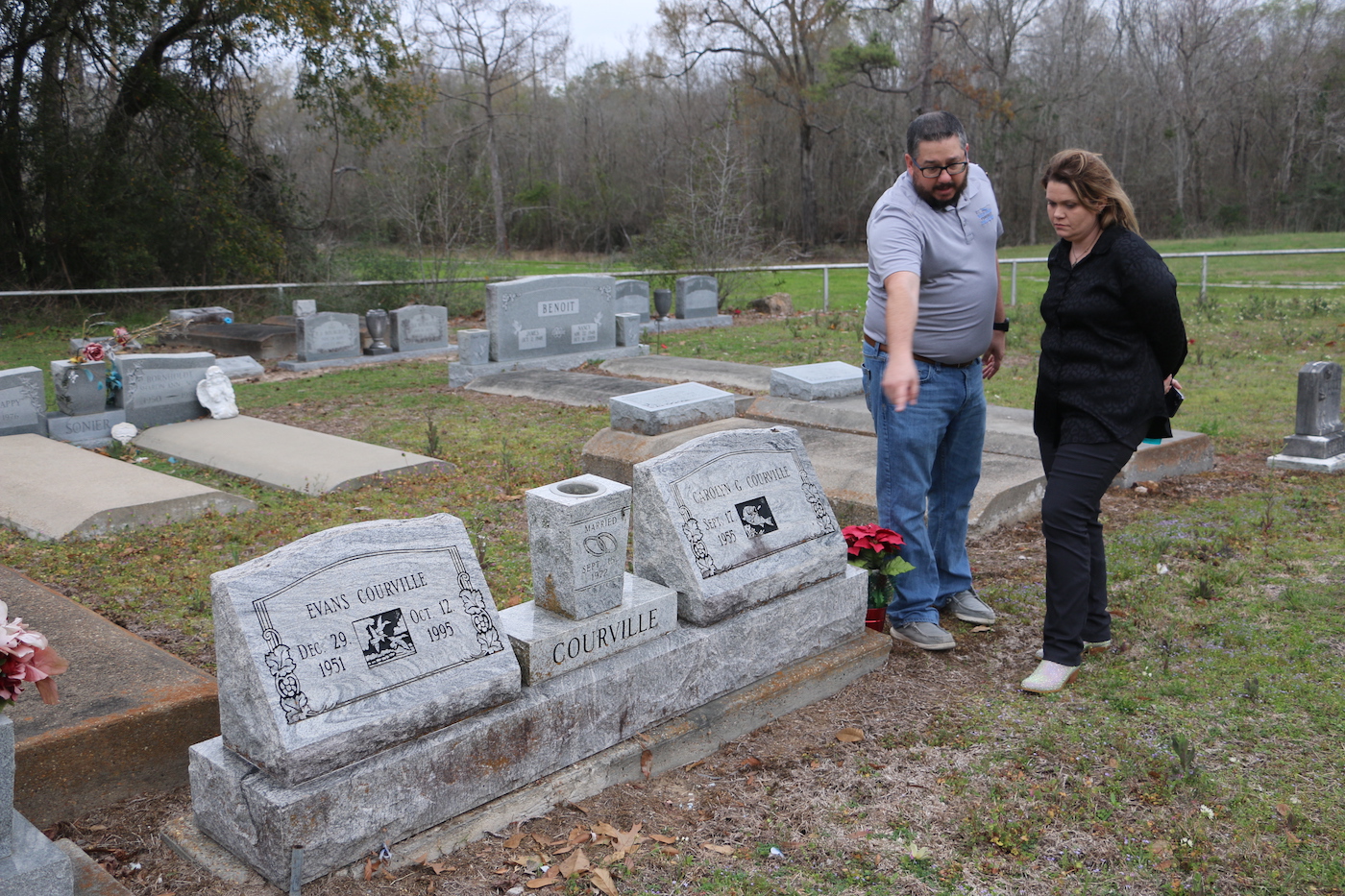
Like Hunter’s company, the task force helps find, recover, and identify lost caskets. Reburial can cost thousands of dollars, but family members of the deceased can receive funding for it through the Federal Emergency Management Agency (FEMA)’s individual assistance program. Because the process of getting that money can be difficult, especially when people are already dealing with fallout from a disaster in other parts of their lives, the task force also helps people apply for it.
And also like Hunter, the task force gets calls from other states where communities find themselves in need of that kind of cemetery restoration expertise—usually along the Atlantic Coast, but sometimes even in the West.
“Oddly, [requests for help have] come from places such as New Mexico, which you wouldn’t think would have flood problems with cemeteries,” says Seidemann, “but apparently as they’ve had wildfire problems and then rainstorms, the undergrowth that is keeping burials in place there is washing off.”
Preparing For Extreme Weather
Climate change is exposing how unprepared cemeteries are for extreme weather events says Jennifer Blanks, a PhD candidate at Texas A&M University who studies cemetery preservation and management.
“Climate change is showing that there actually isn’t really a good protocol or procedure to help with those kinds of issues, in terms of mitigating cemeteries from disasters, and how to recover them afterward,” Blanks says.
That is especially true for Black and other minority cemeteries. In her research, Blanks has found that Black cemeteries in Louisiana have more exposure to flood hazards and proximity to hazardous chemical sites.
“Traditionally, Black residents and non-white people are forced to settle on land that is undesirable for different reasons, whether it cannot produce any type of crop or products, or the value of the land is low because it is in a floodplain,” Blanks says.
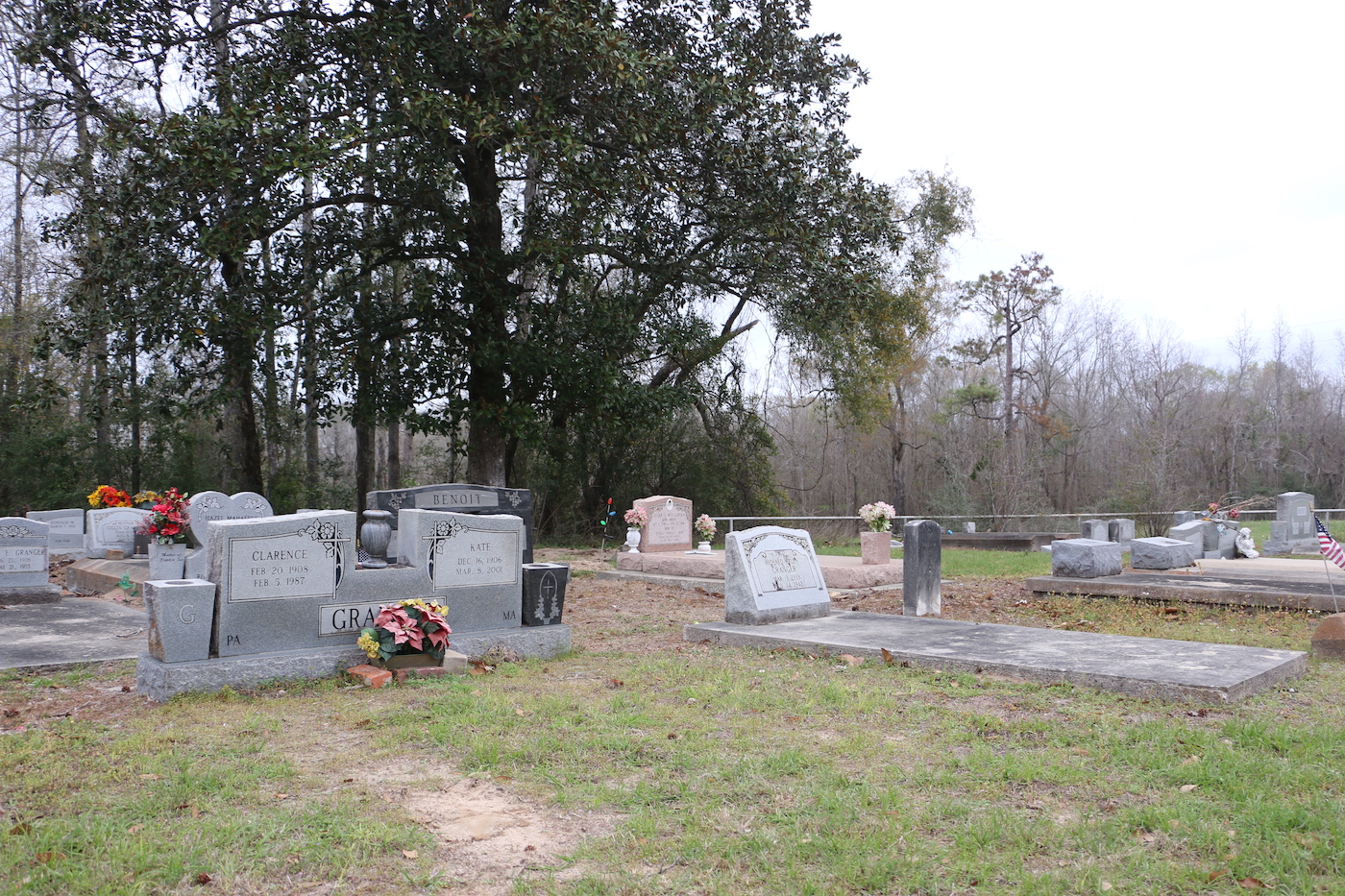
One of the solutions is to bury caskets underground instead of in the surface vaults that are common in Louisiana. Niblett’s Bluff Cemetery now requires that new burials be underground, though there is some debate over whether graves in New Orleans are mostly above ground due to tradition or due to the high water table.
Having good documentation of who is buried where is also extremely important for recovery. If a casket is dislodged and a deceased person cannot be identified, if their next of kin cannot be contacted, or if that person can’t pay, the casket will not get reburied. Hunter says that in those cases his company just tries to get the casket out of public view.
This is exactly what happened in Charlotte Harbor Cemetery in Florida. It could not get FEMA assistance, and Kenner says that finding and contacting relatives of people who had died so long ago would be an impossible task for a cemetery that was established in 1879.
Even in Louisiana—which started to require identification on caskets after Hurricane Katrina—the lack of documentation is still a challenge, Seidemann says.
“Compliance with that has been spotty at best,” he said.
Blanks said those who manage cemeteries should work with the community to gather local knowledge of graves and consider creating maps.
“It’s one thing to protect the physical landscape,” she says, “but it would also be a disservice to not preserve or recover the cultural heritage that is in the landscape itself.”
Further Reading


NEW ORLEANS (WVUE) – Louisiana’s summer heat is becoming harder to ignore, with rising temperatures, higher humidity and thousands of heat-related emergency room visits in recent years.
Across all 64 parishes, average summer temperatures have risen since 1970, according to Climate Central, a nonprofit research group.
In 2023, Louisiana reported a record-breaking 88 heat-related deaths, according to the Louisiana Department of Health. More than 6,100 people went to emergency rooms that year because of heat-related symptoms.
Tony Coker felt how quickly that heat can become dangerous while working his landscaping job last week.
Coker was among a crew cutting grass near LSU’s School of Public Health in New Orleans. He said the heat forced him to stop working.
“I got to a point, I was like, ‘OK guys, you’re going to have to finish. I’m done. My stomach is hurting. I’m sitting down for a minute and I’m going to go home,’” Coker said.
During Louisiana’s often-brutal summers, Coker takes steps to protect himself while working his landscaping job.
“I got this hat on. It’s a little hotter with long sleeves, but it keeps the sun off the body. I wear sunscreen to make sure to get as much protection as possible, you know 100 SPF,” Coker said.
Heat safety
Heat illness in Louisiana
Heat-related illness has sent thousands of people to emergency rooms in Louisiana in recent years.
Heat-related deaths
- 2023: 88 deaths
- 2024: 53 deaths
- 2025: 31 deaths
Emergency room visits
- 2023: 6,187 visits
- 2024: 4,471 visits
- 2025: 4,194 visits
- 2026: 935 visits as of June 30
Signs of heat illness
- Heavy sweating
- Weakness or dizziness
- Nausea
- Headache
- Muscle cramps
- Confusion
- Fainting
How to stay safe
- Drink water before you feel thirsty
- Take breaks in shade or air conditioning
- Wear lightweight, loose-fitting clothing
- Limit strenuous activity during the hottest part of the day
- Check on older adults, children and people without reliable air conditioning
Call 911 if someone is confused, faints, stops sweating or shows signs of heat stroke.
Source: Louisiana Department of Health
According to Climate Central, a nonprofit research group, the average annual temperature in New Orleans has risen by 4.5 degrees since 1970.
The group’s newest summer analysis shows the warming is not limited to New Orleans. Among Louisiana cities analyzed, Shreveport has seen the largest increase in average summer temperatures since 1970, at 4.3 degrees, followed by New Orleans at 4.1 degrees. New Orleans, however, saw the largest increase in hotter-than-normal summer days, with 53 more days above normal than in the early 1970s.
Climate Central’s parish-level data shows average summer temperature increases ranging from 1.4 degrees in Avoyelles and Evangeline parishes to 3.1 degrees in Bienville, Bossier, Caddo, Sabine and Terrebonne parishes.
In Orleans Parish, average summer temperatures have risen by 2.5 degrees since 1970, according to Climate Central’s parish-level data.
“It was relatively cool in the 1950s, 1960s, 1970s and then we went on this rapid warming trend, mimicking what’s going on across the globe, and it’s been very hot,” said Dr. Barry Keim, professor and program director of environmental health, climate and sustainability at LSU Health Sciences Center New Orleans.
Keim, a climatologist, said Louisiana’s humidity makes the heat feel even worse. He said humidity levels have also risen since the 1970s.
“Bottom line is, not only are the temperatures getting warmer, the humidity is going up, and then when you put the two together it just makes it feel horrible out here,” Keim said.
As the Fourth of July approaches, Keim said there will not be much relief in the form of rain. Louisiana is expected to stay hot and humid.
Forecasts show highs mainly in the low to mid-90s across Louisiana on Independence Day, with heat index values expected to reach the 100s in parts of the state and scattered afternoon storms possible
Copyright 2026 WVUE. All rights reserved.


Watch as Shreveport Regional Airport unveils Visitor Center
Visit Shreveport-Bossier and regional partners celebrate monumental tourism growth and unveiling of a new state-of-the-art Visitor Information Center.
Louisiana is expanding the fishing limit for its signature saltwater game fish as part of the state’s American 250 celebration, Gov. Jeff Landry and his Wildlife and Fisheries Secretary Tyler Bosworth announced.
Bosworth signed a declaration of emergency to increase the red snapper bag limit from four fish per person to five fish per person for three days from July 2 to July 5 on Independence Day weekend.
“The celebration of America’s 250th birthday is a time to reflect on the blessings and abundant resources we have in our country and here in Louisiana, the Sportsman’s Paradise,’’ Bosworth said. “Increasing our red snapper limit to five fish is a way we’d like to thank the anglers of our state as they enjoy this special holiday with family and friends.’’
Landry is an avid angler, hunter and outdoorsman.
“The increase in the red snapper limit for the holiday weekend is a great way to celebrate America’s 250th birthday,” the governor said in a statement. “I look forward to seeing anglers across our state celebrating our nation’s independence in Sportsman’s Paradise.”
Louisiana is considered the epicenter of red snapper fishing in the Gulf of America, with Venice and Grand Isle as the state’s premier launching spots to reach the most prolific snapper grounds in the Gulf.
Venice is often call the “Red Snapper Capital.”
The state’s extensive offshore oil and gas rigs and artificial reefs provide exceptional access to massive populations for snapper, which are prized for their fight and taste.
Bosworth encourages anglers to reduce barotrauma while fishing for red snapper and other reef fish by using descending devices to return fish to a survivable depth before being released. See the LDWF barotrauma webpage for more information.
The bag limit will revert to four fish per person, per day on July 6.
For additional questions regarding the current red snapper season, go to the agency’s Red Snapper webpage.
Greg Hilburn covers state politics for the USA TODAY Network of Louisiana. Follow him on Twitter @GregHilburn1.

BATON ROUGE, La. (WAFB) – A 53-year-old Louisiana man will serve 22 years in prison following a child sex crimes case that included possession of handmade childlike sex dolls — items that state lawmakers have since moved to ban.
Sabine Parish prosecutors say Yancy Elie Normand was sentenced after investigators received a tip that he forced someone to view child sexual abuse material. A search of his home allegedly uncovered more than 200 illegal files — including child sexual abuse material and bestiality — along with two handmade childlike sex dolls.
New state law bans child sex dolls
Louisiana lawmakers passed a law banning the possession, trafficking, and importation of child sex dolls statewide in 2024. State Sen. Beth Mizell said the push began after conversations with Homeland Security about human trafficking during the Super Bowl in New Orleans, at a time when the state had no specific law covering the dolls. The measure passed with near-unanimous support.
“I think the importance is that it’s a precursor to actual crimes against children,” Mizell said.
Mizell said the issue extends well beyond Louisiana’s borders.
“It’s a nationwide problem…when you look at just the volume of child abuse cases, to the point where our Attorney General now has multiple task forces in place all over the state,” Mizell said.
Task force expands statewide reach
The Louisiana Attorney General’s Office says protecting children remains the focus of its Louisiana Internet Crimes Against Children Task Force. Supervisory Special Agent Chris Masters leads the group, which now includes more than 80 agencies and 250 detectives.
Masters said the dolls are often misunderstood by the public.
“When people hear sex doll, they think of the blow-up thing. These things are thousands of dollars, and they’re anatomically appropriate to a child,” Masters said. “They’re gonna look like a child. It’s not just what you think on TV.”
Masters said coordination across agencies is essential to the task force’s work.
“It’s completely impossible if law enforcement is not together on the same page with the same type of training, the same access, the same type of equipment,” Masters said. “We can tend to continue expanding our partnerships until there is no safe haven for any sex predator or child predator in this state.”
Lawmakers urge parents to monitor children’s online activity
Mizell said the volume of harmful material accessible online makes parental awareness critical.
“You have access to abhorrent material online in your hand all day, every day,” Mizell said. “Pay attention. Don’t be afraid to look at your child’s phone.”
Click here to report a typo. Please include the headline.
Click here to subscribe to our WAFB 9 News daily digest and breaking news alerts delivered straight to your email inbox.
Watch the latest WAFB news and weather now.
-

 Texas3 minutes ago
Phoenix Merchant Partners and Texas Capital Alternative Asset Management Form Strategic Relationship
-

 Utah6 minutes ago
Therapy dogs offer a welcome break for firefighters battling Utah’s Iron, Cherry fires
-

 Vermont11 minutes ago
She moved from Paris to Vermont and found her ‘dream job’ opening a bakery – The Boston Globe
-

 Virginia18 minutes ago
Reopening date set for Virginia Creeper Trail after months of work
-

 Washington21 minutes ago
Colorado Democrats punish Washington ties in primaries
-

 Wisconsin26 minutes ago
Missing Wisconsin teen Joniah Walker found safe 4 years after disappearing from home
-

 West Virginia33 minutes ago
Transmission line proposals raise ratepayer cost concerns in West Virginia
-

 Wyoming36 minutes ago
Wyoming Department of Health warns of scam callers using official phone number

