Arkansas
Three-point shooting woes reappear at worst possible time for Arkansas basketball


“Great looks.”
Those two words were said five separate times by Tramon Mark when talking to the media Wednesday night after Arkansas basketball’s latest loss. The Razorbacks suffered a 76-66 defeat on the road to Georgia that dropped their record to 9-6 overall and 0-2 on in the SEC.
Mark was referring to the Hogs’ 3-point shot attempts. He felt like Arkansas executed its offense and found openings from downtown against the Bulldogs, but they just couldn’t convert. Arkansas finished the night 3-of-21 from 3-point line, and the ice-cold shooting was a huge difference in another demoralizing defeat.
“I thought we had good ball movement. I thought we had good spacing. We ran more middle pick-and-rolls,” Arkansas head coach Eric Musselman said. “But the 3-of-21 from three, I mean, if you’re a shooter, you’ve got to make open shots.”
Struggles from downtown have now become a two-year problem for the Razorbacks. Arkansas ranked 318th in the country last year, shooting 31.3% from 3-point range.
Musselman knew this was an issue that needed to be fixed, so he went into the transfer portal and brought sharpshooters like Jeremiah Davenport and Khalif Battle to Fayetteville. He also hoped Davonte Davis’ prowess in the SEC last season would carry over to this campaign, and Trevon Brazile would return for a full season. There was plenty of optimism Arkansas would be serviceable from 3-point land.
The Hogs had made strides, entering Wednesday ranked 139th in the country and shooting 34.3% in the category, but they’re reverting back to old ways in the SEC. Arkansas is 10-of-45 (22.2%) from three through two league games.
More: Turnovers prove costly as Arkansas basketball falls to Georgia
More: Arkansas basketball must reverse two-year trend to make this season’s NCAA Tournament
“I shot 0-for-4 from three,” Mark said before going on his rant about all of the misses.
“My last three was a great look. I think I shot one that was kind of forced, but all the other ones were good looks. But the other guys like (Battle) and (Brazile) got great looks. Keyon (Menifield Jr.) got great looks. I passed to them in transition and we got great looks. We just got to make them. We weren’t making them tonight. Devo got great looks.”
The missed threes were hardly the only reason Arkansas fell to Georgia. The Hogs committed 10 turnovers in the first half as Georgia built a 10-point lead at halftime. The Bulldogs scored 25 points off turnovers and won the bench battle 40-19.
But this version of Musselman’s Razorbacks isn’t the same defensive stalwart as previous years. Arkansas struggles to keep guards out of the paint and gives up too many wide open 3-pointers. If the defense is going to take a step back, the offense must take a step forward to replicate the program’s recent success.
“I mean, 3-of-21. We had a bunch of defenders in the past that could go 3-for-21,” Musselman said.
Despite a small surge in non-conference play, the three-point shooting looks like a problem, again. That’s bad news for a team now facing pressure every time it steps out on the court, with each loss representing another hit to an uncertain NCAA Tournament resume.



Temperatures will climb to the upper 90s today and heat index values will get close to 105° this afternoon. There are heat advisories today for part of west and southwest Arkansas.
Today will bring a slight chance of showers or thunderstorms late in the day in Central Arkansas.
Friday will also bring a slight chance of showers and thunderstorms with very hot weather.
Rain chances increase and temperatures drop this weekend when a cold front moves through Arkansas.


Arkansas
ARKANSAS SIGHTSEEING: Randolph County can claim many firsts in Arkansas | Northwest Arkansas Democrat-Gazette

Copyright © 2026, Northwest Arkansas Newspapers LLC. (NWA Media)
All rights reserved.
This document may not be reprinted without the express written permission of Northwest Arkansas Newspapers LLC
Material from the Associated Press is Copyright © 2026, Associated Press and may not be published, broadcast, rewritten, or redistributed. Associated Press text, photo, graphic, audio and/or video material shall not be published, broadcast, rewritten for broadcast or publication or redistributed directly or indirectly in any medium. Neither these AP materials nor any portion thereof may be stored in a computer except for personal and noncommercial use. The AP will not be held liable for any delays, inaccuracies, errors or omissions therefrom or in the transmission or delivery of all or any part thereof or for any damages arising from any of the foregoing. All rights reserved.


Fort Smith Historic Site: Law, conflict and the West
Explore Fort Smith Historic Site, where westward expansion, federal justice and Native American history shaped life on the American frontier.
A former Arkansas Tech University graduate and commander of the U.S. Army Intelligence and Security Command is being remembered with two posthumous honors recognizing his lasting influence on the nation’s military intelligence operations.
The late Maj. Gen. Gary W. Johnston, a 1987 Arkansas Tech graduate and Russellville native, was honored during a dedication ceremony June 25 at Fort Huachuca, Arizona, where the Army officially named a newly consolidated military intelligence complex the Major General Gary W. Johnston Consolidated Mission Facility.
Johnston also was posthumously inducted into the Military Intelligence Hall of Fame for helping reshape Army intelligence through the integration of emerging technologies, including big data analytics, artificial intelligence and machine learning.
The new facility serves as a central hub for U.S. Army Intelligence and Security Command (INSCOM) operations at Fort Huachuca, known as the “Home of Army Intelligence.” It houses some of the Army’s most critical intelligence personnel and brings together units that had previously operated from aging buildings spread across the installation.
Army officials said the previous arrangement created operational challenges, including limited secure workspaces, outdated infrastructure and additional security requirements. Beginning in 2018, INSCOM launched an effort to consolidate those missions by renovating two existing buildings into a 16,300-square-foot intelligence operations center designed to improve collaboration and security.
The facility now houses INSCOM G3’s Detachment 52, elements of the U.S. Army Counterintelligence Command, representatives from the Ground Intelligence Support Activity, an emerging Foundry program element and other intelligence organizations.
Among those attending the dedication were Johnston’s wife, Brig. Gen. Amy Johnston, daughter Lauren Woodworth and granddaughter Arabella Woodworth.
Maj. Gen. Rhett R. Cox, commanding general of U.S. Army Intelligence and Security Command, said the building represents more than a new workplace.
“As we dedicate the U.S. Army INSCOM Major General Gary W. Johnston Consolidated Mission Facility, we do more than just open a new facility… we consecrate a tribute to his indelible legacy,” Cox said. “This facility will stand as a constant reminder of his service, his vision and his unwavering commitment to our nation and to the soldiers he led. It will inspire future generations of intelligence professionals to emulate his example of leadership and selfless service.”
Retired Chief Warrant Officer 5 Kevin Boughton, former INSCOM command chief warrant officer, said Johnston envisioned closer collaboration between the Army’s intelligence training and operational communities.
Boughton said Johnston believed the distance between the Intelligence Center of Excellence and INSCOM’s operational units “shouldn’t be measured in miles,” but instead by “a seamless flow of data, doctrine, and talent” where operational experience and institutional knowledge move freely between soldiers in the field and those training the next generation.
Johnston graduated from Russellville High School in 1983 before earning a Bachelor of Science in Business Administration from Arkansas Tech in 1987. Through the university’s Reserve Officers’ Training Corps program, he received his commission as a U.S. Army officer.
During a military career spanning more than 34 years, Johnston served in command and staff assignments ranging from platoon level to senior leadership within the Army and Department of Defense. He deployed in support of Operation Desert Shield, Operation Desert Storm, Operation Joint Endeavor, Operation Enduring Freedom and Operation Freedom’s Sentinel.
In 2015, Johnston became the seventh graduate of Arkansas Tech’s Army ROTC program to attain the rank of general officer. He was promoted to major general in 2017.
He concluded his military career as commanding general of U.S. Army Intelligence and Security Command, overseeing approximately 17,500 personnel operating in more than 40 countries.
Army leaders credited Johnston with helping modernize military intelligence by laying the groundwork for the establishment of the U.S. Army Counterintelligence Command, which was formally created in 2022 after his retirement. He also led development of what became the Army Intelligence Data Platform, designed to incorporate advanced data analytics, artificial intelligence and machine learning into intelligence operations while supporting future large-scale combat operations.
Johnston also promoted data science education within the military intelligence community by partnering with George Mason University to provide specialized training for Army warrant officers.
Colleagues remembered Johnston not only for his strategic vision but also for his leadership style. Despite working in one of the Army’s most demanding operational environments, they described him as a source of humor, kindness and encouragement whose focus remained on the soldiers, civilians and contractors carrying out the intelligence mission.
Johnston retired from active duty in 2021 and died in January 2022.
His latest recognitions add to previous honors from his alma mater. Johnston was a member of the inaugural Arkansas Tech Army ROTC Hall of Honor in 2017 and was inducted into the university’s Hall of Distinction in 2019.
-
 Business6 minutes ago
California soccer fans sue StubHub after it fails to deliver expensive World Cup tickets
-
 Entertainment9 minutes ago
Lucas Museum to give free annual passes to South L.A. neighbors, host community preview day
-
 Lifestyle14 minutes ago
Meow Wolf taps famed L.A. animation house for its new Los Angeles venue
-
Politics21 minutes ago
Column: Trump decries ‘communism’ while his government takes ownership of companies
-
 Science24 minutes ago
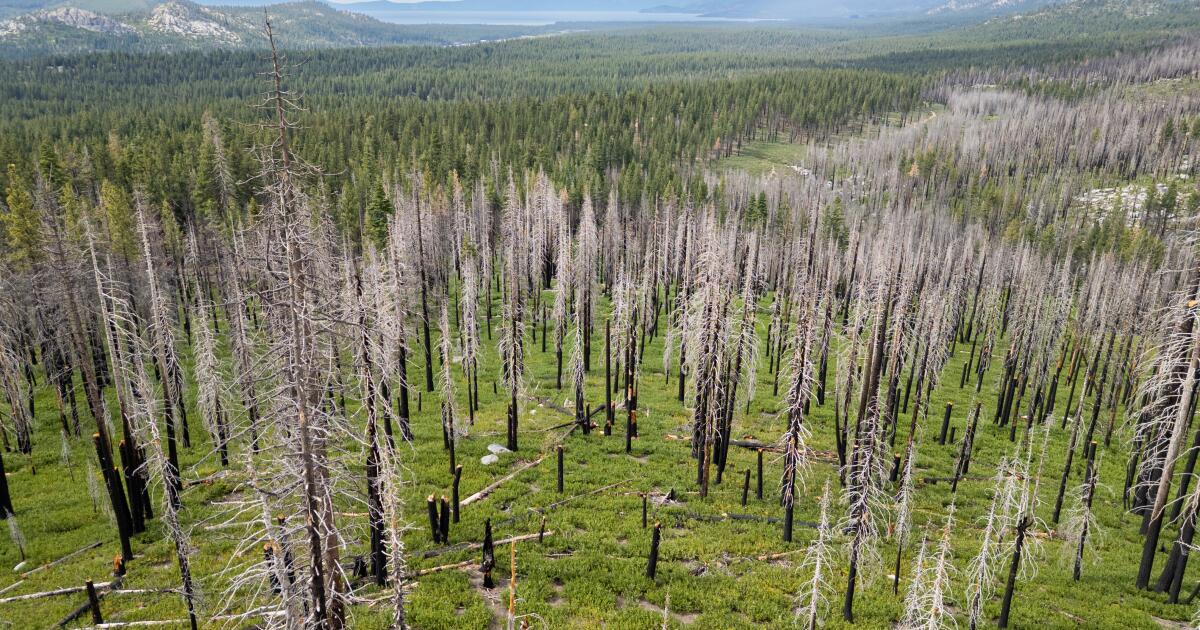
‘I’d rather my house burn down than get cancer’: Herbicide use upends California’s fight to save forests
-
 Sports29 minutes ago
Dodgers scheduled to visit White House in late July to celebrate 2025 World Series win
-

 World39 minutes ago
Former US Olympian pleads not guilty in DC reflecting pool vandalism case
-
 News1 hour ago
Former Olympian pleads not guilty in reflecting pool vandalism charges


