Science
Solar storm heading to Earth could disrupt communications and bring northern lights to California

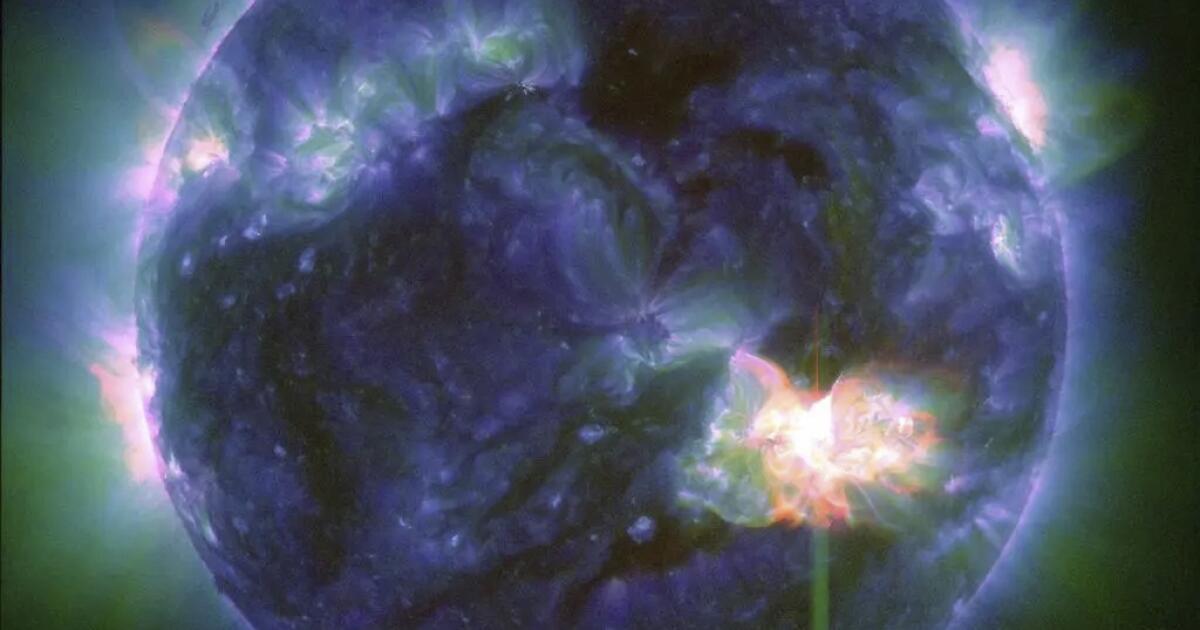
A different kind of storm could complicate this weekend’s plans.
For the first time since January 2005, the U.S. National Oceanic and Atmospheric Administration has issued a severe geomagnetic storm watch for Friday evening.
The category G4 watch from NOAA’s Space Weather Prediction Center signals the possibility that a concentration of energy flaring from the Sun could disturb our planet’s electromagnetic field once it reaches Earth.
A geomagnetic storm of this size could disrupt communications, like the 2003 event that caused blackouts in Sweden and damaged South Africa’s power grid.
More promisingly, super-charged collisions of solar energy into the gas of our atmosphere creates the dazzling phenomena of aurora borealis, or the northern lights. Typically confined to polar regions, the colorful display could be visible this weekend as far south as Northern California.
“We have a very rare event on our hands,” space weather forecaster Shawn Dahl of SWPC said during a news conference Friday morning.
A geomagnetic storm happens when energy from solar wind — the high-speed current of atomic particles the sun is constantly flinging into space — is transferred into the electromagnetic field that surrounds Earth.
The winds of a Category 5 hurricane on our puny little planet can exceed 150 miles per hour. In contrast, solar wind averages about 870,000 miles per hour all day, every day according to NASA.
Earth’s electromagnetic field deflects the majority of these particles, save for those interactions in the polar areas that produce the northern lights. But unusually intense or concentrated eruptions of energy on the surface of the Sun can disrupt that equilibrium, causing geomagnetic storms like the one potentially headed our way.
On Wednesday morning, astronomers noted a series of solar flares and coronal mass ejections — essentially, giant explosions of energy — emanating from a massive sunspot more than 15 times the diameter of Earth.
The Space Weather Prediction Center has observed seven coronal mass ejections, or CMEs, heading in Earth’s direction, said Mike Bettwy, operations chief at SWPC.
“Based on the data we have, all seven of these are going to be spewing that energy toward us,” Bettwy said.
The energy in these various eruptions is expected to merge and reach the Earth’s magnetic field late Friday or early Saturday.
“Our level of confidence is high that we will have an arrival of these CMEs as early as this evening,” Dahl said. The precise time they’ll arrive is less certain.
SPWC will have more clear information once that solar energy reaches NASA’s Advanced Composition Explorer spacecraft, a satellite about 1 million miles from Earth.
Yet “even though that sounds like it’s far away . . . it doesn’t necessarily give us a ton of lead time,” Bettwy said. Given that solar wind is moving faster than the speed of sound, it will reach Earth only 20 to 45 minutes after passing that 1-million-mile marker in space.
Scientists have previously warned that the strongest geomagnetic storms could wreak havoc on our power and communication systems. That is not what’s expected in this case.
Those of us here on Earth may experience power outages and minor internet or GPS glitches, Bettwy said.
“Geomagnetic storms can impact infrastructure in near-Earth orbit and on Earth’s surface, potentially disrupting communications, the electric power grid, navigation, radio and satellite operations,” NOAA said in a statement. “SWPC has notified the operators of these systems so they can take protective action.”
Watches for milder geomagnetic storms are fairly common. In March, a geomagnetic storm briefly reached G4 strength for a few hours.
That event was the third geomagnetic storm to reach G4 status during the current 11-year solar cycle, which began in 2019, according to the SWPC. At that time, the agency said the event posed no risk of adverse impacts to the public.
“What’s unique about what is potentially about to hit us is that it’s a much more significant event, in terms of what’s going to be hitting the atmosphere,” Bettwy said.


The number of Angelenos who went to the hospital with throat pain and concerns about smoke inhalation spiked as a fire burned through the massive Lineage cold storage warehouse in Boyle Heights this month, The Times has learned.
The blaze burned for eight days beginning June 17 and involved solar panels, insulation foam and other industrial materials.
During that time, more than three times as many people went to emergency departments within 10 miles of the warehouse mentioning the fire or smoke inhalation compared with the two weeks prior, according to data from the Los Angeles County Department of Public Health obtained through a public records request.
The agency also noted a near doubling of patients mentioning throat pain within five miles of the fire June 21 — 1.9 times the baseline levels.
Usually, fewer than 50 people go to the emergency room each day for throat pain, and fewer than 20 people for smoke inhalation, the department said.
The hospitalization data was tracked through the department’s syndromic surveillance project, which monitors trends in what people report when they come to emergency departments in L.A. County, as well as diagnosis codes noted by providers. The system is not as comprehensive as full patient health records, and clinicians may not always include key words about “fire,” “smoke” or other circumstantial information in their diagnoses, the public health department said.
As such, it “cannot capture the true number of [emergency department] visits related to symptoms from the fire and likely underestimates the true burden of fire related symptoms,” the department said.
Perhaps unexpectedly, the department said it did not note a substantial increase in asthma, acute respiratory symptoms or chronic obstructive pulmonary disease-related emergency department visits during the fire.
But even these preliminary findings are concerning, experts said. The fire is believed to have started on the solar array on the roof of the 500,000 square-foot building, which housed 85 million pounds of frozen food. It then reached an ammonia line, prompting two brief shelter-in-place orders for nearby residents.
Over the next week, the fire continued to burn through dense insulation foam within the building’s walls and other unknown industrial materials, blanketing much of L.A. in acrid smoke. Residents in downtown L.A., northeast L.A., Burbank, the San Gabriel Valley and many other parts of the city and county reported seeing and smelling the fumes.
The South Coast Air Quality Management District issued multiple warnings about unhealthy levels of PM 2.5, or fine particulate matter. The city and county opened two smoke respite shelters in the immediate area so that people could breath cleaner air.
It is still unclear what exactly was in the smoke that people breathed in. Industrial fires release far more materials than the burned wood smoke that is emitted during wildfires.
“The makeup of the smoke can include toxic chemicals, fine particles and other serious risks to lung health depending on fire conditions and what is burned,” Will Barrett, assistant vice president for nationwide clean air policy at the American Lung Assn., said as the fire was burning. Children and elderly people are particularly at risk.
David Eisenman, director of the UCLA Center for Public Health and Disasters, said urban industrial fires also can represent a hazard that standard PM 2.5 warnings don’t always address. Those advisories are “blunt instruments” that don’t adequately capture emissions from burning man-made goods — or convey that the source of pollution may include burning batteries or toxic refrigerants, he said.
The fact that initial numbers don’t show a spike in asthma attacks is “somewhat reassuring,” Eisenman said. But “people may have gone to their primary care doctors, which this would not capture. This data deserves follow up.”
The air district and the U.S. Environmental Protection Agency deployed air monitors to assess particulate matter, airborne toxic metals and other harmful compounds during the early days of the blaze. The air district said it didn’t find significant levels of air toxics during the first two days of the fire, although it did record significantly elevated concentrations of particulate matter within the plume downwind.
Some of the measurements it took with mobile monitors, which are five-minute snapshots, also showed increased bromine and chlorine, which often are found when buildings burn and were at levels “below short-term health-based exposure thresholds,” the air district said. It began continuous PM 2.5. monitoring at two nearby elementary schools on the third day.
The L.A. Fire Department said it detected low-levels of toxic hydrogen fluoride on the second day of the fire, which can be a byproduct of burning lithium-ion batteries.
Lineage, the tenant-operator of the warehouse, said no concentrations of ammonia were detected in the air at any time.
“There’s no doubt this fire has had a huge impact on the local community, and we are committed to showing up in every way we can,” company officials wrote in a statement last week. They said Lineage worked closely with the Fire Department during the blaze and delivered masks, air purifiers and other supplies to the community, and will work to ensure the fastest cleanup possible.
The long-term health effects of the fire and its smoke probably won’t be known unless researchers conduct a follow-up study, said Eisenman of UCLA.
For example, there may have been delayed pulmonary effects from the hydrogen fluoride and burning insulation foam that — when combined with the elevated PM 2.5 levels in a dense urban environment — produced health effects that didn’t show up in the emergency room data.
“They will show up in increased primary care office visits and exacerbations of chronic disease over the next few weeks,” he said. “So from a public health standpoint, this fire is not over.”

LOS ANGELES — All the water unleashed onto the warehouse fire in Boyle Heights — some of it 480 gallons at a time by helicopter — had to end up somewhere.
That somewhere is the Los Angeles River.
Los Angeles Fire Department crews ripped through 50-foot walls filled with foam insulation to get to the building’s steel skeleton and its storage racks.
Charred chunks of foam have been floating from the burn site, partially blocking storm drains. Now organizers from East Yard Communities for Environmental Justice are teaming up with scientists from UCLA and Columbia University to find out more about what’s in the runoff.
“The community here is really interested in knowing, ‘Are there any contaminants that are potentially making their way down to the L.A. River?’” said Yoshira “Yoshi” Ornelas Van Horne, UCLA assistant professor in environmental health sciences. “We really can’t answer that unless we actually have measures and samples analyzed.”
Water samples collected directly from the warehouse fire runoff have been shipped to Columbia‘s Multi-Element Trace Analysis Laboratory in New York, which has a spectrometer that can identify trace levels of elements. The lab also has relationships with researchers in Southern California.
2

1. Emmanuel Carrera Ruedas, left, and Casey Cooper prep containers to take water samples from the L.A. River. 2. Casey Cooper holds a water sample. (Christina House / Los Angeles Times)
The data will then come back to UCLA for analysis. For now, the scientists and community advocates only have the money to test for copper, lead and arsenic, Ornelas Van Horne said. Residents have expressed interest in testing for more contaminants.
As the water from the firefighting efforts trickles through the warehouse in rivulets, it forms a stream at the corner of S. Indiana and Noakes streets, that gushed into the storm drain. On a recent visit, the water traversed a smoky 10-foot canyon of charred foam and twisted wall panels on its way to the drain.
From there, the water flows to the L.A. River. Despite the fact that its concrete design is intended to whisk water out of the city as fast as possible, life stubbornly persists in the river and nearby. Recreational swimming is not permitted, yet anglers fishing for tilapia, largemouth bass and carp are a common sight along the rocky sides of the soft-bottom areas.
The L.A. River, and all it carries with it, meets the ocean in Long Beach.
The L.A. County Public Works Department said it has deployed three containment booms — floating barriers — on the L.A. River, and is continuing to monitor the water as it makes its way to the ocean.

Emmanuel Carrera Ruedas takes a water sample.
(Christina House / Los Angeles Times)
Before it gets there, the river passes through the Dominguez wetlands, where Public Works is removing some number of dead fish. The wetland has absorbed toxic runoff from a warehouse fire before, resulting in a fish die-off.
“For so long, the L.A. River has been used as a dumping ground for all kinds of chemicals,” said Emmanuel Carrera Ruedas, a community scientist and member of East Yard Communities for Environmental Justice.
Pollution has plagued the L.A. River, but it does have allies. In the 1980s, the Friends of the LA River pushed to address street runoff and trash that had made the water body infamous. Significant progress from advocacy and government initiatives improved water conditions, but these efforts have not been equally distributed.
Carrera said the samples represent “proof of what’s actually going on, and accountability, too, for the city, of not just what’s happening in our air, but what’s actually happening in our waterways.”
The first samples for the project were taken last Friday, the second day of the fire.
They were the first of 20 samples the research groups have agreed to test at no cost to see if any exceed regulatory standards and could pose a risk to people nearby.
The warehouse fire represents the latest environmental disaster for people in Boyle Heights and East L.A. Just four weeks ago, a telecommunications crew accidentally struck one of the many oil pipelines beneath the L.A. area, spilling 25,000 gallons of crude oil near Eastern and Cesar Chavez avenues — including into storm drains feeding to the L.A. River.
“I think it really is difficult to see disaster after disaster hit the communities here, with not a lot of talk about how we can move through these disasters together,” said Casey Cooper, a volunteer community scientist involved in the sampling. They were inspired, they said, by the response of neighbors, and how people were supporting one another.
Results from the laboratory analysis could be back to Ornelas Van Horne within a month.

The U.S. Environmental Protection Agency is ramping up its enforcement of illegal pesticides smuggled through the ports of Long Beach and Los Angeles, officials said during a visit to L.A. on Thursday.
Since President Trump began his second term in January 2025, EPA has blocked more than 2.4 million pounds of illegal pesticides from entering the country, said Lee Zeldin, the agency’s administrator. Much of it comes from China, but some comes from Mexico and, on the East Coast, from Africa.
“We’re very alarmed by any chemical that anyone would seek to bring into this country that our own government hasn’t had the opportunity to vet, to research to fully understand,” Zeldin said. “That’s why it’s so important that these products get stopped at the border.”
The announcement came just hours after the Supreme Court handed a major victory to the makers of the weedkiller Roundup, shielding it from thousands of lawsuits from states alleging the company failed to warn people the product could cause cancer.
Speaking from a U.S. Customs and Border Protection warehouse in Carson, Zeldin pointed to a white bottle with a yellow label reading “SNIPER” — an illegal pesticide product commonly imported from abroad and sold online — that was recently intercepted at the Port of L.A. complex. Sniper contains dichlorvos, or DDVP, a highly toxic insecticide that is not registered or approved for use in the U.S. It is known to cause neurological problems, convulsions and comas, with children particularly at risk.
Illegal pesticides are cause for concern in California, where they are often associated with illegal cannabis operations. Last year, Siskiyou County declared a local emergency in response to the “escalating threat” posed by illegal pesticides, often fumigants, in illicit cannabis operations.
“These chemicals, when burned, create thick, poisonous smoke that presents serious risks to public health, the environment, waterways, and first responder safety,” the county said.
A 2024 Los Angeles Times investigation found that contraband Chinese pesticides used on cannabis farms is a growing problem in the state.
Customs and Border Protection seized containers of an illegal pesticide from China that were packed with legitimate items.
(Myung J. Chun/Los Angeles Times)
Much of the illegal product comes through the ports of L.A. and Long Beach, which together handle more than 30% of the nation’s container traffic, officials said. EPA works closely with Border Patrol officials, who flag suspicious cargo containers at the port for further inspection.
CBP spokesman Jaime Ruiz said the agency is using artificial intelligence tools to help scan incoming cargo manifests for potentially illegal items. Thousands of containers are flagged for inspection each year, although that number also includes drugs, counterfeit goods and other contraband in addition to pesticides, he said. He could not immediately say what percentage were illegal pesticides.
Illegal pesticides have at times been found in California agriculture and the California Department of Pesticide Regulation has taken enforcement action against violators. The DPR operates one of the nation’s largest pesticide residue testing programs, analyzing some 3,500 produce samples each year from wholesale and retail stores and other outlets. The state produces about half of the nation’s fruits and vegetables.
Jeff Hall, assistant administrator of EPA’s Office of Enforcement and Compliance, said the issue should be bipartisan.
“We cannot allow foreign actors to profit by sending toxic and poisonous products into the United States and poisoning American communities,” he said. “This is a message that we should all be able to agree on, especially for pesticides.”
However, the agency’s visit to L.A. arrived at a fractured moment for U.S. pesticide regulation and for the Trump-aligned Make America Healthy Again movement.
On Thursday, the Supreme Court ruled 7-2 in favor of Bayer’s Monsanto, the maker of the powerful weedkiller Roundup, shielding it from thousands of state lawsuits that allege the company failed to warn people the product could cause cancer.
Roundup contains glyphosate, which was classified by the World Health Organization as “probably carcinogenic” in 2015. But the Supreme Court found that the company can’t be sued in state courts because federal agencies — including the EPA — have determined that it’s not likely to cause cancer in humans when used as directed. The EPA has repeatedly approved a label for the product without a cancer warning.
“When people are exposed to pesticides, they deserve honest warnings about the risks,” said Bill Jordan, former deputy director of EPA’s Office of Pesticide Programs, in a statement. “The Court’s decision leaves families, workers, and communities with fewer tools to protect themselves and to recover damages when they are injured by a pesticide.”
-

 Los Angeles, Ca55 minutes ago
Los Angeles County man convicted of sex trafficking, abusing woman he was dating
-

 Detroit, MI1 hour ago
Detroit Tigers tee off on New York Yankees with 5 homers in win
-

 San Francisco, CA1 hour ago
Popular brewery shutters San Francisco location amid industry woes
-

 Dallas, TX1 hour ago
Eight arrested after repeated attempts to enter World Cup matches without tickets
-

 Miami, FL2 hours ago
Reports: Heat add potent bench scorer in Tim Hardaway Jr.
-

 Boston, MA2 hours ago
Boston Pops gearing up for major July 4th celebration: ‘You only turn 250 once’ – Boston News, Weather, Sports | WHDH 7News
-

 Denver, CO2 hours ago
Colorado wildfires destroy more than 100 structures, force more evacuations
-

 Seattle, WA2 hours ago
Will Katie Wilson’s endorsements help or hurt Seattle’s position in Olympia?

