Science
Jane Goodall, trailblazing naturalist whose intimate observations of chimpanzees transformed our understanding of humankind, has died


Jane Goodall, the trailblazing naturalist whose intimate observations of chimpanzees in the African wild produced powerful insights that transformed basic conceptions of humankind, has died. She was 91.
A tireless advocate of preserving chimpanzees’ natural habitat, Goodall died on Wednesday morning in California of natural causes, the Jane Goodall Institute announced on its Instagram page.
“Dr. Goodall’s discoveries as an ethologist revolutionized science,” the Jane Goodall Institute said in a statement.
For the record:
5:45 p.m. Oct. 2, 2025An earlier version of this story stated the chimpanzees are “humankind’s closest living ancestors.” They are humans’ closest living relatives, but not our ancestors.
A protege of anthropologist Louis S.B. Leakey, Goodall made history in 1960 when she discovered that chimpanzees, humankind’s closest living relatives, made and used tools, characteristics that scientists had long thought were exclusive to humans.
She also found that chimps hunted prey, ate meat, and were capable of a range of emotions and behaviors similar to those of humans, including filial love, grief and violence bordering on warfare.
In the course of establishing one of the world’s longest-running studies of wild animal behavior at what is now Tanzania’s Gombe Stream National Park, she gave her chimp subjects names instead of numbers, a practice that raised eyebrows in the male-dominated field of primate studies in the 1960s. But within a decade, the trim British scientist with the tidy ponytail was a National Geographic heroine, whose books and films educated a worldwide audience with stories of the apes she called David Graybeard, Mr. McGregor, Gilka and Flo.
“When we read about a woman who gives funny names to chimpanzees and then follows them into the bush, meticulously recording their every grunt and groom, we are reluctant to admit such activity into the big leagues,” the late biologist Stephen Jay Gould wrote of the scientific world’s initial reaction to Goodall.
But Goodall overcame her critics and produced work that Gould later characterized as “one of the Western world’s great scientific achievements.”
Tenacious and keenly observant, Goodall paved the way for other women in primatology, including the late gorilla researcher Dian Fossey and orangutan expert Birutė Galdikas. She was honored in 1995 with the National Geographic Society’s Hubbard Medal, which then had been bestowed only 31 times in the previous 90 years to such eminent figures as North Pole explorer Robert E. Peary and aviator Charles Lindbergh.
In her 80s she continued to travel 300 days a year to speak to schoolchildren and others about the need to fight deforestation, preserve chimpanzees’ natural habitat and promote sustainable development in Africa. She was in California as part of her speaking tour in the U.S. at the time of her death.
Jane Goodall in Gombe National Park in Tanzania.
(Chase Pickering / Jane Goodall Institute)
Goodall was born April 3, 1934, in London and grew up in the English coastal town of Bournemouth. The daughter of a businessman and a writer who separated when she was a child and later divorced, she was raised in a matriarchal household that included her maternal grandmother, her mother, Vanne, some aunts and her sister, Judy.
She demonstrated an affinity for nature from a young age, filling her bedroom with worms and sea snails that she rushed back to their natural homes after her mother told her they would otherwise die.
When she was about 5, she disappeared for hours to a dark henhouse to see how chickens laid eggs, so absorbed that she was oblivious to her family’s frantic search for her. She did not abandon her study until she observed the wondrous event.
“Suddenly with a plop, the egg landed on the straw. With clucks of pleasure the hen shook her feathers, nudged the egg with her beak, and left,” Goodall wrote almost 60 years later. “It is quite extraordinary how clearly I remember that whole sequence of events.”
When finally she ran out of the henhouse with the exciting news, her mother did not scold her but patiently listened to her daughter’s account of her first scientific observation.
Later, she gave Goodall books about animals and adventure — especially the Doctor Dolittle tales and Tarzan. Her daughter became so enchanted with Tarzan’s world that she insisted on doing her homework in a tree.
“I was madly in love with the Lord of the Jungle, terribly jealous of his Jane,” Goodall wrote in her 1999 memoir, “Reason for Hope: A Spiritual Journey.” “It was daydreaming about life in the forest with Tarzan that led to my determination to go to Africa, to live with animals and write books about them.”
Her opportunity came after she finished high school. A week before Christmas in 1956 she was invited to visit an old school chum’s family farm in Kenya. Goodall saved her earnings from a waitress job until she had enough for a round-trip ticket.
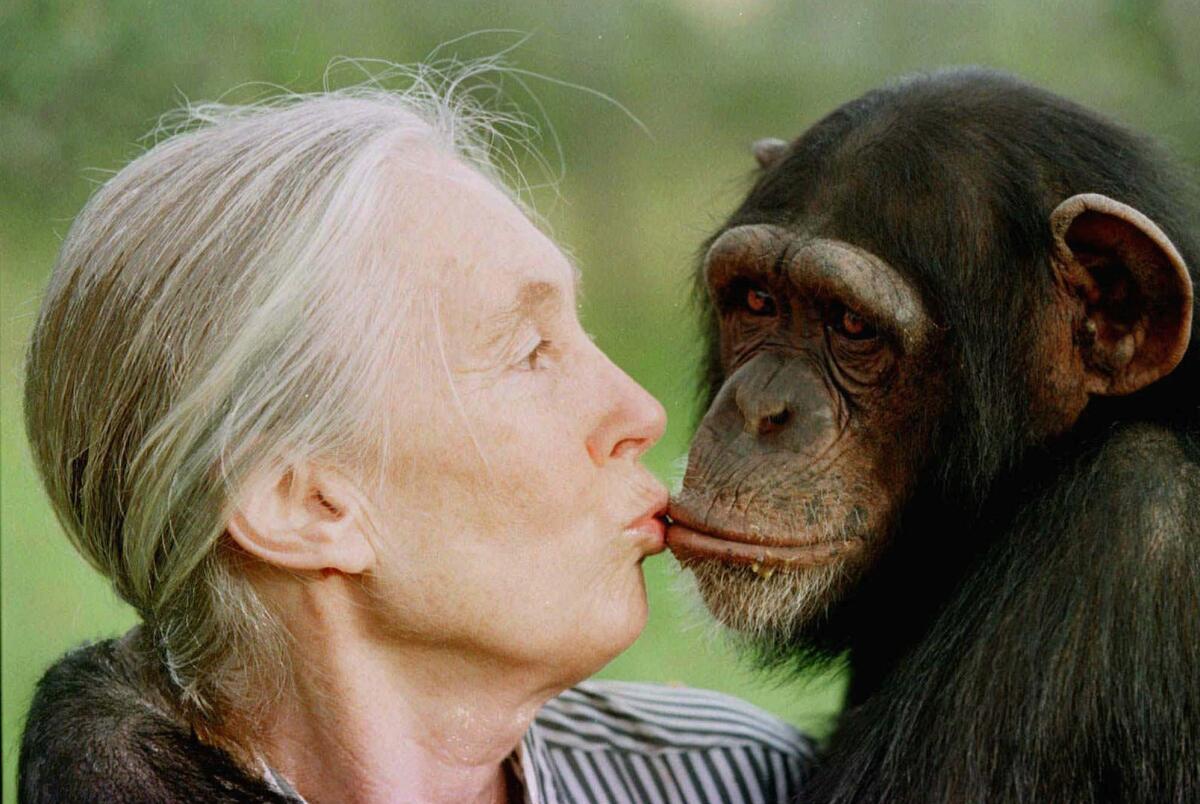
Jane Goodall gives a little kiss to Tess, a 5- or 6-year-old female chimpanzee, in 1997.
(Jean-Marc Bouju / Associated Press)
She arrived in Kenya in 1957, thrilled to be living in the Africa she had “always felt stirring in my blood.” At a dinner party in Nairobi shortly after her arrival, someone told her that if she was interested in animals, she should meet Leakey, already famous for his discoveries in East Africa of man’s fossil ancestors.
She went to see him at what’s now the National Museum of Kenya, where he was curator. He hired her as a secretary and soon had her helping him and his wife, Mary, dig for fossils at Olduvai Gorge, a famous site in the Serengeti Plains in what is now northern Tanzania.
Leakey spoke to her of his desire to learn more about all the great apes. He said he had heard of a community of chimpanzees on the rugged eastern shore of Lake Tanganyika where an intrepid researcher might make valuable discoveries.
When Goodall told him this was exactly the kind of work she dreamed of doing, Leakey agreed to send her there.
It took Leakey two years to find funding, which gave Goodall time to study primate behavior and anatomy in London. She finally landed in Gombe in the summer of 1960.
On a rocky outcropping she called the Peak, Goodall made her first important observation. Scientists had thought chimps were docile vegetarians, but on this day about three months after her arrival, Goodall spied a group of the apes feasting on something pink. It turned out to be a baby bush pig.
Two weeks later, she made an even more exciting discovery — the one that would establish her reputation. She had begun to recognize individual chimps, and on a rainy October day in 1960, she spotted the one with white hair on his chin. He was sitting beside a mound of red earth, carefully pushing a blade of grass into a hole, then withdrawing it and poking it into his mouth.
When he finally ambled off, Goodall hurried over for a closer look. She picked up the abandoned grass stalk, stuck it into the same hole and pulled it out to find it covered with termites. The chimp she later named David Graybeard had been using the stalk to fish for the bugs.
“It was hard for me to believe what I had seen,” Goodall later wrote. “It had long been thought that we were the only creatures on earth that used and made tools. ‘Man the Toolmaker’ is how we were defined …” What Goodall saw challenged man’s uniqueness.
When she sent her report to Leakey, he responded: “We must now redefine man, redefine tool, or accept chimpanzees as human!”
Goodall’s startling finding, published in Nature in 1964, enabled Leakey to line up funding to extend her stay at Gombe. It also eased Goodall’s admission to Cambridge University to study ethology. In 1965, she became the eighth person in Cambridge history to earn a doctorate without first having a bachelor’s degree.
In the meantime, she had met and in 1964 married Hugo Van Lawick, a gifted filmmaker who had traveled to Gombe to make a documentary about her chimp project. They had a child, Hugo Eric Louis — later nicknamed Grub — in 1967.
Goodall later said that raising Grub, who lived at Gombe until he was 9, gave her insights into the behavior of chimp mothers. Conversely, she had “no doubt that my observation of the chimpanzees helped me to be a better mother.”
She and Van Lawick were married for 10 years, divorcing in 1974. The following year she married Derek Bryceson, director of Tanzania National Parks. He died of colon cancer four years later.
Within a year of arriving at Gombe, Goodall had chimps literally eating out of her hands. Toward the end of her second year there, David Graybeard, who had shown the least fear of her, was the first to allow her physical contact. She touched him lightly and he permitted her to groom him for a full minute before gently pushing her hand away. For an adult male chimpanzee who had grown up in the wild to tolerate physical contact with a human was, she wrote in her 1971 book “In the Shadow of Man,” “a Christmas gift to treasure.”
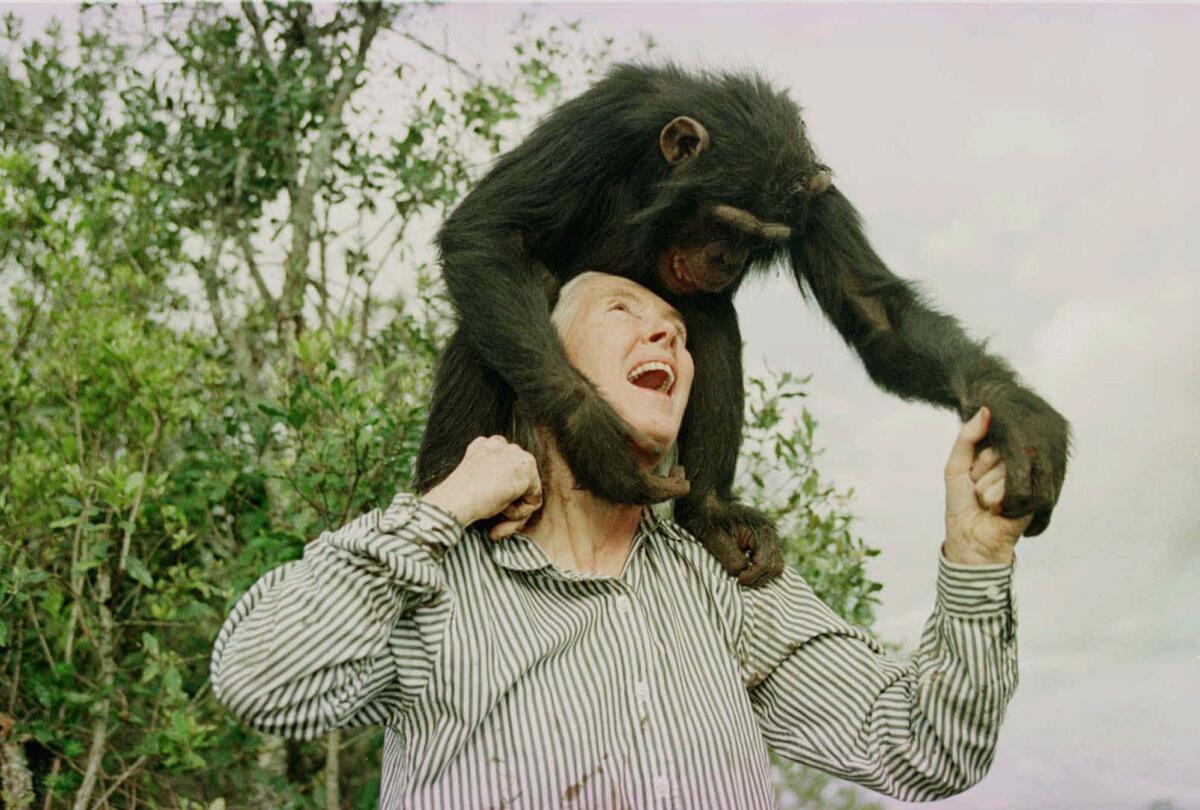
Jane Goodall plays with Bahati, a 3-year-old female chimpanzee, at the Sweetwaters Chimpanzee Sanctuary, north of Nairobi, on Dec. 6, 1997.
(Jean-Marc Bouju / Associated Press)
Her studies yielded a trove of other observations on behaviors, including etiquette (such as soliciting a pat on the rump to indicate submission) and the sex lives of chimps. She collected some of the most fascinating information on the latter by watching Flo, an older female with a bulbous nose and an amazing retinue of suitors who was bearing children well into her 40s.
Her reports initially caused much skepticism in the scientific community. “I was not taken very seriously by many of the scientists. I was known as a [National] Geographic cover girl,” she recalled in a CBS interview in 2012.
Her unorthodox personalizing of the chimps was particularly controversial. The editor of one of her first published papers insisted on crossing out all references to the creatures as “he” or “she” in favor of “it.” Goodall eventually prevailed.
Her most disturbing studies came in the mid-1970s, when she and her team of field workers began to record a series of savage attacks.
The incidents grew into what Goodall called the four-year war, a period of brutality carried out by a band of male chimpanzees from a region known as the Kasakela Valley. The marauders beat and slashed to death all the males in a neighboring colony and subjugated the breeding females, essentially annihilating an entire community.
It was the first time a scientist had witnessed organized aggression by one group of non-human primates against another. Goodall said this “nightmare time” forever changed her view of ape nature.
“During the first 10 years of the study I had believed … that the Gombe chimpanzees were, for the most part, rather nicer than human beings,” she wrote in “Reason for Hope: A Spiritual Journey,” a 1999 book co-authored with Phillip Berman. “Then suddenly we found that the chimpanzees could be brutal — that they, like us, had a dark side to their nature.”
Critics tried to dismiss the evidence as merely anecdotal. Others thought she was wrong to publicize the violence, fearing that irresponsible scientists would use the information to “prove” that the tendency to war is innate in humans, a legacy from their ape ancestors. Goodall persisted in talking about the attacks, maintaining that her purpose was not to support or debunk theories about human aggression but to “understand a little better” the nature of chimpanzee aggression.
“My question was: How far along our human path, which has led to hatred and evil and full-scale war, have chimpanzees traveled?”
Her observations of chimp violence marked a turning point for primate researchers, who had considered it taboo to talk about chimpanzee behavior in human terms. But by the 1980s, much chimp behavior was being interpreted in ways that would have been labeled anthropomorphism — ascribing human traits to non-human entities — decades earlier. Goodall, in removing the barriers, raised primatology to new heights, opening the way for research on subjects ranging from political coalitions among baboons to the use of deception by an array of primates.
Her concern about protecting chimpanzees in the wild and in captivity led her in 1977 to found the Jane Goodall Institute to advocate for great apes and support research and public education. She also established Roots and Shoots, a program aimed at youths in 130 countries, and TACARE, which involves African villagers in sustainable development.
She became an international ambassador for chimps and conservation in 1986 when she saw a film about the mistreatment of laboratory chimps. The secretly taped footage “was like looking into the Holocaust,” she told interviewer Cathleen Rountree in 1998. From that moment, she became a globe-trotting crusader for animal rights.
In the 2017 documentary “Jane,” the producer pored through 140 hours of footage of Goodall that had been hidden away in the National Geographic archives. The film won a Los Angeles Film Critics Assn. Award, one of many honors it received.

In a ranging 2009 interview with Times columnist Patt Morrison, Goodall mused on topics from traditional zoos — she said most captive environments should be abolished — to climate change, a battle she feared humankind was quickly losing, if not lost already. She also spoke about the power of what one human can accomplish.
“I always say, ‘If you would spend just a little bit of time learning about the consequences of the choices you make each day’ — what you buy, what you eat, what you wear, how you interact with people and animals — and start consciously making choices, that would be beneficial rather than harmful.”
As the years passed, Goodall continued to track Gombe’s chimps, accumulating enough information to draw the arcs of their lives — from birth through sometimes troubled adolescence, maturity, illness and finally death.
She wrote movingly about how she followed Mr. McGregor, an older, somewhat curmudgeonly chimp, through his agonizing death from polio, and how the orphan Gilka survived to lonely adulthood only to have her babies snatched from her by a pair of cannibalistic female chimps.

Jane Goodall in San Diego.
(Sam Hodgson / San Diego Union-Tribune)
Her reaction in 1972 to the death of Flo, a prolific female known as Gombe’s most devoted mother, suggested the depth of feeling that Goodall had for the animals. Knowing that Flo’s faithful son Flint was nearby and grieving, Goodall watched over the body all night to keep marauding bush pigs from violating her remains.
“People say to me, thank you for giving them characters and personalities,” Goodall once told CBS’s “60 Minutes.” “I said I didn’t give them anything. I merely translated them for people.”
Woo is a former Times staff writer.


new video loaded: NASA Announces Artemis III Crew
transcript
transcript
NASA Announces Artemis III Crew
NASA announced the crew of Artemis III mission, which will fly to low-Earth orbit to test rendezvous and docking maneuvers with one or two lunar landers.
-
“I am excited to welcome you as the next crew in the Artemis journey to successfully return to the moon — this time to stay.” “I’m honored by the role that I’ve been given. I’m also very humbled by the task in front of us. But first and foremost, I’m grateful.” “So with that, the Artemis II crew, comrade, hands you the baton. You got the controls.” “As you know, we had a significant anomaly at our Launch Complex 36A on May 28. We’ve redoubled our efforts and are moving forward.”
By Alisa Shodiyev Kaff
June 9, 2026
Science
Santa Monica Mountains’ last steelhead trout survived the Palisades fire — and even had babies

Scientists feared the Santa Monica Mountains’ last remaining steelhead trout were dead, smothered by debris flows unleashed by the Palisades fire.
But the endangered fish surprised them: A team of biologists recently spotted 30 of the rare trout — and 21 babies — in Topanga Creek.
“There was a lot of happy dancing in the creek,” said Rosi Dagit, principal conservation biologist for the Resource Conservation District of the Santa Monica Mountains, which works with public and private landowners to conserve natural resources.
That’s because the steelhead here are endangered, at both the state and federal levels. Once, they swam in most streams of the Santa Monicas, but their numbers plummeted amid overfishing and coastal development. Increasingly frequent wildfire has further stressed their habitat. Topanga Creek, a biodiversity hot spot, is home to their last known population in the mountains that stretch from the Hollywood Hills to Point Mugu in Ventura County.
The trout that were spotted, including this one, are part of a distinct Southern California population that’s listed as endangered at the state and federal levels.
(RCDSMM Stream Team)
The California Department of Fish and Wildlife spearheaded a complex mission to rescue trout threatened by the Palisades fire that sparked in January 2025.
Time was of the essence. The fire hadn’t yet been fully contained. But rain was on the way, which would sweep massive amounts of sediment from the denuded hillsides into the water. Fish are often killed this way.
Crews stunned the fish with electricity, scooped them up in buckets, trucked them to a hatchery and ultimately moved them to Arroyo Hondo Creek in Santa Barbara County.
Within days, Topanga Creek was choked with mud. Some assumed the fish left behind were goners.
But in March, the conservation district’s team found four. The following month, when water conditions were clearer, they saw more.
“These fish continue to amaze me,” said Kyle Evans, environmental program manager for the state Department of Fish and Wildlife, who had seen the damage to the creek. “I had seen populations get wiped out in similar situations. So when I heard, I was thrilled.”
Evans surmises the fish that survived were in an area of the creek where less charred material and sediment were swept in.
“These fish likely hunkered down, were hiding under some rocks or places to try to get away from the main concentration of flow,” he said. “And luckily they weren’t buried.”
The ones that were spotted were fairly small, around 6 to 14 inches. Rainbow trout and steelhead trout are the same species, but with different lifestyles. If the fish remain in freshwater, they’ll be considered rainbows. However, they can migrate to the ocean and become steelhead, where they typically grow larger before returning to their natal waters to spawn.
Topanga Creek hasn’t fully recovered from the damage it sustained, but scientists say it’s looking better. Surveys last year were “so depressing,” Dagit said, with very few animals, and stretches that were essentially transformed into flat roads from all the sediment buildup. Some of the riparian canopy burned right down to the creek.
Then came 32 inches of rain over the last nine months, scouring out and moving sediment, creating deeper pools. Dagit said they recently found newt egg masses for the first time in years, as well as a few adult newts and many frogs. Plants that provide cover are starting to recover.
She provided photos comparing certain pools last year and this year, some dramatically transformed. In September 2025, the Shrine Pool could have been an overgrown hiking trail. This April, it was filled with shallow water.

The Shrine Pool in September 2025, left, and the same location in April 2026, right, with RCDSMM’s Isaac Yelchin donning a wetsuit.
(RCDSMM Stream Team)
Topanga Creek is home to another endangered fish, the small but hardy northern tidewater goby, often described as cute. Not long before the trout operation, Dagit led a rescue of hundreds of these fish too. Many were repatriated to the lagoon at the mouth of the creek in a moving ceremony last June.
There’s still the matter of what to do with the trout that were moved to Santa Barbara County last year. Evans would like to bring them home to the Santa Monicas at some point, but isn’t sure if it will happen. On one hand, they could bolster the small, genetically isolated surviving population. On the other, they might inadvertently bring in a disease or bacteria. There is some time to decide. Evans estimates the creek still needs to recover for two to three more years.
For now, the fish are functioning fine in their adopted creek. Experts worried the trauma wrought by the move would disrupt their spawning process, but they had babies that spring. This year, they spawned again.

The Pacifica Municipal Pier was shut down and taped off Thursday after city workers noticed cracks running through the landmark structure and concrete chunks falling into the ocean.
It’s just one of many coastal California structures that have recently crumbled under pressure from a rising and relentless ocean.
Officials from the small, beach city south of San Francisco said the pier was closed due to “cracking, separation, and displacement of the concrete walkway and structural elements.”
It will stay closed while structural engineers asses its safety.
Photos taken by city employees show a wide crack that runs from top to bottom and across the structure as well. Other photos show a large horizontal crack under the foundation of a small restaurant on the pier, the Chit Chat Cafe.
The cafe was also shut down.
This is not the first time the 53-year-old pier has shown signs of stress. In 2021, part of it was shut down after handrails along the edge collapsed. And in 2023, after a series of storms pummeled the Central California coast, damaging parts of the pier, the structure was partially closed for more than year.
Those same storms caused extensive damage in Aptos and Capitola, 70 miles south, where piers and waterfront infrastructure were swept away or damaged.
In 2024, a 150- to 180- foot section of the Santa Cruz wharf was ripped off by powerful waves.
At least 10 of the state’s dozens of coastal public piers were closed for part or all of 2024 due to structural damage sustained in winter storms since 2022. At least five others have longer-term upgrades planned to address structural issues.
“These things are costly to maintain,” said Zach Plopper, senior environmental director at Surfrider. “They are a part of our California coastal culture in many ways, but we’re going to need to reckon with, one, the state that they’re in, and two, the continuous and worsening threats they’re going to experience,”
He said most of the piers were constructed in the early 1900s, and they weren’t built to withstand decades of rough seas, storms and rising sea level.
“With this incoming El Niño, which is forecasted to be significant, and this marine heat wave we’re in the midst of, we’re kind of in uncharted waters as far as what this winter could bring in terms of storms and swells to the California coast, and we’re likely going to see a lot more damage,” he said. “Not just piers, but roads and other coastal infrastructure up and down the state.”
There was no storm in Pacifica earlier this week, so no single event could be blamed for the destruction.
However, a 2025 report from an outside engineering firm, GHD, found that several sections of the pier were in “poor” or “serious” condition, and they recommended closure before anticipated storms or events that could “subject the piles to high winds, swells and large waves.”
The firm found several areas of the pier where concrete was missing and rebar was exposed and corroding.
“The pier has continued to experience high winds and large waves in a harsh marine environment,” the engineers wrote in the report, noting that continuous exposure to seawater or marine spray was “detrimental” to the structure.
A 2023 city report estimated it would cost $19 million to repair.
That same year, a state law was enacted to require local governments along the California coast to plan for sea level rise in the coming decades.
Sea level has risen some 8 inches, on average, along the coast in the past 150 years, Plopper said, and researchers anticipate another foot in the next 25 years.
“We’re going to see profound shifts on our coastline, none that we have ever experienced before, and building static structures on the coast just doesn’t work all that well,” he said. “We’re going to have to make some really hard decisions.”
-

 Alaska2 minutes ago
Land transfer to Alaska Native corporation preserves stretch of Nome River
-

 Arizona8 minutes ago
Texas-based Buc-ee’s reveals opening date for first Arizona store
-

 Arkansas11 minutes ago
Arkansas lands grant to battle deadly cattle tick disease
-

 California17 minutes ago
Operation Hands Down disrupts Central California gangs – Inside CDCR
-

 Colorado24 minutes ago
$25.7M Colorado private ski mountain property heads to auction
-

 Connecticut26 minutes ago
Connecticut driver spots snake in car while driving, police say
-

 Delaware32 minutes ago
Delaware Bay’s new oil spill response boat officially christened
-

 Florida39 minutes ago
Sheriff’s Office investigating fatal shooting of child in Florida City

