Science
Immigration crackdown could stymie efforts to fight bird flu outbreak, experts fear


As authorities brace for a potential resurgence in bird flu cases this fall, infectious disease specialists warn that the Trump administration’s crackdown on undocumented immigrants could hamper efforts to stop the spread of disease.
Dairy and poultry workers have been disproportionately infected with the H5N1 bird flu since it was first detected in U.S. dairy cows in March 2024, accounting for 65 of the 70 confirmed infections, according to the U.S. Centers for Disease Control and Prevention.
As is the case throughout agriculture, immigrants make up a significant proportion of this workforce and both industry groups and academics say many of these workers probably entered the U.S. illegally. That could spell trouble for a future outbreak of bird flu, infectious disease experts say, making workers reluctant to cooperate with health investigators.
“Most dairy and poultry workers, regardless of their immigration status, are in no way going to be like, ‘hey, government, yeah, of course, check me out, I think I might have H5N1,’” said Angela Rasmussen, a virologist at the University of Saskatchewan’s Vaccine and Infectious Disease Organization in Canada.
“No, they’re going to keep their heads down and be as quiet as possible so that they don’t end up at” an immigration detention center, such as Alligator Alcatraz, she said.
Officials with the U.S. Department of Agriculture didn’t respond to requests for comment. Neither did the California Department of Public Health, which has been on the front line of worker testing and safety — offering $25 gift cards to workers who agree to be tested and providing personal protective equipment to farmers and workers.
“To imply that the Trump Administration’s lawful approach to immigration enforcement is somehow suppressing disease reporting is a leap unsupported by evidence and dismissive of the real work being done by the agency,” a spokesperson for the Health and Human Services Administration said in a statement.
Public health officials say the risk of H5N1 infection to the general public is low. People who work with livestock and wild animals are considered to be at elevated risk.
The Trump administration paused immigration arrests at farms, hospitals and restaurants last month, but later reversed course. This month, Agriculture Secretary Brooke Rollins said that there are plenty of able-bodied Americans to perform farm labor and that there would be “no amnesty” for undocumented farmworkers.
Jennifer Nuzzo, director of the Pandemic Center at Brown University, said that there are two big risks with the administration’s crackdown.
Dairy and poultry workers are on the front line of the virus, handling both diseased and infected animals. If they are too afraid to report symptoms or get tested, “it increases the risk that someone could die because the medicines need to be given early after onset of symptoms,” she said.
Nuzzo said the crackdown also decreases the likelihood that a pandemic could be detected in its early stages.
“The virus needs to change and become easily transmissible between people to cause a pandemic and we need to know about as many infections as possible to track the virus and prevent it from gaining those abilities,” Nuzzo said. “[If] people don’t come forward, we can’t do that.”
In the spring, eight undocumented workers at a Vermont dairy were arrested; four were ultimately deported. The raids sent shock waves through the small, tight-knit dairy industry of New England and sent a message to dairies elsewhere that no place is safe.
Anja Raudabaugh, chief executive of Western United Dairies, California’s largest dairy trade association, said dairy farmers aren’t worried about bird flu, adding that measures are in place to protect workers and to prevent a rapid spread of disease.
From a public health perspective, she said, the state is better positioned than it was last year.
“One of the biggest changes in the ground response to Highly Pathogenic Avian Influenza (HPAI) is that the occupational health clinics, ERs, and other rural clinics now have access to the testing equipment necessary to detect the virus (where they didn’t last year),” she said in an email. In addition, the state’s health department has provided the anti-viral medication, Tamiflu, to health clinics “so the workers feel reinforced that their families can be protected.”
The dairy trade group also has no objections to the immigration crackdown.
“America wants this problem solved and dairy farmers are ready to be part of the solution,” Raudabaugh said. “We do not fear ICE. These are good, full-time jobs and we hire anyone who loves cows and wants to work in a quiet, blue-collar family environment.”
Dairy farmer Joey Airoso said the effect on both his workers and cows was minimal when his Pixley dairy was hit by the virus last year.
His bigger concern is “the wide open border that’s let a lot of people into are country that are here for the wrong reasons,” said Airoso, who owns about 2,600 head of cattle.
But Raw Farms dairy owner Mark McAfee said he and his neighboring farmers in Fresno County are “freaked out” by the ICE raids and “want no part of it.”
McAfee’s dairy, which produces raw milk, was shut down by the virus for several months last year. He’s worried not only about the virus returning, but also about immigration agents seizing his workers, many of whom are foreign born.
“Everybody we have is legal, but they (ICE) don’t give a damn about that — they’re picking them up, too,” he said. “Legal status doesn’t mean a lot, and that’s really scary, because that’s something we all relied upon for previous 25 years of operation.”
One question is whether the state will face another big outbreak of bird flu.
There have been only sporadic infections this summer. Detections of the virus in wastewater is low, and in the last 30 days, only two dairy herds — one each in California and Arizona — and one commercial poultry flock in Pennsylvania have reported outbreaks.
But most experts agree that’s likely to change as migrating birds congregate in fields and around lakes as they journey south later this year — passing virus between one another and infecting young birds with no immunity.
“We have 60,000 waterfowl in California right now,” said Maurice Pitesky, a poultry expert at UC Davis. “By late fall, early winter, that number will jump to 6 million.”
Waterfowl — ducks and geese — are considered the primary carriers of the virus.
Since the virus reappeared in North America at the end of 2022, new variants and widespread outbreaks have followed the migrating birds — infecting poultry farms, resident wild birds, wild mammals, such as racoons, mountain lions and skunks, as well as marine and domestic mammals.
In late 2023, the virus made a jump into dairy cattle. And in the fall of 2024, a new variant — the D1.1 version of the virus — sparked a new outbreak in dairy cows, poultry and other animals.
Andrew Ramey, director of the Molecular Ecology Lab at the U.S. Geological Survey’s Alaska Science Center, which monitors for H5N1 in wild bird populations, said one possibility is that the bird flu could return in a more virulent state.
“I think we’re all kind of bracing to see what might happen this fall,” he said.

Science
July Fourth fireworks may bring ‘hazardous’ air quality to Southern California. What you need to know

L.A.’s love of fireworks makes for a colorful Fourth of July, with dozens of official celebrations and countless illicit explosions expected for the holiday.
But as each sparkler, Roman candle, palm and peony dissipates, it leaves behind a cloud of noxious gases, soot and finely ground toxic metals — some of which ends up in the lungs of revelers and passersby below.
Hazardous levels of air pollution are expected across central and southern Los Angeles County, northern Orange County, and Riverside and San Bernardino counties from 5 p.m. Saturday evening through 3 p.m. Sunday, according to the South Coast Air Quality Management District. Unhealthy air quality is also expected in northern Los Angeles County and southern Orange County.
Pollution levels are expected to build from dusk onward Saturday, as light winds and increased firework activity lead to an increase in smoke, a South Coast AQMD advisory said. Soot and particulates will likely linger through Sunday afternoon before being dispersed by the wind.
Firework-related pollution can trigger coughs, breathing problems, asthma flares and heart attacks, according to Los Angeles County Public Health, and anyone experiencing severe or worsening cardiovascular symptoms like chest pain or difficulty breathing should seek medical attention immediately.
Pyrotechnics set off at home are even more likely to trigger cardiovascular problems, the American Lung Assn. says, as the burst of pollutants takes place closer to the ground.
July 4 and 5 are traditionally two of the worst days of the year for the region’s air quality, according to South Coast AQMD. This year’s celebration comes on the heels of a late June warehouse fire in Boyle Heights that released extraordinary amounts of soot and smoke across the county, on par with pollution generated by the previous year’s wildfires.
To limit negative health effects, the L.A. County public health department recommends avoiding strenuous physical activity and keeping doors and windows closed. As whole house fans and swamp coolers can suck additional pollutants inside, the department recommends using air purifiers or air conditioners as alternatives when possible.

Few substances are as deeply woven into everyday life as alcohol. It is a fixture at holiday celebrations, work-related social gatherings, sporting events, airports, and brunch or dinner tables. All demonstrate how deeply alcohol has become embedded in social customs and cultural traditions.
Yet alcohol contributes to millions of deaths globally each year and is linked to cancer, liver disease, unintentional accidents, violence and, importantly, dependence and addiction. Despite this, the disconnect between alcohol’s cultural role and its serious health burden is striking. An estimated 2.3 billion people worldwide consume alcohol.
As a physician working in addiction medicine, I regularly care for patients whose alcohol use affects nearly every organ system. It is often not until these patients end up admitted to the hospital that they learn the effects of alcohol on various parts of their body besides their liver.
Newer evidence challenges assumptions about what was long considered “safe drinking.” Even moderate drinking carries risk and is not as harmless as people, including experts, once thought.
Many people associate alcohol risk primarily with addiction or dangerous behaviors such as driving while intoxicated. However, its effects extend far beyond this, into nearly every aspect of a person’s well-being.
While alcohol may transiently improve mood and ease social anxiety, long-term alcohol use can lead to a worsening of mood, cognition and sleep, which can further compound use.
A 2021 literature review found that consuming approximately two standard drinks roughly doubles the odds of sustaining injuries — with or without a vehicle involved. The review also found that heavy episodic (binge) drinking can increase the risk of injury by 50-fold, depending on the amount of alcohol consumed and the type of injury. While alcohol’s effects on the liver are well known, it can also lead to gastrointestinal complications and heart disease
The World Health Organization estimates that 2.6 million deaths each year are attributable to alcohol, accounting for nearly 1 in every 20 deaths worldwide.
While many people recognize the risks of alcohol addiction, people are generally much less aware of the links between alcohol use and cancer risk.
The World Health Organization classifies alcohol as a Group 1 carcinogen — the same category as tobacco and asbestos. In 2025, the U.S. surgeon general emphasized that alcohol increases the risk of at least seven cancers, including cancers of the breast, colorectal, liver, oral, esophagus and larynx. An advisory called for updated warning labels.
Yet fewer than half of Americans recognize alcohol as a risk factor for cancer, particularly for cancers such as breast cancer that are not commonly associated with alcohol use.
Throughout the 1990s and early 2000s, observational studies suggested that moderate alcohol consumption might offer cardiovascular benefits. Over the past decade, however, higher-quality studies have challenged these findings, suggesting that much of the apparent benefit may have reflected differences in the health and lifestyles of moderate drinkers rather than a protective effect of alcohol itself.
Current evidence increasingly suggests that even low levels of alcohol may increase cancer risk.
Federal guidelines acknowledge that adults should “consume less alcohol for better overall health.” However, the most recent version of the “Dietary Guidelines for Americans,” updated in January, removed the previous recommendation to limit intake to no more than one drink per day for women and two for men. It also omitted explicit discussion of alcohol’s links to cancer.
These changes have drawn criticism from public health experts, who argue that the revised language plays down the growing evidence of alcohol-related harms and provides less specific guidance to consumers. The current administrator of the Centers for Medicare & Medicaid Services characterized alcohol as a “social lubricant” that brings people together, rather than emphasizing its well-established health risks.
This may be true physiologically, at least temporarily, but obscures the fact that relying on it as a social lubricant can lead to chemical and psychological dependency. In my view, statements to that effect are shortsighted, prioritizing short-term social effects over more insidious and long-term issues, including addiction.
While many dangerous mind-altering substances are hidden from public perception, alcohol is often placed at the center of it – a trend that shows no sign of changing imminently.
Further, large companies often profit from ads that appeal to young people.
Looking back at the history of tobacco smoking provides some helpful insights. In 1965, 42.4% of the U.S. population smoked. By 2022, that figure had dropped to 11.6%.
This steep decline did not happen because of a single intervention, but through decades of accumulating scientific evidence, public education campaigns, warning labels, restrictions on advertising, smoke-free policies, higher tobacco taxes and shifts in social norms. Together, these efforts transformed smoking from a widely accepted social behavior into one broadly recognized as a major health risk and correspondingly, less socially accepted.
Although alcohol consumption has modestly declined in recent years, it remains deeply embedded in social life in ways cigarette smoking no longer is.
People often assume that if a substance is legal, common and widely socially accepted — even encouraged — it must also be safe. But public health history suggests those assumptions can and should change.
Emma Fenske is an addiction medicine fellow and internal medicine physician at Oregon Health & Science University. This article was produced in partnership with the Conversation.
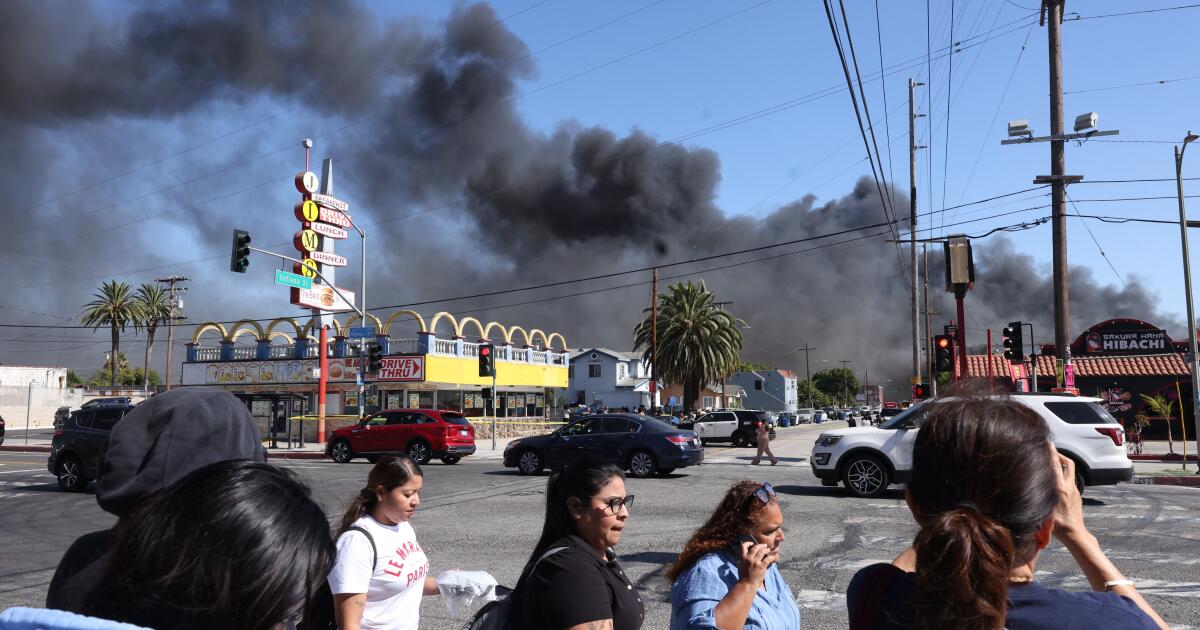
The air near the Lineage refrigerated warehouse fire in Boyle Heights carried astronomically high levels of smoke and soot, surpassing some of the worst air pollution during the Los Angeles County fires in January 2025, according to preliminary data from air officials.
The fire spewed thick black smoke for days. From downtown Los Angeles to the San Gabriel Valley, tens of thousands were enveloped in unhealthful levels of smoke, even as some local officials told residents that the air posed no danger.
As the days wore on, worst off were communities nearest the blaze. On June 19, three days after the facility ignited, a temporary air quality monitoring station at Eastman Elementary in unincorporated East Los Angeles measured an extremely hazardous 755 micrograms per cubic meter of fine particles for more than an hour, according to the South Coast Air Quality Management District.
For comparison, a Caltech air monitor in Pasadena recorded about 650 micrograms per cubic meter during the Eaton fire.
These high levels of fine particles, known as PM 2.5, probably resulted in the surge of residents into local emergency rooms during the fire, according to local health officials. But even now with the smoke gone, people still have not been told what chemicals they were breathing in during the weeklong ordeal.
Michael Jerrett, an environmental health professor at the UCLA Fielding School of Public Health, said his concern is the composition of materials emitted when the building burned.
“These contain many particularly toxic components,” Jerrett said, “and we know little about how these mixtures affect health.”
There is no completely safe level of fine particulate pollution, he noted, meaning higher concentrations are always worse.
During the 2025 L.A. County fires, local air officials announced that several monitors downwind had detected elevated levels of brain-damaging lead and cancer-causing arsenic from toxic paint and construction materials used in older homes.
The Lineage warehouse, built in 2018, is likely to contain different materials of concern. Thick insulation foam required for a massive refrigeration operation, solar panels and refrigerants were burned, leaving many residents on edge.
Even though three public agencies conducted air monitoring, the picture is still murky.
“[Public officials] are speaking with a lot of confidence but not a lot of information,” said mark! Lopez, a community organizer with East Yard Communities for Environmental Justice. “We’ve gotten in the room with folks to discuss where the gaps lie and where assumptions are being made. And I think they are realizing these agencies supposed to protect our air and our health aren’t as reliable as they thought they were.”
In response to the Boyle Heights fire, the South Coast air district deployed a mobile monitoring vehicle to screen for toxic substances in the community near the fire, according to Nahal Mogharabi, a spokesperson for the air district. It found increased levels of bromine, a chemical commonly found in fire retardant, and chlorine, often released from burning plastic. Both were below short-term health-based exposure thresholds.
Toxic metals, including lead and arsenic, were not elevated, according to air district data.
“That was the reassuring piece, that they were not picking up any of the metals,” said Dr. Nichole Quick, chief medical advisor for the Los Angeles County Department of Public Health. “But … that smoke is unhealthy. “You don’t want to be breathing it, regardless.”
The U.S. Environmental Protection Agency set up air monitors around the perimeter of the facility to test for toxic air contaminants, has the results and has not made them public. Julia Giarmoleo, an EPA spokesperson, said the monitors did not detect elevated metals, but would not provide a copy of the data without a federal records request.
The Los Angeles Fire Department’s hazardous material team also tested for ammonia, which is used in refrigeration, and hydrogen fluoride, a toxic chemical that could be released by burning lithium-ion batteries and solar panels.
Fire officials previously said they measured low levels of hydrogen fluoride on the second day of the fire. But the department would not answer questions about its air monitoring. It also told a reporter to submit a public records request.
It remains unclear whether any agency has tested for hydrogen cyanide or isocyanates, highly toxic gases that could be released from burning chemical-laden insulating foam inside the building.
“The real issue is what monitoring has not been done to protect the fence-line community from the air toxics,” said Jane Williams, executive director of California Communities Against Toxics.
Without the EPA or LAFD data, what is known of the smoke’s toxicity rests on the air district’s mobile monitoring.
Jerrett, the UCLA researcher, said that is not ideal for understanding the kind of plume released by the Boyle Heights fire, which rapidly changed direction with the wind.
“This can in some instances lead to levels that look low, but they are resulting from a mismatch between the location of the vehicle and the plume,” he said.
The Boyle Heights blaze, similar to the Eaton and Palisades fires, has revealed the region’s air monitoring can’t always tell people what they’ve been exposed to in a disaster.
“We do need a better monitoring system in place,” he said.
Local officials are now shifting their focus to the rancid odors from millions of pounds of rotting food in the ruined wing of the warehouse. Decomposing food can release hydrogen sulfide, a toxic gas synonymous with landfills and garbage. Lineage hired contractors who are measuring this noxious gas and other pollution. Their data indicate they have not detected hydrogen sulfide.
As Lineage workers haul the rotting food to local landfills, they are using deodorizing mist and have discussed using shrink wrapping to suppress the stench and minimize issues for nearby homes.
At this point, the odors are believed to be an inconvenience rather than a public health threat, according to Quick, the county medical advisor. She said running air purifiers may help to reduce odors indoors.
“It’s very important for folks to understand that the odors themselves do not indicate any dangerous levels of toxins, mold, bacteria, and so forth,” Quick said. “But the odors are a public nuisance.”
The air district is still encouraging residents to report odors to its online complaint system or by calling (800) 288-7664.
-

 North Dakota17 seconds ago
Armstrong, Strinden celebrate grand opening of Theodore Roosevelt Presidential Library in Medora
-

 Ohio7 minutes ago
Water main break closes part of Glenwood Avenue
-

 Oklahoma10 minutes ago
Widespread outages hit Norman and Oklahoma City as crews begin power restoration
-

 Oregon15 minutes ago
Wildfire Fact Sheet – (Incident #0383) | Central Oregon Fire Information
-

 Pennsylvania22 minutes ago
PHOTOS: Storm damage across central Pennsylvania
-

 Rhode Island25 minutes ago
Will Taylor Swift hold a post-wedding bash in Rhode Island?
-

 South-Carolina30 minutes ago
Summer offer leads to EDGE Jayden Broadie’s commitment to South Carolina
-
South Dakota37 minutes ago
SD Lottery Powerball, Lotto America winning numbers for July 4, 2026

