Science
How to Plan a Garden With Climate Change in Mind


The silent season is drawing to a close.
All winter, there was little birdsong to lift my heart. The occasional caw of a crow, the chickadee-dee-dee of a chickadee, the big song of the little Carolina wren that now stays on our Pennsylvania farm all winter. But no courtship call of great horned owls, no wood thrush or Baltimore oriole. Still, I rejoiced in the music that remained.
I just heard the first notes of our first returning songbird, though, a red-winged blackbird, and the snowdrops have begun to poke out of the ground.
The other day, I moved last fall’s potted tulips and hyacinth from the unheated side of the barn to the warmth of the garden room to force their blooms. But the vegetable garden is an icy mud puddle and the flower beds, still mulched with shredded leaves, show little signs of life. Boxwood is covered in burlap and snow fence is draped around trees and shrubs to prevent deer from devouring them.
Those deer, which have changed from the color of milk chocolate to dark, break through our makeshift deterrents anyway and eat the yew, euonymus, arborvitae, and this winter, even the holly. Squirrels race around adding to their larders, but the chipmunks are nowhere to be seen yet. They’re in their dens I suppose, as are the opossum, raccoons and the bears, too.
Once I longed for a greenhouse, but now I, too, wish to hibernate in winter, to take time off from sowing, potting and nurturing. To walk in snowy woods and observe animal tracks, study ice patterns on the pond, to be one with the season. I want to read by the fire and peruse garden catalogs, imagining what next year’s garden will be like, expecting, as all gardeners do, that next year will be better than the last. As Vita Sackville-West wrote in her poem “The Garden:”
The gardener dreams his special own alloy
Of possible and the impossible.
But what is possible anymore? As I reflect on last year’s abysmal season, I wonder how I will adapt to the changes I witness.
A year ago, winter was so warm that shrubs hardly died back and, last spring, dripped with foliage, a welcome sight but not normal. Spring was so hot I missed that lovely, cool, window for transplanting. I didn’t know when to plant early season, cold-hardy vegetables, certainly not in 85 degrees, or when to set out tender plants.
“After danger of frost,” is common wisdom, but when is that now? My Plant Hardiness Zone shifted recently because the average coldest temperature in my area is now three degrees higher than it was in 2012. But even that new guidance didn’t help me.
Mid-May felt like mid-June. Then, we had hail on May 29.
I planted poppies in April anyway (they like cool weather) but the seeds were washed away by floods, which can now stretch here from April through October. Between June and November, we had a drought. The grass was brown. Dogwood and tulip poplar lost their leaves in July. My vegetable garden resembled a cracked riverbed, the soil so hard that weeding was nearly impossible.
Streams ran dry, so for the first time in 36 years I saw deer wade into the pond to drink. Little food was available for them, so they sauntered up to our garage and ate the deer-resistant lavender. On my walks in the forest, I was struck by that lack of undergrowth, particularly a huge patch of Canadian Wood Nettle, a North America native that is a host plant for Red Admiral and Eastern Comma butterflies. Chanterelles never fruited in their usual spots. I worried that our spring would run dry.
Pennsylvania saw record wildfires in fall. Two lilacs, which normally appear in spring, bloomed in October, and in late November I was still harvesting what little I did manage to grow.
All this reminds me of a radio program called “Piano Puzzler” that my husband and I listen to on Saturday mornings. The composer Bruce Adolphe rewrites a familiar tune in the style of a classical composer. He changes the tune’s tempo, harmony or mode and contestants try to name the tune and composer. Imagine “Hey Jude” in the style of Brahms. Somewhere in my brain the tune sounds familiar, yet something is off, the music is disorienting. Occasionally, I guess correctly. Often, not.
Gardening in climate change is the same: confusing, with a lot of guessing.
What’s a home gardener to do?
“The only predictable thing is that it is going to be unpredictable.” said Sonja Skelly, director of education at Cornell Botanic Gardens in Ithaca, N.Y. “It’s been crazy up here, too.”
Last spring was hot in Ithaca as well, so the vegetable gardener started planting two weeks before the May 31 frost-free date. Then came extreme temperature fluctuations, but the plants set out earlier did better because they got established. Those planted on the target date were stunted and had a poor growing season. “A good lesson,” Dr. Skelly said. Row covers, which allow gardeners to get plants in earlier and grow them later in the season, are “going to be really important in climates like ours,” she said.
Cover crops like millet, sorghum, and black-eyed peas have been successful at the botanic gardens. They improve water retention, decrease weeds, reduce erosion and limit negative microorganisms in soil. The birds love them, Dr. Skelly said.
She recommended planting together what the Haudenosaunee people call the three sisters: corn, beans and squash. This system produces a better per-hectare yield than any monoculture cropping system, she said.
Drip irrigation is another solution, Dr. Skelly said. “It adds moisture where it’s needed, at the roots,” she said. Water is released slowly, stays put, and doesn’t run off like hand watering or using sprinklers.
“Observe, take notes, ask questions, seek out answers,” Dr. Skelly advised. “What are the neighbors seeing?” Learn by going to local botanic gardens, public gardens and nature centers, which have been working on this problem for a while now. “Keep the cycle of information flowing, talking with friends and family and neighbors as a way to help us figure it out. That’s so important,” she said.
Dr. Skelly believes it’s crucial for home gardeners to really understand their plants. “Maybe climate change will be the way to know our gardens far better,” she said. “We have to.”
I’ve long depended on experts to teach me how to garden responsibly. To help, not harm, the environment. I plant a diverse range of plants, including natives for pollinators, and have learned to celebrate native weeds like fleabane. I practice companion planting. I don’t spray pesticides or insecticides and, instead of synthetic fertilizers, use compost or make my own out of comfrey or stinging nettle. I wish I could buy plants in something other than plastic.
But the more I ponder gardening in the time of climate change, the more I believe we home gardeners are going to have to figure out many solutions for ourselves. So much of gardening is trial and error and erratic weather patterns mean we’ll have to experiment even more, to do our own studies. In essence, we must become citizen-scientists of our own vegetable patches and flower beds.
Cornell Botanic Gardens has a climate change demonstration garden, but, really, we all do. None of us has been through this before. And in the end, we’re all in this together, navigating a strange new world of digging in soil and growing things, each trying as we might to contribute to a new way of gardening in a changing world.
Daryln Brewer Hoffstot’s collection of essays, “A Farm Life: Observations From Fields and Forests,” was published by Stackpole Books.



It was after 3 a.m. Thursday when Joe Swann got word from someone at a bar perched on the banks of the Guadalupe River in Ingram, Texas, that rising floodwaters had triggered a new flood warning device. The alarm was flashing a bright light and blaring orders.
“Move away from the tower,” the device warned, alerting a nearby campground. By the time Mr. Swann arrived to see it for himself, campers were already leaving for higher ground.
Mr. Swann and his company, River Sentry, had installed 100 of the eight-foot-tall devices along the Guadalupe in the year since a deluge surged down the river and shocked the Hill Country region last July 4, killing dozens of people, many of them children at summer camp. Government money and philanthropic investment have also funded other flood siren systems that kicked in when Hill Country flooded again this week, devastating many of the same areas as last summer’s tragedy.
This time, the systems worked, though they could not prevent at least two deaths. In Kerrville, where floods wrecked areas still in the process of recovering from last summer’s deluge, Mayor Joe Herring Jr. said all residents were accounted for as of Thursday night.
“We had better warning,” he said in a phone interview.
“I’m thankful to the state of Texas and the Upper Guadalupe River Authority for working to install an automated, data-driven warning system,” he added. “And that helped save lives today.”
But the latest disaster also underscored a need to continue investing in improved forecasting and warning systems, said Phil Bedient, a professor at Rice University working on such a project.
“It’s wonderful to have that warning going off,” Dr. Bedient said of the new siren systems. “You’ve got to have more than that to have a bona fide early flood warning system.”
Texas made significant investments in flood warning systems after the tragedy last July. The state legislature and Gov. Greg Abbott, a Republican, approved $50 million for warning systems, rain and river gauges and other flood infrastructure.
Much of that was in place before this week’s storms, including sirens that blared across Kerr County, home to the worst of the flooding last summer.
Other work is still ongoing.
The Upper Guadalupe River Authority, a group responsible for guarding the health of the river, installed new sirens in May. It plans to install more river and rain gauges and develop software to help predict flooding, according to its website. An authority official could not be reached for comment.
Dr. Bedient and colleagues at the University of Texas, Arlington, are using $4 million from the state to develop a system to monitor rainfall on radar and use computer models to compare that data with a range of flooding scenarios. The goal is to increase the lead time for warning systems like flood sirens, he said.
“They will then know to turn sirens on even before the flood gets there,” Dr. Bedient said.
Researchers at Texas Tech University are using another $24 million in state funds to increase radar coverage and capability for meteorological analysis across Hill Country and other parts of rural Texas where flood risks are high but forecasting can be spotty.
River Sentry installed devices, including the ones that alerted campers in Ingram, using private fund-raising led by the owners of Camp Mystic, where 28 children and counselors died in last July’s floods. Each device cost $8,000, said Ian Cunningham, the company’s CEO.
The company, based in the Austin area, plans to add more capabilities, including connecting the network of devices wirelessly and adding small, portable sensors that people can keep with them to receive flood alerts and call for help when needed, Mr. Cunningham said.
Mr. Cunningham also works as an American Airlines pilot, but because he has two daughters who attend summer camp, he used his background in the U.S. Navy to lead River Sentry’s quick work to build the flood warning system.
“We can’t have what occurred last summer occur here again,” Mr. Cunningham said.
Pooja Salhotra contributed reporting.
Science
After wildfires destroyed 95% of this California tribe’s forests, members uncovered 1,200 ancestral sites
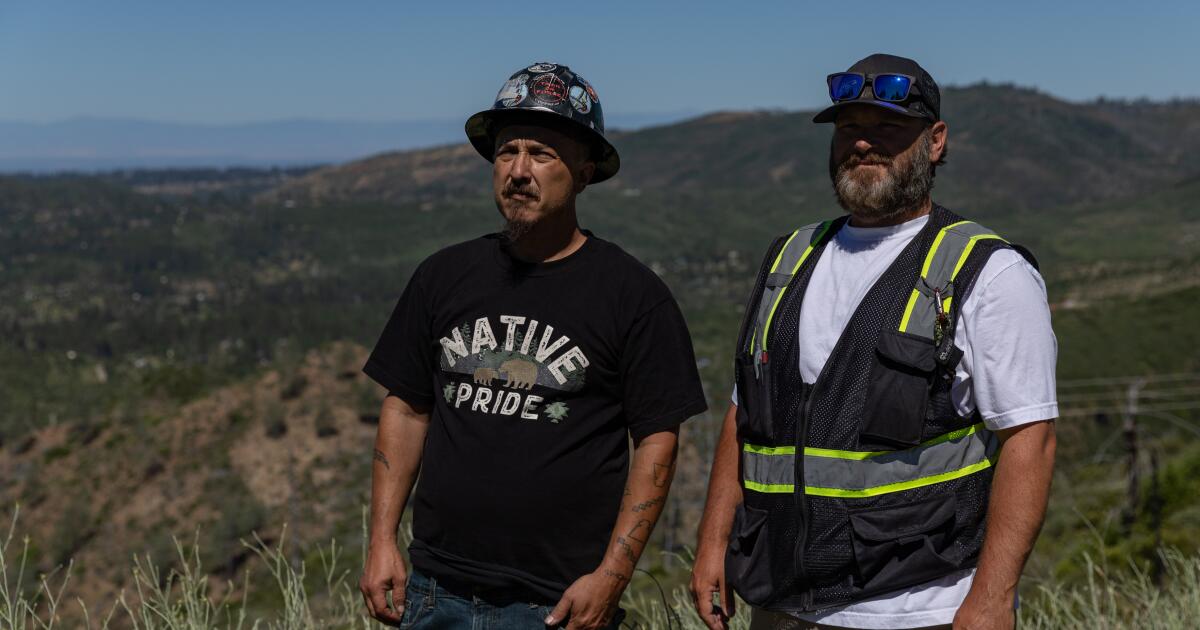
CONCOW, Calif. — Until recently, when members of the Konkow Valley Band of Maidu pulled up a map of their ancestral land in the foothills of the Sierra Nevada, only about two dozen of their historic sites appeared.
Disease, violence and forced labor had separated California tribe members from their history. Without routine Indigenous fire to clear out the foothills, the landscape — much of it now managed by the U.S. Forest Service — grew dense with conifers, obscuring the signs of their enduring presence.
As a result, archaeologists’ picture of the tribe’s past was spare. No more than 500 people. Going back about 3,000 years — a fraction of the time other tribes are known to have lived in the state.
Then the forests burned.
In less than a decade, wildfires destroyed forests across 95% of the tribe’s homelands. The Forest Service turned to the tribe for help healing the land. As members walked the wide-open moonscape, they found evidence of their vibrant history everywhere.
Now just a few years later, their map shows more than 1,200 sites.
Each one is itself a collection: Arrowheads. Rock art. Milling stations where ancestors used cups carved into rock faces to grind salmon, manzanita berries and bay leaves. The circular pits of winter houses, where they sat around a fire under a cedar roof.
A milling station found by the Konkow Valley Band of Maidu in their tribal homelands.
(Sara Nevis / For The Times)
Now, as Tribal Chairperson Matthew Williford Sr. walks these lands, he imagines a much more vibrant past than the one traditionally portrayed by archeologists.
For millennia, upward of 5,000 ancestors living in the basin, many trekking to higher elevation to gather food in the summertime. Husbands venting about domestic life as they shaped their arrowheads on one side of the hill; wives doing the same at the milling stations on the other side.

Matthew Williford Sr., Konkow Valley Band of Maidu tribal chairperson, stands in Plumas National Forest.
(Sara Nevis / For The Times)
Now, to better understand the tribe’s past, the Konkow Valley Band of Maidu is teaming up with a new generation of archaeologists. On a recent day in the Plumas National Forest, Matthew O’Brien, an anthropology professor at Chico State University, worked alongside a handful of students and tribal members.
The team excavated a house pit, carefully carrying artifacts to a rudimentary lab of folding tables and camp chairs, where students weighed them, measured them with calipers and assessed their chemical makeup with an expensive tool called an XRF analyzer. People offered explanations for how their ancestors used the artifacts.
For O’Brien, this form of archeology is worlds apart from the practice of the past. Tribal people are not voiceless historical subjects to study but active collaborators helping to understand and protect the past.
In the 20th century, “the government put archaeologists in charge of stewarding the past. In places like the United States, that leads to some serious ethical issues because what we’re in charge of protecting is not our own culture,” O’Brien said. Now, “it’s our job to help repair that relationship.”
It’s an irony lost on no one that the same policies that disconnected tribal members from their history also enabled the fires that then allowed them to rediscover it.
Even before California gained statehood, Gold Rush lawmakers banned tribes from lighting fire to rejuvenate and thin out forests. That same law also allowed white Californians to force Indigenous adults and children into labor, which separated “at least a generation of children and adults from their families, languages, and cultures,” the state later acknowledged.
Meanwhile, the federal government refused to ratify treaties to establish reservations for tribes whose homelands lay within newly created California, leaving tribes like the Konkow Valley Band of Maidu landless. By the early 1900s, Forest Service officials were working aggressively to squash lingering sentiment among white ranchers that intentional fire was productive. Any fire that started on Forest Service land, the policy became, ought to be contained by 10 a.m. the next morning.
The Konkow Valley Band of Maidu did what they could. Tribal members drove around in a beat-up Buick flinging matches out the window. Eventually those efforts landed one elder in jail for arson.
The open forests of oak, dogwood and a few pines, once routinely thinned and maintained with low-intensity “good” fire, became thick with conifers, to the delight of the Forest Service. Now five to six times denser, the trees formed yet another barrier between the tribe and its history — yet a fragile one. When fire inevitably ignites within so much wood in such a tight space — through lightning or human error — it does not burn gently.

A statue stands in a lot charred by the Camp fire, which tore through Paradise, Calif., in 2018.
(Noah Berger / Associated Press)
In 2018, the Camp fire ripped through Butte County, burning 150,000 acres and killing 85 people. Three years later, the Dixie fire ravaged nearly a million acres. In its wake, a world covered in ash. Waterways turned into black sludge. A foul smell of sulfur lingered in the air.
“It was sickening,” Williford said. “Just disgusting.”

Material to be burned is piled in an area of Plumas National Forest that the Konkow Valley Band of Maidu helps manage.
(Sara Nevis / For The Times)
“The land used to repay us, or acknowledge us, by giving us what we needed,” Williford said, standing on a dirt road overlooking the valley. “There were Native generations that were disconnected, unplugged. … We feel lucky that it’s our opportunity to reconnect, to let the land know that ‘Hey! We’re still here!’”
Restoration work with the Forest Service — surveying sites, planting trees and bringing back good fire — continues to unearth long-lost artifacts. And the most exciting data from O’Brien’s team is yet to come:
The team plans to carbon-date a piece of charcoal from the house pit it excavated to see just how long ago tribal ancestors sat around its hearth.
It was an ancient fire, not the recent ones, that preserved some dead wood, and with it, a lasting elemental fingerprint saying, “We were here.”

Mayor Karen Bass’ adminstration quietly appointed a new chief heat officer over a month ago, The Times has confirmed.
Daniela Simunovic took on the role May 31 after the administration discreetly fired Marta Segura, the first person to hold the position. Simunovic previously served as Bass’ senior director of climate and sustainability for three years.
The chief heat officer is responsible for overseeing the city’s response to extreme heat, one of the deadliest climate risks facing California. Like her predecessor, Simunovic will also head the city’s Climate Emergency Mobilization Office.
The move comes after Bass proposed eliminating the office entirely when facing a $1-billion budget shortfall. The L.A. City Council rejected the move, and the final budget ultimately moved the office from Public Works to the Emergency Management Department.
Los Angeles created the office in early 2021 to coordinate city efforts to reduce greenhouse gas emissions and protect Angelenos from climate disasters worsened by global warming. Then-Mayor Eric Garcetti appointed Segura as its director.
The following year, L.A. moved to also name the office’s director as the city’s chief heat officer, making it the third city in the country — after Phoenix and Miami — to create such a position.
On the hottest days, heat-related illness can account for nearly 1 in every 100 emergency department visits in L.A. County. In 2025, the County recorded 10 heat-related deaths, according to a new dashboard.
Segura was paid about $222,0000 in 2025 according to payroll data from the city controller. Simunovic, while in her role as senior director of climate and sustainability, was paid about $161,000 last year.
Before joining L.A. City government, Simunovic was a senior advisor for the California Air Resources Board, which is responsible for protecting the public from air pollution.
The Substack Climate Colored Goggles first reported Simunovic’s appointment Thursday. A spokesperson with Mayor Bass’s office confirmed it in a statement to The Times.
“Many stakeholders and City partners have been working closely with her and are excited to have her lead the office, including during the current Extreme Heat Warning in effect for the City of L.A.,” the statement said.
The Climate Emergency Mobilization Office has been “working with community partners on the development of the City’s Heat Action and Resilience Plan,” it read, “which should be completed by early 2027.”
Despite Bass’ proposal to cut the office last year, the mayor has reaffirmed and advanced several L.A. climate goals, including reaching 100% renewable energy by 2035.
Bass’s Climate Action Plan, released in April, called for doubling local solar power by 2030, reducing the use of fossil fuels in buildings and city buses, and addressing heat risk by planting more trees to increase shade, establishing “cooling centers” to provide relief during hot days and developing the Heat Action and Resilience Plan.
-
 Alaska2 minutes ago
EPA waives Clean Air Act restrictions on high-sulfur diesel for the North Slope
-

 Arizona8 minutes ago
Arizona lacrosse leaders believe sport is poised to grow
-

 Arkansas14 minutes ago
Two Narratives, One Ballot Box: Trump’s Concerns and Arkansas’ Response
-

 California20 minutes ago
Forest Service workers held hostage at gunpoint by father, son in CA forest for hours: Authorities
-

 Colorado26 minutes ago
The presiding judge of Colorado Springs Municipal Court will retire
-

 Connecticut32 minutes ago
Wethersfield woman accused of sexually coercing minor from New York after meeting him online
-

 Delaware38 minutes ago
Canadian Wildfire Smoke Pushes Delaware Air Quality to Code Red | Delaware LIVE News
-

 Florida44 minutes ago
Will Florida see its next named storm this weekend?

