Science
Early Humans Thrived in Rainforests


For generations, scientists looked to the East African savanna as the birthplace of our species. But recently some researchers have put forward a different history: Homo sapiens evolved across the entire continent over the past several hundred thousand years.
If this Africa-wide theory were true, then early humans must have figured out how to live in many environments beyond grasslands. A study published Wednesday shows that as early as 150,000 years ago, some of them lived deep in a West African rainforest.
“What we’re seeing is that, from a very early stage, ecological diversification is at the heart of our species,” said Eleanor Scerri, an evolutionary archaeologist at the Max Planck Institute of Geoanthropology in Jena, Germany, and an author of the study.
In the 20th century, after scientists found many fossils and stone tools in East African savannas, many researchers concluded that our species was especially adapted to life in grasslands and open woodlands, where humans could hunt great herds of mammals.
Only much later, the theory went, did our species become versatile enough to survive in tougher environments. Tropical rainforests appeared to be the toughest of them all. It can be hard to find enough food in jungles, and they offer lots of places for predators to lurk.
“You can’t see what to hunt,” Dr. Scerri said, “and you can’t see what’s coming for you.”
But in 2018, Dr. Scerri and her colleagues challenged the idea that East African grasslands were the single cradle of humanity. The abundance of stone tools and fossils found there, they argued, might have meant simply that the region had the right conditions for preserving those traces of history.
The scientists pointed to other fossils and stone tools discovered from southern and northern Africa. Those artifacts had often been dismissed as the products of extinct human relatives, rather than our own species.
Dr. Scerri and her colleagues suggested that for hundreds of thousands of years, our forerunners lived in isolated populations across Africa, periodically mixing their DNA when they came into contact.
If that were true, then early humans should have also been present in West and Central Africa, where rainforests were common. The oldest firm evidence of humans in African rainforests dated back just 18,000 years. But the acidic soils in tropical forests could have destroyed the bones before they turned to fossils, and tools could have been washed away.
Dr. Scerri came across an older report about a site in the Ivory Coast. The researchers dug a massive trench in a hillside called Anyama. In the hard, sandy sediment, they discovered bits of plant matter as well as some stone tools, though they could not determine their age.
In March 2020, Dr. Scerri and her colleagues traveled to Anyama and excavated a fresh face of sediment, where they found more stone tools. But they worked for only a few days before the Covid pandemic forced them home. They returned to the site in November 2021, only to discover that it had been illegally quarried for road building.
“It was absolutely heartbreaking,” said Eslem Ben Arous, a member of the team now at the National Center for Research on Human Evolution in Burgos, Spain.
Dr. Ben Arous and her colleagues discovered a small area not far from the original dig where they found more tools. But the new site has been destroyed as well.
Still, the researchers managed to gather a lot of clues. Dr. Ben Arous, an expert on geochronology, used new methods to estimate the age of the sediment layers. The oldest layer in which the researchers found stone tools formed 150,000 years ago.
The sediment also preserved wax from the surface of ancient leaves. Analyzing the chemistry of the leaf wax revealed that Anyama was a dense rainforest throughout its history. Even in the ice age, when the cool, dry climate shrank jungles across Africa, Anyama remained a tropical refuge.
Cecilia Padilla-Iglesias, an anthropologist at the University of Cambridge who was not involved in the new study, said that the work offered clear proof that people were living in those jungles — and that they were living there very early in the history of our species.
“It’s important because it confirms what other research predicted,” Dr. Padilla-Iglesias said.
Khady Niang, an archaeologist at Cheikh Anta Diop University in Senegal and an author of the study, noted that many of the oldest artifacts discovered were massive chopping tools crafted from quartz. She speculated that the Anyama people used them to dig up food or hack their way through the rainforest.
“If you move a lot, you need tools to cut the trees that hinder your path,” Dr. Niang said.
The distinctive tool kit makes Dr. Scerri suspect that the Anyama people had already lived in the rainforest long before 150,000 years ago. “They’re not people who have just arrived,” she said. “These are people who had the time to adjust to their living conditions.”



It was after 3 a.m. Thursday when Joe Swann got word from someone at a bar perched on the banks of the Guadalupe River in Ingram, Texas, that rising floodwaters had triggered a new flood warning device. The alarm was flashing a bright light and blaring orders.
“Move away from the tower,” the device warned, alerting a nearby campground. By the time Mr. Swann arrived to see it for himself, campers were already leaving for higher ground.
Mr. Swann and his company, River Sentry, had installed 100 of the eight-foot-tall devices along the Guadalupe in the year since a deluge surged down the river and shocked the Hill Country region last July 4, killing dozens of people, many of them children at summer camp. Government money and philanthropic investment have also funded other flood siren systems that kicked in when Hill Country flooded again this week, devastating many of the same areas as last summer’s tragedy.
This time, the systems worked, though they could not prevent at least two deaths. In Kerrville, where floods wrecked areas still in the process of recovering from last summer’s deluge, Mayor Joe Herring Jr. said all residents were accounted for as of Thursday night.
“We had better warning,” he said in a phone interview.
“I’m thankful to the state of Texas and the Upper Guadalupe River Authority for working to install an automated, data-driven warning system,” he added. “And that helped save lives today.”
But the latest disaster also underscored a need to continue investing in improved forecasting and warning systems, said Phil Bedient, a professor at Rice University working on such a project.
“It’s wonderful to have that warning going off,” Dr. Bedient said of the new siren systems. “You’ve got to have more than that to have a bona fide early flood warning system.”
Texas made significant investments in flood warning systems after the tragedy last July. The state legislature and Gov. Greg Abbott, a Republican, approved $50 million for warning systems, rain and river gauges and other flood infrastructure.
Much of that was in place before this week’s storms, including sirens that blared across Kerr County, home to the worst of the flooding last summer.
Other work is still ongoing.
The Upper Guadalupe River Authority, a group responsible for guarding the health of the river, installed new sirens in May. It plans to install more river and rain gauges and develop software to help predict flooding, according to its website. An authority official could not be reached for comment.
Dr. Bedient and colleagues at the University of Texas, Arlington, are using $4 million from the state to develop a system to monitor rainfall on radar and use computer models to compare that data with a range of flooding scenarios. The goal is to increase the lead time for warning systems like flood sirens, he said.
“They will then know to turn sirens on even before the flood gets there,” Dr. Bedient said.
Researchers at Texas Tech University are using another $24 million in state funds to increase radar coverage and capability for meteorological analysis across Hill Country and other parts of rural Texas where flood risks are high but forecasting can be spotty.
River Sentry installed devices, including the ones that alerted campers in Ingram, using private fund-raising led by the owners of Camp Mystic, where 28 children and counselors died in last July’s floods. Each device cost $8,000, said Ian Cunningham, the company’s CEO.
The company, based in the Austin area, plans to add more capabilities, including connecting the network of devices wirelessly and adding small, portable sensors that people can keep with them to receive flood alerts and call for help when needed, Mr. Cunningham said.
Mr. Cunningham also works as an American Airlines pilot, but because he has two daughters who attend summer camp, he used his background in the U.S. Navy to lead River Sentry’s quick work to build the flood warning system.
“We can’t have what occurred last summer occur here again,” Mr. Cunningham said.
Pooja Salhotra contributed reporting.
Science
After wildfires destroyed 95% of this California tribe’s forests, members uncovered 1,200 ancestral sites
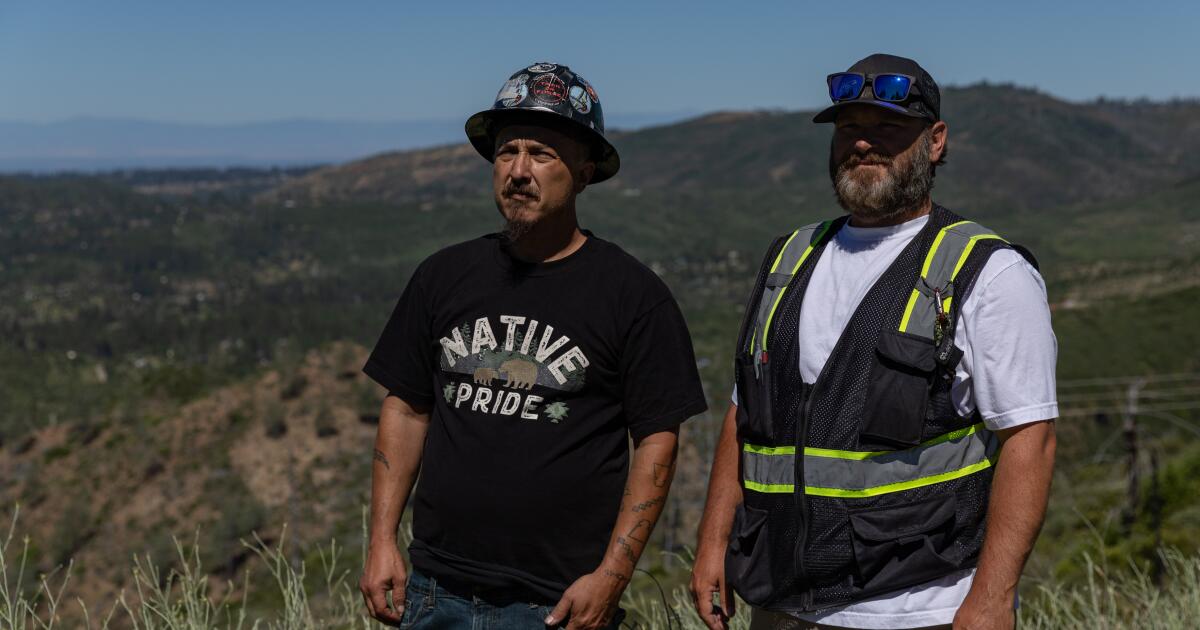
CONCOW, Calif. — Until recently, when members of the Konkow Valley Band of Maidu pulled up a map of their ancestral land in the foothills of the Sierra Nevada, only about two dozen of their historic sites appeared.
Disease, violence and forced labor had separated California tribe members from their history. Without routine Indigenous fire to clear out the foothills, the landscape — much of it now managed by the U.S. Forest Service — grew dense with conifers, obscuring the signs of their enduring presence.
As a result, archaeologists’ picture of the tribe’s past was spare. No more than 500 people. Going back about 3,000 years — a fraction of the time other tribes are known to have lived in the state.
Then the forests burned.
In less than a decade, wildfires destroyed forests across 95% of the tribe’s homelands. The Forest Service turned to the tribe for help healing the land. As members walked the wide-open moonscape, they found evidence of their vibrant history everywhere.
Now just a few years later, their map shows more than 1,200 sites.
Each one is itself a collection: Arrowheads. Rock art. Milling stations where ancestors used cups carved into rock faces to grind salmon, manzanita berries and bay leaves. The circular pits of winter houses, where they sat around a fire under a cedar roof.
A milling station found by the Konkow Valley Band of Maidu in their tribal homelands.
(Sara Nevis / For The Times)
Now, as Tribal Chairperson Matthew Williford Sr. walks these lands, he imagines a much more vibrant past than the one traditionally portrayed by archeologists.
For millennia, upward of 5,000 ancestors living in the basin, many trekking to higher elevation to gather food in the summertime. Husbands venting about domestic life as they shaped their arrowheads on one side of the hill; wives doing the same at the milling stations on the other side.

Matthew Williford Sr., Konkow Valley Band of Maidu tribal chairperson, stands in Plumas National Forest.
(Sara Nevis / For The Times)
Now, to better understand the tribe’s past, the Konkow Valley Band of Maidu is teaming up with a new generation of archaeologists. On a recent day in the Plumas National Forest, Matthew O’Brien, an anthropology professor at Chico State University, worked alongside a handful of students and tribal members.
The team excavated a house pit, carefully carrying artifacts to a rudimentary lab of folding tables and camp chairs, where students weighed them, measured them with calipers and assessed their chemical makeup with an expensive tool called an XRF analyzer. People offered explanations for how their ancestors used the artifacts.
For O’Brien, this form of archeology is worlds apart from the practice of the past. Tribal people are not voiceless historical subjects to study but active collaborators helping to understand and protect the past.
In the 20th century, “the government put archaeologists in charge of stewarding the past. In places like the United States, that leads to some serious ethical issues because what we’re in charge of protecting is not our own culture,” O’Brien said. Now, “it’s our job to help repair that relationship.”
It’s an irony lost on no one that the same policies that disconnected tribal members from their history also enabled the fires that then allowed them to rediscover it.
Even before California gained statehood, Gold Rush lawmakers banned tribes from lighting fire to rejuvenate and thin out forests. That same law also allowed white Californians to force Indigenous adults and children into labor, which separated “at least a generation of children and adults from their families, languages, and cultures,” the state later acknowledged.
Meanwhile, the federal government refused to ratify treaties to establish reservations for tribes whose homelands lay within newly created California, leaving tribes like the Konkow Valley Band of Maidu landless. By the early 1900s, Forest Service officials were working aggressively to squash lingering sentiment among white ranchers that intentional fire was productive. Any fire that started on Forest Service land, the policy became, ought to be contained by 10 a.m. the next morning.
The Konkow Valley Band of Maidu did what they could. Tribal members drove around in a beat-up Buick flinging matches out the window. Eventually those efforts landed one elder in jail for arson.
The open forests of oak, dogwood and a few pines, once routinely thinned and maintained with low-intensity “good” fire, became thick with conifers, to the delight of the Forest Service. Now five to six times denser, the trees formed yet another barrier between the tribe and its history — yet a fragile one. When fire inevitably ignites within so much wood in such a tight space — through lightning or human error — it does not burn gently.

A statue stands in a lot charred by the Camp fire, which tore through Paradise, Calif., in 2018.
(Noah Berger / Associated Press)
In 2018, the Camp fire ripped through Butte County, burning 150,000 acres and killing 85 people. Three years later, the Dixie fire ravaged nearly a million acres. In its wake, a world covered in ash. Waterways turned into black sludge. A foul smell of sulfur lingered in the air.
“It was sickening,” Williford said. “Just disgusting.”

Material to be burned is piled in an area of Plumas National Forest that the Konkow Valley Band of Maidu helps manage.
(Sara Nevis / For The Times)
“The land used to repay us, or acknowledge us, by giving us what we needed,” Williford said, standing on a dirt road overlooking the valley. “There were Native generations that were disconnected, unplugged. … We feel lucky that it’s our opportunity to reconnect, to let the land know that ‘Hey! We’re still here!’”
Restoration work with the Forest Service — surveying sites, planting trees and bringing back good fire — continues to unearth long-lost artifacts. And the most exciting data from O’Brien’s team is yet to come:
The team plans to carbon-date a piece of charcoal from the house pit it excavated to see just how long ago tribal ancestors sat around its hearth.
It was an ancient fire, not the recent ones, that preserved some dead wood, and with it, a lasting elemental fingerprint saying, “We were here.”

Mayor Karen Bass’ adminstration quietly appointed a new chief heat officer over a month ago, The Times has confirmed.
Daniela Simunovic took on the role May 31 after the administration discreetly fired Marta Segura, the first person to hold the position. Simunovic previously served as Bass’ senior director of climate and sustainability for three years.
The chief heat officer is responsible for overseeing the city’s response to extreme heat, one of the deadliest climate risks facing California. Like her predecessor, Simunovic will also head the city’s Climate Emergency Mobilization Office.
The move comes after Bass proposed eliminating the office entirely when facing a $1-billion budget shortfall. The L.A. City Council rejected the move, and the final budget ultimately moved the office from Public Works to the Emergency Management Department.
Los Angeles created the office in early 2021 to coordinate city efforts to reduce greenhouse gas emissions and protect Angelenos from climate disasters worsened by global warming. Then-Mayor Eric Garcetti appointed Segura as its director.
The following year, L.A. moved to also name the office’s director as the city’s chief heat officer, making it the third city in the country — after Phoenix and Miami — to create such a position.
On the hottest days, heat-related illness can account for nearly 1 in every 100 emergency department visits in L.A. County. In 2025, the County recorded 10 heat-related deaths, according to a new dashboard.
Segura was paid about $222,0000 in 2025 according to payroll data from the city controller. Simunovic, while in her role as senior director of climate and sustainability, was paid about $161,000 last year.
Before joining L.A. City government, Simunovic was a senior advisor for the California Air Resources Board, which is responsible for protecting the public from air pollution.
The Substack Climate Colored Goggles first reported Simunovic’s appointment Thursday. A spokesperson with Mayor Bass’s office confirmed it in a statement to The Times.
“Many stakeholders and City partners have been working closely with her and are excited to have her lead the office, including during the current Extreme Heat Warning in effect for the City of L.A.,” the statement said.
The Climate Emergency Mobilization Office has been “working with community partners on the development of the City’s Heat Action and Resilience Plan,” it read, “which should be completed by early 2027.”
Despite Bass’ proposal to cut the office last year, the mayor has reaffirmed and advanced several L.A. climate goals, including reaching 100% renewable energy by 2035.
Bass’s Climate Action Plan, released in April, called for doubling local solar power by 2030, reducing the use of fossil fuels in buildings and city buses, and addressing heat risk by planting more trees to increase shade, establishing “cooling centers” to provide relief during hot days and developing the Heat Action and Resilience Plan.
-
 Alaska43 seconds ago
EPA waives Clean Air Act restrictions on high-sulfur diesel for the North Slope
-

 Arizona7 minutes ago
Arizona lacrosse leaders believe sport is poised to grow
-

 Arkansas13 minutes ago
Two Narratives, One Ballot Box: Trump’s Concerns and Arkansas’ Response
-

 California19 minutes ago
Forest Service workers held hostage at gunpoint by father, son in CA forest for hours: Authorities
-

 Colorado25 minutes ago
The presiding judge of Colorado Springs Municipal Court will retire
-

 Connecticut31 minutes ago
Wethersfield woman accused of sexually coercing minor from New York after meeting him online
-

 Delaware37 minutes ago
Canadian Wildfire Smoke Pushes Delaware Air Quality to Code Red | Delaware LIVE News
-

 Florida43 minutes ago
Will Florida see its next named storm this weekend?

