Science
An L.A. AIDS trailblazer has advice on how to stay hopeful in dark times for public health


The year was 1987. Phill Wilson was 31, a recent transplant to L.A. from his hometown of Chicago. A mysterious infection that weakened its hosts’ immune systems was killing people at a terrifying rate, while the Reagan administration downplayed and openly joked about the disease. Some major news outlets initially wrote off the emerging epidemic as a “gay plague,” insinuating that other Americans didn’t need to worry about it.
Wilson’s doctor told him that he was HIV-positive, had six months to live and that he should get his affairs in order.
Instead, Wilson decided to “focus on the living.”
“Let’s use the time I have to do something,” he recalls thinking.
“My life,” Wilson says now, at age 69, “is that something.”
Wilson went on to found L.A.’s Black AIDS Institute, using the nonprofit think tank to draw attention to the lack of outreach, prevention and treatment programs tailored to Black Americans — despite the disproportionate toll that AIDS had taken on them.
Wilson not only defied his doctor’s orders. He also defied the odds, surviving one of the world’s deadliest epidemics, along the way preaching the message of prevention and care, from demonstrations in the nation’s capital to the sanctified realm of the Black church.
A participant holds a sign referring to Rock Hudson during a three-hour walkathon through Hollywood on July 28, 1985, in a fundraiser sponsored by AIDS Project Los Angeles.
(Jim Ruymen / Associated Press)
It’s been 40 years since Angelenos took to the streets for the first time to raise money for research in the wake of screen legend Rock Hudson’s stunning announcement that he had AIDS in 1985. That’s why it’s so hard for Wilson to accept that today, as L.A. is set to hold its annual AIDS Walk on Oct. 12 in West Hollywood, a new era of death and grief could be on the horizon.
Just as success appears within reach to end fatalities from HIV/AIDS worldwide, the U.S. — the global leader in that battle — seems to be in retreat.
In recent months, Republicans in Congress have followed up on moves by the Trump administration by calling for deep cuts to federal funding for HIV/AIDS prevention and home treatment, leaving public health officials and LGBTQ+ nonprofits in L.A. and elsewhere with few options besides cutting staff and suspending programs. AIDS organizations worldwide are also alarmed over the administration’s gutting of foreign aid initiatives for nations in Africa and elsewhere that cannot afford to fight infectious diseases on their own.
Wilson worries that 40 years of work that he and other activists, public health experts and providers, and members of the LGBTQ+ community have done to mobilize will be reversed in the space of a presidential term.

Phill Wilson reflects on the friends who lost their lives to AIDS while standing next to what he calls “My Wall of Dead People.”
(Genaro Molina / Los Angeles Times)
“I never imagined that I would be 69; I never imagined that I would still be alive and healthy,” Wilson said. “And I also never imagined that the trajectory of the AIDS pandemic would take us from malicious neglect, during the Reagan years, to a powerful movement that changed the trajectory of treatment and care and prevention not just for HIV and AIDS but for chronic diseases and infectious diseases in general, to … a day when in fact our government was actively engaged in dismantling institutions and systems that … were actually saving lives.”
Wilson, who also sits on the board of trustees at amfAr, one of the top AIDS research foundations, has been lauded by Republican and Democratic presidents. He has also attended the funerals of too many friends killed by the disease to count — giving him both a global and a painfully personal perspective on a disease that has infected more than 88 million people and claimed more than 42 million lives worldwide, according to the 2024 L.A. Annual AIDS Surveillance Report.
AIDS-related illnesses have killed at least 30,000 people in Los Angeles County alone, according to a report from the county’s Commission on HIV.
There is still no cure for AIDS. But since the introduction of powerful antiretroviral drugs in the 1990s that allow those infected to continue living healthy lives — and more recent preventative treatments such as PrEP — fatalities have plunged. In 2020, the U.S. government set a goal of reducing AIDS fatalities by 90% over the following decade.
But a team of researchers from UCLA and other institutions recently concluded that the Trump administration’s plan to shutter the U.S. Agency for International Development, a foreign aid program, and rescind already-appropriated funding to it could lead to millions of people dying of HIV/AIDS over the next five years who could have been protected through HIV outreach, testing and lifesaving drugs.
“With the current policies in place, there is a very good chance that we’re going to see a huge spike in new infections and we’re going to return to the days of people dying of HIV and AIDS when that’s preventable,” Wilson said.
Closer to home in L.A., the successes have been uneven.
The racial disparities that sparked Wilson’s activism at the dawn of the pandemic have narrowed but still exist.
Black Angelenos make up just 8% of the county’s population but represented roughly 18% of HIV cases recorded between January 2023 and December 2024, the most recent period for which sufficient data were available on the county’s public health dashboard. Latinos made up about 60% of cases, though this group constitutes 49% of the county’s population.
Wilson doesn’t need these grim statistics to remind him of the stakes involved if HIV/AIDS funding gets cut.
His partner, Chris Brownlie, was diagnosed with AIDS in1985, and after four years of suffering, died of the illness. That wrenching experience prompted Wilson to become an activist full time.
Wilson survived his own near-death illness stemming from AIDS in 1995, thanks to a new treatment that kept the virus from replicating. By then he had grown used to attending AIDS vigils and delivering eulogies for others who died too soon. Eventually he became AIDS coordinator for the city of Los Angeles and director of policy and planning at AIDS Project Los Angeles, now called APLA Health.

Phill Wilson, founder and former head of the Black AIDS Institute, meets President Obama.
(Courtesy of Phill Wilson)
Today, Wilson’s home radiates with colorful artworks from his private collection and vibrant African wood carvings climbing toward the loft ceiling. There are pictures of him shaking hands with Presidents George W. Bush, Clinton and Obama.
Facing Wilson as he speaks is a Kwaku Alston portrait of late South African President Nelson Mandela, commissioned when Wilson persuaded that nation’s first Black president to sit for a portrait session to celebrate him being honored by the Black AIDS Institute.
Situated among these bursts of color and patterns and Afrocentric pride, though, are photos of unspeakable losses.
It’s chilling to see the many images of fallen Black gay men — among them the poet and activist Essex Hemphill; Marlon Riggs, maker of a seminal 1989 film on the Black queer experience “Tongues Untied,” and the South African anti-apartheid and AIDS activist Simon Nkoli, who helped organize Africa’s first Pride march in 1990 — and realize how many of Wilson’s brothers in spirit and in struggle were cut down by the disease in their prime.
“My nephews call this wall my ‘Wall of Dead People,’” Wilson said, “because so many of the photographs are of people who are no longer with us, or photographs where I’m the only one alive.
“My motivation is to keep the memories of all of my friends who we lost during the AIDS pandemic alive,” he said, “to remind people that they were here, and they meant something and did work and they had lives and they had loves.”

Standing in front of a piece by artist Woodrow Nash, Phill Wilson describes the art that fills his home in Los Feliz.
(Genaro Molina / Los Angeles Times)
Wilson remembers how hard it was at first to promote HIV/AIDS awareness in L.A.’s Black community.
He had grown frustrated with the limited breadth of AIDS outreach in the 1980s and ‘90s. The whole model seemed too “white centric,” conspicuously lacking in outreach that took into account the obstacles that queer people of color faced. It was daunting enough to come out as gay in some Black and brown households, let alone speak openly about a deadly epidemic whose uncertain origins had fueled wild, often-racist conspiracy theories suggesting that Black people were chiefly responsible for its spread.
The idea of inviting LGBTQ+ advocates into your home to talk about prevention may have worked in settings where gay men were affluent (and mostly white), but many lower-income queer Angelenos (many of whom where nonwhite) still lived with their families.
He knew he needed an “unapologetically Black” game plan, which included co-founding the National Gay and Lesbian Leadership Forum, an organization whose meetings allowed Black AIDS activists in L.A. and other cities to network and exchange best practices with peers who looked like them and could relate to their life experiences.
Wilson, who grew up in the projects of Chicago’s South Side and attended a Black church, also tried to enlist L.A.’s Black pastors to help spread the word about AIDS in their neighborhoods. It was slow going at first.
He recalls breaking with protocol at one Black house of worship by taking to the raised lectern — traditionally the exclusive domain of the preacher — to warn worshipers about the risks of ignoring the deadly disease killing their sons, brothers, nephews and nieces.
His stern address was mainly met with silence. But as Wilson walked toward the exit, minister after minister held out a hand to take one of the educational fliers he’d brought to hand out.
“They already knew that AIDS had visited their churches,” Wilson said.
In July, Wilson was struck again by memories of days gone by when Jewel Thais-Williams, the founder of the legendary Black queer club Jewel’s Catch One on Pico Boulevard, died at age 86.
Wilson remembers when the club, now a mixed venue, was known as a sanctuary for the city’s Black and brown queer community. Williams presided as a surrogate mother and life coach for Black gays and lesbians, transgender Angelenos of color, people living with HIV who felt stigmatized because of their status, and those who didn’t necessarily feel at home in mostly white venues. Williams had also established the first housing complex in the U.S. for Black women living with HIV and their children and started a holistic wellness clinic for members of the city’s Black and brown communities.
Wilson attended Williams’ public memorial at “The Catch” in August, alongside hundreds of friends, loved ones, politicians, former drag performers and club staffers. Some older club patrons strode in with the aid of walking sticks, less agile than they used to be but determined to pay their respects to “Mama Jewel.”
Everyone dressed as if for Sunday morning service — but the event morphed midway into a Sunday afternoon tea dance, with the crowd grooving under the disco balls to gospel-inflected house music, evoking the roof-raising atmosphere that made the club famous back in the day.
Wilson took to the stage to pose with L.A. Mayor Karen Bass as she presented a proclamation declaring the club a historical landmark.
In some ways, that moment of light seems like a long time ago. The current situation for public health in L.A. and across the country feels much darker.
That said, Wilson has learned to find solace in times of sadness and dread by taking the long view.
Having weathered the Reagan administration’s negligence, twice outlived his own death sentence in the AIDS crisis and recovered from a stroke two years ago, he has no patience for those who wallow in hopelessness about the federal cuts.
What people must do now, Wilson says, is the same thing that catalyzed him and local leaders such as Williams in the initial war against AIDS: Find ways to help, refuse to be silent and heed a piece of advice that may not sound satisfying in the moment but has sustained him through bouts of indignation and grief: “This too shall pass.”
Wilson realizes that, much like in the ‘80s, not everyone in the queer community or society at large feels personally invested in the fight against HIV/AIDS. For them, he has another bit of wisdom: Just because a government engaged in upending practices and slashing programs has yet to attack you or those you love doesn’t mean you should be a bystander to the damage done to others.
Wilson recites a James Baldwin line from his “Open Letter to My Sister, Miss Angela Davis”: “For if they come for you in the morning, they will be coming for us at night.”
“We may not know it,” Wilson says, “but we all have skin in the game.”



Sharon Horton stepped through the door of a sky-blue mobile clinic and onto a Skid Row sidewalk. She wore a yellow knit beanie, gold hoop earrings and the relieved grin of a woman who has finally checked a mammogram off her to-do list.
It had been years since her last breast cancer screening procedure. This one, which took place in City of Hope’s Cancer Prevention and Screening mobile clinic, was faster and easier. The staff was kind. The machine that X-rayed her breast was more comfortable than the cold hard contraption she remembered.
Relatively speaking, of course — it was still a mammogram.
“It’s like, OK, let me go already!” Horton, 68, said with a laugh.
The clinic was parked on South San Pedro Street in front of Union Rescue Mission, the nonprofit shelter where Horton resides. Within a week, City of Hope, a cancer research hospital, would share the results with Horton and Dr. Mary Marfisee, the mission’s family medical services director. If the mammogram detected anything of concern, they’d map out a treatment plan from there.
Naureen Sayani, 47, a resident of Union Rescue Mission, left, discusses her medical history with Adriana Galindo, a medical assistant, before getting a mammogram on last week.
(Kayla Bartkowski / Los Angeles Times)
“It’s very important to take care of your health, and you need to get involved in everything that you can to make your life a better life,” said Horton, who is looking forward to a forthcoming move into Section 8 housing.
Horton was one of the first patients of a new women’s health initiative from UCLA’s Homeless Healthcare Collaborative at Union Rescue Mission. Staffed by third-year UCLA Medical School students and led by Marfisee, a UCLA assistant clinical professor of family medicine, the clinic treats mission residents as well as unhoused people living in the surrounding neighborhood.
The new cancer screening project arrives at a time of dire financial pressures on county public health services.
Citing rising costs and a $50-million reduction in federal, state and local grant and contract income, the Los Angeles County Department of Public Health on Feb. 27 ended services at seven of 13 public clinics that provide vaccines, tests and treatment for sexually transmitted diseases and other services to housed and unhoused county residents.
Although Union Rescue Mission’s own funding comes mainly from private sources and is less imperiled by public cuts, the 135-year-old shelter expects the need for its services to rise, Chief Executive Mark Hood said.
Even as unsheltered homelessness declined for the last two years across Los Angeles County, the unsheltered population on Skid Row — long seen as the epicenter of the region’s homelessness crisis — grew 9% in 2024, the most recent year for which census data are available.
For many local women navigating daily concerns over housing, food and personal safety, “their own health is not a priority,” Marfisee said.
Those whose problems have become too serious to ignore face daunting obstacles to care. Marfisee recalled one patient who came to her with a lump in her breast and no identification.
In order to get a mammogram, Marfisee explained, the woman first needed to obtain a birth certificate, and then a state-issued identification card. Then she needed to enroll in Medi-Cal. After that, clinic staff helped her find a primary care physician who could order the imaging test.
Given the barriers to preventative care, homeless women die from breast cancer at nearly twice the rate of securely housed women, a 2019 study found. Marfisee’s own survey of the mission’s female residents found that nearly 90% were not up to date on recommended cancer screenings like mammograms and pap smears, which detect early cervical cancer.
To address this gap, Marfisee — a dogged patient advocate — reached out to City of Hope. The Duarte-based research and treatment center unveiled in March 2024 its first mobile cancer screening clinic, a moving van-sized clinic on wheels that it deploys to food banks and health centers, as well as to companies offering free mammograms as an employee benefit.
“In true Dr. Mary fashion, she saw the vision,” said Jessica Thies, the mobile screening program’s regional nursing director. After working through some logistical hurdles, the mission and City of Hope secured a date for the van’s first visit.
The next challenge was getting the word out to patients. Marfisee and her students walked through the surrounding neighborhood, went cot to cot in the women’s dorm and held two informational sessions in December and January to answer patients’ questions.
At the sessions, the team walked through the basics of who should get a mammogram (women age 40 or older, those with a family history of breast cancer) and the procedure itself. (“Like a tortilla maker?” one woman asked skeptically after hearing a description of the mammography unit.)
The medical students were able to dispel rumors some women had heard: The test doesn’t damage breast tissue, nor do the X-rays increase cancer risk. Others questioned a mammogram’s value: What good was it knowing they had cancer if they couldn’t get follow-up care?
On this latter point, Marfisee is determined not to let patients fall through the cracks.
Thirteen patients received mammograms at the van’s first visit on Wednesday. Within a week, City of Hope will contact patients with their results and send them to Marfisee and her team. She is already mentally mapping the next steps should any patient have a situation that requires a biopsy or further imaging: working with their case manager at the mission, calling in favors, wrangling with any insurance the patient might have.
“It’ll be a good fight,” Marfisee said, as residents in the adjacent cafeteria carried trays of sloppy joes and burgers to their lunch tables. “But we’ll just keep asking for help and get it done.”

At first glance, it looks like nothing more than a charming Spanish-revival, quintessentially Californian home — but this Pacific Palisades rebuild is constructed like a tank.
Every exterior wall of the steel-framed home is a foot-thick, fire-resistant barricade. The home is connected to a satellite fire monitoring service. Should a fire start in town, sturdy metal shutters descend to cover every window. An exterior sprinkler system can pump 40,000 gallons of water from giant tanks hidden behind the shrubs in the property’s yard. If the cameras and heat sensors around the house detect danger, the system can envelop the home in over 1,000 gallons of fire retardant and hundreds of gallons of fire-suppressing foam.
Palisades resident and architect Ardie Tavangarian is so confident in his design that he even asked the fire department if they could start a controlled fire on the property to test it all out. (They said no.)
Tavangarian built a career designing multimillion-dollar luxury homes in Los Angeles, but after the Palisades fire destroyed 13 of his works — including his family’s home — he found another calling: how to design a house that can handle what the Santa Monica Mountains throw at it. And how to do it quickly and affordably.
Water tanks form part of a backup water supply in a newly built fire-resistant home in Pacific Palisades.
“Nature is so powerful,” he said, sitting on a couch in the new house, which he built for his adult twin daughters. “We are guests living in that environment and expecting, ‘Oh, nature is going to be really kind to me.’ No, it’s not. It does what it’s supposed to do.”
Tavangarian watched the Jan. 1 Lachman fire from his property not far from here; a week later that fire rekindled, grew into the Palisades fire, and burned through his house. But the painful details of the fire — the missteps of the fire department, the empty reservoir — didn’t matter when it came to deciding how to rebuild, he said. The reality is, many fires have burned in these mountains. Many more will.

A sprinkler on the roof is part of a house-wide sprinkler system.
For the architect, who has spent much of his 45-year career designing for luxury, hardening a home against wildfire has brought a new kind of luxury to his homes: peace of mind.
It’s a sentiment that resonates with fire survivors: Tavangarian says he’s received considerable interest from other property owners in the Palisades looking to rebuild their houses.
The metal shutters and advanced outdoor sprinkler system are the flashiest parts of Tavangarian’s home hardening project, and the efficacy of these adaptations is still up for debate. Because the measures have not yet been widely adopted, there are few studies exploring how much or little they protect homes in real-world fires.
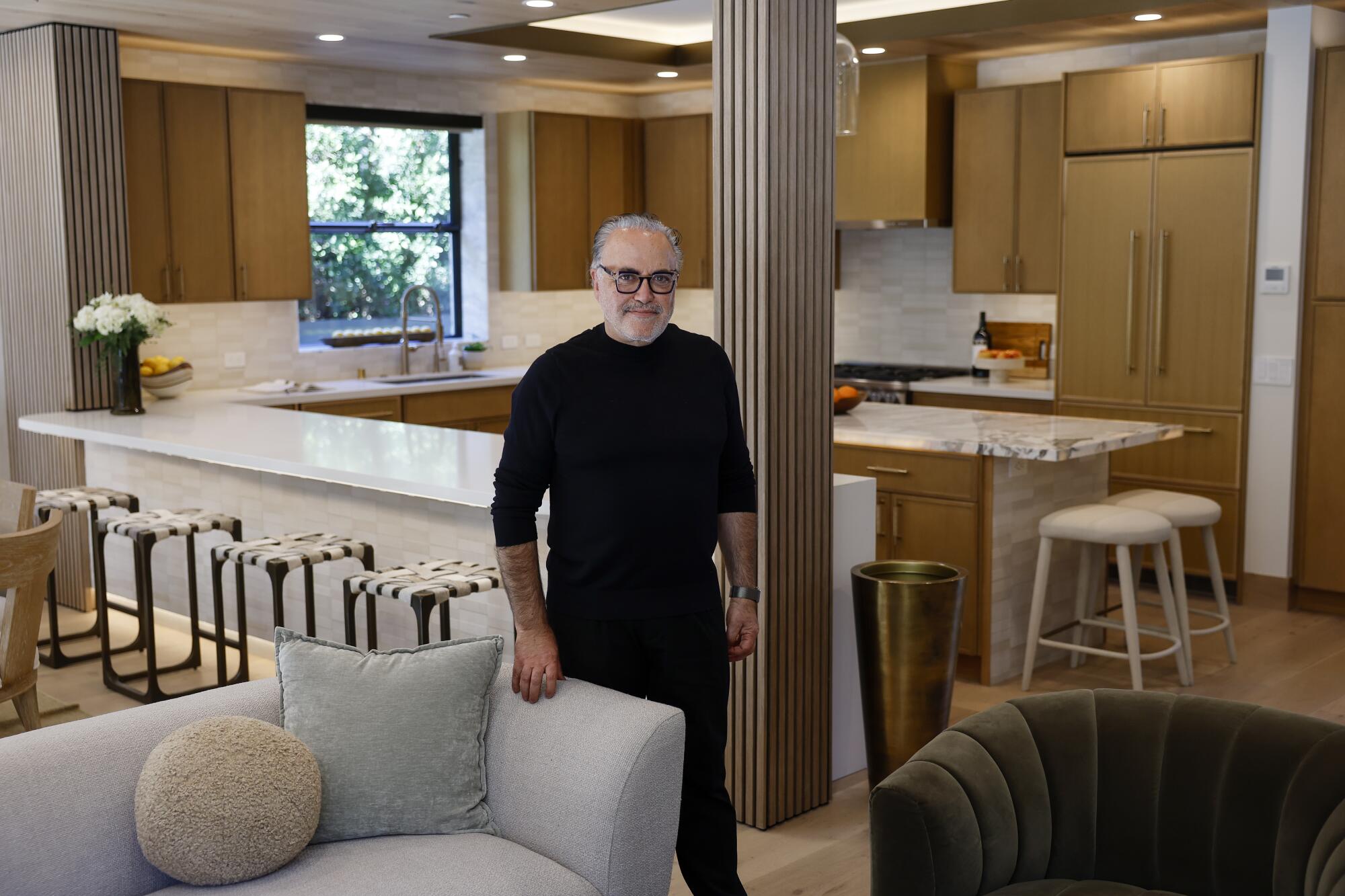
Architect Ardie Tavangarian inside the house he designed.
Anecdotal evidence has indicated the effectiveness of sprinklers can vary significantly based on the setup and the conditions during the fire. Extreme wind, for example, can make them less effective. Lab studies have generally found shutters can reduce the risk of windows shattering.
These measures aren’t cheap, either. Sprinkler systems can cost north of $100,000, for example. However, Tavangarian said when all was said and done, the home he built for his daughters cost around $700 per square foot — less than what Palisades residents said they expected to pay, but more than what Altadena residents expected for their rebuilds.
Tavangarian also hopes to see insurers increasingly consider the home-hardening measures property owners take when writing policies, which he said could potentially offset the extra cost in a decade or less. As he explored getting insurance for the new home, one insurer quoted him $80,000 a year. After he convinced the company to visit the property, it lowered the quote to just $13,000, he said.

The house includes metal heat shields that can drop down if a fire approaches.
The home also has essentially all of the other less flashy — but much cheaper and well-proven — home hardening measures recommended by fire professionals: The underside of the roof’s overhang is closed off — a common place embers enter a home. The roof, where burning embers can accumulate, is made of fire-resistant material. The windows, vulnerable to shattering in extreme heat, are made of a toughened glass. There is virtually no vegetation within the first five feet of the home.
When asked if he felt he had compromised on design, comfort or aesthetics for the extra protection — one of the many concerns Californians have with the state’s draft “Zone Zero” requirements that may significantly limit vegetation within five feet of a home — Tavangarian simply said, “You be the judge.”
Science
Commentary: My toothache led to a painful discovery: The dental care system is full of cavities as you age
I had a nagging toothache recently, and it led to an even more painful revelation.
If you X-rayed the state of oral health care in the United States, particularly for people 65 and older, the picture would be full of cavities.
“It’s probably worse than you can even imagine,” said Elizabeth Mertz, a UC San Francisco professor and Healthforce Center researcher who studies barriers to dental care for seniors.
Mertz once referred to the snaggletoothed, gap-filled oral health care system — which isn’t really a system at all — as “a mess.”
But let me get back to my toothache, while I reach for some painkiller. It had been bothering me for a couple of weeks, so I went to see my dentist, hoping for the best and preparing for the worst, having had two extractions in less than two years.
Let’s make it a trifecta.
My dentist said a molar needed to be yanked because of a cellular breakdown called resorption, and a periodontist in his office recommended a bone graft and probably an implant. The whole process would take several months and cost roughly the price of a swell vacation.
I’m lucky to have a great dentist and dental coverage through my employer, but as anyone with a private plan knows, dental insurance can barely be called insurance. It’s fine for cleanings and basic preventive routines. But for more complicated and expensive procedures — which multiply as you age — you can be on the hook for half the cost, if you’re covered at all, with annual payout caps in the $1,500 range.
“The No. 1 reason for delayed dental care,” said Mertz, “is out-of-pocket costs.”
So I wondered if cost-wise, it would be better to dump my medical and dental coverage and switch to a Medicare plan that costs extra — Medicare Advantage — but includes dental care options. Almost in unison, my two dentists advised against that because Medicare supplemental plans can be so limited.
Sorting it all out can be confusing and time-consuming, and nobody warns you in advance that aging itself is a job, the benefits are lousy, and the specialty care you’ll need most — dental, vision, hearing and long-term care — are not covered in the basic package. It’s as if Medicare was designed by pranksters, and we’re paying the price now as the percentage of the 65-and-up population explodes.
So what are people supposed to do as they get older and their teeth get looser?
A retired friend told me that she and her husband don’t have dental insurance because it costs too much and covers too little, and it turns out they’re not alone. By some estimates, half of U.S. residents 65 and older have no dental insurance.
That’s actually not a bad option, said Mertz, given the cost of insurance premiums and co-pays, along with the caps. And even if you’ve got insurance, a lot of dentists don’t accept it because the reimbursements have stagnated as their costs have spiked.
But without insurance, a lot of people simply don’t go to the dentist until they have to, and that can be dangerous.
“Dental problems are very clearly associated with diabetes,” as well as heart problems and other health issues, said Paul Glassman, associate dean of the California Northstate University dentistry school.
There is one other option, and Mertz referred to it as dental tourism, saying that Mexico and Costa Rica are popular destinations for U.S. residents.
“You can get a week’s vacation and dental work and still come out ahead of what you’d be paying in the U.S.,” she said.
Tijuana dentist Dr. Oscar Ceballos told me that roughly 80% of his patients are from north of the border, and come from as far away as Florida, Wisconsin and Alaska. He has patients in their 80s and 90s who have been returning for years because in the U.S. their insurance was expensive, the coverage was limited and out-of-pocket expenses were unaffordable.
“For example, a dental implant in California is around $3,000-$5,000,” Ceballos said. At his office, depending on the specifics, the same service “is like $1,500 to $2,500.” The cost is lower because personnel, office rent and other overhead costs are cheaper than in the U.S., Ceballos said.
As we spoke by phone, Ceballos peeked into his waiting room and said three patients were from the U.S. He handed his cellphone to one of them, San Diegan John Lane, who said he’s been going south of the border for nine years.
“The primary reason is the quality of the care,” said Lane, who told me he refers to himself as 39, “with almost 40 years of additional” time on the clock.
Ceballos is “conscientious and he has facilities that are as clean and sterile and as medically up to date as anything you’d find in the U.S.,” said Lane, who had driven his wife down from San Diego for a new crown.
“The cost is 50% less than what it would be in the U.S.,” said Lane, and sometimes the savings is even greater than that.
Come this summer, Lane may be seeing even more Californians in Ceballos’ waiting room.
“Proposed funding cuts to the Medi-Cal Dental program would have devastating impacts on our state’s most vulnerable residents,” said dentist Robert Hanlon, president of the California Dental Assn.
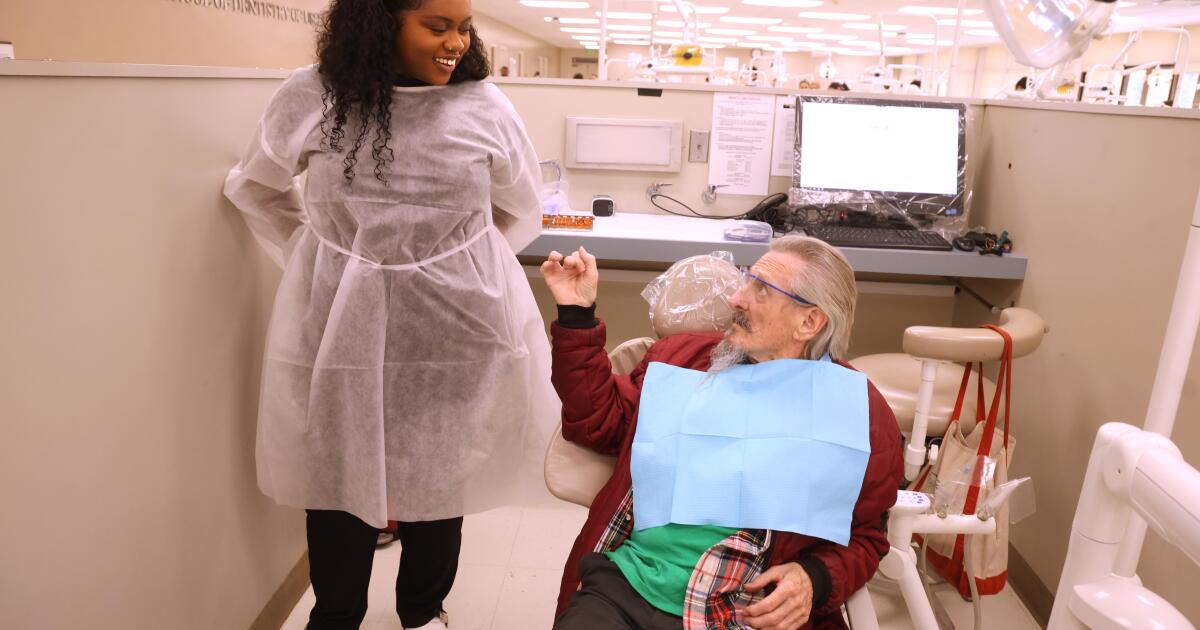
Dental student Somkene Okwuego smiles after completing her work on patient Jimmy Stewart, 83, who receives affordable dental work at the Ostrow School of Dentistry of USC on the USC campus in Los Angeles on February 26, 2026.
(Genaro Molina / Los Angeles Times)
Under Proposition 56’s tobacco tax in 2016, supplemental reimbursements to dentists have been in place, but those increases could be wiped out under a budget-cutting proposal. Only about 40% of the state’s dentists accept Medi-Cal payments as it is, and Hanlon told me a CDA survey indicates that half would stop accepting Medi-Cal patients and many others will accept fewer patients.
“It’s appalling that when the cost of providing healthcare is at an all-time high, the state is considering cutting program funding back to 1990s levels,” Hanlon said. “These cuts … will force patients to forgo or delay basic dental care, driving completely preventable emergencies into already overcrowded emergency departments.”
Somkene Okwuego, who as a child in South L.A. was occasionally a patient at USC’s Herman Ostrow School of Dentistry clinic, will graduate from the school in just a few months.
I first wrote about Okwuego three years ago, after she got an undergrad degree in gerontology, and she told me a few days ago that many of her dental patients are elderly and have Medi-Cal or no insurance at all. She has also worked at a Skid Row dental clinic, and plans after graduation to work at a clinic where dental care is free or discounted.
Okwuego said “fixing the smiles” of her patients is a privilege and boosts their self-image, which can help “when they’re trying to get jobs.” When I dropped by to see her Thursday, she was with 83-year-old patient Jimmy Stewart.
Stewart, an Army veteran, told me he had trouble getting dental care at the VA and had gone years without seeing a dentist before a friend recommended the Ostrow clinic. He said he’s had extractions and top-quality restorative care at USC, with the work covered by his Medi-Cal insurance.
I told Stewart there could be some Medi-Cal cuts in the works this summer.
“I’d be screwed,” he said.
Him and a lot of other people.
steve.lopez@latimes.com

Whitefish council creates proclamation in solidarity with city, citizens of Minneapolis

Noblesville man arrested, accused of rape of UIndy student in dorm room

Judge calls Pittsburgh crash death ‘textbook example’ of why DUI is illegal

Augusta family flees Middle East as U.S. launches Operation Epic Fury

Fact Check Team: Iran conflict revives Washington fight over who can authorize US force

Florida High School Football Rankings: Top 25 teams – Oct. 21

Cleary's 21 help Le Moyne down Central Connecticut State 69-64 in OT

How old is Bo Nix? What to know about Oregon quarterback ahead of 2024 NFL Draft

99th annual Pony Swim held in Virginia

Indiana Members Credit Union announced as new anchor tenant at Bottleworks District

Fraud-plagued Minnesota sues Trump admin for withholding $243M in Medicaid payments

Is Iran expanding attacks to target energy and civilian sites in the Gulf?

Trump claims US stockpiles mean wars can be fought ‘forever’; Kristi Noem testifies before Congress – US politics live

War in the Middle East: Iran’s broad retaliation in the Gulf • FRANCE 24 English

Trump sends official notification to Congress on strikes against Iran
-

 World6 days ago
Exclusive: DeepSeek withholds latest AI model from US chipmakers including Nvidia, sources say
-

 Massachusetts6 days ago
Mother and daughter injured in Taunton house explosion
-

 Denver, CO6 days ago
10 acres charred, 5 injured in Thornton grass fire, evacuation orders lifted
-

 Louisiana1 week ago
Wildfire near Gum Swamp Road in Livingston Parish now under control; more than 200 acres burned
-

 Oregon4 days ago
2026 OSAA Oregon Wrestling State Championship Results And Brackets – FloWrestling
-

 Florida3 days ago
Florida man rescued after being stuck in shoulder-deep mud for days
-

 Technology1 week ago
Arturia’s FX Collection 6 adds two new effects and a $99 intro version
-

 News1 week ago
Video: How Lunar New Year Traditions Take Root Across America