Politics
With oil funds and Formula One, Saudi Arabia steamrolls its way onto sports’ hallowed grounds

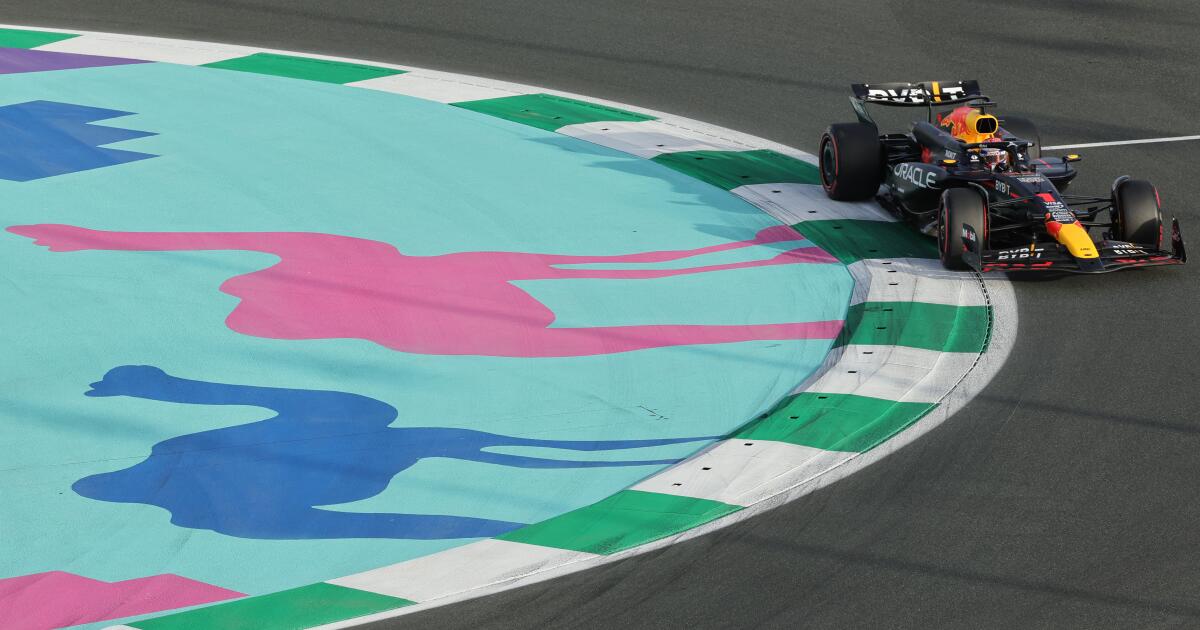
To understand the scope of Saudi Arabia’s ambitions in the sporting landscape, don’t look just to this spring’s Formula One race in Jeddah — which ended with a predictable one-two win for the Red Bull team. The revealing action was at the after-party.
Amid a bloom of fireworks over Jeddah’s coast, dozens of drones buzzed in synchronicity to spell out the kingdom’s goal: “Saudi Arabia. Home of Sporting Events.”
It’s a vision that increasingly seems within reach. Backed by funds from the state-owned oil giant Aramco and the vast endowment of its Public Investment Fund, the autocratic monarchy has in only a few years steamrolled its way onto the sporting world’s most hallowed grounds.
In soccer, it has lavished its local clubs with hundreds of millions of dollars, courted superstar players to its league and successfully lobbied to host the 2034 World Cup. Its bid to create a rival golf tournament rattled the genteel PGA enough to force it into a reluctant union. Tennis, boxing, cricket, pro wrestling, even eSports — all have been rocked by the sheer scale of investment the kingdom is wielding to transform itself into a sports and entertainment powerhouse.
Soccer fans hold pictures of Saudi Arabia’s King Salman, left, and Crown Prince Mohammed bin Salman ahead a match at King Abdullah stadium in Jiddah, Saudi Arabia. The kingdom is building a new stadium for the 2034 World Cup.
(Uncredited / Associated Press)
But it is in motorsports, and Formula One in particular, where Saudi Arabia has made some of its most audacious and expensive moves, outpacing its regional rivals — Bahrain, Qatar and the United Arab Emirates, all host F1 races — amid a wider push to establish the Gulf as a racing hub.
“It’s amazing what they’re doing here,” said Jefferson Slack, commercial and marketing director for Aston Martin Aramco.
“No county in the world is investing in motorsports as much as Saudi Arabia.”
Slack would know. An executive with three decades of experience in sports investments and management of athletes such as Michael Jordan, he joined the team before Saudi Arabia came on board, when Canadian billionaire Lance Stroll bought the defunct Force India Formula One team and rebranded it as Aston Martin in 2021.
Since then, Aramco, the kingdom’s flagship oil company, has plowed money into the team, while the Saudi Public Investment Fund increased its stake in car manufacturer Aston Martin to more than 20%. As of January, Aramco became exclusive title sponsor and is signed on as a strategic partner until 2028. Rumors abound that Aramco may try to buy the team outright.
Critics charge that the massive investments are an attempt at “sportswashing,” calculated to distract from an abysmal human rights record — imprisonment and violence against commentators and activists, travel bans, and male guardianship laws over women.
The kingdom says it is merely modernizing and diversifying its economy, with F1 as an eager partner. Less than two years after Saudi henchmen killed and dismembered a Saudi Washington Post columnist and monarchy critic, the F1 and the kingdom’s flagship oil company entered into a 10-year partnership deal.
The deal, which began in 2020, is believed to have cost the Saudis some $45 million a year. Some whisper it’s only a matter of time before Saudi Arabia bids for the race series franchise as a whole, which Liberty Media Corp. bought for $4.6 billion in 2017 and whose valuation has since risen many times over — in no small part because the Netflix series “Formula 1: Drive to Survive” has supercharged the sport’s international popularity.
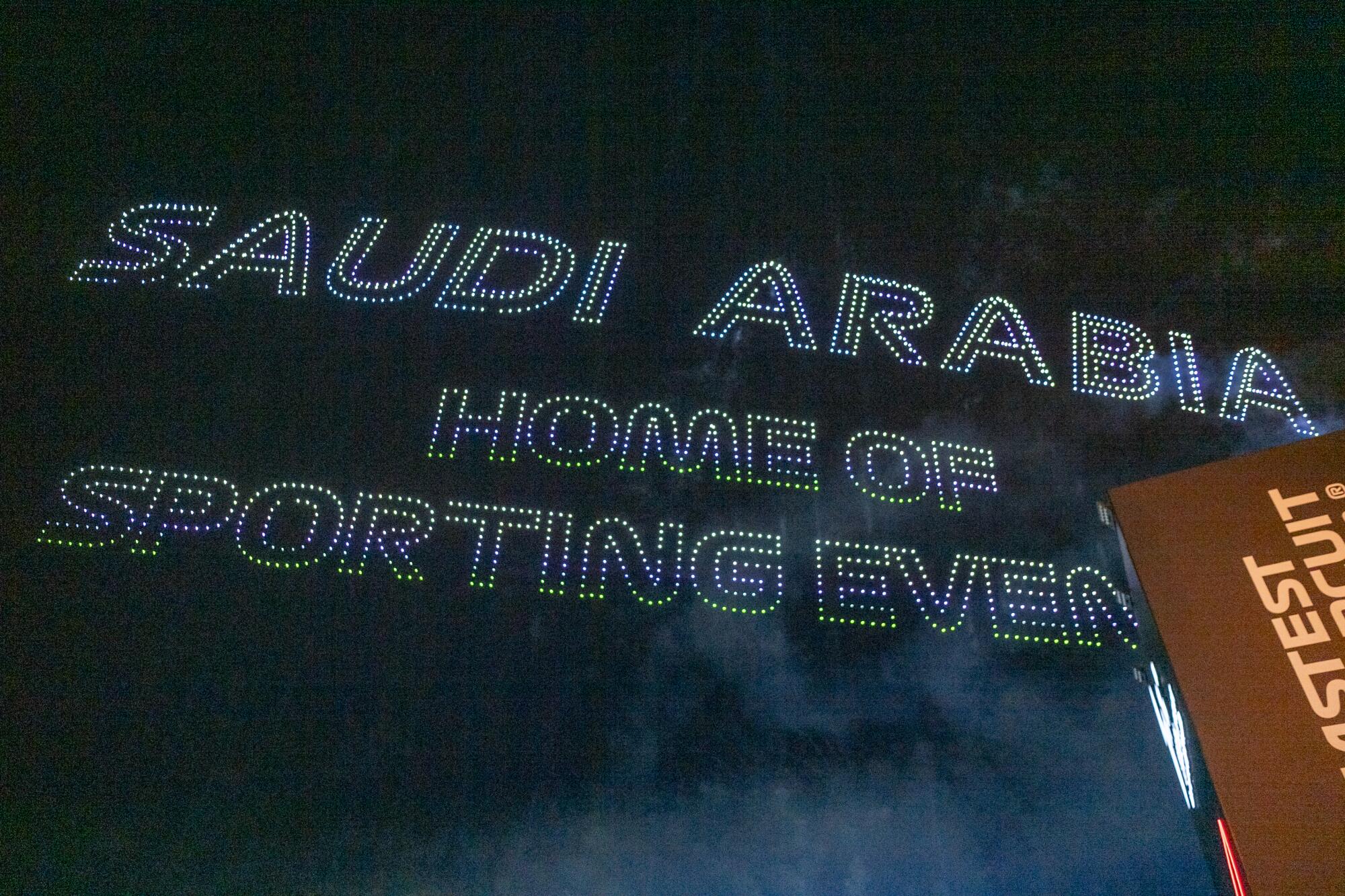
A light show spells out Saudia Arabia’s ambitions after the Grand Prix in Jeddah in March.
(Anadolu / Anadolu via Getty Images)
In addition, there’s a half-billion dollar racing circuit under construction in the city of Qiddiya, a mega project near the capital, Riyadh, intended to be part city and part tourism, sport and entertainment zone.
Plans are also in place to develop racing at a grassroots level, said Martin Whitaker, head of the Saudi Motorsports Company, the PIF-owned commercial entity charged with bringing motor sport events to the country.
“We’ve raised the bar in how the sport is seen globally,” he said. “Now we have to produce a concrete set of foundations and platforms so we can build it here.”
Creating that sort of ecosystem for racing is harder than it sounds. Soccer for example, can be played just about anywhere: Find an empty lot or quiet street, use whatever is available for goalposts, and that’s largely it.
Racing on the other hand requires infrastructure and major investment. Starting a pipeline of kids in karting — the gateway into circuit racing — can be painfully expensive; move up the ranks to the higher classes and you’re looking at $80,000 a race.
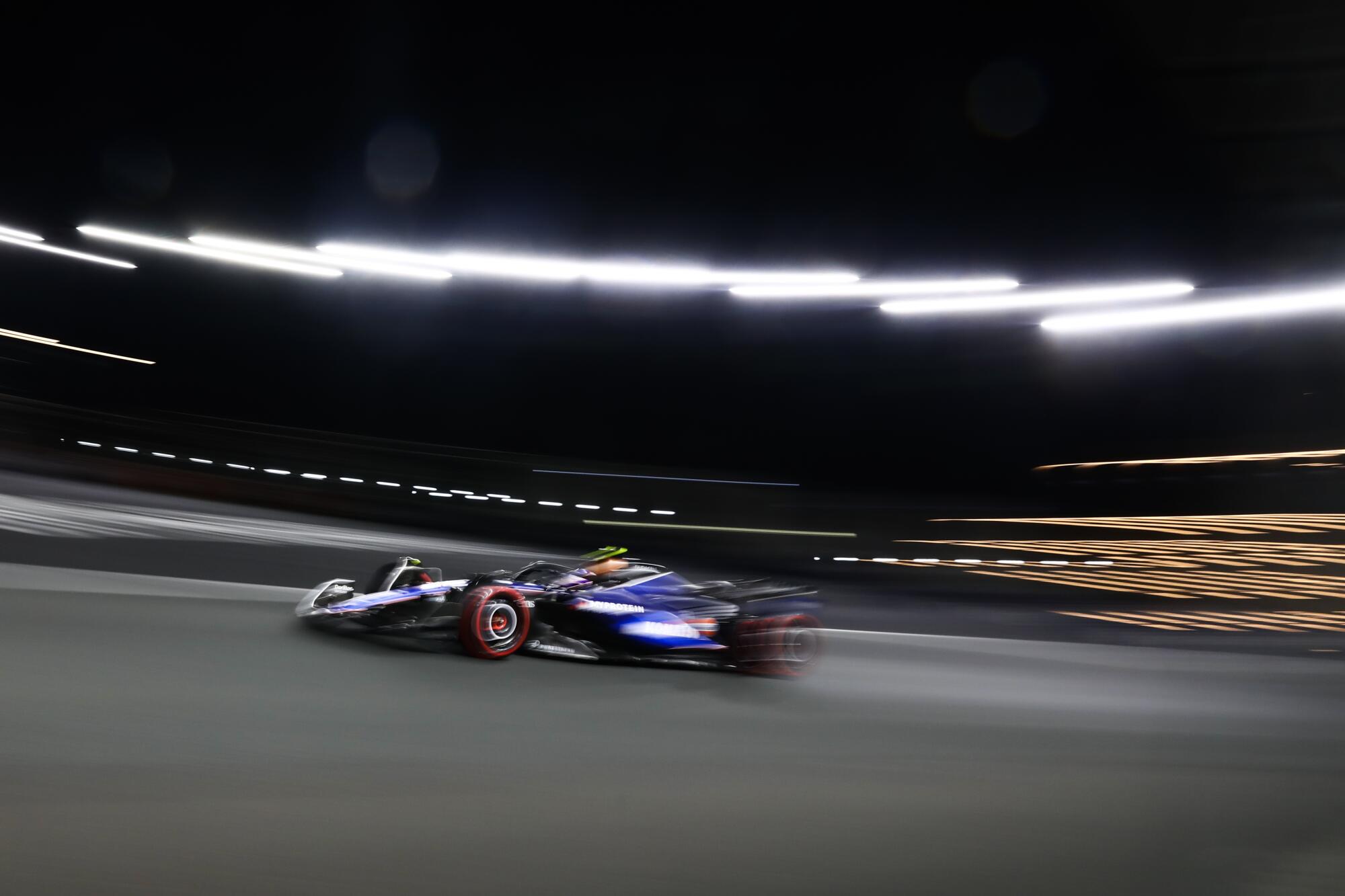
Logan Sargeant of the Williams team drivings qualifying for the Formula One race at Saudi Arabia’s Jeddah Corniche Circuit.
(NurPhoto / Getty Images)
Without serious sponsorship, drivers have little hope of sustaining a career, restricting the sport to what Mercedes driver and F1 superstar Lewis Hamilton (who comes from a working-class background) said in 2021 was a “billionaire’s boy’s club.” Even with that advantage, the odds of getting a seat in an F1 car are astronomical.
One afternoon this spring, visiting journalists were given a tour of a new regulation karting circuit in Jeddah — the first of its kind in the country that could host internationally sanctioned events. The idea, according to Prince Khaled bin Sultan Al-Faisal, chairman of the Saudi Automobile and Motorcycle Federation, was to have many more such circuits across the country, with a focus on drawing children as young as 5.
“We’ve hosted events and championships, but we have to focus on the sport itself and serve its practitioners, and start with a young generation. A circuit like this is the first step,” he said, adding that he was expecting a 15- to 20-year-long timeline before a Saudi F1 driver appears on the grid.
Whitaker, standing nearby, said it wasn’t just about finding drivers of the future.
“It’s engineers, technicians, placing kids with internships with other teams, talking to international teams to base themselves here,” he said.
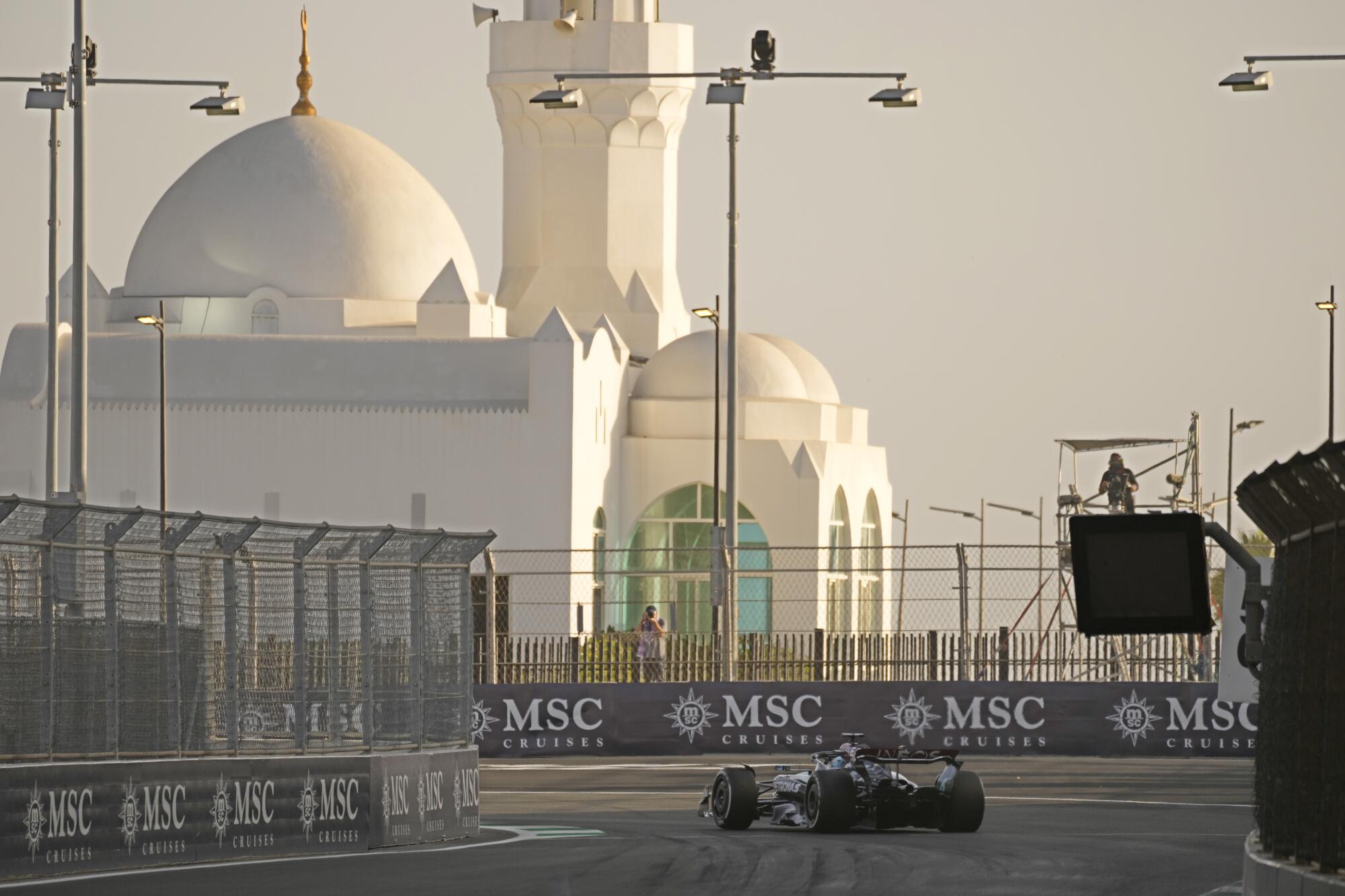
Mercedes driver George Russell drives in a practice sesson at the Jeddah Corniche Circuit.
(Darko Bandic / Associated Press)
“It’s developing career paths for young people.”
That puts the endeavor in line with Vision 2030, Crown Prince Mohammad bin Salman’s all-encompassing plan to diversify the oil-rich kingdom’s economy and change its reputation from strict religious realm to tourism and sports hot spot, all while providing jobs for young Saudis.
But first you have to get people interested in F1.
::
Soccer remains far and away the most popular sport in Saudi Arabia and throughout the region, but Liberty representatives have identified the Middle East as one of F1’s fastest-growing markets.
About a third of F1’s roughly 1.55 billion fans worldwide became interested in the sport in the last four years, according to Salesforce data. Meanwhile, analysts at the World Economic Forum predict sport industries in the Middle East to grow by 8.7% in 2026 — more than double the global average.
The region, meanwhile, has gone all-in with Formula One. Races in the Gulf bookend the season — Bahrain in the beginning, Abu Dhabi at the end. The Gulf region is home to four races, the second most after Europe’s nine.
At F1’s top administrative levels you find Emirati former rally driver Mohammed Ben Sulayem heading the Federation Internationale de l’Automobile, or FIA, the sport’s governing body. Bahrain’s Sheikh Abdullah bin Hamad bin Isa Al Khalifa serves as the FIA’s vice-president of sport for the Middle East and North Africa.
::
Almost anyone who attends an F1 race, if they’re honest, will tell you it’s easier to understand what’s happening if you watch it on TV. But it’s not just about who’s leading the field.
In Jeddah, the rich and connected watch the race from the premium lounge, with a commanding view of the track and “grazing tables” loaded with precision-prepared pastries and concoctions such as caviar cheesecake. Extra perks include traversing the pit lane as the teams prepare or paddock access, all the way up to meet-and-greets with F1 ambassadors. The price tag on that sort of package? $13,999.
In the cheap seats — which at a cost of at least $200 for a three-day pass are hardly cheap and allow only the occasional glance at the cars as they scream by — the fans didn’t seem to miss the caviar cheesecake.
Before the Jeddah race, a DJ bounced among fans, riling up the crowd with impromptu quizzes or throwing F1 merch, and some of the drivers passed by and signed shirts. Above, the Saudi Falcons, the country’s jet aerobatics team, roared back and forth over the circuit.
Even in the stands farther from the track the sound of an F1 car is a multisensory affair: speed takes on physical proportions, the engine roar passes through your body.
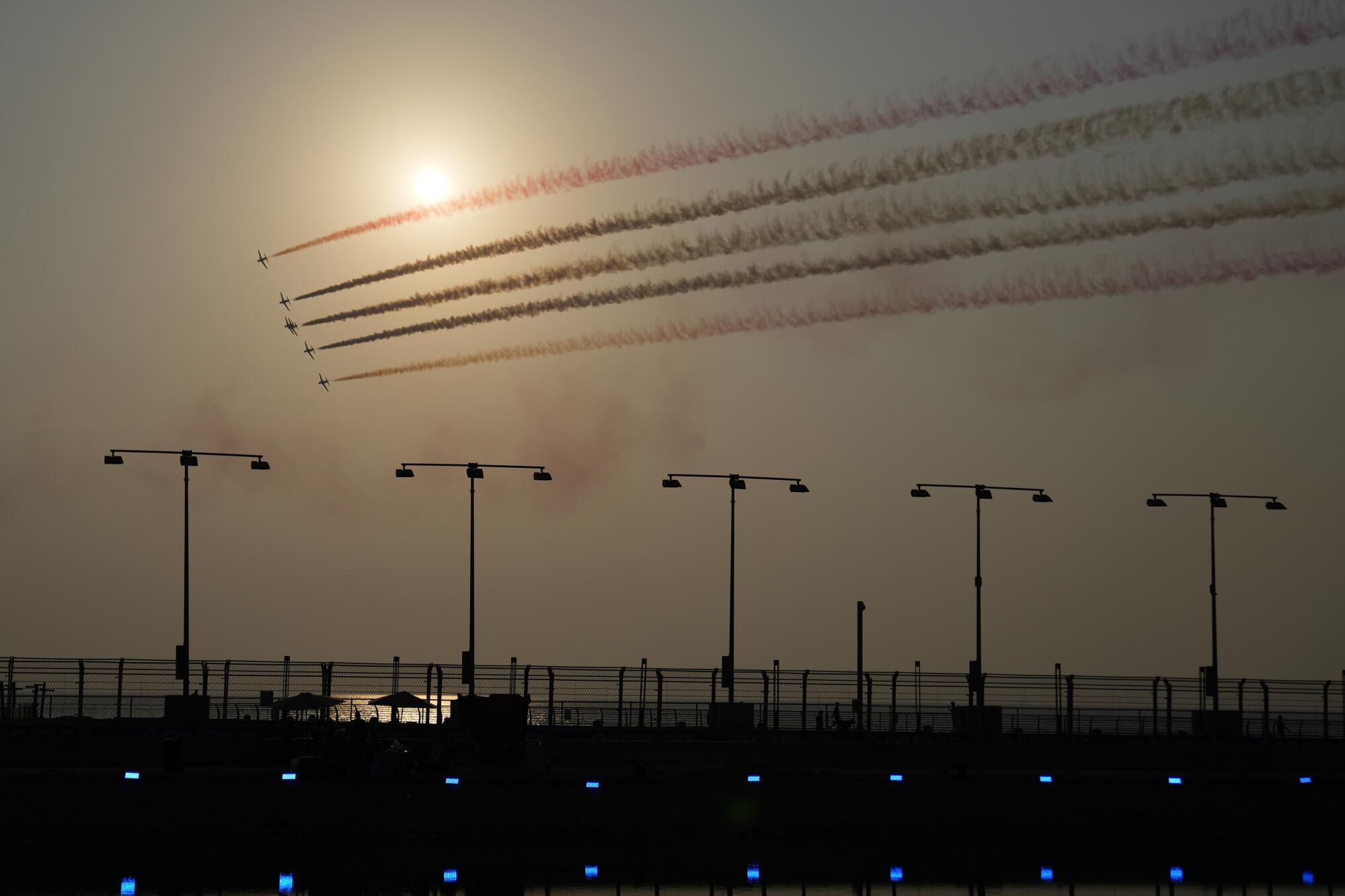
The Saudi Hawks aerobatic team performs over the racetrack in Jeddah, Saudi Arabia.
(Hassan Ammar / Associated Press)
“My friends and I are really into it. In my community, at least, there are a lot of F1 fans,” said Sireen Fataani, a 16-year-old wearing a Ferrari jacket. Beside her was Ibaa Qattan, also 16, and her sister, Shumookh Qattan, 22.
The three were walking around the pit lane after one of the non-F1 races at the track that weekend, gazing at the cars and hoping to catch a glimpse of some of their favorite drivers — McLaren’s Oscar Piastri for Sireen, Mercedes’ George Russell for Ibaa, and McLaren’s Lando Norris for Shumookh.
“I wanted something to be obsessed about one summer, and for me it was F1,” Ibaa said.
She insisted she didn’t get into it because of “Drive to Survive.” “Too much drama,” she said dismissively.
Both of the teens were enrolled in “F1 in Schools,” an Aramco-sponsored program that has students establishing and managing their own racing team as part of STEM and other lessons. Ibaa had taken on the role of head engineer for her team, while Sireen was doing marketing.
“Ours is called Fennec,” she said. “It’s a desert fox that lives in Saudi Arabia.”
: :
Not everyone is convinced that the region’s plans to build up its racing bonafides are a good thing.
There have been grumblings over how the infusion of Gulf money has changed F1. Hosting a race is prestigious and a calling card for countries, but the high fees — Saudi Arabia pays an estimated $55 million for the honor — mean storied tracks in Europe (where the most die-hard fans reside) have to compete in ways they didn’t before, and without the coffers of a petrostate backing them up.
Aside from the fees, tracks such as Belgium’s Spa have been forced into upgrades and expensive face-lifts or risk being dropped from the F1 calendar.
Corruption charges have also been leveled at the FIA’s leadership under Ben Sulayem. He was accused in March of trying to block the Las Vegas circuit from being certified ahead of last year’s Grand Prix. That followed a previous accusation that he had interfered in the 2023 Saudi Arabia Grand Prix in favor of Aston Martin. The FIA’s ethics committee cleared him of both charges.
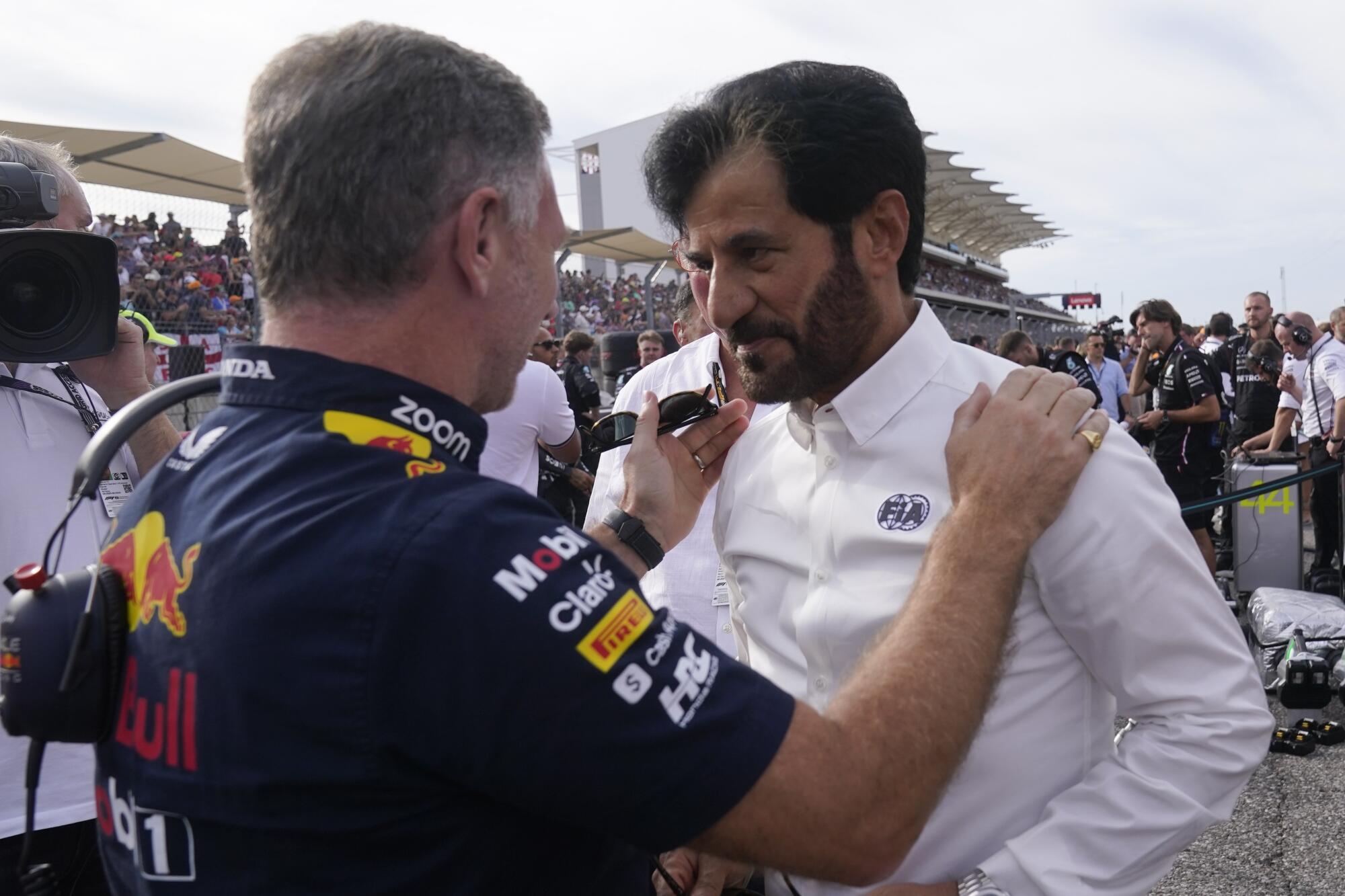
Christian Horner, left, team principal of the Red Bull Formula One team, talks with FIA President Mohammed Ben Sulayem before a 2023 race in Austin, Texas.
(Darron Cummings / Associated Press)
And then there are the accusations of sportswashing, as wealthy nondemocratic countries try to lure more sporting events to the Gulf.
During the last soccer World Cup, host Qatar, which had already bought the French team Paris Saint-Germain, was accused of trying to launder its repressive reputation. The monarchy’s human rights record and labor rights nevertheless edged into the spotlight.
Saudi Arabia’s efforts in soccer, Formula One and golf, among other sports, have kicked up similar criticism as Saudi money has continued to flow.
“The leaders of these autocratic nations strategically utilize sports, leveraging major events such as Formula One to operate beyond the conventional political stage,” said Stanis Elsborg, a Danish researcher with Play the Game, an initiative to promote democracy and transparency in international sports.
“While immediate changes may be subtle, the long-term ownership by an autocratic state poses substantial threats to the sport’s integrity and introduces conflicts of interest.”
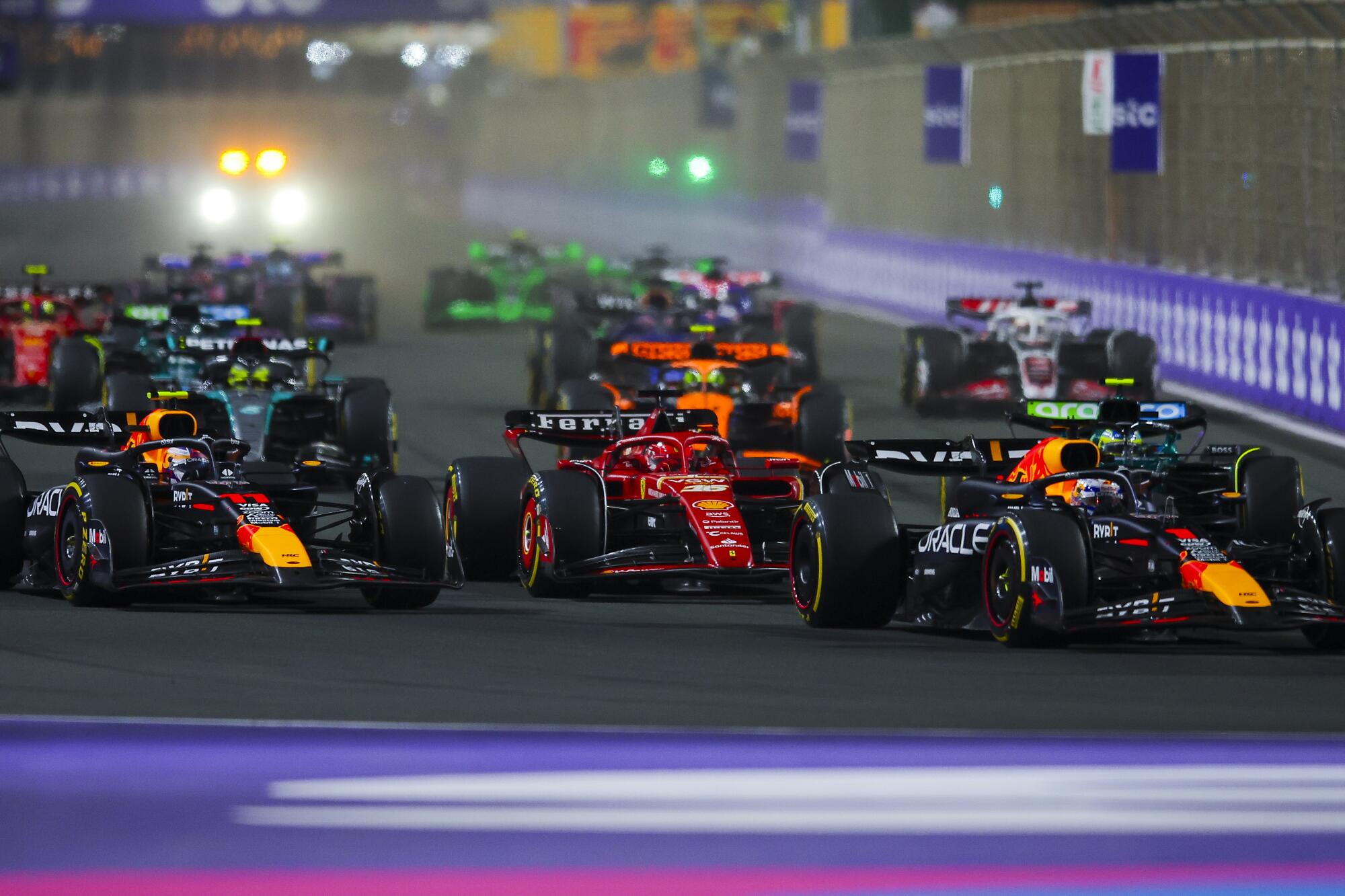
Max Verstappen, in the Oracle Red Bull Racing RB20 at right, leads the field at the start during the Formula One Grand Prix of Saudi Arabia on March 9.
(Eric Alonso / Getty Images)
Others allege that Saudi Arabia is leveraging its influence on F1 officials to have them lobby governments to weaken legislation that curbs usage of internal combustion engines and fossil fuels.
“If your goal is to diversify into other industries, it’s a little inconsistent that your sponsorship is all about the oil business,” said Frank Huisingh, founder of Fossil Free Football, a campaign organization that aims to remove high-polluting companies from soccer sponsorship.
“They need to work on their image to keep selling a product that is becoming very unpopular but also because they’re a country with a bad reputation for both human rights and climate reasons.”
In an interview with Fox News in September, Bin Salman dismissed such accusations, insisting his main concerns are domestic growth.
“If sportswashing is going to increase my GDP by way of 1%, then I will continue doing sportswashing,” he said.
“I don’t care… I’m aiming for another one-and-a-half percent. Call it whatever you want, we’re going to get that one-and-a-half percent.”
In that same interview, Bin Salman expressed shame at the country’s repressive laws, but said that dozens of laws had been amended and that he was “trying to prioritize the change day by day,”
“Do we have bad laws? Yes. Are we changing that? Yes,” he said.
F1 portrays its involvement in Saudi Arabia and the Gulf in general as a driver for that change. During the race weekend, F1 Academy, an all-women’s race series and training program run by Scottish former racing driver Susie Wolff, had its season opener in Jeddah. Wolff called the event “iconic.”
“I think to open here in a country where just six years ago women couldn’t drive really shows incredible progress,” she said at a panel on sports’ role in Saudi Arabia.
“Sometimes in life, you have to see it to believe it. And we are out there to show that this sport wants to provide opportunity to women and wants to make the sport more diverse in the long term.”
Drivers were also encouraging.
“We are not going to change the world at the end of the day as a sport, but we try to share positive values. And then, of course, it’s also up to the country to make positive changes,” Max Verstappen said at a post-race news conference. The Belgian-Dutch Red Bull driver added that he had already seen change in the kingdom and that it was a “work in progress.”
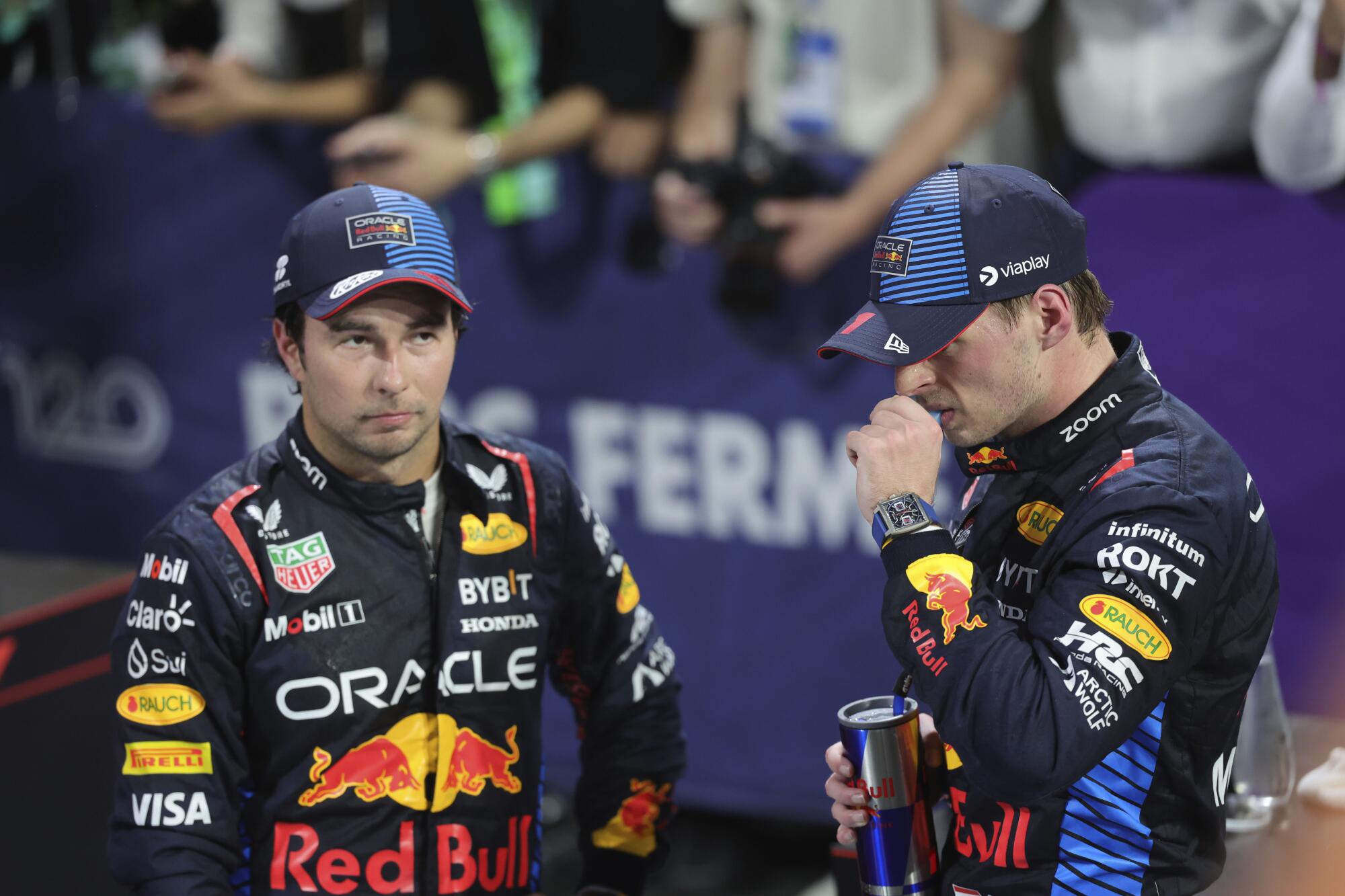
Red Bull driver Sergio Pérez of Mexico, left, came in second to Belgian-Dutch teammate Max Verstappen at the Formula One Saudi Arabian Grand Prix.
(Giuseppe Cacace / Associated Press)
Ferrari driver Charles Leclerc, who is from Monaco, said F1 needed to go to different countries “in order to hopefully open minds.” Red Bull driver Sergio Pérez said it was important to expand beyond its traditional areas.
“I feel like in the past, Formula One was very centralized in Europe, not just with drivers, but also the people working in the paddock,” said Pérez, who is from Mexico, adding that now there were more nationalities at different levels of the sport.
::
Some in the Gulf are already on the yearslong journey to score a place on the F1 grid.
Sisters Amna, 24, and Hamda Al Qubaisi, 21, started karting in their home country of the United Arab Emirates as children with their father’s encouragement and are now part of F1 Academy. In 2021, Hamda became the first woman to win a podium finish in the history of the Italian F4 series.
When they started competing in races, they’d hear grumblings and anger from the Gulf region.
“In the beginning people were very unsupportive. They didn’t like the fact there was a girl competing in a male-dominated sport. We’d hear ‘Women belong in the kitchen. Women aren’t supposed to be playing a sport, they should focus on studies or something else,’” Amna Al Qubaisi said.
Now “everything switched, and people are happy and supportive of what we’re doing,” she added.
Their racing careers have encouraged other women and girls, Hamda Al Qubaisi said. “They tell their father ‘Amna and Hamda are racing,’ and then he says ‘Why not?’”
“Every time we go back to visit our karting team, we’re seeing it grow more and more with girls from the Middle East, which makes it even more special.”
When Saudi Arabia’s first female racer, Reema Juffali, 32, got her first regular driver’s license while studying in the U.S. in 2010, women in the kingdom weren’t allowed behind the wheel.
Seven years later, King Salman, Bin Salman’s father, issued a decree overturning the ban on women driving. That same year, Juffali — then working a finance job in the U.K. — got her racing license, the first Saudi woman to do so. She made her professional debut at the TRD 86 Cup in Abu Dhabi in 2018 — the same year the kingdom began issuing driver licenses to women.
Nearly six years later, Juffali sped through the turns in front of a home city crowd in the first F1 Academy race in Jeddah, also a significant and emotional milestone for her.
“I’ve been wanting to be able to share what I do with my friends, family, fans, people who have never really been able to come to my races,” she said.
But while there is progress on the track and some restrictions against women have been eased to much fanfare, women in Saudi Arabia are far from enjoying equal rights. Under the patriarchal government, women need a male guardian’s approval to get married or divorced. They are required by personal status laws to obey their husbands, and the law places fathers as the default guardians for children, among other limitations on women.
And though women are now able to drive, one activist who campaigned to overturn the driving ban is still caught up in Bin Salman’s crackdown on dissent.
Loujain al-Hathloul, who was imprisoned from 2018 until 2021, remains barred from leaving Saudi Arabia. Manahel al-Otaibi, 29, another women’s rights activist who had spoken in favor of Bin Salman’s reforms but called for more change to the male guardianship laws, was sentenced in January to 11 years for what the government labeled “terror offenses.”
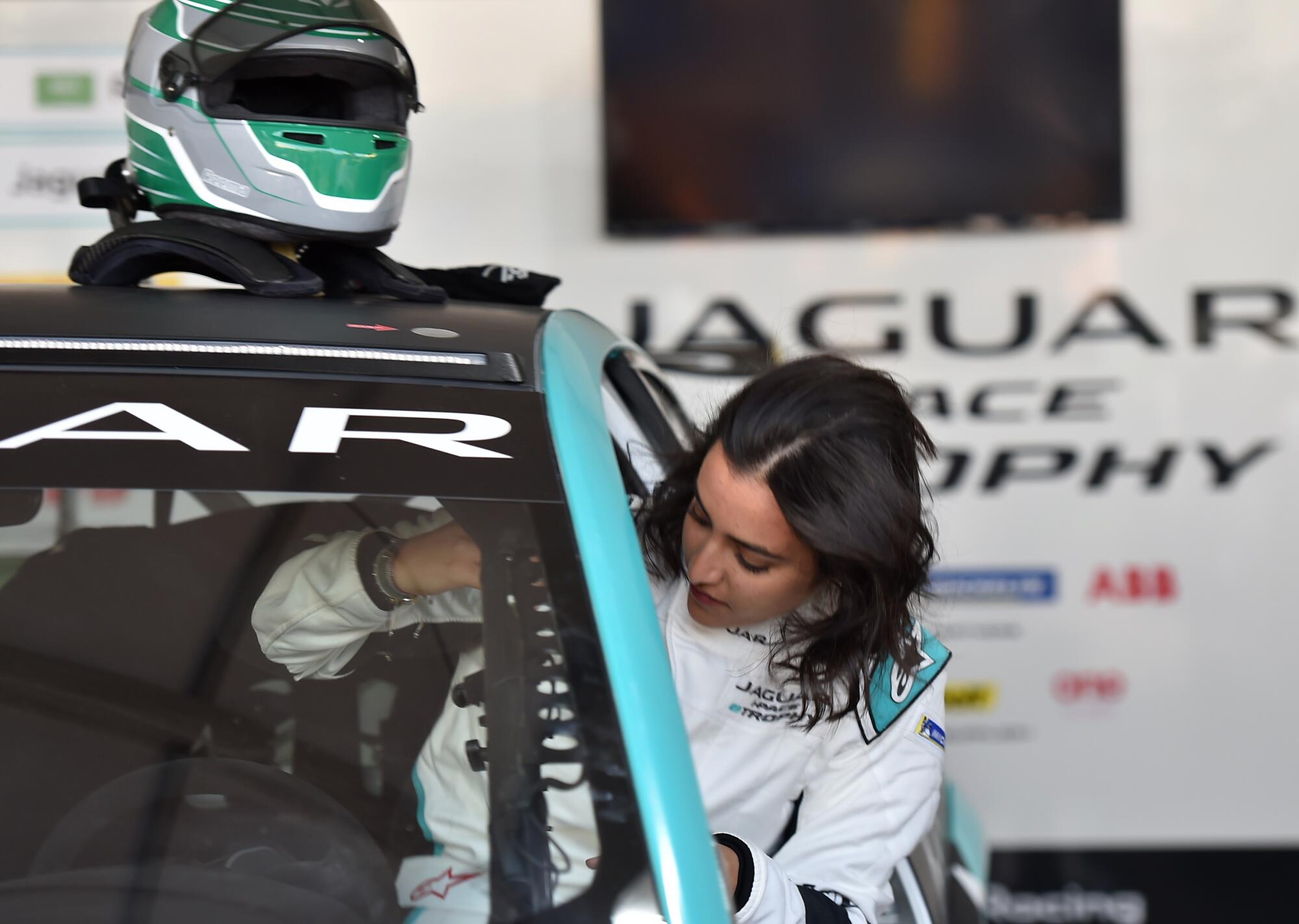
Saudi Arabia’s first female race driver, Reema Juffali, climbs into her car ahead of a race in Riyadh, Saudi Arabia, in 2019.
(Fayez Nureldine / Getty Images)
Though Juffali acknowledges the criticism of her country, she says people need to come to Saudi Arabia and see the changes happening themselves.
“We’re not just advancing on sports, which speaks to me personally, but also to see young people who are so much more ambitious, so much more hungry and happy — I feel that when I’m here,” she said.
Juffali aims to boost Saudi participation in racing through the team she founded, Theeba Motorsport, named for her childhood nickname, which roughly translates as “she-wolf.” She hopes Theeba will become the first Saudi team to compete in the 24 Hours of Le Mans.
“The aim is to one day be a Saudi team — not just drivers, but mechanics, engineers, for all facets of the team be Saudi,” Juffali said.
“These events we have, they’re for Saudis as well. This is serving a bigger purpose than anyone realizes.”



NEWYou can now listen to Fox News articles!
Minnesota filed a federal lawsuit Monday against the Trump administration, accusing federal health officials of illegally withholding $243 million in Medicaid payments from the state.
Attorney General Keith Ellison and the Minnesota Department of Human Services sued the Centers for Medicare and Medicaid Services (CMS) and the U.S. Department of Health and Human Services (HHS), arguing the funding freeze violates federal law.
The state is seeking a temporary restraining order to immediately block the action.
The dispute stems from a January notice in which the Trump administration said it would withhold more than $2 billion annually from Minnesota’s Medicaid program over what it described as “noncompliance” with federal regulations, specifically, alleged failures to “adequately identify, prevent, and address fraud in its Medicaid program.”
Minnesota Attorney General Keith Ellison speaks during a Senate Homeland Security Committee hearing on Capitol Hill. (Tom Brenner/AP)
State officials say they have not been told specifically how Minnesota is out of compliance or what changes the administration wants to see.
The lawsuit follows a Feb. 25 announcement from CMS that it was deferring roughly $260 million in quarterly federal Medicaid funding to Minnesota, including about $243 million tied to “unsupported or potentially fraudulent” claims.
CMS said the deferral is part of a broader fraud crackdown and cited unusually high spending and rapid growth in personal care services, home- and community-based services, and other practitioner services.
HEAVILY-REDACTED AUDIT FINDS MINNESOTA MEDICAID HAD WIDESPREAD VULNERABILITIES
Vice President JD Vance looks on as Medicare and Medicaid Administrator Mehmet Oz speaks about combating fraud at the White House complex in Washington, D.C., on Feb. 25, 2026. (Oliver Contreras/AFP via Getty Images)
“For decades, Medicare fraud has drained billions from American taxpayers — that ends now,” HHS Secretary Robert F. Kennedy Jr. said in a statement. “We are replacing the old ‘pay and chase’ model with a real-time ‘detect and deploy’ strategy, using advanced AI tools to identify fraud instantly and stop improper payments before they go out the door.”
Minnesota officials contend the move improperly uses a funding “deferral” mechanism and amounts to denying the state due process before any formal finding of noncompliance.
WALZ SLAMS TRUMP ADMIN FOR TEMPORARILY HALTING MEDICAID FUNDING TO MINNESOTA: ‘CAMPAIGN OF RETRIBUTION’
CLICK HERE TO DOWNLOAD THE FOX NEWS APP
The threatened cuts represent about 7% of Minnesota’s quarterly Medicaid funding and could force reductions in health care services for low-income residents, according to Ellison’s office.
“Trump’s M.O. is to cut first, no matter what the law says or who gets hurt, and ask questions later, if at all,” the attorney general said. “These cuts are the latest in a long series of efforts to go around the law to punish Minnesotans — but just as we fought back and won when they illegally tried to cut funding for childcare, hungry families, and our schools, we are suing them again today to make them follow the law.”
Related Article

Politics
Fearing GOP win, California’s Democratic leader urges unviable party candidates for governor to drop out

Fearing the prospect of a Republican winning California’s gubernatorial race, state Democratic Party Chair Rusty Hicks on Tuesday urged his party’s candidates who lack a viable path to victory to drop out.
“It is imperative that every candidate honestly assess the viability of their candidacy and campaign,” Hicks wrote in an open letter to the politicians vying to replace termed-out Gov. Gavin Newsom. “I recognize my suggestions are hard for many to contemplate and may be even viewed as overly harsh by some.”
Hicks did not name the Democrats he wants out of the race, but such a public admonishment by a party leader is a rarity in California politics.
Even though the odds are relatively low, California cannot risk having a Republican elected as the next governor at a time when President Trump is in the White House, Hicks said.
“[S]o much is at stake in our Nation and so many are counting on the leadership of California Democrats to stand up and speak out at this historic moment,” Hicks wrote. “California’s leadership on the world stage is significantly harder if a Democrat is not elected as our next Governor.”
Hicks urged Democrats languishing at the bottom of the field of candidates to drop out before the Friday deadline to officially file to run for governor — to ensure their names do not appear on the June primary ballot.
Under California’s top-two primary system, the two candidates who receive the most votes in the June primary advance to the November general election, regardless of party.
With nine top Democrats running, the fear is that the candidates will splinter their party’s vote and allow the top two Republicans in the race to finish in first and second place. This is despite Democratic registered voters outnumbering Republicans in the state by almost 2 to 1, and no GOP candidate winning a statewide election since 2006.
Having two Republicans competing in the November election would be devastating to Democratic voter turnout and could hurt party candidates in pivotal down-ballot races.
“The result would present a real risk to winning the congressional seats required and imperil Democrats’ chances to retake the House, cut Donald Trump’s term in half, and spare our Nation from the pain many have endured since January 2025,” Hicks said in his letter. “We simply can’t let that happen.”
A recent poll by the Public Policy Institute of California found that five candidates lead the contest — former Rep. Katie Porter, Rep. Eric Swalwell and hedge fund founder Tom Steyer among Democrats and conservative commentator Steve Hilton and Riverside County Sheriff Chad Bianco, both Republicans. Hilton and Bianco have led all candidates in other polls over the last few months. No other candidate received the support of more than 5% of likely voters.
After Hicks issued his directive, two influential leaders in California Democratic politics said they shared his concerns.
Lorena Gonzalez, the head of the California Federation of Labor Unions, said she worries that Democratic candidates who are drawing low single-digit support in the polls and remain in the race could tilt the election.
“You’re in a situation where a candidate who pulls 2 or 3% could make all the difference whether there’s two Republicans and anti-union folks in the runoff or if there’s not,” she said.
Gonzalez said that while she believes the legislature, where Democrats hold super majorities in both chambers, would be a check if a Republican was elected the state’s leader, that might not be enough protect Californians from Trump’s destructive policies.
“We are seeing with Trump how much damage an executive who wants to ignore normal rules of engagement or the Constitution can do,” she said. “We can’t afford that.”
The federation began its endorsement process last week, and there were difficult conversations with gubernatorial candidates not only about their political beliefs, but also about their viability. The umbrella group of unions is expected to make an announcement about any potential endorsement on March 16.
Jodi Hicks, CEO and president of Planned Parenthood Affiliates of California, said it was imperative to block the “real possibility” of two Republicans advancing to the general election because of the deep cuts that the Trump administration has made to health care, including access to abortion.
“Given the severity of this moment, we urge candidates to consider how continuing their candidacy may put California’s values and reproductive freedom at risk,” Jodi Hicks said. “The stakes are too high for all of us, but especially for immigrant communities, transgender individuals, the over 15 million patients enrolled in Medi-Cal, and the over 25,000 patients a week who access essential health care at Planned Parenthood health centers.”
Discussions about the need for some Democrats to exit the race took place at last weekend’s California Democratic Party convention.
But a politically thorny issue is that nearly all of the Democrats lagging in the polls are people of color, as former U.S. Health and Human Services Secretary Xavier Becerra noted at a candidate forum Monday evening.
“There are people who are calling for candidates to get out of the race,” he said at the gathering hosted by Equality California and the Los Angeles LGBT Center at the Renberg Theatre in Hollywood. “Isn’t it interesting that the candidates they are asking get out of the race are the candidates of color?”
Rusty Hicks, asked about the effect on minority candidates who have spent years or decades of their lives in public service, did not directly answer the question but lauded the field’s accomplishments.
“We have a number of strong candidates. They have incredible stories, and they are reflective of the diversity of our party. That being said, there are some political realities of where we are at at this particular moment,” he said in an interview. “I’m not calling on any specific candidates to move in one direction or the other. I’m just calling on them to assess their campaign and determine if they have a viable [path] and if they don’t, to not file.”
During Monday evening’s gubernatorial forum, Porter said she is concerned about the prospect of two Republicans making the top two.
“I hear people say to me, it could never happen, but everybody said that about Trump too,” she said at the forum. “And I look at how much harm we’re suffering, and I think about all the political risks that people are facing every day, the risk of an immigrant to leave their home and walk on our streets, the risk of a kid who’s trans to try to play sports even in this state. And I just don’t think we can take any more political risks.”
Times staff writer Phil Willon contributed to this report.

Since moving back in, President Trump has significantly altered the “People’s House.” East Wing: gone. Oval Office: maximalized. Rose Garden: Mar-a-lago-ified. And the art? Lots of Trump.
Over the last year, The New York Times has captured at least nine paintings, posters, memes, and even a mugshot outside the Oval Office, that Mr. Trump added throughout the historic space.
Many of the selections are gifts from his supporters that highlight his political stature and reinforce the idea that Mr. Trump is invincible.
All presidents or first ladies add to and shuffle the art in the White House.
Barack Obama brought in abstract paintings.
George W. Bush decorated with images from his Texas roots.
In Mr. Trump’s first term, Melania Trump added a sculpture by Isamu Noguchi to the Rose Garden.
But never before has a sitting president displayed so much of his own image on the White House walls.
There is an “assertion of symbolic power that he wants to be on view essentially everywhere in that space,” said Cara Finnegan, a communication professor at the University of Illinois and author of “Photographic Presidents: Making History from Daguerreotype to Digital.”
Even outside his current residence, Mr. Trump’s visage has proliferated in unexpected places — on banners hanging from government buildings, on National Parks passes and on social media, where he has been likened to a king. There has also been talk of a U.S. Treasury-minted coin with Mr. Trump on both sides.
Break with tradition
In recent decades, each president’s official White House portrait has been unveiled in a ceremony hosted by his successor.
The Carters hosted the Fords:
The Clintons hosted the Bushes:
And the Bushes hosted the Clintons:
The mood has often been lighthearted, with political party tensions melting away.
“I am pleased that my portrait brings an interesting symmetry to the White House collection,” George W. Bush joked in a ceremony hosted by the Obamas. “It now starts and ends with a George W.”
In a break with tradition, Mr. Trump did not schedule a ceremony for the unveiling of the Obamas’ portraits during his first term. Joe Biden later did, in a ceremony with a “Welcome Home!” vibe.
Typically, the latest available presidential portrait — often a realistic oil painting — hangs in the main entrance hall, where heads of state are welcomed.
The Obama portrait was in the spot until April …
… when Mr. Trump replaced it with this painting by Marc Lipp, a Florida pop artist, last April.
It depicts a striking moment in 2024 when a bloodied Mr. Trump pumped his fist in defiance, soon after being shot at by a would-be assassin during a campaign event.
Presidential historians have criticized the departure from convention.
Though Mr. Trump had a portrait commissioned for the Smithsonian’s American Presidents collection after his first term, none was confirmed for the permanent White House collection, and the White House said that this is where that portrait would have hung.
It is not totally unprecedented for a president to hang a painting of himself in the White House during his term. Theodore Roosevelt, William Howard Taft and Grover Cleveland all did, according to the White House Historical Association. But more often than not, paintings of presidents and first ladies are hung after they have left office, historians said.
Flags, fists and faith from fans
In what has become something of a muse for many of the president’s artistic supporters, there are at least three other depictions of the fist-pumping scene in the White House.
The image “is in people’s garages when I walk around my neighborhood,” said Leslie Hahner, a Texas resident and communication professor at Baylor University, who studies visual political culture. “People love that image.”
Behind the Oval Office, one is in a small room that houses Trump merchandise:
Another was seen in the West Wing next to a “Still Life with Fruit” painting from 1850:
A statue form was spotted in the Oval Office:
The sculptor, Stan Watts, told a Utah TV station last year that he believes the president was saved by God that day. Many of Mr. Trump’s Christian supporters have echoed that sentiment.
At least two works by a self-described “Christian worship artist,” Vanessa Horabuena, are among Mr. Trump’s White House collection. He has called Ms. Horabuena, who often paints live in front of an audience, “one of the greatest artists anywhere in the world.”
In 2022, she painted a portrait of Mr. Trump at a booth at the Conservative Political Action Conference. When he saw it, he asked to meet her, Ms. Horabuena’s representative said. She most recently painted Mr. Trump live at a New Year’s Eve party at Mar-A-Lago.
One of her portraits was spotted in the Cabinet room in January.
It shows Mr. Trump, his eyes closed, in front of a mountain with a small cross on the top:
Ms. Horabuena hand-delivered it to the White House, according to her website.
Her other painting shows the president walking through a phalanx of flags. It was seen hanging prominently in a hallway leading to the Cabinet Room and the Oval Office:
“He’s positioned as this embattled warrior in a lot of these images,” Dr. Hahner said.
Historical figures Mr. Trump adulates are co-stars in some of the art he has chosen.
In an image created by the team of White House trade adviser Peter Navarro, Mr. Trump is pictured with William McKinley and Henry Clay, who, like the president, championed the use of tariffs:
Here, Mr. Trump is with two other Republican presidents, Abraham Lincoln (to whom he has compared himself) and Ronald Reagan (whom he is a fan of):
Titled “Great American Patriots,” the piece was painted by Dick Bobnick, an illustrator and Trump supporter from Minnesota. He said he mailed several prints to 1600 Pennsylvania Avenue, but he had no idea his work was on the White House walls until a USA Today reporter called him about it.
“I could hardly believe it,” said Mr. Bobnick. (He said the print is now his best-seller.)
If not in portraits, Mr. Trump’s image is reflected on mirrors that he has added to the White House complex.
Two are in the Oval Office …
… making his image visible from the Resolute Desk.
The mirrors, the portraits and the gilding mimic the look of his properties, like Mar-a-Lago, his Florida estate.
“Trump is obsessed with his image,” Dr. Hahner said. “And he is so controlling of his image.”
Trump everywhere, all the time
One portrait seen in the White House has become a communication tool between Mr. Trump and his supporters in the real world.
This is his social media profile picture.
It was seen last October hanging between former first ladies Laura Bush and Barbara Bush in the now-demolished East Wing:
The portrait was painted by Lena Ruseva, an immigrant from the former Soviet Union, who goes by the name MAGALANGELO. Mr. Trump invited her to his Bedminster golf club in 2022, and she gave it to him as a birthday gift.
“Every time social media or the news quotes the president and I see my artwork alongside it, I feel proud and grateful,” she said.
For a time, the same portrait hung next to Hillary Clinton, his political rival and a former first lady.
Supporters at that time lauded the placement on social media:
This example of a positive feedback loop demonstrates how Mr. Trump has used social media to redefine the presidency and presidential communication. Ms. Ruseva’s portrait was used on social media, hung up in the real world, then photographed and put back on social media by supporters who praised the president.
When Mr. Trump was elected to his first term in 2016, Dr. Hahner said that scholars referred to him as the first “meme president.”
Mr. Trump and his internet fans are used to a meme culture based on irony, and rehashing, repurposing and remixing existing images. The collection of White House artwork — much of it originating from his supporters — sits in an uncanny valley between realism and meme-ism, Dr. Hahner said.
Like memes that multiply, Mr. Trump’s image has been reproduced in other ways, outside the White House.
Last month, a huge banner with Mr. Trump’s face was draped outside the Justice Department headquarters …
Last year, similar signage was strung over the Labor Department building …
… and the Agriculture Department building (this one, alongside Lincoln).
At his request, Mr. Trump’s portrait was recently updated at the Smithsonian’s National Portrait Gallery:
Still, Mr. Trump wants more. The White House has suggested that the National Portrait Gallery add a separate section for Trump-related art.

Colorado weather: Up to 14 inches of snow forecast for mountains

Sleet, freezing rain leading to treacherous travel in parts of Connecticut

Attention Ag Insurance Agents: Subsidy issues subject of Monday, March 9 virtual Q&A with USDA Risk Management Agency – State of Delaware News

Man convicted of 1991 fatal shooting of a police officer is set to be executed in Florida

Gov. Kemp signs amended FY 2026 budget, delivering $2B in Georgia tax relief

Florida High School Football Rankings: Top 25 teams – Oct. 21

Cleary's 21 help Le Moyne down Central Connecticut State 69-64 in OT

How old is Bo Nix? What to know about Oregon quarterback ahead of 2024 NFL Draft

99th annual Pony Swim held in Virginia

Indiana Members Credit Union announced as new anchor tenant at Bottleworks District

Fraud-plagued Minnesota sues Trump admin for withholding $243M in Medicaid payments

Is Iran expanding attacks to target energy and civilian sites in the Gulf?

Trump claims US stockpiles mean wars can be fought ‘forever’; Kristi Noem testifies before Congress – US politics live

War in the Middle East: Iran’s broad retaliation in the Gulf • FRANCE 24 English

Trump sends official notification to Congress on strikes against Iran
-

 World6 days ago
Exclusive: DeepSeek withholds latest AI model from US chipmakers including Nvidia, sources say
-

 Massachusetts6 days ago
Mother and daughter injured in Taunton house explosion
-

 Denver, CO6 days ago
10 acres charred, 5 injured in Thornton grass fire, evacuation orders lifted
-

 Louisiana1 week ago
Wildfire near Gum Swamp Road in Livingston Parish now under control; more than 200 acres burned
-

 Oregon4 days ago
2026 OSAA Oregon Wrestling State Championship Results And Brackets – FloWrestling
-

 Florida3 days ago
Florida man rescued after being stuck in shoulder-deep mud for days
-

 Technology1 week ago
Arturia’s FX Collection 6 adds two new effects and a $99 intro version
-

 News1 week ago
Video: How Lunar New Year Traditions Take Root Across America