Politics
Trump, California and the multi-front war over the next election


In recent weeks, Marin County Registrar Natalie Adona has been largely focused on the many mundane tasks of local elections administrators in the months before a midterm: finalizing voting locations, ordering supplies, facilitating candidate filings.
But in the wake of unprecedented efforts by the Trump administration to intervene in state-run elections, Adona said she has also been preparing her staff for far less ordinary scenarios — such as federal officials showing up and demanding ballots, as they recently did in Georgia, or immigration agents staging around polling stations on election day, as some in President Trump’s orbit have suggested.
“Part of my job is making sure that the plans are developed and then tested and then socialized with the staff so if those situations were to ever come up, we would not be figuring it out right then and there. We would know what to do,” Adona said. “Doing those sort of exercises and that level of planning in a way is kind of grounding, and makes things feel less chaotic.”
Natalie Adona faced harassment from election deniers and COVID anti-maskers when she served as the registrar of voters in Nevada County. She now serves Marin County and is preparing her staff for potential scenarios this upcoming election, including what to do if immigration agents are present.
(Jess Lynn Goss / For The Times)
Across California, local elections administrators say they have been running similar exercises to prepare for once unthinkable threats — not from local rabble-rousers, remote cyberattackers or foreign adversaries, but their own federal government.
State officials, too, are writing new contingency plans for unprecedented intrusions by Trump and other administration officials, who in recent days have repeated baseless 2020 election conspiracies, raided and taken ballots from a local election center in Fulton County, Ga., pushed both litigation and legislation that would radically alter local voting rules, and called for Republicans to seize control of elections nationwide.
California’s local and state officials — many of whom are Democrats — are walking a fine line, telling their constituents that elections remain fair and safe, but also that Trump’s talk of federal intervention must be taken seriously.
Their concerns are vastly different than the concerns voiced by Trump and other Republicans, who for years have alleged without evidence that U.S. elections are compromised by widespread fraud involving noncitizen voters, including in California.
But they have nonetheless added to a long-simmering sense of fear and doubt among voters — who this year have the potential to radically alter the nation’s political trajectory by flipping control of Congress to Democrats.

An election worker moves ballots to be sorted at the Orange County Registrar of Voters in Santa Ana on Nov. 5, 2024.
(Allen J. Schaben / Los Angeles Times)
Trump has said he will accept Republican losses only if the elections are “honest.” A White House spokesperson said Trump is pushing for stricter rules for voting and voter registration because he “cares deeply about the safety and security of our elections.”
Rick Hasen, an election law expert and director of the Safeguarding Democracy Project at UCLA Law, said some of what Trump says about elections “is nonsensical and some is bluster,” but recent actions — especially the election center raid in Georgia — have brought home the reality of his threats.
“Some worry that this is a test run for trying to seize ballot boxes in 2026 and prevent a fair count of the votes, and given Trump’s track record, I don’t think that is something we can dismiss out of hand,” Hasen said. “States need to be making contingency plans to make sure that those kinds of things don’t happen.”
The White House dismissed such concerns, pointing to isolated incidents of noncitizens being charged with illegally voting, and to examples of duplicate registrations, voters remaining on rolls after death and people stealing ballots to vote multiple times.
“These so-called experts are ignoring the plentiful examples of noncitizens charged with voter fraud and of ineligible voters on voter rolls,” said Abigail Jackson, the White House spokesperson.
Experts said fraudulent votes are rare, most registration and roll issues do not translate into fraudulent votes being cast, and there is no evidence such issues swing elections.
A swirl of activity
Early in his term, Trump issued an executive order calling for voters nationwide to be required to show proof of U.S. citizenship, and for states to be required to disregard mail ballots received after election day. California and other states sued, and courts have so far blocked the order.
This past week, Trump said outright that Republicans should “take over” elections nationwide.
The Justice Department has sued California Secretary of State Shirley Weber and her counterparts in other states for refusing to hand over state voter rolls — the lawsuit against Weber was tossed — and raided and seized ballots from the election office of Fulton County, long a target of right-wing conspiracy theories over Trump’s 2020 election loss.
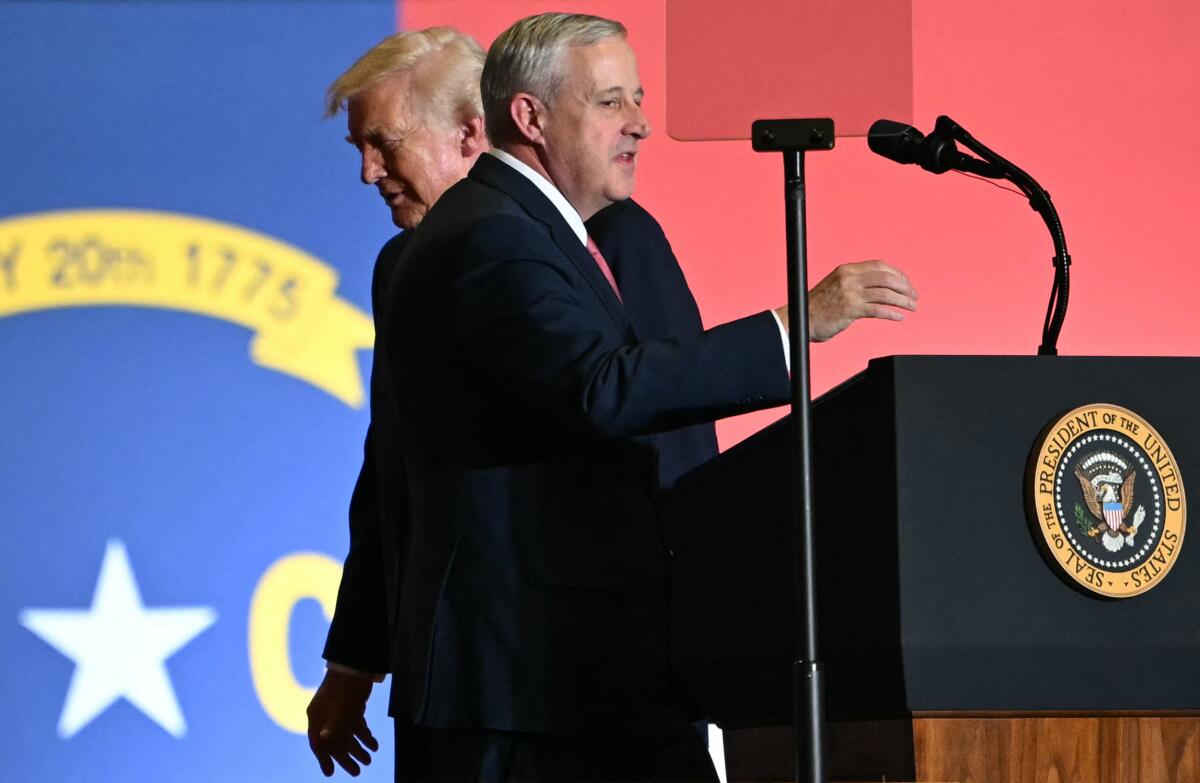
President Trump walks behind former chairperson of the Republican National Committee Michael Whatley as he prepares to speak during a political rally in Rocky Mount, N.C., on Dec. 19.
(Andrew Caballero-Reynolds / AFP via Getty Images)
Longtime Trump advisor and ally Stephen K. Bannon suggested U.S. Immigration and Customs Enforcement agents will be dispatched to polling locations in November, reprising old fears about voter intimidation. White House Press Secretary Karoline Leavitt said she couldn’t rule that out, despite it being illegal.
Democrats have raised concerns about the U.S. Postal Service mishandling mail ballots in the upcoming elections, following rule changes for how such mail is processed. Republicans have continued pushing the SAVE America Act, which would create new proof of citizenship requirements for voters. The U.S. Supreme Court is considering multiple voting rights cases, including one out of Louisiana that challenges Voting Rights Act protections for Black representation.
Charles H. Stewart, director of the MIT Election Data + Science Lab, said the series of events has created an “environment where chaos is being threatened,” and where “people who are concerned about the state of democracy are alarmed and very concerned,” and rightfully so.
But he said there are also “a number of guardrails” in place — what he called “the kind of mundane mechanics that are involved in running elections” — that will help prevent harm.
California prepares
California leaders have been vociferous in their defense of state elections, and said they’re prepared to fight any attempted takeover.
“The President regularly spews outright lies when it comes to elections in this country, particularly ones he and his party lose,” Gov. Gavin Newsom said in a statement. “We will continue to correct those lies, rebuild much-needed trust in our democratic institutions and civic duties, and defend the U.S. Constitution’s grant to the states authority over elections.”
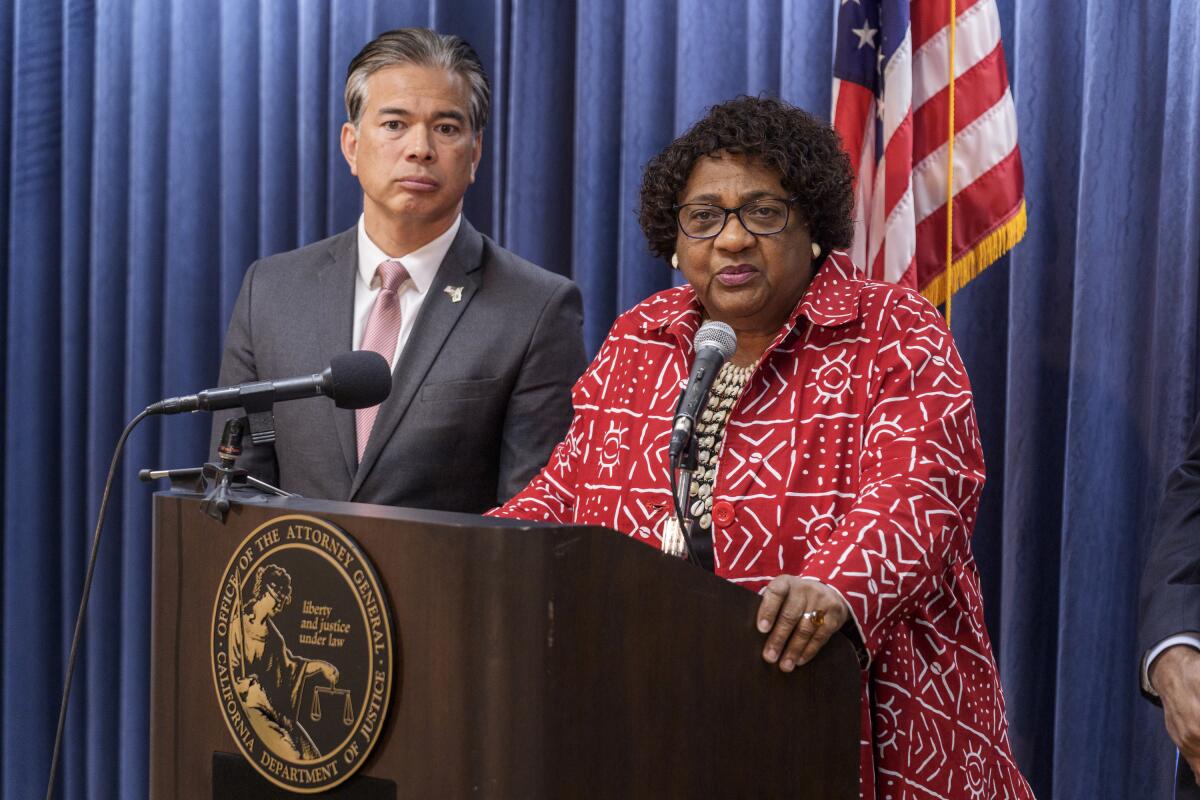
California Atty. Gen. Rob Bonta and Secretary of State Shirley Weber take questions after announcing a lawsuit to protect voter rights in 2024.
(Damian Dovarganes / Associated Press)
California Atty. Gen. Rob Bonta said in an interview that his office “would go into court and we would get a restraining order within hours” if the Trump administration tries to intervene in California elections, “because the U.S. Constitution says that states predominantly determine the time, place and manner of elections, not the president.”
Weber told The Times that the state has “a cadre of attorneys” standing by to defend its election system, but also “absolutely amazing” county elections officials who “take their job very seriously” and serve as the first line of defense against any disruptions, from the Trump administration or otherwise.
Dean Logan, Los Angeles County’s chief elections official, said his office has been doing “contingency planning and tabletop exercises” for traditional disruptions, such as wildfires and earthquakes, and novel ones, such as federal immigration agents massing near voting locations and last-minute policy changes by the U.S. Postal Service or the courts.
“Those are the things that keep us up at night,” he said.
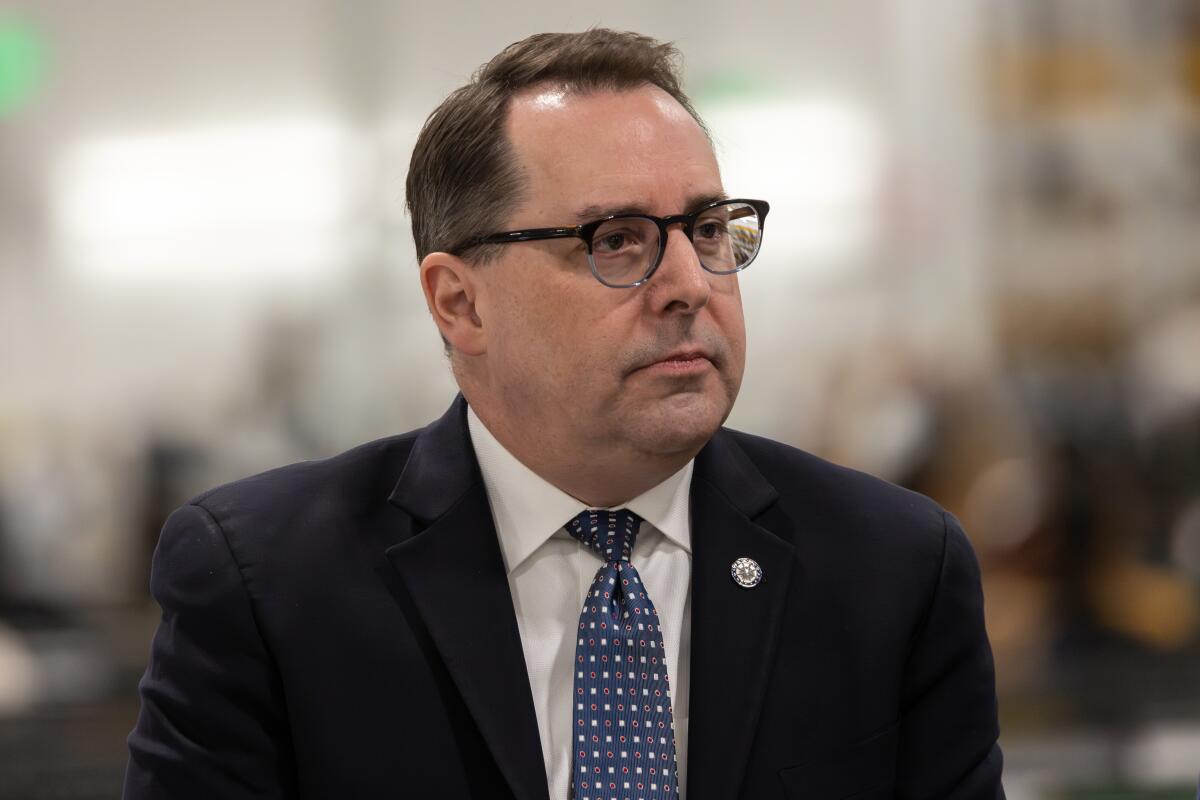
Los Angeles County Registrar-Recorder Dean Logan said the county no longer has ballots from the 2020 election.
(Irfan Khan / Los Angeles Times)
Logan said he is not currently concerned about the FBI raiding L.A. County elections offices because, while Fulton County still had its 2020 ballots on hand due to ongoing litigation, that is not the case for L.A. County, which is “beyond the retention period” for holding, and no longer has, its 2020 ballots.
However, Logan said he does consider what happened in Georgia a warning that the Trump administration “will utilize the federal government to go in and be disruptive in an elections operation.”
“What we don’t know is, would they do that during the conduct of an election, before an election is certified?” Logan said.
Kristin Connelly, chief elections officer for Contra Costa County, said she’s been working hard to make sure voters have confidence in the election process, including by giving speeches to concerned voters, expanding the county’s certified election observer program, and, in the lead-up to the 2024 election, running a grant-funded awareness campaign around election security.
Connelly — who joined local elections officials nationwide in challenging Trump’s executive order on elections in court — said she also has been running tabletop exercises and coordinating with local law enforcement, all with the goal of ensuring her constituents can vote.
“How the federal government is behaving is different from how it used to behave, but at the end of the day, what we have to do is run a mistake-free, perfect election, and to open our offices and operation to everybody — especially the people who ask hard questions,” she said.
Lessons from the past
Several officials in California said that as they prepare, they have been buoyed by lessons from the past.
Before being hired by the deep-blue county of Marin in May, Adona was the elected voting chief in rural Nevada County in the Sierra foothills.
In 2022, Adona affirmed that Trump’s 2020 election loss to Democrat Joe Biden was legitimate and enforced a pandemic mask mandate in her office. That enraged a coalition of anti-mask, anti-vaccine, pro-Trump protesters, who pushed their way into the locked election office.
Protesters confronted Adona and her staffers, with one worker getting pushed down. They stationed themselves in the hallway, leaving Adona’s staff too terrified to leave their office to use the hallway bathroom, as local, state and federal authorities declined to step in.
“At this point, and for months afterwards, I felt isolated and depressed. I had panic attacks every few days. I felt that no one had our back. I focused all my attention on my staff’s safety, because they were clearly nervous about the unknown,” Adona said during subsequent testimony before the Senate Judiciary Committee.
In part because she knows what can go wrong, Adona said her focus now is on preparing her new staff for whatever may come, while following the news out of Georgia and trying to maintain a cool head.
“I would rather have a plan and not use it than need a plan and not have one,” she said.
Clint Curtis, the clerk and registrar of voters in Shasta County — which ditched its voting machines in 2023 amid unfounded fraud allegations by Trump — said his biggest task ahead of the midterms is to increase both ballot security and transparency.
Since being appointed to lead the county office last spring, the conservative Republican from Florida has added more cameras and more space for election observers — which, during the recent special election on Proposition 50, California’s redistricting measure, included observers from Bonta’s and Weber’s offices.
He has also reduced the number of ballot drop boxes in the vast county from more than a dozen to four. Curtis told The Times he did not trust the security of ballots in the hands of “these little old ladies running all over the county” to pick them up, and noted there are dozens of other county locations where they can be dropped off. He said he invited Justice Department officials to observe voting on Proposition 50, though they didn’t show, and welcomes them again for the midterms.
“If they can make voting safer for everybody, I’m perfectly fine with that,” he said. “It always makes me nervous when people don’t want to cooperate. Whatcha hiding? It should be: ‘Come on in.’”
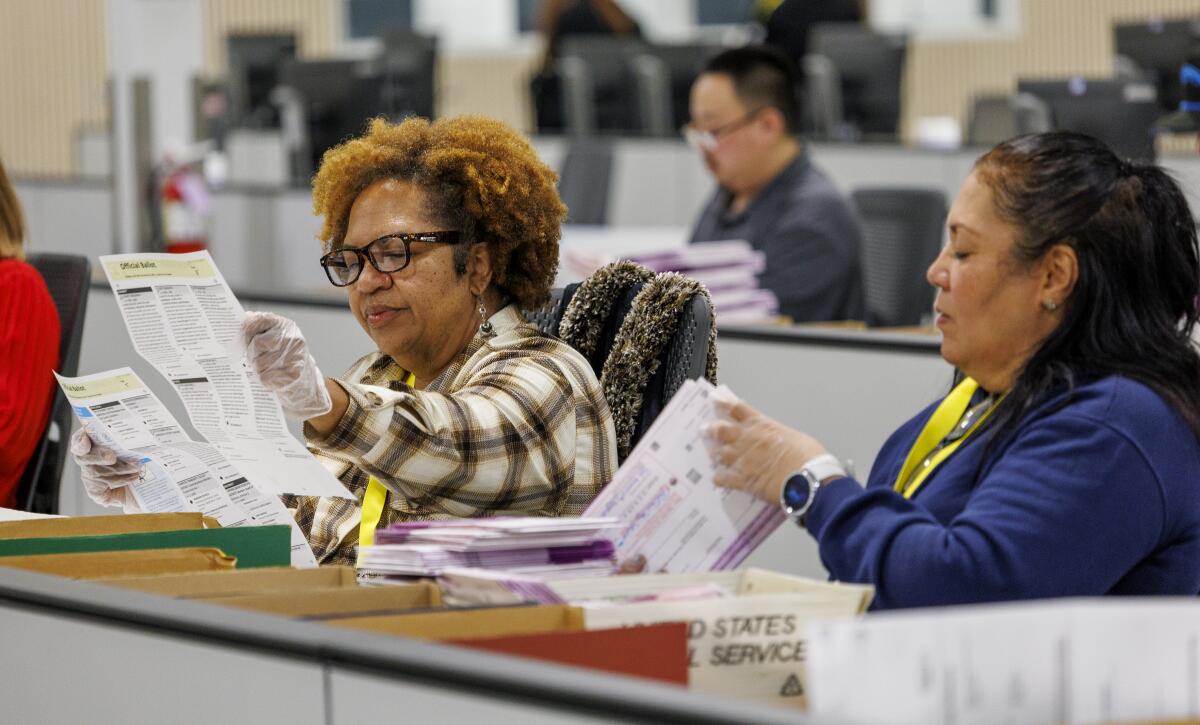
Election workers inspect ballots after extracting them from envelopes on election night at the Los Angeles County Ballot Processing Center on Nov. 5, 2024, in the City of Industry.
(Gina Ferazzi / Los Angeles Times)
Weber, 77 and the daughter of an Arkansas sharecropper whose family fled Southern racism and threats of violence to reach California, said that while many people in the U.S. are confronting intense fear and doubt about the election for the first time, and understandably so, that is simply not the case for her or many other Black people.
“African Americans have always been under attack for voting, and not allowed to vote, and had new rules created for them about literacy and poll taxes and all those other kinds of things, and many folks lost their lives just trying to register to vote,” Weber said.
Weber said she still recalls her mother, who had never voted in Arkansas, setting up a polling location in their home in South L.A. each election when Weber was young, and today draws courage from those memories.
“I tell folks there’s no alternative to it. You have to fight for this right to vote. And you have to be aware of the fact that all these strategies that people are trying to use [to suppress voting] are not new strategies. They’re old strategies,” Weber said. “And we just have to be smarter and fight harder.”


NEWYou can now listen to Fox News articles!
President Donald Trump said Tuesday he plans to lift U.S. sanctions on Turkey and signaled he is prepared to move forward with the long-stalled sale of F-35 stealth fighter jets, marking a dramatic reversal in U.S. policy toward the NATO ally years after Ankara was expelled from the program for its purchase of a Russian missile defense system.
Speaking alongside Turkish President Recep Tayyip Erdoğan during a bilateral meeting at the NATO summit in Ankara, Turkey, Tuesday, Trump said his administration would remove sanctions imposed on Turkey’s defense sector.
“I can tell you we’re going to be taking the sanctions off, OK?” Trump said. “I don’t want him to waste his time answering that question. It’s time. We don’t sanction friends.”
TRUMP BETS ON FORMER NATO TROUBLEMAKER AS TURKEY’S STRATEGIC VALUE SURGES
Turkish President Recep Tayyip Erdogan welcomes US President Donald Trump at Ankara Airport, who is paying an official visit to Turkey ahead of the 36th NATO Heads of State and Government Summit in Ankara, Turkey, on July 07, 2026. (Dogukan Keskinkilic/Pool via REUTERS)
Asked whether he would sell F-35 fighter jets to Turkey despite existing legal restrictions tied to Ankara’s purchase of the Russian-made S-400 air defense system, Trump indicated he was open to doing so.
“Many people, including the people sitting right here thinks why wouldn’t we do that?” Trump said. “Turkey has been in many ways much more loyal than other countries that we think would be loyal.”
Pressed on concerns about Turkey’s continued possession of the S-400, Trump dismissed them.
“I have no concerns about anything.”
The remarks represent Trump’s clearest indication yet that he intends to restore defense ties with Turkey, building on months of efforts to revive military cooperation with one of NATO’s largest armed forces after years of strained relations.
Turkey was removed from the multinational F-35 program in 2019 after taking delivery of the Russian-made S-400 air defense system, prompting Washington to argue that operating the Kremlin-built system alongside America’s most advanced stealth fighter could expose sensitive U.S. technology. Congress subsequently imposed sanctions under the Countering America’s Adversaries Through Sanctions Act, or CAATSA.
‘WRITTEN IN OUR DNA’: POLISH PILOTS WHO REMEMBER SOVIET RULE PREPARE FOR AMERICA’S MOST LETHAL FIGHTER JET
Congress long has been one of the biggest obstacles to restoring Turkey’s access to the F-35, with bipartisan lawmakers arguing that Ankara should not receive America’s most advanced fighter aircraft while it continues to possess the Russian-made S-400 air defense system and pursues policies they say run counter to U.S. interests.
A U.S. airmen watches an Air Force F-35 Lightning II joint strike fighter aircraft approach for the first time on July 14, 2011 at Eglin Air Force Base in Florida. (Samuel King Jr./U.S. Air Force)
Beyond political opposition, the Trump administration also faces legal hurdles.
While the president has authority over sanctions policy, Congress enacted additional restrictions after Turkey’s purchase of the S-400. Section 1245 of the fiscal year 2020 National Defense Authorization Act bars the transfer of F-35 aircraft to Turkey unless the executive branch certifies that Ankara has met statutory requirements related to the Russian missile system.
In recent days, a bipartisan group of House lawmakers urged Trump not to move forward with an F-35 sale, arguing that doing so without satisfying those legal requirements would violate U.S. law and undermine national security.
Lawmakers also have warned that Turkey’s continued possession of the S-400, support for Hamas and tensions with fellow NATO allies Greece and Cyprus raise broader concerns about restoring Ankara’s access to the stealth fighter.
Russian S-400 missile air defence systems are seen before the military parade to commemorate the 75th anniversary of the battle of Stalingrad in World War Two, in the city of Volgograd, Russia February 2, 2018. REUTERS/Tatyana Maleyeva – UP1EE220T3A2B
CLICK HERE TO DOWNLOAD THE FOX NEWS APP
The Pentagon has maintained that the S-400’s sophisticated radar could collect data on the F-35’s radar signature and electronic profile during routine operations, potentially allowing Russia to better detect and defeat the aircraft in a future conflict if that information were shared with Moscow.
When the Trump administration removed Turkey from the F-35 program in 2019, the White House said “the F-35 cannot coexist with a Russian intelligence collection platform that will be used to learn about its advanced capabilities.”
Pentagon acquisition chief Ellen Lord similarly warned at the time that allowing Turkey to operate both systems would jeopardize the long-term security of the F-35 program because “much of the F-35’s strength lies in its stealth capabilities.”
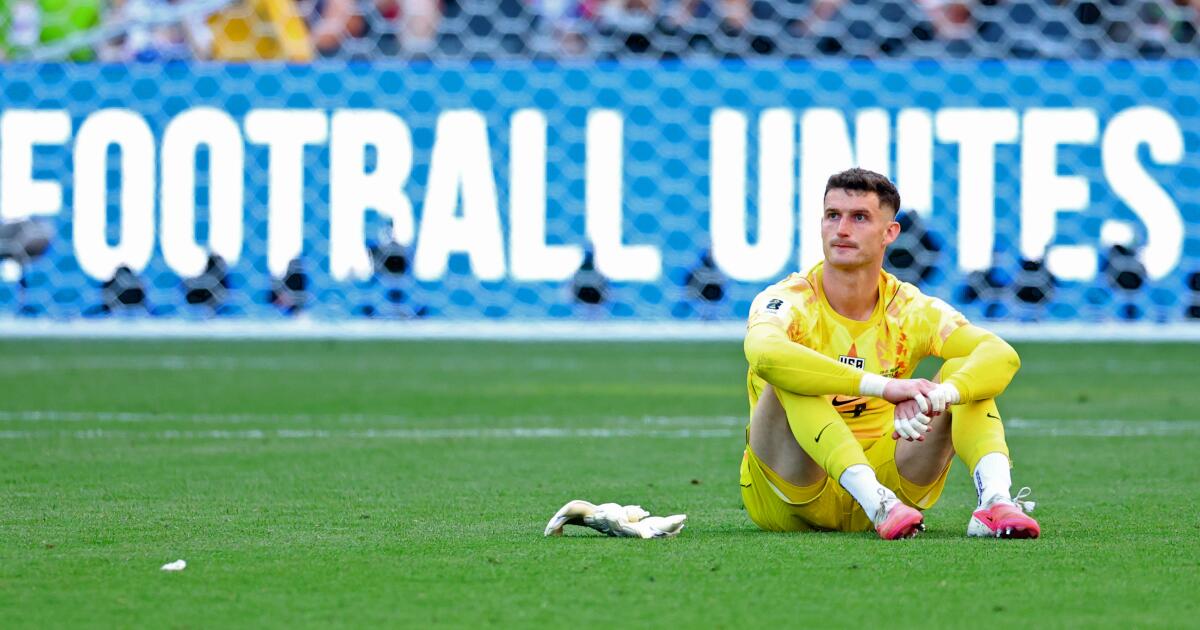
SEATTLE — Is everybody happy now? You good, Mr. President?
Put our boys in a blender, President Trump did, with those phone calls to FIFA President Gianni Infantino. Messed with their mojo by politicking to get American striker Folarin Balogun’s red card rescinded.
We’ll have to check VAR, but it might be the first time Trump succeeded at having a decision overturned.
Probably because this time what he sought to overturn — discipline stemming from Balogun’s accidental contact in the United States’ victory over Bosnia and Herzegovina — actually was unjust. Balogun should not have received a red card.
The problem is, having our President butt in here was a joke. Unfunny and out of bounds, offsides, an own goal — all of the things.
It put the U.S. team at the center of a geopolitical maelstrom, which is exactly what they did not need in the hours before the biggest match of their lives and the biggest match in the history of the U.S. men’s soccer program.
Some 40 or 50 million viewers were expected to tune in; how many of them watched for the first time? And what sort of impression did Monday’s 4-1 blunder-filled meltdown against Belgium make? That we stink at soccer — still?
If you were one of them, please, believe your soccer-fan friends when they tell you the Americans played much better in previous matches.
But so much for a magical run. On their home turf, the Americans pulled up lame before the finish line (aka, for the U.S. team’s purposes, its first quarterfinals since 2002).
To their credit, after the debacle, members of the U.S. team didn’t complain about anything being rigged. They didn’t use the distraction as an excuse. And they didn’t point fingers at anyone — anyone at all.
U.S. striker Folarin Balogun (20) walks to the locker room at halftime against Belgium in the World Cup on Monday at Lumen Field in Seattle.
(Allen J. Schaben / Los Angeles Times)
“We’re playing on home soil,” defender Chris Richards said. “So the only pressure we put on ourselves is to perform for our country, and ultimately didn’t feel the way we wanted to today. But I don’t think the antics of the last 24 hours had anything to do with it.”
No, they said the “debate,” or “outside noise” or “political manipulation” — as Tim Ream, Alex Freeman and coach Mauricio Pochettino described what others are calling “Balogate” — were not to blame for the gut-punch that answered the question: Why not us?
Because the U.S. is not yet good enough to beat the world’s great teams. Especially not when their pregame preparation includes having to try to block out an international uproar.
To have any hope against the Belgians in the round of 16 — a matchup between FIFA’s Nos. 9- and 17-ranked sides — the Americans needed to be going full-tilt, to be focused and ferocious and probably also a little bit lucky.
Instead, they looked shook, rattled. And they got rolled.
They were the worst version of themselves at the worst time, which was so weird from a team that had been on its front foot from the first whistle against Paraguay.
Not Monday. Against Belgium, they were on their heels from the outset. Heavy touches, slow afoot, playing like they had the weight of the World Cup on their shoulders.
And all that White House maddening meddling — for what?
Balogun started and played most of the match, but it could just as well have been reserve striker Ricardo Pepi. Or you or me, Balogun was that ineffective.
His play of the day came postmatch, when he approached Belgian coach Rudi Garcia and the two had a respectful exchange. A real diplomat, that Brooklyn-born, Britain-raised American by birthright.

This loss was a real team effort, of course. Christian Pulisic came off in the 59th minute after twisting his right ankle — leaving this World Cup without a goal in the four matches he appeared.
Matt Freese, the Harvard-educated starting goalkeeper, had a brain cramp of epic proportions when he stepped outside of the box and failed to corral a ball. Belgium’s Charles De Ketelaere kicked it loose and set up Hans Vanaken, whose shot traveled behind Ream for an easy score that made it 3-1 in the 57th minute.
There was a lot of poor decision-making with this match, on and off the pitch.
In the end, Trump’s appeal to Infantino did more harm than good. But what if some good could come from it?
Hey, FIFA, what about giving teams a process to appeal cards, like our American athletes in the NBA, NFL and MLB have?
Offering a suggestion box wouldn’t be opening Pandora’s box, not if it were a transparent and regular part of the game that would, hopefully, offer increasingly fair outcomes in a tournament where every match is so monumental — as our President recognized, much too enthusiastically.

U.S. coach Mauricio Pochettino waves to the crown after a 4-1 loss to Belgium at the World Cup on Monday.
(Allen J. Schaben / Los Angeles Times)
Prosecutors on Monday began laying out their case against the man accused of murdering Charlie Kirk. It was the first day of a weeklong preliminary hearing that will determine whether or not there is enough evidence against the accused killer to stand trial.
-

 Massachusetts2 minutes ago
ICE detentions rise in Massachusetts amid World Cup festivities
-

 Minnesota9 minutes ago
Man accused of attacking woman in Midwest Bank parking lot at gunpoint
-

 Mississippi12 minutes ago
Jabil to invest $119 million in Marshall County, create 2,200 jobs
-

 Missouri24 minutes ago
Explosion reported after Missouri school employee hits firework with lawn mower
-

 Montana27 minutes ago
Surreal trail-cam footage shows giant, ‘big-headed’ grizzly bear
-

 Nebraska32 minutes ago
Judge sentences Northeast Nebraska man for sexual assault of a minor, faces possible deportation
-

 Nevada39 minutes ago
VOTE: Do you think Northern Nevada has enough resources to support family caregivers?
-

 New Hampshire42 minutes ago
Tidemark, BOD Holdings Complete 135-Unit Multifamily Project in Somersworth, New Hampshire

