Politics
Trump Begins Selling New Meme Coin Days Ahead of Inauguration


President-elect Donald J. Trump and his family on Friday started selling a cryptocurrency token featuring an image of Mr. Trump drawn from the July assassination attempt, a potentially lucrative new business that ethics experts assailed as a blatant effort to cash in on the office he is about to occupy again.
Disclosed just days before his second inauguration, the venture is the latest in a series of moves by Mr. Trump that blur the line between his government role and the continued effort by his family to profit from his power and global fame. It is yet another sign that the Trump family will be much less hesitant in this second term to bend or breach traditional ethical boundaries.
Mr. Trump himself announced the launch of his new business on Friday night on his social media platform, in between announcements about filling key federal government posts. He is calling the token $Trump, selling it with the slogan, “Join the Trump Community. This is History in the Making!”
The venture was organized by CIC Digital LLC, an affiliate of the Trump Organization, which already has been selling an array of other kinds of merchandise like Trump-branded sneakers, fragrances and even digital trading cards.
But this newest venture brings Mr. Trump and his family directly into the world of selling cryptocurrency, which is regulated by the Securities and Exchange Commission. Mr. Trump recently disclosed he intended to name a cryptocurrency advocate as S.E.C. chairman.
A disclosure on the website selling the tokens says that CIC Digital and its affiliates own 80 percent of the supply of the new Trump tokens that will be released gradually over the coming three years and that they will be paid “trading revenue” as the tokens are sold.
The move by Mr. Trump and his family was immediately condemned by ethics lawyers who said they could not recall a more explicit profiteering effort by an incoming president.
“It is literally cashing in on the presidency — creating a financial instrument so people can transfer money to the president’s family in connection with his office” said Adav Noti, executive director of Campaign Legal Center, a nonprofit ethics group. “It is beyond unprecedented.”
Eric Trump, who helps run Trump Organization business operations, said on Saturday that this offering was part of a new and growing business sector that the Trump family has entered.
“I am extremely proud of what we continue to accomplish in crypto,” Eric Trump said in a statement to The New York Times. “$Trump is currently the hottest digital meme on earth.” He added: “This is just the beginning.”
But even some in the cryptocurrency industry were quick to criticize the new token.
“Trump owning 80 percent and timing launch hours before inauguration is predatory and many will likely get hurt by it,” wrote Nick Tomaino, a crypto venture capitalist and former executive at Coinbase, one of the largest crypto trading platforms, in a social media posting on Saturday.
The president-elect and his three sons had, as of late last year, already lent their name to another cryptocurrency startup called World Liberty Financial, an arrangement that included a cut of token sales for the Trump family in exchange for helping promote the new brand.
But the members of the Trump family, with World Liberty Financial, were not actually owners of the platform or officers in the company.
There are other crypto currency coins in the marketplace based on Mr. Trump that are not directly affiliated with his family like the new Trump Meme. Typically, these so-called meme coins — which were born when coins were created as a joke inspired by an internet meme or cartoonish animal faces — are largely worthless and traded more like a hobby.
With this new venture, companies associated with Mr. Trump’s family have a direct financial stake in the value of the new tokens and in the volume of their sales, which quickly surged after going on the market.
“GetTrumpMemes.com is not political and has nothing to do with any political campaign or any political office or governmental agency,” the venture’s website says, adding, “Trump Memes are intended to function as an expression of support for, and engagement with, the ideals and beliefs embodied by the symbol ‘$TRUMP.’”
The legal disclosures say the tokens are not intended to be seen as “an investment opportunity, investment contract or security of any type.” But trading of them on cryptocurrency markets began immediately, driving up the value of each token from $7 to nearly $30 as of noon on Saturday.
This suggested that the so-called fully diluted value of all the tokens as of Saturday at noon was $30 billion, a number achieved less than a day after the token went on the market, according to CoinMarketCap, a site that tracks cryptocurrency trading.
Mr. Trump and his family are clear in the marketing of the new token that the image picked for the coin had been inspired by the July assassination attempt in Butler, Pa.
“President Trump faced death and came up fighting!” the website promoting the tokens says.
Cryptocurrency markets tend to be highly volatile, in part because tokens are not backed by any tangible assets. The website for Mr. Trump’s new venture includes an extensive collection of disclaimers limiting the ability of anyone buying the token to file a class-action lawsuit related to it and warning buyers that “Trump Memes may be extremely volatile, and price fluctuations in cryptocurrencies could impact the price.”
Mr. Trump has already made clear that he will be working to promote the cryptocurrency industry.
He has announced his intention to appoint regulators who will lift restrictions on the sale of new tokens and ties between cryptocurrency companies and other more traditional financial enterprises.
This stands in contrast to efforts by Biden-era regulators to tightly regulate the industry, out of a concern that a sudden crash in the value of cryptocurrency could potentially lead to a future financial crash.



As a student years ago, I dove deep into the history of the Red-hunting McCarthy era and became familiar with the actor who emerged second only to Wisconsin Sen. Joe McCarthy as the villain of that insidious time: his shameless, conniving young lawyer, Roy Cohn. Never would I have imagined that a future president would count Cohn as a mentor and role model.
Then came Donald Trump.
Now, in Cohn-inflected McCarthyesque style, President Trump is channeling his tutor yet again, baselessly labeling his political enemies — all Democrats — as communists as he looks ahead to the fall’s midterm elections. Once more Trump shows that his catchphrase “Make America great again” means regressing, this time to Trump’s formative 1950s and the McCarthy era that sadly helped define it.
In recent speeches, including on the Fourth of July, Trump’s utterances of “communist” or “communism” reached double digits each time. (As that implies, the president didn’t set aside his divisive rhetoric even for the nation’s 250th birthday.)
“Our warriors did not fight communism on battlefields across the world only to have that menace rear its ugly head right back here in America,” Trump said late on the Fourth on the National Mall.
Trump couples his commie-baiting with a dash of his trademark xenophobia. “There is now a resurgence of the communist menace in our land, including by newcomers to our country who embrace ideas totally opposed to our way of life and our great success,” he said at Mount Rushmore a day earlier. (He’s got it backward, of course: Immigrants come here for the American way of life and promise of success.)
Here’s the irony: Trump’s actions in his second term make him look more like the commie. He’s projecting again.
Now that Trump is exploiting a few victories lately by left-wing democratic socialists in Democratic primaries to paint the entire party as communists, it’s time to review the record — his record.
A hallmark of communism is government ownership of companies and control of the economy, at the expense of private property and free markets. In just over a year, Trump has used billions of taxpayers’ dollars to buy shares for the government in a growing list of private companies — U.S. Steel, Intel, Westinghouse and more — citing national security. The companies don’t always welcome their new stakeholder; at a minimum, they rightly fear it for the demands the government could make about prices and production.
“It’s what Putin did,” the estranged Republicans at the Lincoln Project posted online Monday. “Trump is the closest we’ve ever come to communism.”
“What began as a populist revolt against so-called elites has become a program of state ownership, price fixing and top-down industrial control,” free-market economist Veronique de Rugy wrote in The Times last October of Trump’s actions. “The power to ‘partner’ with business is the power to control it.”
Comrade Trump’s first big government grab, and a model for those to come, was in June last year, when he wrested a permanent “golden share” in U.S. Steel in return for approving its sale to Japan’s Nippon Steel. The company’s charter was revised to give the U.S. president extraordinary veto power over nearly a dozen corporate activities, including closing or relocating plants, supply-chain decisions, even pricing.
“We have a golden share, which I control,” Trump told reporters at the time, in words I never thought I’d hear from a president of the party once associated with free markets.
Just last week, Trump boasted to CNBC how he’d extracted a 10% stake in beleaguered chip giant Intel last August, after first demanding that its chief executive resign. “Intel came in. They had a problem. I said, ‘I can solve your problem, but I want 10% of the company.’ … Somebody said that’s not very American. I said, ‘No, I think it is very American, actually.’ And I’ve done that with other deals.”
And so he has.
The Pentagon is now the largest stockholder in struggling MP Materials, a large rare-earth mine in California, and guarantees a 10-year price floor for its output that stunned competitors. The administration has since taken shares in other rare-earth companies. The Commerce Department took an option for an 8% stake in Westinghouse, to spur construction of nuclear reactors, and has the right to 20% if the government decides the company should go public. The government takes a 15% cut of Nvidia’s and Advanced Micro Devices’ AI chip sales to China.
As much as anything he does, Trump’s direct intervention in private enterprise invites the question “What if Biden/Harris/Obama did that?” The answer, of course: Trump and Republicans would cry “Communist!”
Trump’s actions are the sort Americans generally have only seen during economic emergencies or major wars, and then rarely. I covered the frenzied and ultimately successful response to the near-collapse of the global financial system and the U.S. auto, insurance and housing industries. Behind the scenes in the Obama White House (and George W. Bush’s at the outset) was constant, angst-filled debate about any actions smacking of government takeovers and a determination that interventions be temporary, unlike Trump’s schemes. (For all the still-lingering unpopularity of the banking bailout, the Treasury — the taxpayers — got all the money back and then some, and exited the business.)
Trump’s economic big-footing isn’t the only way in which he resembles the commies Americans know best, and whom he so admires: Vladimir Putin, Xi Jinping, Kim Jung Un. There are also the images of himself everywhere, monuments planned, drearily long and self-adulating speeches and interference in the nation’s cultural, educational and legal spheres and — worst of all — in elections.
At Rushmore, Trump closed with a demand that Congress pass his so-called SAVE America Act to restrict voting. “We do that and we’re not going to lose an election for 100 years,” he said, speaking of course about Republicans.
One-party rule through central government election finagling? Now that’s a communist.
Bluesky: @jackiecalmes
Threads: @jkcalmes
X: @jackiekcalmes

NEWYou can now listen to Fox News articles!
Maine state Rep. Valli Geiger, a Rockland Democrat, former nurse and former mayor, is drawing sudden national attention after saying now-former Democratic Senate nominee Graham Platner encouraged her to consider taking his place on the ballot in the Maine Senate race.
While Geiger has not been named the replacement nominee, her name entered the Maine Senate scramble after she told local outlet WMTW that Platner called her Monday night, praised her as a “fighter” and asked whether he could put her name forward. Platner’s campaign told the outlet he had not made an endorsement decision but confirmed he encouraged Geiger to consider running if he stepped aside.
After Geiger said Platner called her about potentially putting her name forward, Geiger posted Tuesday she would not “throw Graham under the bus,” while also saying she would not “slander or accuse” Jenny Racicot, the woman who accused Platner of rape, “of anything more than telling the truth as she experienced it.”
By Wednesday, local outlets were reporting that Geiger said Platner had encouraged her to consider running if he withdrew. Platner, who suspended his campaign Wednesday night, has denied the claim.
WHAT HAPPENS NEXT IF PLATNER DROPS OUT? HERE’S WHO COULD REPLACE HIM ON THE BALLOT AND HOW IT COULD WORK
Graham Platner Maine State Rep. Valli Geiger (Maine State Legislature/Getty Images)
“For the movement to continue, it can’t be me. For that reason, we are suspending campaign operations,” Platner said in a video posted to social media.
Geiger is a third-term Democratic state representative from Rockland, according to her legislative biography, representing a coastal House district in Maine that includes Rockland, Criehaven Township, Matinicus Isle Plantation, the Muscle Ridge Islands, North Haven and part of Owls Head. Her biography says she serves on the Labor Committee and the Energy, Utilities and Technology Committee.
Before entering the state legislature, Geiger served six years on the Rockland City Council, including one year as mayor and four years on the Rockland Comprehensive Planning Commission, three of them as chair.
Her biography says she holds a master’s degree in sustainable design and built her own passive-solar, net-zero-energy house. It also describes her as a former nurse at Pen Bay Medical Center who later worked as a health policy analyst and health administrator, including as director of the Healthreach Hospice program and clinical director for Federally Qualified Health Centers around Maine.
The Maine State Capitol May 18, 2026, in Augusta, Maine. (Joe Raedle/Getty Images)
PLATNER CAMPAIGN PUTTING ‘THUMB ON SCALE’ TO INFLUENCE POSSIBLE REPLACEMENT, MAINE DEM ALLEGES
Geiger’s connection to Platner predates the latest replacement speculation. Local reporting has described her as a close Platner supporter, and WMTW reported she previously stood with him and credited him with helping secure funding for rape kit tracking in Maine.
In her Facebook post responding to Racicot’s allegation, Geiger wrote that Racicot’s story “seems credible” but added that “none of us knows the truth nor will we ever.” She also described Platner as “a man becoming a better man” and said she had hoped he would lead the political movement his campaign had built and will not “throw Graham under the bus.”
In the post, Geiger also praised Platner’s “passion for economic populism” and said she had granted him “an enormous amount of grace” for his behavior during what she described as his “dark years” after multiple deployments.
Dr. Nirav D. Shah, director of the Maine Center for Disease Control and Prevention, speaks during a news conference about COVID-19 at Maine Emergency Management Agency in Augusta. (Derek Davis/Portland Press Herald via Getty Images)
CLICK HERE TO DOWNLOAD THE FOX NEWS APP
The Maine state representative is not the only Democrat whose name has surfaced as Maine Democrats prepare for the possibility that Platner exits the race against Republican Sen. Susan Collins.
Several Democrats have expressed interest or are considering bids, including former gubernatorial candidate Troy Jackson, Secretary of State Shenna Bellows and former Maine CDC Director Nirav Shah.
Under Maine law, the Maine Democratic Party can replace him on the general election ballot by selecting a new nominee through its party process, with the replacement required to be chosen by July 27.
Fox News Digital’s Andrew Mark Miller and Paul Steinhauser contributed to this report.
Politics
Nexstar launches its first digital subscription service with The Hill Insider, aimed at political junkies

Nexstar Media Group’s The Hill, the political web site that started as a free newspaper read in most congressional offices in Washington, is launching a new direct-to-consumer streaming service that will be behind a paywall.
Starting Wednesday, Nexstar will offer The Hill Insider, which will carry daily streaming video programs and newsletters. Subscribers will also be able to interact with The Hill’s journalists and analysts, who will take questions live.
The service, available for $5.99 a month or $59.99 a year, is the first digital subscription product for the Irving, TX-based Nexstar, the largest owner of television stations in the U.S. Premium memberships are available for $9.99 a month, or $99.99 a year, which will be ad-free and offer access to live events presented by The Hill.
The endeavor is the first subscription streaming service offered by Nexstar. The Hill already produces a free ad-supported streaming channel distributed on such platforms as Roku.
The free version of The Hill is the most viewed political web site in the U.S. with 1.24 billion page views in 2025, a year-to-year increase of 7%, according to Comscore. The Hill is known for offering brisk, up-to-date reports out of each branch of government in Washington, and is often linked to on other websites.
Nexstar, which also owns the cable network NewsNation, acquired The Hill in 2021 from New York-based entrepreneur James Finkelstein for $130 million. NewsNation adapted The Hill brand name for its Washington-based programs, including a Sunday roundtable show with Chris Stirewalt, politics editor for The Hill and NewsNation.
NewsNation politics editor Chris Stirewalt on the set of “The Hill Sunday.”
(NewsNation)
Stirewalt and the Washington journalists and commentators seen on NewsNation programs will be featured on The Hill Insider. The service will also use the resources of Decision Desk HQ, the political media firm that was the first to call President Trump’s victory on election night in 2024. Decision Desk will be involved in a streaming show called “Data Nerds.”
The Hill Insider will be aimed at the political junkie who wants to go deeper on polling data and hear longer, in-depth discussion on issues. Bill Sammons, senior vice president of editorial content for Nexstar, said the company’s research shows there is a national appetite for such content, as only 5% of The Hill’s current audience is based in Washington.
The Hill has long touted itself as non-partisan and Stirewalt hopes users will gravitate to the subscription version to become better informed about legislative and political issues and not reaffirm their existing opinions.
“My imagined audience is of people in America who are not addicted to politics but are addicted to good citizenship and the idea of fulfilling their civic virtue,” Stirewalt said in a recent interview. “And they would like to do it in a way that doesn’t insult their intelligence.”
While the free version of The Hill has been growing, the new subscription product enters a crowded field of digital programs and platforms aimed at the consumers of political news.
The launch comes as journalists from legacy media such as former CNN anchor Jim Acosta, former ABC News correspondent Terry Moran, and Chuck Todd, the longtime moderator of NBC’s “Meet the Press,” have launched their own daily podcasts and newsletters as second acts in their careers.
MS NOW, the progressive-leaning cable news channel, is entering the direct to consumer market later this year making the channel available outside of pay-TV packages for the first time. Like The Hill Insider, the MS NOW streaming product is expected to offer users additional benefits, such as access to live events and content not seen on the cable network.
Original topical programming that does not have a shelf life is challenging to sustain on a streaming service. When Fox News Media launched its streaming service Fox Nation in 2018, it carried a line-up of live, politically-oriented shows aimed at its conservative-leaning audience. The service eventually pivoted to documentary, movies and lifestyle programming and became the home of the annual Fox News fan event, The Fox Nation Patriot Awards.
-
 Business7 minutes ago
California soccer fans sue StubHub after it fails to deliver expensive World Cup tickets
-
 Entertainment10 minutes ago
Lucas Museum to give free annual passes to South L.A. neighbors, host community preview day
-
 Lifestyle15 minutes ago
Meow Wolf taps famed L.A. animation house for its new Los Angeles venue
-
Politics22 minutes ago
Column: Trump decries ‘communism’ while his government takes ownership of companies
-
 Science25 minutes ago
‘I’d rather my house burn down than get cancer’: Herbicide use upends California’s fight to save forests
-
 Sports30 minutes ago
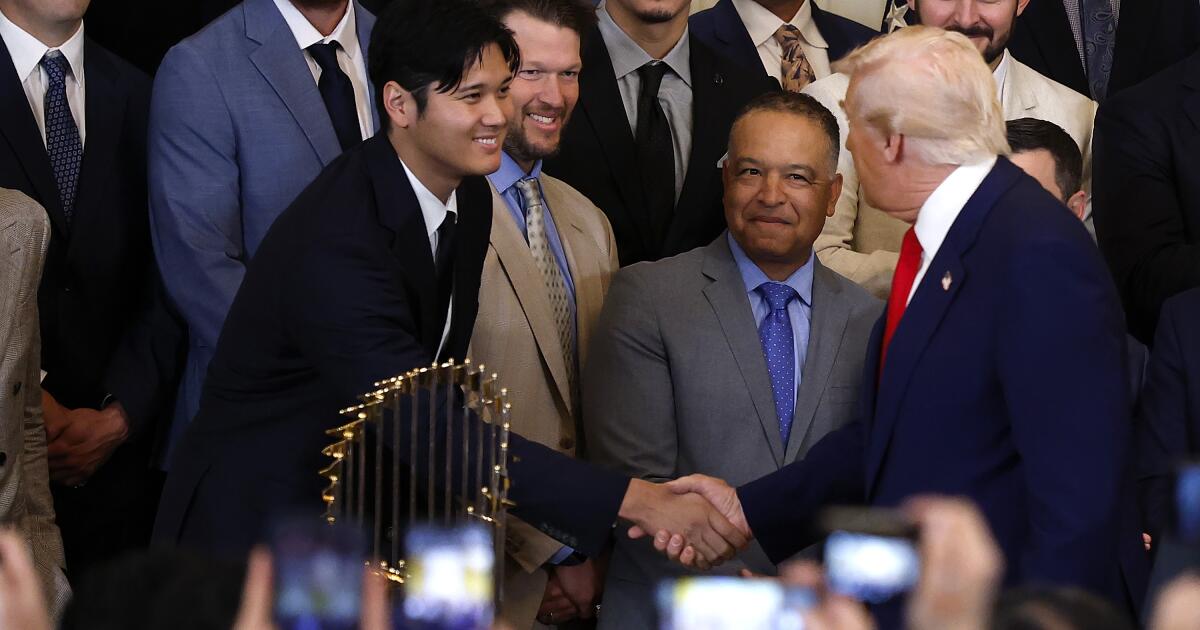
Dodgers scheduled to visit White House in late July to celebrate 2025 World Series win
-

 World40 minutes ago
Former US Olympian pleads not guilty in DC reflecting pool vandalism case
-
 News1 hour ago
Former Olympian pleads not guilty in reflecting pool vandalism charges

