Politics
Taiwan's new president calls for peace amid tenuous relations with China

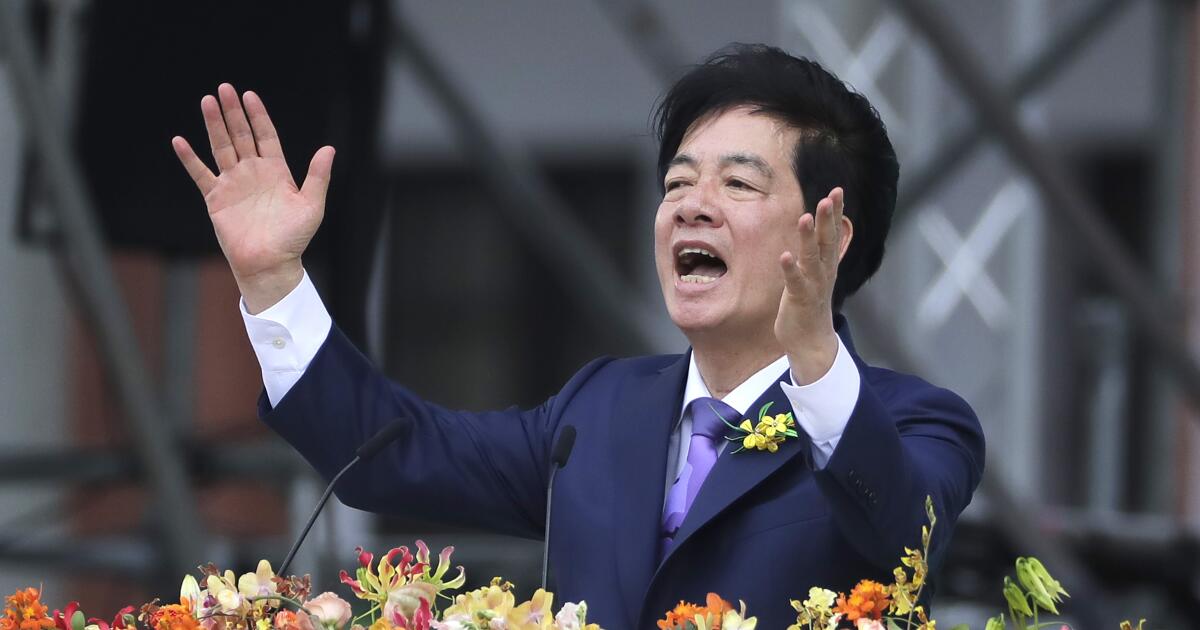
In his first speech as president of Taiwan, Lai Ching-te emphasized preserving peace amid rising tensions with China and criticism that he could provoke military conflict.
At his inauguration Monday, Lai called for China to help maintain peace and halt military and political intimidation directed at the self-ruled island. Chinese President Xi Jinping considers Taiwan a part of China’s territory and has vowed to pursue its unification with the mainland, by force if necessary.
Denounced by China as a “separatist” who advocates for Taiwan’s independence, Lai stressed his dedication to preserving the status quo without ceding ground to Beijing’s claims of sovereignty.
“As we pursue the ideal of peace, we must not harbor any delusions,” he said after his being sworn in. “So long as China refuses to renounce the use of force against Taiwan, all of us in Taiwan ought to understand, that even if we accept the entirety of China’s position and give up our sovereignty, China’s ambition to annex Taiwan will not simply disappear.”
The Chinese government’s Taiwan Affairs Office posted a statement Monday after Lai’s speech that he “stubbornly maintains a separatist stance of ‘Taiwan independence’” and accused him of undermining peace and stability in the region.
China also sanctioned three U.S. defense contractors Monday for providing weapons to Taiwan.
China has ramped up military activity around the island of 23 million in the last few years. It has also cut preferential tariffs and trade on certain goods from Taiwan, in what officials have criticized as economic coercion.
Daniel Russel, vice president for international security and diplomacy at the Asia Society Policy Institute, said that while Lai’s remarks may reassure some foreign governments that he will not pursue formal independence for Taiwan, it did little to placate leaders in China.
“There is virtually nothing that Lai could have said, short of ‘unconditional surrender,’ that would satisfy Beijing,” Russel said.
Lai’s election marks the first time that one political party in Taiwan has ruled for more than two presidential terms. Under his predecessor, Tsai Ing-wen, the island democracy bolstered defense spending and strengthened ties with the U.S., which recently passed a bill to provide $8 billion in aid to Taiwan.
Wen-ti Sung, a political scientist at Australia National University who specializes in cross-strait relations, said Lai’s inauguration speech largely telegraphed his plan to continue the same policies as Tsai, whom Beijing cut contact with when she took office eight years ago.
“He’s trying to project an image of pragmatism and predictability,” Sung said.
Lai, a 64-year-old former doctor, won election in January with 40% of the vote and faces a divided parliament. In his remarks, he addressed the need to work with opposition lawmakers as well as domestic issues such as low wage growth, energy security and affordable housing.
“This new structure is a result of the people’s choice,” he said. “Looking at it with a different frame of mind, a lack of absolute majority means that the ruling and opposition parties are now all able to share their ideas, and that we will be undertaking the nation’s challenges as one.”
He also proposed restarting tourism and student exchanges with China.
“Cross-strait relations will remain fragile and mired in distrust,” said Amanda Hsiao, senior China analyst at International Crisis Group. “But the resumption of tourism and student exchange can help improve the atmosphere.”
There was sparse coverage of the inauguration in Chinese state or social media. On Weibo, China’s X-like social media platform, searches for Lai and Tsai appeared to be blocked. The Global Times, the Communist Party tabloid, called Lai a secessionist in an article Sunday and warned that he may become emboldened in taking steps toward independence during his time in office.
“In the long term, the state of cross-Straits relations will not be optimistic,” the article said.
Special correspondent Huiyee Chiew in Taipei contributed to this report.

Politics
Fetterman unleashes on ‘dirtbag’ wing of Dems after far-left victories: ‘Orgy of socialism’

NEWYou can now listen to Fox News articles!
Sen. John Fetterman, D-Pa., unloaded on his own party on Sunday evening, blasting a series of victories for progressives he called “anti-America.”
“Big night for the dirtbag left,” Fetterman said, referring to New York’s recent primaries, where two members of the Democratic Socialists of America (DSA) won primaries.
“I’ve said the party is becoming an orgy of socialism. Clearly anti-America, anti-Western Civilization,” Fetterman said.
Fetterman’s striking calls give a rare look at how some moderates may view the developments on their far-left flank that have dominated the party’s momentum in recent months, sparking concern that their high visibility is dragging the party further and further left.
FETTERMAN WARNS DEMOCRATS ‘DRIFTING FIRMLY INTO COMMUNISM’ AFTER SOCIALIST PRIMARY WINS
Sen. John Fetterman, D-Pa., speaks to reporters outside the Senate Chamber during votes on Nov. 10, 2025, on Capitol Hill in Washington, D.C. (Andrew Harnik/Getty Images)
His comments come on the heels of a handful of key progressive victories.
In Maine, Graham Platner, a controversial Democratic candidate for U.S. Senate, has attracted controversy for denying knowledge of the meaning behind a Nazi-linked tattoo, for off-color comments about race and calling himself a “communist” in a deleted Reddit post.
In New York, one DSA member, Claire Valdez, won a primary on a platform of abolishing ICE and a Green New Deal-style approach to climate change. Similarly, Darializa Avila-Chevalier, another DSA candidate, beat out incumbent Rep. Adriano Espillat, D-N.Y., a high-ranking Democrat and the chair of the Congressional Hispanic Caucus.
WINNERS AND LOSERS EMERGE AFTER SOCIALIST EARTHQUAKE ROCKS NYC PRIMARIES
Graham Platner, Democratic Senate candidate for Maine, speaks at a primary election night event at the Blue Hill YMCA in Blue Hill, Maine, on June 9, 2026. Platner won the party’s Senate primary after a campaign marked by accusations of past misbehavior and voter concerns. (Graeme Sloan/Bloomberg via Getty Images)
Both Chevalier and Valdez had the backing of New York Mayor Zohran Mamdani, himself a socialist.
The wins have captured national attention and drawn criticisms from Republicans who have pointed to their success as emblematic of the direction of the Democratic Party.
Fetterman, who has not shied away from confrontations, has been one of the few Democrats to express alarm about the kind of candidates carrying the party’s banner.
“I mean, you look at some of the things that people have said. Abolish prison, abolish the border, abolish ICE, I mean these crazy people — I have colleagues in my caucus that refuse to even call this out,” Fetterman said.
FETTERMAN REACTS TO MAMDANI’S REFUSAL TO ACCEPT SUPREME COURT’S IMMIGRATION RULING
U.S. Sen. John Fetterman, D-Pa., walks through the Senate Subway during the Senate War Powers vote on April 22, 2026, in Washington, D.C. (Heather Diehl/Getty Images)
CLICK HERE TO DOWNLOAD THE FOX NEWS APP
“Between P-hustle in Maine and some of the other winners in New York, they should form their own party and run on all the things that they’ve had to delete on social media,” Fetterman said, referring to Platner.
“That’s where our party has moved,” he added.
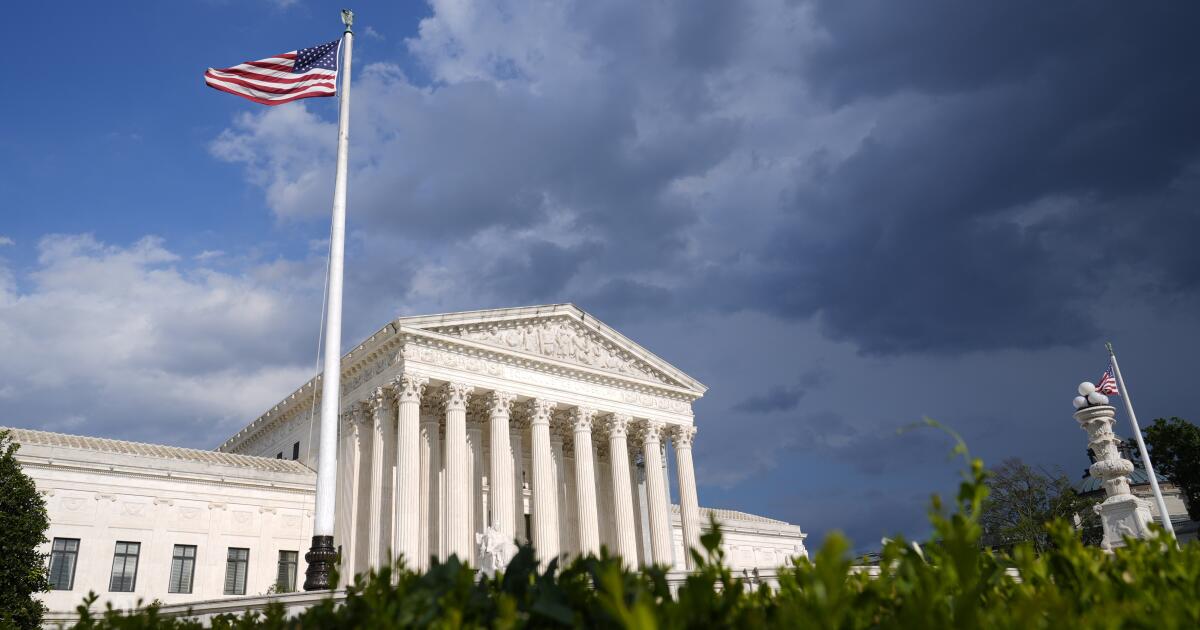
WASHINGTON — The Supreme Court cast doubt Monday on whether police may obtain cellphone data to find crime suspects.
In a 6-3 decision, the justices said this location information showing where a cellphone user has traveled is personal and private and subject to the protection of the 4th Amendment’s ban on unreasonable searches.
Justice Elena Kagan said these “records serve as a personal journal of a user’s movements.”
She said the information “resembles other private materials — think of emails, documents, photographs, or calendars—that even if stored on Google’s servers, a user reasonably views as his own…and reasonably expects to be shielded from the inquisitive eyes of the government.”
Because an “individual has a legitimate expectation of privacy in his cellphone location data,” she said police investigators need a valid search warrant from a magistrate.
The court stopped short of deciding the proper basis for a search warrant in such cases. Instead, the justices sent the case back to judges in Virginia.
But the outcome casts doubt on “geofence warrants.”
In recent years, police have gone to Google and cellphone companies seeking tracking data on cellphones that were at a crime scene. Sometimes, they have had a warrant from a magistrate.
Civil libertarians say the use of this tracking data raises the specter of mass surveillance on innocent people.
Police and government lawyers say no one has a reasonable right to privacy when they are walking on a sidewalk or driving down the street.
The case before the court arose from the armed robbery conviction of a Virginia man who stole $195,000 from a credit union in a small town near Richmond.
By the time police arrived, the robber had fled. But surveillance cameras showed he was carrying a gun and a cellphone.
Lacking other leads, detective Joshua Hilton asked a judge to issue a special type of warrant seeking information from Google.
Referred to as a “geofence warrant,” it seeks data from phones in a particular area at a particular time.
The detective sought data on phones that were within 150 yards of the credit union within one hour of the late afternoon robbery.
After examining and paring down the data, the detective asked for the phone records of Okello Chatrie. Then, with a search warrant of his home, investigators found two robbery-style demand notes, a semi-automatic pistol and about $100,000 in cash.
A judge refused to suppress the evidence from an allegedly unconstitutional search, and Chatrie entered a conditional guilty plea.
The full 4th Circuit Court of Appeals split evenly on the legality of the geofence warrant, and the Supreme Court agreed to decide the issue in Chatrie vs. U.S.
Usually investigators obtain warrants to search the home or vehicle of a known crime suspect.
The new and disputed geofence warrants seek to find a suspect by examining data on the cellphones that were at the scene of a crime.
The FBI used this cellphone data in 2021 to identify suspects who broke through police barricades on Jan. 6, 2021, and pushed their way into the Capitol to disrupt the official counting of electoral votes.
Chief Justice John G. Roberts Jr. and Justices Sonia Sotomayor, Neil M. Gorsuch, Brett M. Kavanaugh and Ketanji Brown Jackson agreed on the outcome in Chatrie vs. U.S.
In a 21-page dissent, Justice Samuel A. Alito Jr. said the court had “carefully set the stage for its planned performance: striking a pose as a great champion of privacy in the digital age. I cannot support this irresponsible escapade.”
Justice Clarence Thomas agreed.
Justice Amy Coney Barrett agreed in a one-paragraph dissent. “Chatrie had no reasonable expectation of privacy in data about his public movements that he voluntarily disclosed to Google,” she said.
The Supreme Court ruled 6-3 that President Trump could fire independent regulators for any reason. But the justices carved out an exception for the Federal Reserve, preventing the immediate removal of Lisa D. Cook, a Federal Reserve governor.
-

 World2 minutes ago
UK asylum seekers could have to pay government $13K before applying for settlement
-

 Politics9 minutes ago
Fetterman unleashes on ‘dirtbag’ wing of Dems after far-left victories: ‘Orgy of socialism’
-

 Health11 minutes ago
Doctors thought man had brain cancer — they found live tapeworms instead
-

 Sports17 minutes ago
Paraguay stuns four-time World Cup champions Germany in penalty shootout after controversial call
-
 Business27 minutes ago
Comcast is spinning off NBCUniversal media and entertainment assets
-
 Entertainment31 minutes ago
Alannah Keyser is latest fired ‘Love Island USA’ contestant to apologize for using a racist slur
-

 Lifestyle38 minutes ago
Chanel’s Bruno Pavlovsky on Reengineering an Iconic Brand
-
Politics41 minutes ago
Supreme Court limits police use of cellphone data to find crime suspects

