Politics
Supreme Court Rejects Trump’s Bid to Freeze Foreign Aid


The Supreme Court on Wednesday rejected President Trump’s emergency request to freeze nearly $2 billion in foreign aid as part of his efforts to slash government spending.
The court’s brief order was unsigned, which is typical when the justices act on emergency applications. It said only that the trial judge, who had ordered the government to resume payments, “should clarify what obligations the government must fulfill.”
But the ruling is one of the court’s first moves in response to the flurry of litigation filed in response to President Trump’s efforts to dramatically reshape government. The vote was 5 to 4, with Chief Justice John G. Roberts Jr. and Justice Amy Coney Barrett joining the three liberal members to form a majority.
Justice Samuel A. Alito Jr., writing for the four dissenting justices, said the majority had gone profoundly astray.
“Does a single district-court judge who likely lacks jurisdiction have the unchecked power to compel the government of the United States to pay out (and probably lose forever) $2 billion taxpayer dollars? “ he asked. “The answer to that question should be an emphatic ‘No,’ but a majority of this court apparently thinks otherwise. I am stunned.”
The administration halted the aid on Jan. 20, President Trump’s first day in office. Recipients and other nonprofit groups filed two lawsuits challenging the freeze as an unconstitutional exercise of presidential power that thwarted congressional appropriations for the U.S. Agency for International Development.
The groups said the frozen funds have created cascading crises, threatening critical medical care around the world, leaving food rotting in warehouses, ruining businesses and risking the spread of diseases and political instability.
“One cannot overstate the impact of that unlawful course of conduct: on businesses large and small forced to shut down their programs and let employees go; on hungry children across the globe who will go without; on populations around the world facing deadly disease; and on our constitutional order,” lawyers for Global Health Council, a membership organization of health groups, wrote in one of the suits.
Judge Amir Ali of the Federal District Court in Washington, who was appointed by President Joseph R. Biden, issued a temporary restraining order on Feb. 13 prohibiting administration officials from ending or pausing payments of appropriated money under contracts that were in place before Mr. Trump took office.
He said the administration had offered no explanation for the blanket suspension of aid Congress had directed be paid.
But administration officials seemed to evade if not defy that order, saying they were entitled to continue to conduct case-by-case review of the grants and contracts and halt or approve spending one at a time.
The plaintiffs repeatedly returned to court, asking Judge Ali to enforce his order. In a ruling on Feb. 25, he ordered the officials to pay more than $1.5 billion in already completed aid work. He set a deadline for midnight the next day.
Just hours before the deadline, the Trump administration filed in an emergency application to the Supreme Court arguing the judge had overstepped his authority.
Chief Justice John G. Roberts Jr., acting on his own, promptly issued an “administrative stay” temporarily blocking the orders. Such stays are interim measures meant to give the justices some breathing room while the full court considered the matter. Wednesday’s order lifted the stay.
Justice Alito wrote that the court should not allow the lower court judge’s order to remain in place.
“The government must apparently pay the $2 billion posthaste — not because the law requires it, but simply because a district judge so ordered. As the nation’s highest court, we have a duty to ensure that the power entrusted to federal judges by the Constitution is not abused. Today, the court fails to carry out that responsibility.”
In a brief filed on Friday, the challengers wrote that the administration was wrong at every step of its legal analysis.
“The government comes to this court with an emergency of its own making,” the brief said, adding: “By forcing thousands of American businesses and nonprofits to suspend their work, and by halting disbursements for work that they had already performed, even work that already had been reviewed by the government and cleared for payment, the government plunged respondents into financial turmoil.”
The brief added that the administration had challenged only Judge Ali’s order requiring the money to be disbursed and not his original order preventing the funding freeze. Even if the government won, the brief said, the administration would not be able to proceed with the funding freeze.
In an executive order on Jan. 20, Mr. Trump temporarily halted thousands of programs around the globe to assess whether they are “fully aligned with the foreign policy of the President of the United States.”
“The United States foreign aid industry and bureaucracy are not aligned with American interests and in many cases antithetical to American values,” the order said. “They serve to destabilize world peace by promoting ideas in foreign countries that are directly inverse to harmonious and stable relations internal to and among countries.”



Politics
Senate hopeful with deep Dem ties slapped with scathing complaint targeting alleged family payout ‘scheme’

NEWYou can now listen to Fox News articles!
FIRST ON FOX: A watchdog is urging the Federal Election Commission (FEC) to investigate Nebraska Senate hopeful Dan Osborn, alleging he is improperly steering campaign funds for personal use to nearly half-a-dozen of his relatives, including around a quarter-million-dollars to his wife alone, through his principal campaign committee and a web of political action committees.
Last month, Fox News Digital reported on Osborn’s spending that has come under scrutiny, showing that north of $370,000 had been disbursed to his wife, daughter, sister-in-law, and to himself through his campaign and a web of political action committees.
A complaint filed with the FEC Monday by conservative watchdog Americans for Public Trust, is now calling on the FEC to investigate Osborn’s spending, and lays out even more relatives receiving money from Osborn’s campaign plus another consulting firm his wife works at that has been receiving funds. In total, the complaint says, Osborn, his wife Megan, daughter Georgia, sister-in-law Jodi, second sister-in-law Bridget and brother-in-law James have received $434,734.42.
Fox News Digital reached out to the Osborn campaign with questions about the payments, but many of them went unanswered. However, a campaign spokesperson did tell Fox News Digital that the campaign “is fully compliant with all FEC rules.”
FIVE SLEEPER RACES THAT COULD UPEND 2026 – FROM THE ALLEGHENIES TO THE LAND OF ENCHANTMENT
Independent Senate candidate Dan Osborn chats with attendees after speaking during his campaign stop at the Handlebend coffeshop in O’Neill, Neb., on Monday, October 14, 2024. Osborn is running againt Sen. Deb Fischer, R-Neb. (Bill Clark/CQ-Roll Call, Inc via Getty Images)
“We haven’t received any formal complaints, but what you describe are baseless, nuisance allegations designed to slow Dan’s momentum as he’s tied with Pete Ricketts in four straight polls,” the spokesperson said.
While paying family members with campaign money is not necessarily a violation of campaign finance law, concerns have been raised about whether Osborn’s payments to his family members have followed the campaign finance laws that must still be adhered to, such as that the pay must be at fair-market value, it must be strictly for campaign services, must be transparently reported and must not be used for personal expenses, meaning expenses incurred irregardless of the ongoing campaign, like housing costs.
Entities not controlled and operated by candidates can deal in what is called “soft money,” or money that does not need to comply with federal limits. However, that money cannot then be controlled by the candidate to help him directly with his campaign. Money from entities controlled by candidates, often referred to as “hard money,” must follow the FEC’s limits and other rules.
Americans for Public Trust is accusing Osborn of using an end-around to funnel money to his relatives, including from a now-defunct campaign. They cite the fact that Osborn’s Working Class Heroes Fund (WCHF), which he launched in 2024, has a “join the movement” button that routes users to a form so they can be contacted by a different PAC called the League of Labor Voters. They also cite the involvement of Osborn’s custodian of records for his failed 2024 Senate campaign, Brandon Philipczyk, who was also listed as such in Statement of Organization for Osborn’s WCHF and LLV until just a few days ago.
Americans for Public Trust is alleging that these are not truly outside groups — they are effectively part of Osborn’s operation — and therefore shouldn’t be raising or spending money in ways that function like an end-around to bypass federal limitations.
SQUAD-BACKED PROGRESSIVES HIT WITH ‘COLD SHOWER’ AS MODERATES WIN ILLINOIS PRIMARIES
“Despite being established, financed, maintained, or controlled by federal candidate Dan Osborn and his agents, WCHF and LLV have solicited, received, directed, transferred, or spent funds that do not comply with FECA’s contribution limitations, source prohibitions, and reporting requirements, including receiving contributions from individuals in excess of $5,000 and receiving funds from prohibited sources,” the complaint letter to the FEC states.
Independent Dan Osborn, a challenger to two-term Republican Sen. Deb Fischer in 2024, chats with guests at a brewery in Beatrice, Neb. (AP/Margery Beck)
Osborn’s wife, Megan, who reportedly was a former bar manager, has raked in around a quarter-million dollars from Osborn’s campaign and a web of political action committees tied to him. In some cases, Megan has gotten money directly from her husband’s campaign and in other cases she has received it from two firms, one called Independent Campaigns LLC, which Megan has a one-third ownership stake in, and Dark Forest LLC, which official candidate disclosures show Megan gets compensation from.
Just two days after Independent Campaigns was set up, Osborn’s WCHF made its first $50,000 payment to the firm, according to local Nebraska news outlet the Lincoln-Journal Star. Thus far, per the FEC complaint, Independent Campaigns has received nearly $200,000 from Osborn and WCHF and another PAC called the League of Labor Voters (LLV), which Americans for Public Trust also alleges is controlled by Osborn.
In total, per the Americans for Public Trust complaint letter, Osborn’s wife has been able to rake in close to $300,00 for herself for things like “strategy consulting” and work reimbursements.
Osborn’s daughter Georgia, a part-time dancer who Osborn says still needs help paying her bills, was given $4,200 between when Osborn’s first 2024 campaign lost, and before launching his 2026 bid. The money was for “assistant services” from the then-dormant campaign.
Osborn’s sister-in-law, Jodi, received $1,400 for “treasurer services” from WCHF at the end of 2025, according to campaign disclosures which also show that she is listed as WCHF’s Treasurer.
GOP OVERPERFORMS IN VIRGINIA SPECIAL ELECTION, FUELING EARLY MOMENTUM TALK IN BLUE-TRENDING STATE
Meanwhile, the group also points to a $2,500 payment to Osborn’s brother-in-law, who served as treasurer of Osborn’s 2024 committee, as part of what it calls a broader pattern of family-linked payments that should be scrutinized for bona fide services and fair-market rates.
“Perhaps the Osborn family is teeming with previously undiscovered, dynastic political talent, akin to the Kennedys or Roosevelts,” the Americans for Public Trust letter to the FEC says. “Or perhaps Mr. Osborn has realized his ability to funnel large amounts of unchecked campaign cash to his own family.”
Caitlin Sutherland, Executive Director of Americans for Public Trust, added that Osborn “has become too comfortable blurring the lines between family, fortune, and campaign finance law.”
“Osborn has engaged in various tactics — including utilizing a defunct campaign account — to enrich members of both his immediate and extended family,” Sutherland continued. “In addition to lining the pockets of his close relatives, who appear to lack any notable professional campaign experience—Osborn is racking up federal campaign finance violations by orchestrating a scheme that seemingly finds him illegally running and controlling multiple federal PACs.”
Besides questions about how Osborn is paying himself and his loved ones, critics of the candidate have also balked at his decision to run as an Independent. Osborn has indicated he has no plans to caucus with either major party if elected and says on his website that, as an Independent, he is “uniquely positioned” to get things done in Congress. Meanwhile, speaking at a town hall, Osborn reportedly told Nebraskans that if his bid as an Independent didn’t work out, “there’s only one party I would caucus with.”
CLICK HERE TO DOWNLOAD THE FOX NEWS APP
When pressed on which political party he was speaking of, Osborn replied: “Not (Republican) Pete Ricketts’s party,” according to the audio reviewed by Nebraska news organization The Plains Sentinel. However, Osborn’s decision to cash in on national Democratic Party support, including utilizing the party’s main fundraising platform, ActBlue, have led to questions about how independent he really will be.
Labor Union leader Dan Osborn is running for a second election in a row to be a U.S. Senator after losing in 2024. (Leigh Vogel/Wire Image and Bill Clark/CQ-Roll Call, Inc via Getty Images)
In December, Osborn was slammed for hiring an anti-cop staffer seen at an anti-police event featuring severed pig heads, and the agency creating Osborn’s ads, Fight Agency, was also behind ads for the Zohran Mamdani, Sen. Bernie Sanders, I-Vt., Rep. Greg Casar, D-Texas, and other Democrats.
One of the firm’s leaders said they were struck by Osborn’s “over performance” in 2024, leading him to surmise “that Democrats need to run a lot of different kinds of campaigns.”
The consulting firm co-owned by Osborn’s wife, Independent Campaigns, has also worked with Democrat candidates. FEC filings show Nathan Sage, a Democrat running for Senate in Iowa, has paid thousands to Osborn’s wife’s consulting firm.
Politics
Californians may need to mail ballots early as Supreme Court signals support for new election day deadline
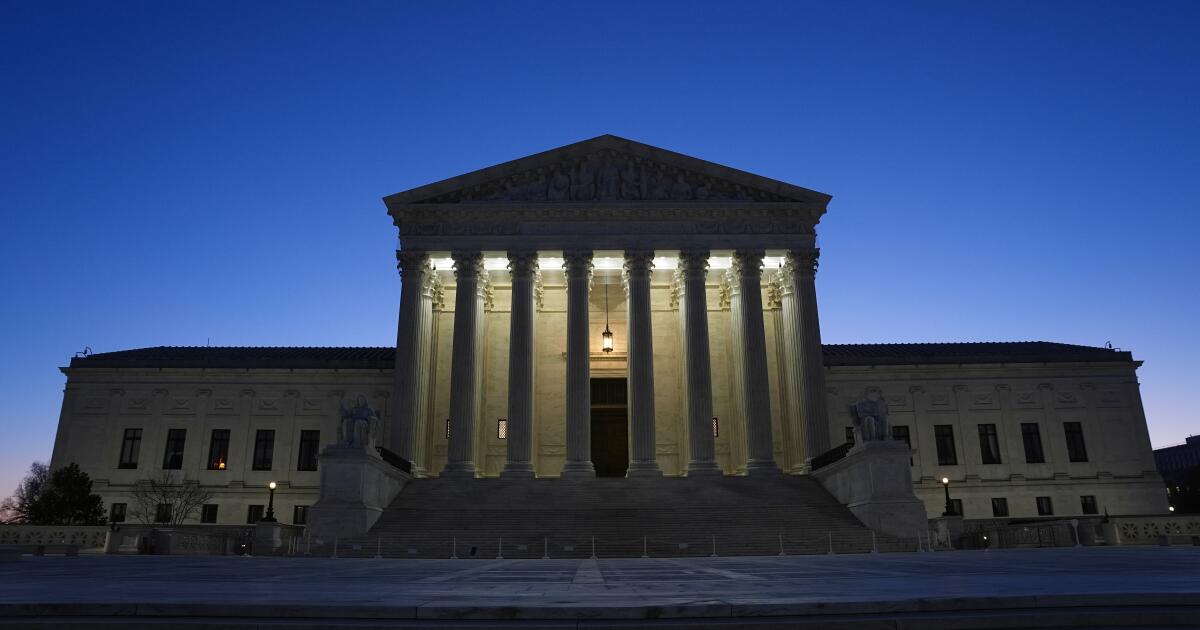
WASHINGTON — Californians may be forced to put their ballots in the mail well before election day to be certain they will be counted.
That’s the likely outcome of a Republican challenge to mail ballots that came before the Supreme Court on Monday.
The court’s six conservatives sounded ready to rule that federal law requires that ballots must be received by election day if they are to be counted as legal.
In the 19th century, Congress set a national day for federal elections on a Tuesday in early November, but it did not say how or when states would count their ballots. The Constitution leaves it to states to decide the “times, places and manners for holding elections.”
California and 13 other states count mail ballots that were cast before or on election day but arrive a few days late. And most states accept late ballots from members of the military who are stationed overseas.
By law, California counts mail ballots that arrive within seven days of election day. In 2024, more than 406,000 of these late-arriving ballots were counted in California, about 2.5% of the total.
Other Western states — Washington, Oregon, Nevada and Alaska — also count late-arriving mail ballots.
But President Trump has repeatedly claimed that voting by mail leads to fraud, and the Republican National Committee has gone to court to challenge the state laws that allow for counting the legally cast ballots of citizens which are postmarked on time but arrive late.
GOP lawyers argued that the phrase “election day” has always meant ballots must be in the hands of election officials on that day. In their questions and comments, all six conservatives agreed.
Justice Samuel A. Alito Jr. saw a real prospect of fraud. There could be “a big stash of ballots” that arrive late and “flip the outcome,” he said.
Democrats and election law experts say that the proposed new rule conflicts with more than a century of practice, because most states allowed for some people to vote by mail if they were traveling on election day. They argued that election day is like the federal tax day of April 15. While tax returns must be postmarked then, the tax returns are legal even if they arrive at the Internal Revenue Service a few days later.
The GOP filed its challenge in Mississippi, which accepts ballots that arrive up to five days after election day. A district judge rejected the claim, but a 5th Circuit Court panel with three Trump appointees ruled that ballots are illegal if they are not received by election day.
The case before the court is Watson vs. Republican National Committee.
California has been criticized for taking weeks to count all the votes, but that issue was not raised in this case.

NEWYou can now listen to Fox News articles!
A startup putting high-tech collars on cows could soon be worth more than $2 billion, as investors bet the technology could help farmers cut costs and cope with labor shortages.
Halter, a New Zealand-based company, is in talks to raise new funding in a deal expected to be led by billionaire Peter Thiel’s Founders Fund, according to a Bloomberg report. The round is attracting heavy investor interest and is close to being filled, though final details are still being negotiated.
THE SINGLE CRUSHING PROBLEM AMERICAN CATTLE RANCHERS WISH TRUMP WOULD FIX INSTEAD
A ranch hand rounds up cattle by horseback and drive them into the pens at the Adams Ranch Inc. in St. Lucie County, Florida on July 9, 2013. (Ty Wright/Bloomberg/Getty Images)
Farmers are increasingly looking for ways to lower expenses and boost efficiency — changes that could eventually affect food prices for consumers.
Beef prices are already soaring, and economists warn Americans shouldn’t expect relief anytime soon as the U.S. cattle herd has shrunk to its smallest size in 75 years.
The decline has been driven by years of drought, rising costs and an aging ranching workforce. Experts say rebuilding herds will take years, meaning beef prices are likely to remain elevated.
According to U.S. Department of Agriculture data, the average price of beef in grocery stores climbed from about $8.60 per pound in February 2025 to $10.12 per pound a year later — a roughly 18% increase.
THE COST OF THIS GROCERY STAPLE IS NEARING RECORD HIGHS — AND AMERICANS CAN’T GET ENOUGH
Against that backdrop, Halter is pitching technology aimed at helping farmers do more with less.
The company’s solar-powered, artificial intelligence-driven collars let ranchers herd cattle without fences, using GPS, sound and vibration signals controlled through a smartphone app. The system also tracks livestock health and movement in real time, giving farmers a way to manage herds remotely.
The goal is straightforward — fewer workers, lower costs and more efficient land use.
THE SURPRISING REASON WHY AMERICANS COULD FACE HIGH BEEF PRICES FOR YEARS
Cattle are shown in pens at the Cattlemen’s Columbus Livestock Auction in Columbus Wednesday, Oct. 8, 2025. (Melissa Phillip/Houston Chronicle/Getty Images)
Halter is part of a broader push toward “precision agriculture,” where technology is used to modernize farming. But that sector has struggled in recent years, with a wave of startups collapsing and investors pulling back amid high costs and slow adoption.
The company has also expanded into the U.S., opening an office in Colorado and targeting American ranchers as a key growth market.
CLICK HERE TO DOWNLOAD THE FOX NEWS APP
If the latest round closes as expected, it would signal renewed confidence that AI can succeed in farming — an industry where many tech bets have fallen short.
Halter did not immediately respond to Fox News Digital’s request for comment.

Here’s what Metro Detroit homebuyers face heading into spring season

Preparations for SMART expansion to Healdsburg set to begin

Construction underway on Harold Simmons Park’s first attraction

‘Confident’ Bencic takes out Anisimova, eyes Gauff next in Miami

Bruins Sign James Hagens to AHL Amateur Tryout Agreement | Boston Bruins

Florida High School Football Rankings: Top 25 teams – Oct. 21

How old is Bo Nix? What to know about Oregon quarterback ahead of 2024 NFL Draft

Cleary's 21 help Le Moyne down Central Connecticut State 69-64 in OT

99th annual Pony Swim held in Virginia

Indiana Members Credit Union announced as new anchor tenant at Bottleworks District

See TSA Wait Times at Major U.S. Airports

Senate hopeful with deep Dem ties slapped with scathing complaint targeting alleged family payout ‘scheme’

How the Iran war is about to hit your wallet

Suspect in slaying of Loyola University student was in the country illegally, officials say

Video: Plane Collides With Vehicle at LaGuardia Airport
-

 Detroit, MI5 days ago
Drummer Brian Pastoria, longtime Detroit music advocate, dies at 68
-

 Oklahoma1 week ago
Family rallies around Oklahoma father after head-on crash
-

 Georgia1 week ago
How ICE plans for a detention warehouse pushed a Georgia town to fight back | CNN Politics
-
 Science1 week ago
Federal EPA moves to roll back recent limits on ethylene oxide, a carcinogen
-

 Alaska1 week ago
Police looking for man considered ‘armed and dangerous’
-

 Movie Reviews5 days ago
‘Youth’ Twitter review: Ken Karunaas impresses audiences; Suraj Venjaramoodu adds charm; music wins praise | – The Times of India
-
 Science1 week ago
Long COVID leaves thousands of L.A. county residents sick, broke and ignored
-

 Education1 week ago
Video: Turning Point USA Clubs Expand to High Schools Across America