Politics
Supreme Court might upend Voting Rights Act and help GOP keep control of the House

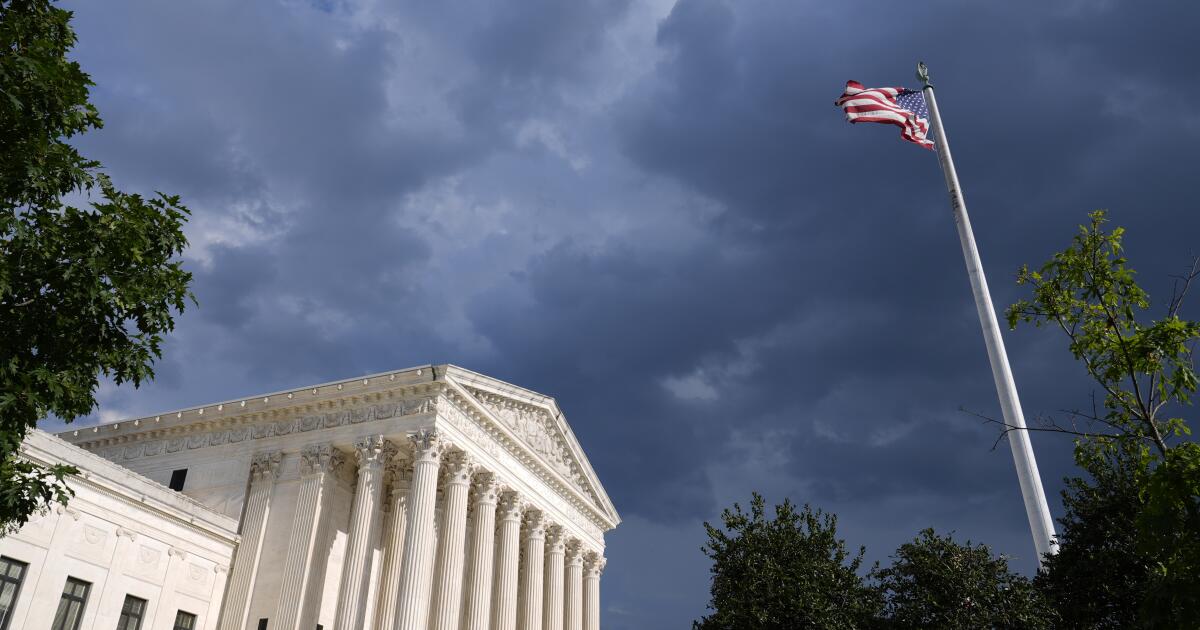
WASHINGTON — The Supreme Court may help the GOP keep control of the House of Representatives next year by clearing the way for Republican-led states to redraw election districts now held by Black Democrats.
That prospect formed the backdrop on Wednesday as the justices debated the future of the Voting Rights Act in a case from Louisiana.
The Trump administration’s top courtroom attorney urged the justices to rule that partisan politics, not racial fairness, should guide the drawing of election districts for Congress and state legislatures.
“This court held that race-based affirmative action in higher education must come to an end,” Solicitor Gen. D. John Sauer wrote in his brief. The same is true, he said, for using the Voting Rights Act to draw legislative districts that are likely to elect a Black or Latino candidate.
Too often, he said, the civil rights law has been “deployed as a form of electoral race-based affirmative action to undo a state’s constitutional pursuit of political ends.”
The court’s conservatives lean in that direction and sought to limit the use of race for drawing district boundaries. But the five-member majority has not struck down the use of race for drawing district lines.
But the Trump administration and Louisiana’s Republican leaders argued that now was the time to do so.
If the court’s conservatives hand down such a ruling in the months ahead, it would permit Republican-led states across the South to redraw the congressional districts of a dozen or more Black Democrats.
“There’s reason for alarm,” said Harvard law professor Nicholas Stephanopoulous. “The consequences for minority representation would likely be devastating. In particular, states with unified Republican governments would have a green light to flip as many Democratic minority-opportunity districts as possible.”
Such a ruling would also upend the Voting Rights Act as it had been understood since the 1980s.
As originally enacted in 1965, the historic measure put the federal government on the side of Black residents in registering to vote and casting ballots.
But in 1982, Republicans and Democrats in Congress took note that these new Black voters were often shut out of electing anyone to office. White lawmakers could draw maps that put white voters in the majority in all or nearly all the districts.
Seeking a change, Congress amended the law to allow legal challenges when discrimination results in minority voters having “less opportunity … to elect representatives of their choice.”
In decades after, the Supreme Court and the Justice Department pressed the states, and the South in particular, to draw at least some electoral districts that were likely to elect a Black candidate. These legal challenges turned on evidence that white voters in the state would not support a Black candidate.
Since he joined the court in 1991, Justice Clarence Thomas has argued that drawing districts based on race is unconstitutional and should be prohibited. Justices Samuel A. Alito Jr., Neil M. Gorsuch and Amy Coney Barrett dissented with Thomas two years ago when the court by a 5-4 vote approved a second congressional district in Alabama that elected a Black Democrat.
Chief Justice John G. Roberts Jr. wrote the opinion. Justice Brett M. Kavanaugh cast the deciding fifth vote but also said he was open to the argument that “race-based redistricting cannot extend indefinitely into the future.”
That issue is now before the court in the Louisiana case.
The state has six congressional districts, and about one-third of its population is Black.
Prior to this decade, the New Orleans area elected a Black representative, and in response to a voting rights suit, it was ordered to draw a second district where a Black candidate had a good chance to win.
But to protect its leading House Republicans — Speaker Mike Johnson and Majority Leader Steve Scalise — the state drew a new elongated district that elected Rep. Cleo Fields, a Black Democrat.
Now the state and the Trump administration argue the court should strike down that district because it was drawn based on race and free the state to replace Fields with a white Republican.







NEWYou can now listen to Fox News articles!
Several House Republicans are pushing Speaker Mike Johnson, R-La., to go to war with the Senate GOP over an election security bill that has little chance of passing the upper chamber under current circumstances.
House GOP leaders convened a lawmaker-only call on Sunday in the wake of a massive military operation against Iran launched by the U.S. and Israel.
After leaders briefed House Republicans on how the chamber would respond to the ongoing conflict — including a vote on ending Democrats’ weeks-long government shutdown targeting the Department of Homeland Security (DHS) — Fox News Digital was told that several lawmakers raised concerns about the Senate not yet taking up the Safeguarding American Voter Eligiblity (SAVE America) Act. Among other provisions, the act would require voters in federal elections to produce valid ID and proof of citizenship.
Rep. Derrick Van Orden, R-Wis., was among those pushing the House to reject any bills from the Senate until the measure was taken up, telling Johnson according to multiple sources on the call, “If we don’t get this done, or at least show that we’ve got some backbone, we’re done. The midterms are over.”
Speaker of the House Mike Johnson, R-La., pauses for questions from reporters as he arrives for an early closed-door Republican Conference meeting at the Capitol in Washington, Tuesday, Feb. 3, 2026. (J. Scott Applewhite/AP Photo)
At least three other House Republicans shared similar concerns. Sources on the call said Rep. Brandon Gill, R-Texas, argued that GOP voters were “not enthused” heading into November and that “the single biggest thing” to turn that around would be forcing the Senate to pass the SAVE America Act.
The SAVE America Act passed the House last month with support from all Republicans and just one Democrat, Rep. Henry Cuellar, D-Texas.
JEFFRIES ACCUSES REPUBLICANS OF ‘VOTER SUPPRESSION’ OVER BILL REQUIRING VOTER ID, PROOF OF CITIZENSHIP
Republicans have pointed out on multiple occasions that voter ID measures have bipartisan support across multiple public polls and surveys. But Democrats have dismissed the legislation as an attempt at voter suppression ahead of the 2026 midterms.
Senate Majority Leader John Thune speaks at a press conference with other members of Senate Republican leadership following a policy luncheon in Washington, D.C. on Oct. 28, 2025. (Nathan Posner/Anadolu via Getty Images)
The legislation would require 60 votes in the Senate to break filibuster, which it’s likely not to get given Democrats’ near-uniform opposition. But House Republicans have pressured Senate Majority Leader John Thune to use a mechanism known as a standing filibuster to circumvent that — which Thune has signaled opposition to, given the vast amount of time it would take up in the Senate and potential unintended consequences in the amendment process.
It also comes as Congress grapples with the fallout from the strikes on Iran and the need to ensure safety for the U.S. domestically and for service members abroad, both of which will require close coordination between the two chambers.
Johnson told Republicans several times on the Sunday call that he was privately pressuring Thune on the bill but was wary of creating a public rift with his fellow GOP leader, sources said.
HARDLINE CONSERVATIVES DOUBLE DOWN TO SAVE THE SAVE ACT
“If we’re going to go to war against our own party in the Senate, there may be implications to that,” Johnson said at one point, according to people on the call. “So we want to be thoughtful and careful.”
Sen. Mike Lee, R-Utah, talks with a guest during a “Only Citizens Vote Bus Tour” rally in Upper Senate Park to urge Congress to pass the Safeguard American Voter Eligibility (SAVE) Act on Wednesday, Sept. 10, 2025. (Tom Williams/CQ-Roll Call, Inc via Getty Images)
At another point in the call, sources said Rep. Andrew Clyde, R-Ga., suggested pairing a coming vote on DHS funding with the SAVE America Act in order to force the Senate to take it up.
CLICK HERE TO DOWNLOAD THE FOX NEWS APP
But both Johnson and House Homeland Security Committee Chairman Andrew Garbarino, R-N.Y., were hesitant about such a move given the enhanced threat environment in the wake of the U.S. operation in Iran.
Both spoke out in favor of the SAVE America Act, people told Fox News Digital, but warned the current situation merited leaving the DHS funding bill on its own in a bid to end the partial shutdown, so the department could fully function as a national security shield.
Related Article


According to President Trump, the United States attacked Iran because the Islamic Republic posed “imminent threats” to the U.S. and its allies, including through its use of terrorist proxies and continued pursuit of nuclear weapons.
“Its menacing activities directly endanger the United States, our troops, our bases overseas and our allies throughout the world,” he said in a recorded statement Saturday.
According to leading Democrats in Congress, Trump’s justification is questionable, especially given his claims of having “completely obliterated” Iran’s nuclear capabilities in separate U.S. bombings last June.
“Everything I have heard from the administration before and after these strikes on Iran confirms this is a war of choice with no strategic endgame,” said Rep. Jim Himes (D-Conn.), ranking Democrat on the House Intelligence Committee and part of a small group of congressional leaders — the Gang of Eight — who were briefed on the operation by Secretary of State Marco Rubio.
That divide is bound to remain an issue politically heading into this year’s midterm elections, and could be a liability for Republicans — especially considering that some in the “America First” wing of the MAGA base were raising their own objections, citing Trump’s 2024 campaign pledges to extricate the U.S. from foreign wars, not start new ones.
The debate echoed a similar if less immediate one around President George W. Bush’s decision to go to war in Iraq following the Sept. 11, 2001, attacks, also based on claims that “weapons of mass destruction” posed an immediate threat. Those claims were later disproved by multiple findings that Iraq had no such arsenal, fueling recriminations from both political parties for years.
The latest divide also intensified unease over Congress ceding its wartime powers to the White House, which for years has assumed sweeping authority to attack foreign adversaries without direct congressional input in the name of addressing terrorism or preventing immediate harm to the nation or its troops.
Even prior to the weekend bombings, Democrats including Sen. Adam Schiff of California were pushing Congress to pass a resolution barring the Trump administration from attacking Iran without explicit congressional authorization.
“President Trump must come to Congress before using military force unless absolutely necessary to defend the United States from an imminent attack,” Sen. Tim Kaine (D-Va.), a member of the armed services and foreign relations committees, said in a statement Thursday.
In justifying the daylight strikes that killed Supreme Leader Ayatollah Ali Khamenei just two days later, Trump accused the Iranian government of having “waged an unending campaign of bloodshed and mass murder” for nearly half a century — including through attacks on U.S. military assets and commercial shipping vessels abroad — and of having “armed, trained and funded terrorist militias” in multiple countries, including Hezbollah and Hamas.
Trump said that after the U.S. bombed Iran last summer, it had warned Tehran “never to resume” its pursuit of nuclear weapons. “Instead, they attempted to rebuild their nuclear program and to continue developing long-range missiles that can now threaten our very good friends and allies in Europe, our troops stationed overseas, and could soon reach the American homeland,” he said.
Other Republican leaders largely backed the president.
“The United States did not start this conflict, but we will finish it. If you kill or threaten Americans anywhere in the world — as Iran has — then we will hunt you down, and we will kill you,” said Defense Secretary Pete Hegseth.
“Every president has talked about the threat posed by the Iranian regime. President Trump is the one with the courage to take bold, decisive action,” said Atty. Gen. Pam Bondi.
While Iran’s coordination with and sponsorship of groups such as Hezbollah and Hamas are well known, Trump’s claims about Tehran’s ongoing development of nuclear weapons systems are less established — and the administration has provided little evidence to back them up.
Democrats seized on that lack of fresh intelligence in their responses to the attacks, contrasting Trump’s latest statements about imminent threats with his assertion after last year’s bombings that the U.S. had all but eliminated Iran’s nuclear aspirations.
“Let’s be clear: The Iranian regime is horrible. But I have seen no imminent threat to the United States that would justify putting American troops in harm’s way,” said Sen. Mark Warner (D-Va.), vice chairman of the Senate Intelligence Committee and a member of the Gang of Eight. “What is the motivation here? Is it Iran’s nuclear program? Their missiles? Regime change?”
Senate Minority Leader Chuck Schumer (D-N.Y.) said in a statement that the Trump administration “has not provided Congress and the American people with critical details about the scope and immediacy of the threat,” and must do so.
House Minority Leader Hakeem Jeffries (D-N.Y.) said the Trump administration needs congressional authority to wage such attacks barring “exigent circumstances,” and didn’t have it.
“The Trump administration must explain itself to the American people and Congress immediately, provide an ironclad justification for this act of war, clearly define the national security objective and articulate a plan to avoid another costly, prolonged military quagmire in the Middle East,” he said.
After the U.S. military announced Sunday that three U.S. service personnel were killed and five others seriously wounded in the attacks, the demands for a clearer justification and new constraints on Trump only increased.
Rep. Ro Khanna (D-Fremont) said Sunday he is optimistic that Democrats will be unified in trying to pass the war powers resolution, and also that some Republicans will join them, given that the strikes have been unpopular among a portion of the MAGA base.
Rep. Thomas Massie (R-Ky.), who partnered with Khanna to force the release of the Jeffrey Epstein files, has said he will work with him again to push a congressional vote on war with Iran, which he said was “not ‘America First.’”
Benjamin Radd, a political scientist and senior fellow at the UCLA Burkle Center for International Relations, said that whether or not Iran represented an “imminent” threat to the U.S. depends not just on its nuclear capabilities, but on its broader desire and ability to inflict pain on the U.S. and its allies — as was made clear to both the U.S. and Israel after the Hamas attacks on Israel on Oct. 7, 2023, which Iran praised.
“If you are Israel or the United States, that’s imminent,” he said.
What happens next, Radd said, will largely depend on whether remaining Iranian leaders stick to Khamenei’s hard-line policies, or decide to negotiate anew with the U.S. He expects they might do the latter, because “it’s a fundamentalist regime, it’s not a suicidal regime,” and it’s now clear that the U.S. and Israel have the capabilities to take out Iranian leaders, Iran has little ability to defend itself, and China and Russia are not rushing to its aid.
How the strikes are viewed moving forward may also depend on what those leaders decide to do next, said Kevan Harris, an associate professor of sociology who teaches courses on Iran and Middle East politics at the UCLA International Institute.
If the conflict remains relatively contained, it could become a political win for Trump, with questions about the justification falling away. But if it spirals out of control, such questions are likely to only grow, as occurred in Iraq when things started to deteriorate there, he said.
Israel and the U.S. are betting that the conflict will remain manageable, which could turn out to be true, Harris said, but “the problem with war is you never really know what might happen.”
On Sunday, Iran launched retaliatory attacks on Israel and the wider Gulf region. Trump said the campaign against Iran continued “unabated,” though he may be willing to negotiate with the nation’s new leaders. It was unclear when Congress might take up the war powers measure.

new video loaded: Trump’s War of Choice With Iran

By David E. Sanger, Gilad Thaler, Thomas Vollkommer and Laura Salaberry
March 1, 2026

Ilhan Omar doesn’t have any regrets for her ‘unavoidable’ outburst at State of the Union

FAA restricts Texas airspace after Pentagon reportedly strikes down Customs and Border Protection drone

Federal prosecutor admits ‘extraordinary’ timing in Abrego Garcia smuggling case charges

NJ Gov Mikie Sherrill booed at Devils game honoring US Olympic hockey hero Jack Hughes

Rex Satterfield’s 1956 Bel Air takes 2026 Ridler Award in Detroit

Florida High School Football Rankings: Top 25 teams – Oct. 21

Cleary's 21 help Le Moyne down Central Connecticut State 69-64 in OT

How old is Bo Nix? What to know about Oregon quarterback ahead of 2024 NFL Draft

99th annual Pony Swim held in Virginia

Indiana Members Credit Union announced as new anchor tenant at Bottleworks District

House Republicans push Johnson to go to war with Senate over SAVE Act

Israel FM says Europe too divided, slams Spanish PM

Satellite images provide view inside Iran at war

Video: What the Texas Primary Battle Means for the Midterms

Dems’ potential 2028 hopefuls come out against US strikes on Iran
-

 World4 days ago
Exclusive: DeepSeek withholds latest AI model from US chipmakers including Nvidia, sources say
-

 Massachusetts5 days ago
Mother and daughter injured in Taunton house explosion
-

 Denver, CO5 days ago
10 acres charred, 5 injured in Thornton grass fire, evacuation orders lifted
-

 Louisiana1 week ago
Wildfire near Gum Swamp Road in Livingston Parish now under control; more than 200 acres burned
-

 Technology1 week ago
YouTube TV billing scam emails are hitting inboxes
-

 Politics1 week ago
OpenAI didn’t contact police despite employees flagging mass shooter’s concerning chatbot interactions: REPORT
-

 Technology1 week ago
Stellantis is in a crisis of its own making
-

 News1 week ago
World reacts as US top court limits Trump’s tariff powers