Politics
RFK Jr.’s past support for higher gas prices and electric cars surfaces, old interviews show


Independent presidential candidate Robert F. Kennedy, Jr. previously expressed support for higher gas prices for consumers, which he argued would force a market shift toward electric vehicles.
Kennedy made the argument in a number of media appearances, as well as at least one speech, going back to 2003, claiming that ending subsidies to oil companies and forcing them to cover certain costs related to oil production, would lead to gasoline costing its “true price” of up to $22 per gallon.
“The No. 1 thing we need to do as a nation, more important than the moonshot, more important than anything else, is to get off of foreign oil, whatever it takes, and I think if we had true markets, we’d spend $5.2 trillion a year on subsidies to the carbon industry, and that doesn’t include the $8 trillion that we spent on wars protecting essentially oil pipelines,” Kennedy said during an interview last year.
INSIDERS PREDICT THIS POSSIBLE TRUMP VP PICK POSES ‘EXISTENTIAL THREAT’ TO KEY AREA OF BIDEN SUPPORT
Independent presidential candidate Robert F. Kennedy, Jr. expressed support for higher gas prices in order to force a market shift toward electric vehicles. (Getty Images)
“If those companies were forced to internalize those costs, gasoline would cost its true price, which is about $22 a gallon, and we would be figuring out using American initiative and our industrial genius other ways to get around,” he added.
Kennedy made a similar argument during a 2016 speech at the University of California, Berkeley, telling the audience that if oil companies were “forced” to internalize costs related to the effects the industry had on nearby populations, such as healthcare costs, crop damage, acid rain damage and other pollution costs, it would, in turn, be reflected in the price of oil.
“We’d be paying $12 at the pump, and we’d be sending the correct signals to the marketplace. And the market would be saying, we need an alternative to a gasoline car because every American would say, ‘Well, it costs about 0.30 cents a mile to drive an electric car, and it costs about $4 a mile once you get to buy a gasoline car,’” he said.
“We’d very quickly transition, and you would incentivize all these people out there who are adding efficiencies to lithium-ion batteries and looking at different battery systems.”
He went on to argue that the federal government should be creating an “ecosystem” that incentivizes the most efficient technologies available and “punishes the inefficiencies of oil and coal.”
NIKKI HALEY SILENT ON TRUMP’S NYC CONVICTION AS OTHER PROMINENT REPUBLICANS SPRING TO HIS DEFENSE
Independent presidential candidate Robert F. Kennedy Jr. speaks at the Libertarian National Convention on May 24, 2024 in Washington, DC. (Kevin Dietsch/Getty Images)
Kennedy similarly wrote in a 2014 article for the Huffington Post that “if the oil industry had to pay the true costs of bringing its product to market, gas prices would be upwards of $12 per gallon at the pump.”
“Most Americans would be running to buy electric cars,” he wrote. “With low-cost disruptive technologies like cheap, fast and efficient electric vehicles, and solar and wind technologies poised to displace Big Oil, the industry is using its hold on the Republican Party to permanently embed itself in our economy while subverting science, American democracy, free market capitalism and our sacred belief in an ethical God.”
Kennedy appeared on CNN in 2003 and also argued then that removing subsidies for oil companies to a point where consumers would pay more at the pump would force a market reaction.
“There’s no stronger advocate for free market capitalism than myself, and I don’t think the government should be telling people what to buy or Detroit what to build. The problem is the free market has been distorted in this case,” he said. “We give $6 to $15 billion a year in direct subsidies to the oil industry. That allows big oil to artificially lower the price of gasoline to about $1.89 a gallon, as it is today.”
TRUMP GUILTY VERDICT REVEALS SPLIT AMONG FORMER GOP PRESIDENTIAL PRIMARY OPPONENTS
Independent Presidential candidate Robert F. Kennedy Jr. speaks to attendees during a campaign rally at Brazos Hall on May 13, 2024 in Austin, Texas. (Brandon Bell/Getty Images)
“If we were paying the true price of gasoline, we’d be paying what they pay in Europe and elsewhere, $5 a gallon. Americans then would be screaming at Detroit to give us cars that get 40 miles per gallon. And Detroit would be giving us SUVs that get 40 miles per gallon.”
Kennedy was asked why automakers weren’t, at the time, already producing more electric vehicles if they could make billions by enticing consumers unhappy over gas prices, but Kennedy argued there was no demand for them at the time because the price of gas, then just under $2 on average, was “still relatively low.”
“If we go up over $2.50 a gallon, they will be making within, two or three years, 40 mile per gallon SUVs, and we’ll be buying them. And the problem is that we have a distortion in the free market that’s caused by these giant subsidies to the oil industry,” he said.
Kennedy’s campaign told Fox News Digital that “Mr. Kennedy believes the transition to clean energy must never come at the expense of those who can least afford it.”
Get the latest updates from the 2024 campaign trail, exclusive interviews and more at our Fox News Digital election hub.

Politics
Fetterman unleashes on ‘dirtbag’ wing of Dems after far-left victories: ‘Orgy of socialism’

NEWYou can now listen to Fox News articles!
Sen. John Fetterman, D-Pa., unloaded on his own party on Sunday evening, blasting a series of victories for progressives he called “anti-America.”
“Big night for the dirtbag left,” Fetterman said, referring to New York’s recent primaries, where two members of the Democratic Socialists of America (DSA) won primaries.
“I’ve said the party is becoming an orgy of socialism. Clearly anti-America, anti-Western Civilization,” Fetterman said.
Fetterman’s striking calls give a rare look at how some moderates may view the developments on their far-left flank that have dominated the party’s momentum in recent months, sparking concern that their high visibility is dragging the party further and further left.
FETTERMAN WARNS DEMOCRATS ‘DRIFTING FIRMLY INTO COMMUNISM’ AFTER SOCIALIST PRIMARY WINS
Sen. John Fetterman, D-Pa., speaks to reporters outside the Senate Chamber during votes on Nov. 10, 2025, on Capitol Hill in Washington, D.C. (Andrew Harnik/Getty Images)
His comments come on the heels of a handful of key progressive victories.
In Maine, Graham Platner, a controversial Democratic candidate for U.S. Senate, has attracted controversy for denying knowledge of the meaning behind a Nazi-linked tattoo, for off-color comments about race and calling himself a “communist” in a deleted Reddit post.
In New York, one DSA member, Claire Valdez, won a primary on a platform of abolishing ICE and a Green New Deal-style approach to climate change. Similarly, Darializa Avila-Chevalier, another DSA candidate, beat out incumbent Rep. Adriano Espillat, D-N.Y., a high-ranking Democrat and the chair of the Congressional Hispanic Caucus.
WINNERS AND LOSERS EMERGE AFTER SOCIALIST EARTHQUAKE ROCKS NYC PRIMARIES
Graham Platner, Democratic Senate candidate for Maine, speaks at a primary election night event at the Blue Hill YMCA in Blue Hill, Maine, on June 9, 2026. Platner won the party’s Senate primary after a campaign marked by accusations of past misbehavior and voter concerns. (Graeme Sloan/Bloomberg via Getty Images)
Both Chevalier and Valdez had the backing of New York Mayor Zohran Mamdani, himself a socialist.
The wins have captured national attention and drawn criticisms from Republicans who have pointed to their success as emblematic of the direction of the Democratic Party.
Fetterman, who has not shied away from confrontations, has been one of the few Democrats to express alarm about the kind of candidates carrying the party’s banner.
“I mean, you look at some of the things that people have said. Abolish prison, abolish the border, abolish ICE, I mean these crazy people — I have colleagues in my caucus that refuse to even call this out,” Fetterman said.
FETTERMAN REACTS TO MAMDANI’S REFUSAL TO ACCEPT SUPREME COURT’S IMMIGRATION RULING
U.S. Sen. John Fetterman, D-Pa., walks through the Senate Subway during the Senate War Powers vote on April 22, 2026, in Washington, D.C. (Heather Diehl/Getty Images)
CLICK HERE TO DOWNLOAD THE FOX NEWS APP
“Between P-hustle in Maine and some of the other winners in New York, they should form their own party and run on all the things that they’ve had to delete on social media,” Fetterman said, referring to Platner.
“That’s where our party has moved,” he added.
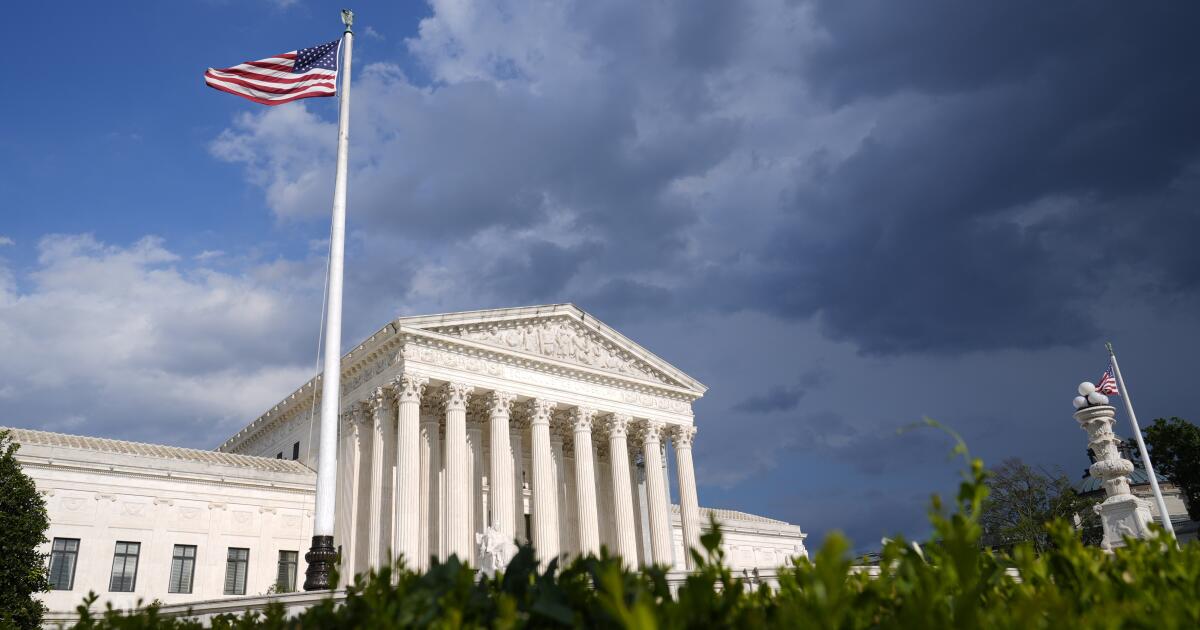
WASHINGTON — The Supreme Court cast doubt Monday on whether police may obtain cellphone data to find crime suspects.
In a 6-3 decision, the justices said this location information showing where a cellphone user has traveled is personal and private and subject to the protection of the 4th Amendment’s ban on unreasonable searches.
Justice Elena Kagan said these “records serve as a personal journal of a user’s movements.”
She said the information “resembles other private materials — think of emails, documents, photographs, or calendars—that even if stored on Google’s servers, a user reasonably views as his own…and reasonably expects to be shielded from the inquisitive eyes of the government.”
Because an “individual has a legitimate expectation of privacy in his cellphone location data,” she said police investigators need a valid search warrant from a magistrate.
The court stopped short of deciding the proper basis for a search warrant in such cases. Instead, the justices sent the case back to judges in Virginia.
But the outcome casts doubt on “geofence warrants.”
In recent years, police have gone to Google and cellphone companies seeking tracking data on cellphones that were at a crime scene. Sometimes, they have had a warrant from a magistrate.
Civil libertarians say the use of this tracking data raises the specter of mass surveillance on innocent people.
Police and government lawyers say no one has a reasonable right to privacy when they are walking on a sidewalk or driving down the street.
The case before the court arose from the armed robbery conviction of a Virginia man who stole $195,000 from a credit union in a small town near Richmond.
By the time police arrived, the robber had fled. But surveillance cameras showed he was carrying a gun and a cellphone.
Lacking other leads, detective Joshua Hilton asked a judge to issue a special type of warrant seeking information from Google.
Referred to as a “geofence warrant,” it seeks data from phones in a particular area at a particular time.
The detective sought data on phones that were within 150 yards of the credit union within one hour of the late afternoon robbery.
After examining and paring down the data, the detective asked for the phone records of Okello Chatrie. Then, with a search warrant of his home, investigators found two robbery-style demand notes, a semi-automatic pistol and about $100,000 in cash.
A judge refused to suppress the evidence from an allegedly unconstitutional search, and Chatrie entered a conditional guilty plea.
The full 4th Circuit Court of Appeals split evenly on the legality of the geofence warrant, and the Supreme Court agreed to decide the issue in Chatrie vs. U.S.
Usually investigators obtain warrants to search the home or vehicle of a known crime suspect.
The new and disputed geofence warrants seek to find a suspect by examining data on the cellphones that were at the scene of a crime.
The FBI used this cellphone data in 2021 to identify suspects who broke through police barricades on Jan. 6, 2021, and pushed their way into the Capitol to disrupt the official counting of electoral votes.
Chief Justice John G. Roberts Jr. and Justices Sonia Sotomayor, Neil M. Gorsuch, Brett M. Kavanaugh and Ketanji Brown Jackson agreed on the outcome in Chatrie vs. U.S.
In a 21-page dissent, Justice Samuel A. Alito Jr. said the court had “carefully set the stage for its planned performance: striking a pose as a great champion of privacy in the digital age. I cannot support this irresponsible escapade.”
Justice Clarence Thomas agreed.
Justice Amy Coney Barrett agreed in a one-paragraph dissent. “Chatrie had no reasonable expectation of privacy in data about his public movements that he voluntarily disclosed to Google,” she said.
The Supreme Court ruled 6-3 that President Trump could fire independent regulators for any reason. But the justices carved out an exception for the Federal Reserve, preventing the immediate removal of Lisa D. Cook, a Federal Reserve governor.
-

 Illinois8 minutes ago
Serial Springfield Township sex offender faces public indecency charge
-

 Idaho10 minutes ago
Idaho man seriously injured in western Kansas motorcycle crash
-

 Indiana18 minutes ago
Indiana faces high odds of backyard fireworks accidents
-

 Iowa25 minutes ago
Laid-off Iowa state IT workers receive offers from private company
-

 Kansas28 minutes ago
2 rescued from roof as house fire breaks out in Kansas City
-

 Kentucky28 minutes ago
Kentucky Wildcat News: Milan Momcilovic explains why he chose UK
-

 Louisiana40 minutes ago
Louisiana is epicenter for red snapper fishing in Gulf of America
-

 Maine43 minutes ago
Maine could face $50M in penalties from federal food assistance policy changes

