Politics
New Lawsuit Challenges Legality of Trump’s Sending Migrants to Guantánamo


The Trump administration faced the first direct legal challenge to its policy of sending migrants to the U.S. military base at Guantánamo Bay, Cuba, for continued immigration detention with a lawsuit filed on Saturday by a coalition of human rights and immigrant advocacy organizations.
“Plaintiffs seek this court’s intervention to put a stop to these cruel, unnecessary and illegal transfers to and detention at Guantánamo,” the newly filed complaint said.
The plaintiffs, led by the American Civil Liberties Union, are for now seeking a judicial stay to block the transfer of 10 migrants whom the coalition signed up to represent. But it appears to lay the groundwork to seek a potential broader order against the transfer policy, which has raised many novel legal issues.
The 10 migrants named in the lawsuit each has final removal orders, it said, and comes from countries including Afghanistan, Bangladesh, Pakistan and Venezuela. The lawsuit asserts that none are gang members, and some have been specifically threatened with transfer to Guantánamo.
“In attempting to justify the transfers, the government has claimed that the individuals it sent to Guantánamo are members of gangs and dangerous criminals — the ‘worst of the worst,’” the complaint said, citing a remark in January by Defense Secretary Pete Hegseth.
It continued: “That characterization is patently false. It is also legally irrelevant because the government lacks statutory authority to send any immigration detainees from the United States to Guantánamo.”
The Justice Department press office did not immediately respond to a request for comment.
The lawsuit is not the first to challenge aspects of President Trump’s policy. Last month, a judge prevented the government from moving three Venezuelan men who were being held in immigration detention in New Mexico to the base, and a group of legal aid organizations sued the administration asking that migrants taken there have access to lawyers.
Neither of those cases, however, directly addressed the legality of the overall policy. The new lawsuit claims that it exceeds the government’s authority under the Immigration and Nationality Act to take the migrants to Cuban soil, and that the government has no statutory authority to detain people outside the United States for immigration purposes.
Calling such transfers “arbitrary and capricious,” the lawsuit also claims that the policy violates the Administrative Procedure Act and the migrants’ due process rights.
“It’s not just that it’s illegal, but wholly illogical from a cost standpoint, something this administration supposedly cares about,” said Lee Gelernt of the American Civil Liberties Union, who is the lead lawyer in the lawsuit. “The administration has had its Guantánamo photo op moments, and now it’s time to move on.”
It has not been clear whether there is any concrete policy advantage to the cost that taxpayers are incurring for flying migrants to the remote island base rather than housing them more cheaply on U.S. soil until directly deporting them to their home countries.
But the operation has generated stories that could send a deterrent message — a purpose Mr. Hegseth appeared to allude to last week when he visited the base with a former colleague from Fox News.
“The message is clear: If you break the law, if you are a criminal, you can find your way at Guantánamo Bay,” Mr. Hegseth told Fox. “You don’t want to be at Guantánamo Bay, which is where we housed Al Qaeda after 9/11.”
Mr. Trump directed the U.S. military and the Homeland Security Department on Jan. 29 to prepare to expand a migrant operations center at Guantánamo Bay, saying it would “provide additional detention space for high-priority criminal aliens unlawfully present in the United States.”
Soon after, the military began transporting migrants to the base on what became near daily flights from an immigration site in El Paso. Despite the Trump administration’s portrayal of them as criminals, only some of the migrants who have been identified as being transferred to the base have had criminal records.
The first 178 migrants taken there were all citizens of Venezuela, a country to where deporting people had been difficult because of a breakdown in relations between its authoritarian government and the United States.
However, the Trump administration has persuaded Venezuela to begin taking its people back. On Feb. 20, it abruptly cleared out the detention operation, sending 177 migrants to Honduras where they were picked up by a Venezuelan plane and taken home. (One man had earlier been transferred back to the United States.)
Then, in a series of flights starting on Feb. 23, the administration began sending more migrants there, this time from a spectrum of other countries including Honduras, Colombia, El Salvador, Guatemala and Ecuador, according to a document seen by The New York Times. They ranged in age from 23 to 62.
As of Friday morning, the military was holding 26 migrants in a dormitory-style building handled by the Coast Guard, where it has been housing those deemed to be “lower risk,” and 17 men in a war-on-terror prison called Camp 6, where it has sent those deemed “high risk,” according to a defense official who was not authorized to speak about the matter by name.
Nine migrants were sent back to the United States this week. Another flight arrived Friday afternoon, but the number migrants who were on it and which of the two holding facilities they were sent to is unclear.
The new lawsuit is likely to be handled by Judge Carl Nichols of the Federal District Court in Washington. Judge Nichols, a Trump appointee, was earlier assigned the legal access suit, and the coalition filed the new lawsuit as a related matter. Mr. Gelernt is also the lead lawyer in the earlier case.



As anyone who has ever seen his buildings knows, Donald Trump has always liked to see his name displayed prominently. It’s become a hallmark of his presidency, to the point that the Treasury Department announced on Thursday that President Trump’s signature will appear on U.S. dollars later this year, a first for a sitting U.S. president.
The move is the latest reflecting a push to imprint his personal brand on Washington and the nation in ways that could outlast his presidency.
In total, since the start of Mr. Trump’s second term, there have been more than a dozen instances of his name, image or signature emblazoned on a variety of American initiatives and institutions. Some changes seem as if they could be lasting, some are caught up in the courts, and others may never get off the ground.
Here is a look at that ever-growing list.
Already approved uses
Joseph Eid/AFP via Getty Images, Stephen Crowley/The New York Times

U.S. Treasury
Eric Lee/The New York Times
Eric Lee/The New York Times
Trump Card
TrumpRX
Dr. Mehmet Oz, who runs Medicare and Medicaid, has said that Mr. Trump was not involved in picking the name. “We thought it had a catchy element to it,” he said.
Trump Accounts
Department of Interior, via Center for Biological Diversity
U.S. Navy
U.S. Air Force
Proposed uses
Johnny Milano/The New York Times
Todd Heisler/The New York Times
Shawn Thew/EPA, via Shutterstock
Washington Commanders
Ruth Fremson/The New York Times
Joseph Eid/AFP via Getty Images
Chip Somodevilla/Getty Images

NEWYou can now listen to Fox News articles!
A bipartisan group of lawmakers found Rep. Sheila Cherfilus-McCormick, D-Fla., guilty of more than two dozen ethics violations, but House Democratic leadership is standing by their embattled colleague.
“As I understand it, the Ethics Committee has one final step in their process, so I’m not going to get out ahead of the Ethics Committee process that will be completed upon our return,” House Minority Leader Hakeem Jeffries, D-N.Y., said Friday morning. “And then I’ll have more to say.”
House Democratic Conference Chairman Rep. Pete Aguilar, D-Calif., also told Punchbowl News on Friday that he had not seen the ethics panel’s findings, but added “that doesn’t sound good” when told the body determined that she committed 25 ethics violations. Those charges include money laundering, making false statements on campaign finance reports and seeking special favors from entities receiving federal funding.
INDICTED DEMOCRAT REP. SHEILA CHERFILUS-MCCORMICK ONE STEP CLOSER TO EXPULSION
An eight-member House Ethics investigative subcommittee determined Friday that Rep. Sheila Cherfilus-McCormick, D-Fla., committed 25 House ethics violations, which could lead to her potential expulsion from the House of Representatives. (Joe Cavaretta/South Florida Sun Sentinel/Tribune News Service via Getty Images)
The Florida Democrat is facing a separate federal criminal indictment that could result in more than five decades in prison if convicted. Cherfilus-McCormick, who has pleaded not guilty, is accused of illegally transferring millions in disaster relief funds improperly paid to her family’s healthcare company to finance her run for Congress and the purchase of luxury items, including a massive diamond ring.
The House Ethics Committee said it would announce its recommended punishment for Cherfilus-McCormick in April, which could be as severe as expulsion. Under House rules, a two-thirds majority would have to support the resolution to formally remove the Florida Democrat from the chamber.
Jeffries’ refusal so far to condemn Cherfilus-McCormick’s conduct mirrors the relative silence of the Democratic caucus, though some rank-and-file members are beginning to break their silence on the Florida Democrat.
Moderate Rep. Marie Gluesenkamp Perez, D-Wash., was the first Democratic lawmaker to publicly issue a statement Friday calling on Cherfilus-McCormick to resign or be removed following the guilty verdict.
“You can’t crime your way into legitimate power,” Gluesenkamp Perez wrote. “Since she was found guilty, she should resign or be removed.”
House Minority Leader Hakeem Jeffries, D-N.Y. has so far refused to condemn Rep. Sheila Cherfilus-McComrick, an indicted lawmaker facing a looming expulsion threat. (Kevin Dietsch/Getty Images; Andrew Harnik/Getty Images)
HOUSE DEMOCRAT ACCUSES FELLOW DEM OF VIOLATING A ‘FREE AND FAIR ELECTION’ IN STUNNING PUBLIC MOVE
A handful of other congressional Democrats said Friday that they would consider backing an expulsion resolution if the indicted lawmaker did not leave on her own terms.
A Jeffries spokeperson did not respond to Fox News Digital’s request for comment.
Despite the looming expulsion threat, Cherfilus-McCormick has given no indication that she will resign. She is also running for a fourth term in November’s midterm elections.
“I look forward to proving my innocence,” Cherfilus-McCormick said in a statement Friday. “Until then, my focus remains where it belongs: showing up for the great people of Florida’s 20th District who sent me to Washington to fight for them.”
Rep. Marie Gluesenkamp Perez, D-Wash., was the first congressional Democrat to call for Rep. Sheila Cherfilus-McCormick to resign or be removed following the conclusion of a rare House ethics hearing. (Tom Williams/CQ-Roll Call, Inc via Getty Images)
CLICK HERE TO DOWNLOAD THE FOX NEWS APP
The National Republican Congressional Committee (NRCC), House Republicans’ campaign arm, ripped congressional Democrats’ lack of outrage over Cherfilus-McCormick’s conduct.
“The Ethics Committee just confirmed that Sheila Cherfilus-McCormick broke the rules, and House Democrats are still saying nothing,” NRCC spokesman Mike Marinella said Friday. “Their silence is a choice. Democrats can stand for accountability or keep protecting a proven ethics violator, but voters won’t forget it.”
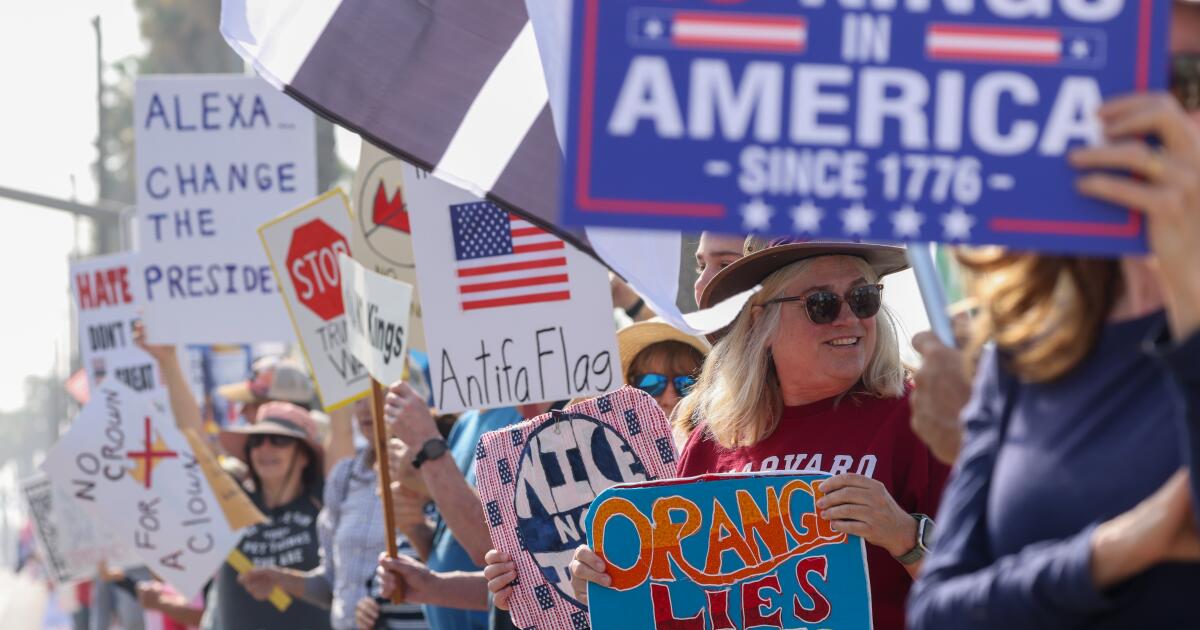
A rolling wave of “No Kings” protests swelled through America’s small towns and big cities Saturday, with crowds gathering to blast President Trump, Immigration and Customs Enforcement crackdowns, the war in Iran and high gas and food prices.
Saturday’s demonstrations were expected to draw millions of people nationwide, including thousands for a downtown Los Angeles rally. More than 40 protests were planned for L.A., Orange and Ventura counties, part of the national “No Kings Day of Nonviolent Action.”
No Kings Coalition organizers were hoping that turnout for the rallies in all 50 states could combine to form the largest single-day protest in U.S. history. They pointed to growing anger over the country’s direction, including fatal ICE shootings and troops dispatched to the Middle East, since the first “No Kings” demonstration was held last June.
On Saturday morning, hundreds gathered around the reflecting pool at Pasadena City College. A band rolled through with a fascism-themed parody of Johnny Cash’s “Folsom Prison Blues.” Sign-toting protesters lined Colorado Boulevard, drawing a constant stream of honking from the cars driving by. For many, the Iran war was top of mind.
“Every time we protest, there’s something completely new, which speaks to the chaos of the Trump administration,” Cindy Campbell told The Times. “ICE raids last year, Epstein files a few months ago. Now, war.”
“This administration doesn’t serve us. It serves billionaires,” said Kent Miller, of Monrovia, who participated in the Pasadena protest. “War with Iran is only making life harder for working people.”
Miller pointed to a Chevron gas station advertising gas for $6.45 per gallon.
“See?” he said.
National coordinators said there has been increased interest in smaller communities, including Republican bastions, with higher-than-expected attendance during Saturday’s protests.
“I’m out here because I’m disgusted with what I’m seeing,” said Kersty Kinsey, a mother who was protesting near the Beaufort, S.C., City Hall. “People are suffering, and he’s playing golf. People are suffering, and he’s going other places and blowing things up.”
In Beaufort, an antebellum city founded in 1711, an estimated 3,000 people turned out — a marked increase over earlier “No Kings” rallies, said Barb Nash, one of the coordinators. Amid the moss-draped live oaks and blooming pink and white azaleas, a person in a purple Barney dinosaur costume held a sign reading: “Dino’s for Democracy.” A young girl handed out homemade “Resistance Cookies.”
Los Angeles coordinators said they expect more than 100,000 people at the local events, which were being planned for Beverly Hills, Burbank, West Covina, West Hollywood and Thousand Oaks. One group planned a “Road Outrage” car caravan to motor through Mid City with flapping flags calling for “No War,” and “ICE Out of LA.” At a Torrance gathering, cars honked, protesters waved flags, and a person in an inflatable green cow costume hoisted a large American flag.
The White House, in a Saturday statement, dismissed the protests as a “Trump Derangement Therapy Session.”
Organizers said they have been particularly encouraged by the surge of interest from groups in rural communities that wanted to join the loose-knit No Kings Coalition and hold protests.
Jaynie Parrish, founder of the Arizona Native Vote project, started planning a protest for her tiny town of Kayenta, on the Navajo Nation in northern Arizona, only earlier this week.
“My dad, who’s a [military] veteran and an elder, said: ‘We should go,’ and I said, ‘OK,’” Parrish told The Times.
“Our folks don’t always protest for things, but this was very important,” Parrish said. “A lot of our families are feeling the impacts right now of higher prices and things being cut. A lot of our healthcare benefits are being cut … and our tribal sovereignty is being threatened.”
Upbeat Midwestern activists withstood whipping winds to form a line of protesters stretching nearly three blocks of Burlington Avenue in Hastings, Neb. Under the crisp blue skies, one of the protesters, Drew Fausett, told The Times in a phone interview that he is a registered Republican in the decidedly red state.
“My politics haven’t really changed — but the party around me has,” Fausett said. “It used to be the two parties were two sides of the same coin, and they would work together — but not anymore.”
He and his wife, Becky, have attended “No Kings” and other protests because “it’s the only way to show that people have different opinions,” he said. “People are out here speaking for their families and their neighbors. That’s what this is all about.”
Trump’s policies are hurting many in Nebraska — including farmers, said Debby Thompson, one of the Hastings organizers.
“We want to urge our representatives in Congress to not just rubber stamp whatever Trump wants because it’s really hurting rural folks and farmers,” Thompson said. “The tariffs and huge increase in prices on fertilizer are hitting farmers really hard.”
The “No Kings” campaign sprouted in June as an act of defiance on Trump’s 79th birthday. He wanted a military parade in Washington to mark his milestone, and anti-Trump protesters came out in force — an estimated 5 million people around the country — with their own display. At the time, Trump’s second-term policies were coming into focus, including ramping up immigration raids, deploying the National Guard to L.A. in response to protests, and mass firings within the federal government.
A subsequent event in mid-October drew even larger crowds, with an estimated 7 million people protesting around the country.
Saturday’s event coincided with a dip in Trump’s approval ratings. A Reuters/Ipsos poll last week found 36% approve of Trump’s job performance, marking the lowest level since his return to office last year. In a separate Fox News Poll released last week, 59% disapproved of his job performance.
“Since the last ‘No Kings,’ we’re seeing higher gas prices and groceries, all while there’s an illegal war in Iran,” national organizer Sarah Parker of the organization 50501 said during a Thursday press briefing. “We’ve also seen our neighbors executed — American citizens executed.”
Widespread protests and candlelight vigils followed January’s fatal shootings by ICE agents in Minneapolis of Renee Good, a 37-year-old mother of three, and Alex Pretti, a 37-year-old intensive care unit nurse.
“The defining story of this Saturday’s mobilization is not just how many people are protesting — but where they are protesting,” Leah Greenberg, co-founder of Indivisible, said during the press briefing. She said two-thirds of the RSVPs to national organizers came from outside of major urban centers.
The Los Angeles event was organized by the local chapter of 50501 (short for “50 protests, 50 states, 1 movement”) and other progressive groups, including the ACLU, Human Rights Campaign, Indivisible and Public Citizen, as well as labor unions such as Unite Here Local 11 and the Service Workers International Union.
“There’s an affordability crisis in this country — people can’t afford groceries or healthcare,” Joseph Bryant, SEIU executive vice president, said in a statement. “But this administration is focused on expanding its power, starting unnecessary wars that benefit billionaires, and targeting immigrants and citizens who dare to stand up for them.”

Lifeguards recover body of man believed to have drowned in Oceanside
![!$+∇√$[+[!LIVESTREAMs!]+] San Antonio Spurs vs Milwaukee Bucks Live Free Streams On Tv Channel 2026-03-29](https://i3.wp.com/encrypted-tbn0.gstatic.com/images?q=tbn:ANd9GcReQZPBURuIIuh0fPF6YTAqOY-y1_BeWJWzPA&s&w=80&resize=80,80&ssl=1 "!$+∇√$[+[!LIVESTREAMs!]+] San Antonio Spurs vs Milwaukee Bucks Live Free Streams On Tv Channel 2026-03-29")
!$+∇√$[+[!LIVESTREAMs!]+] San Antonio Spurs vs Milwaukee Bucks Live Free Streams On Tv Channel 2026-03-29

Instant Takeaways From A Historic Atlanta Hawks Win Over The Sacramento Kings

Man found dead in south Minneapolis house fire

Mt. Vernon boys basketball wins program’s first state title

Florida High School Football Rankings: Top 25 teams – Oct. 21

How old is Bo Nix? What to know about Oregon quarterback ahead of 2024 NFL Draft

Cleary's 21 help Le Moyne down Central Connecticut State 69-64 in OT

99th annual Pony Swim held in Virginia

Indiana Members Credit Union announced as new anchor tenant at Bottleworks District

Jeffries declines to break with indicted Democrat after ethics panel’s guilty verdict

Hundreds of thousands march through London in stand against the far right

2 students killed, 7 other people injured in Tennessee bus crash during school field trip

Dem senators dodge crucial question on illegal alien accused of killing Chicago college student

EU Parliament unblocks key political hurdle in digital euro talks
-

 Movie Reviews1 week ago
‘Youth’ Twitter review: Ken Karunaas impresses audiences; Suraj Venjaramoodu adds charm; music wins praise | – The Times of India
-

 Sports1 week ago
IOC addresses execution of 19-year-old Iranian wrestler Saleh Mohammadi
-

 New Mexico6 days ago
Clovis shooting leaves one dead, four injured
-
 Business1 week ago
Disney’s new CEO says his focus is on storytelling and creativity
-

 Tennessee5 days ago
Tennessee Police Investigating Alleged Assault Involving ‘Reacher’ Star Alan Ritchson
-

 Technology6 days ago
YouTube job scam text: How to spot it fast
-

 Minneapolis, MN3 days ago
Boy who shielded classmate during school shooting receives Medal of Honor
-

 Texas1 week ago
How to buy Houston vs. Texas A&M 2026 March Madness tickets