Politics
Litman: Does it matter that Donald Trump just became a convicted criminal? Of course it does

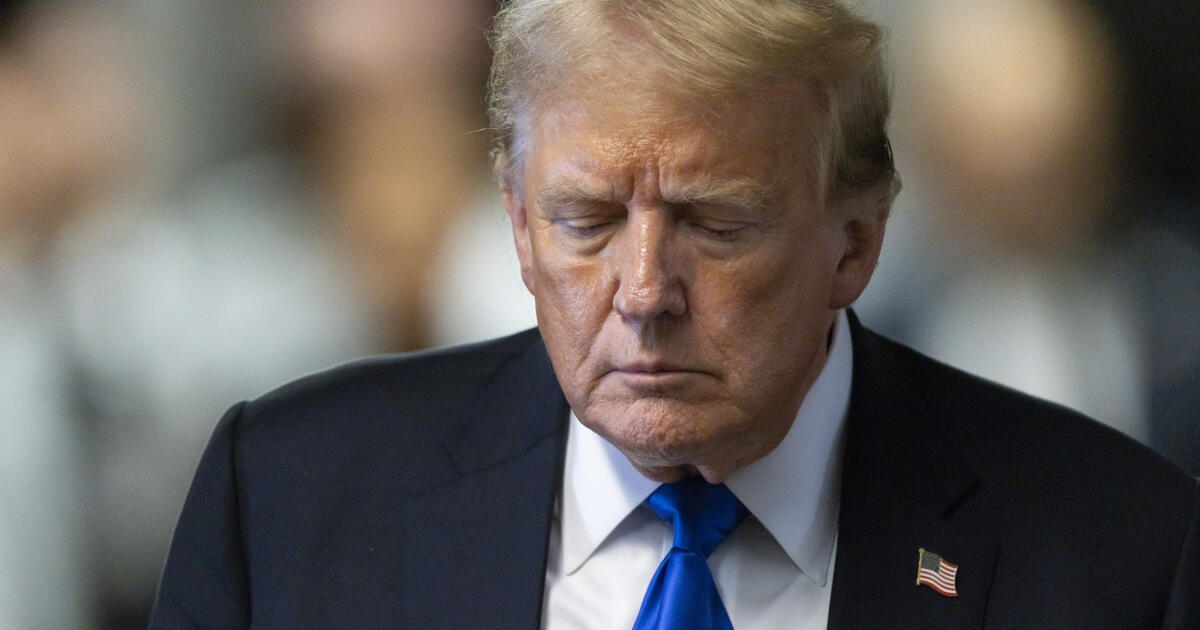
It’s of course true that come Nov. 5, the nation’s voters could well decide to shrug off the historic guilty verdict that a Manhattan jury rendered against Donald Trump on Thursday afternoon. And that is the conclusion many have already reached about the seismic event that just took place in Room 1530 of the Manhattan Criminal Courthouse: It’s hollow unless it ignites the will to deliver a popular denunciation of the former president this fall.
That analysis is, in my view, myopic.
It’s always been the case that the American people can override the rule of law — a normally slight risk that has roared forward in recent years under the whip hand of a would-be tyrant. That’s the message that a furious and ashen Trump delivered when he emerged from the courtroom where a jury of seven men and five women gave the prosecution all it asked for by convicting him on 34 felony counts. “The real verdict,” Trump barked, “is going to be November 5th by the people.”
In fact, the jury that delivered the real verdict, and the judge who presided over the hush money trial and is expected to sentence him in July, did their work conscientiously and even doggedly under a hailstorm of insults and threats from the defendant and his supporters. We have for years hoped for such a measure of accountability for the unrepentant former president. It finally arrived, and the center held.
Unlike the insults, the accolades showered on the jurors and Judge Juan M. Merchan are more than deserved. Having attended most of the trial, I think their seriousness of purpose matched the gravity of their duties.
But it wasn’t just the determination of the jury, judge and prosecutors that forced Trump to endure weeks of damning testimony in person and to now face at least the possibility of a short prison term. And it wasn’t just the resolve of the witnesses, some of whom retain loyalty or at least affection for Trump but understood their legal duty to testify truthfully.
Merchan’s firm hold of the reins bolstered his authority, but what really made the difference was his robe, or what his robe represents. Trump was forced to submit to a whole regime that ultimately springs from our deepest constitutional values of fairness and equality before the law. How galling for a man who holds such deep contempt for — indeed seems incapable of apprehending — the rule of law rather than men.
Now what? First of all, Trump is an altered figure in the eyes of that law. No longer presumed innocent, he is proven guilty, a convict, a serial offender. And like any other convict, he will have to sit down for an interview with the probation office, which will prepare a report and recommendation for the judge based on its assessment of Trump’s offenses and his acceptance of responsibility, among other factors. That doesn’t augur well for a man who has spent a lifetime failing to own up to misconduct.
Merchan set sentencing for July 11, when he may well take into account Trump’s perverse lack of remorse and contempt for the system that convicted him. The sentence will be at the discretion of the judge, who will no doubt strive to handle it as he would for any other similarly convicted felon.
Next will come the inevitable appeal of the conviction, in which Trump’s lawyers will likely allege that the trial was tainted by several serious errors. And the legal issues here were complicated enough to present a risk of reversal regardless of how Merchan handled them.
But the measured pace of justice has finally ceased to serve Trump’s interests in this case. It will be a year and a half or more before there is any possibility of a reversal of the sentence or conviction. By then, Trump figures to be either a convict in other forums — and today’s groundbreaking result can only make convictions in his three other criminal cases more plausible — or a president taking a wrecking ball to the entire legal system.
Again, though, that prospect has always been on the horizon. The full and fair operation of the rule of law to hold a former president accountable, however, was not.
On the contrary, it has often seemed over the last few years as if some combination of power-mongering, legal bluster, friends in high places (some of them wearing judicial robes) and bizarre good luck would invariably combine to insulate Trump from the law that is supposed to apply to all of us. Indeed, we can fairly expect that at some point in the coming weeks, the U.S. Supreme Court will render an opinion that will serve both to elevate future presidents above the law to an extent and to forestall the most important trial Trump faces, the federal Jan. 6 case, until after the election.
Today, though, the law prevailed in a fashion that was at the same time basic and majestic. Trump received a fair trial and due process, no more and no less than the next defendant who will be in the same seat in the same dilapidated courtroom where he spent most of the last six weeks. Given all the powerful forces aligned against the rule of law in recent years, we should see that as nothing less than a triumph in and of itself.
Harry Litman is the host of the “Talking Feds” podcast and the Talking San Diego speaker series. @harrylitman



Politics
Fetterman unleashes on ‘dirtbag’ wing of Dems after far-left victories: ‘Orgy of socialism’

NEWYou can now listen to Fox News articles!
Sen. John Fetterman, D-Pa., unloaded on his own party on Sunday evening, blasting a series of victories for progressives he called “anti-America.”
“Big night for the dirtbag left,” Fetterman said, referring to New York’s recent primaries, where two members of the Democratic Socialists of America (DSA) won primaries.
“I’ve said the party is becoming an orgy of socialism. Clearly anti-America, anti-Western Civilization,” Fetterman said.
Fetterman’s striking calls give a rare look at how some moderates may view the developments on their far-left flank that have dominated the party’s momentum in recent months, sparking concern that their high visibility is dragging the party further and further left.
FETTERMAN WARNS DEMOCRATS ‘DRIFTING FIRMLY INTO COMMUNISM’ AFTER SOCIALIST PRIMARY WINS
Sen. John Fetterman, D-Pa., speaks to reporters outside the Senate Chamber during votes on Nov. 10, 2025, on Capitol Hill in Washington, D.C. (Andrew Harnik/Getty Images)
His comments come on the heels of a handful of key progressive victories.
In Maine, Graham Platner, a controversial Democratic candidate for U.S. Senate, has attracted controversy for denying knowledge of the meaning behind a Nazi-linked tattoo, for off-color comments about race and calling himself a “communist” in a deleted Reddit post.
In New York, one DSA member, Claire Valdez, won a primary on a platform of abolishing ICE and a Green New Deal-style approach to climate change. Similarly, Darializa Avila-Chevalier, another DSA candidate, beat out incumbent Rep. Adriano Espillat, D-N.Y., a high-ranking Democrat and the chair of the Congressional Hispanic Caucus.
WINNERS AND LOSERS EMERGE AFTER SOCIALIST EARTHQUAKE ROCKS NYC PRIMARIES
Graham Platner, Democratic Senate candidate for Maine, speaks at a primary election night event at the Blue Hill YMCA in Blue Hill, Maine, on June 9, 2026. Platner won the party’s Senate primary after a campaign marked by accusations of past misbehavior and voter concerns. (Graeme Sloan/Bloomberg via Getty Images)
Both Chevalier and Valdez had the backing of New York Mayor Zohran Mamdani, himself a socialist.
The wins have captured national attention and drawn criticisms from Republicans who have pointed to their success as emblematic of the direction of the Democratic Party.
Fetterman, who has not shied away from confrontations, has been one of the few Democrats to express alarm about the kind of candidates carrying the party’s banner.
“I mean, you look at some of the things that people have said. Abolish prison, abolish the border, abolish ICE, I mean these crazy people — I have colleagues in my caucus that refuse to even call this out,” Fetterman said.
FETTERMAN REACTS TO MAMDANI’S REFUSAL TO ACCEPT SUPREME COURT’S IMMIGRATION RULING
U.S. Sen. John Fetterman, D-Pa., walks through the Senate Subway during the Senate War Powers vote on April 22, 2026, in Washington, D.C. (Heather Diehl/Getty Images)
CLICK HERE TO DOWNLOAD THE FOX NEWS APP
“Between P-hustle in Maine and some of the other winners in New York, they should form their own party and run on all the things that they’ve had to delete on social media,” Fetterman said, referring to Platner.
“That’s where our party has moved,” he added.
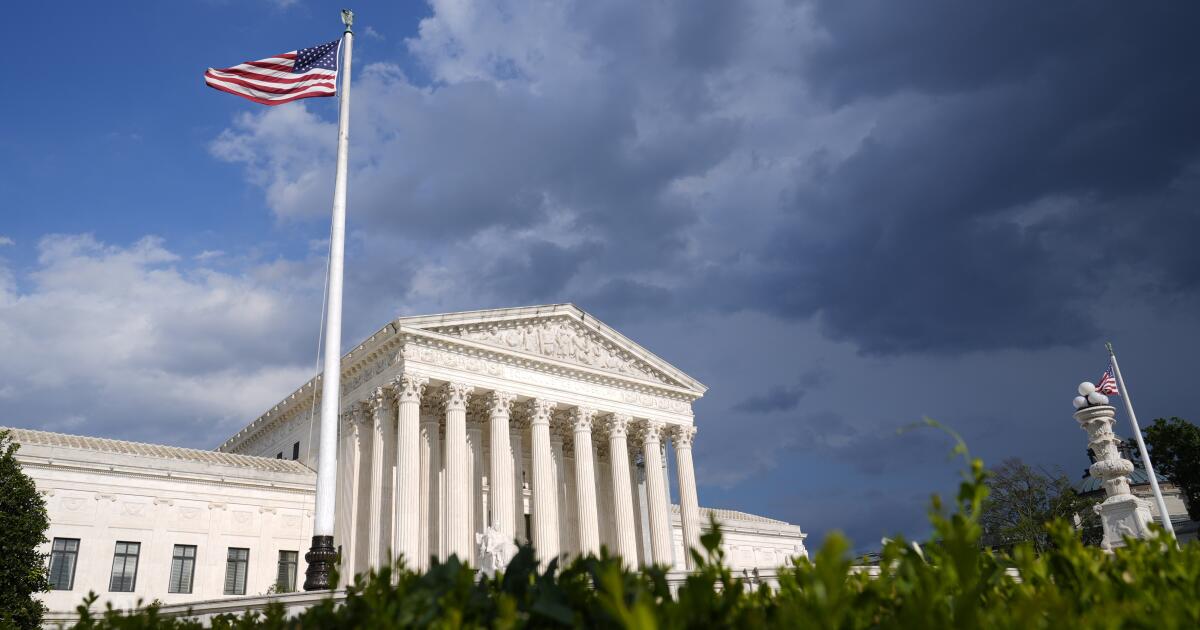
WASHINGTON — The Supreme Court cast doubt Monday on whether police may obtain cellphone data to find crime suspects.
In a 6-3 decision, the justices said this location information showing where a cellphone user has traveled is personal and private and subject to the protection of the 4th Amendment’s ban on unreasonable searches.
Justice Elena Kagan said these “records serve as a personal journal of a user’s movements.”
She said the information “resembles other private materials — think of emails, documents, photographs, or calendars—that even if stored on Google’s servers, a user reasonably views as his own…and reasonably expects to be shielded from the inquisitive eyes of the government.”
Because an “individual has a legitimate expectation of privacy in his cellphone location data,” she said police investigators need a valid search warrant from a magistrate.
The court stopped short of deciding the proper basis for a search warrant in such cases. Instead, the justices sent the case back to judges in Virginia.
But the outcome casts doubt on “geofence warrants.”
In recent years, police have gone to Google and cellphone companies seeking tracking data on cellphones that were at a crime scene. Sometimes, they have had a warrant from a magistrate.
Civil libertarians say the use of this tracking data raises the specter of mass surveillance on innocent people.
Police and government lawyers say no one has a reasonable right to privacy when they are walking on a sidewalk or driving down the street.
The case before the court arose from the armed robbery conviction of a Virginia man who stole $195,000 from a credit union in a small town near Richmond.
By the time police arrived, the robber had fled. But surveillance cameras showed he was carrying a gun and a cellphone.
Lacking other leads, detective Joshua Hilton asked a judge to issue a special type of warrant seeking information from Google.
Referred to as a “geofence warrant,” it seeks data from phones in a particular area at a particular time.
The detective sought data on phones that were within 150 yards of the credit union within one hour of the late afternoon robbery.
After examining and paring down the data, the detective asked for the phone records of Okello Chatrie. Then, with a search warrant of his home, investigators found two robbery-style demand notes, a semi-automatic pistol and about $100,000 in cash.
A judge refused to suppress the evidence from an allegedly unconstitutional search, and Chatrie entered a conditional guilty plea.
The full 4th Circuit Court of Appeals split evenly on the legality of the geofence warrant, and the Supreme Court agreed to decide the issue in Chatrie vs. U.S.
Usually investigators obtain warrants to search the home or vehicle of a known crime suspect.
The new and disputed geofence warrants seek to find a suspect by examining data on the cellphones that were at the scene of a crime.
The FBI used this cellphone data in 2021 to identify suspects who broke through police barricades on Jan. 6, 2021, and pushed their way into the Capitol to disrupt the official counting of electoral votes.
Chief Justice John G. Roberts Jr. and Justices Sonia Sotomayor, Neil M. Gorsuch, Brett M. Kavanaugh and Ketanji Brown Jackson agreed on the outcome in Chatrie vs. U.S.
In a 21-page dissent, Justice Samuel A. Alito Jr. said the court had “carefully set the stage for its planned performance: striking a pose as a great champion of privacy in the digital age. I cannot support this irresponsible escapade.”
Justice Clarence Thomas agreed.
Justice Amy Coney Barrett agreed in a one-paragraph dissent. “Chatrie had no reasonable expectation of privacy in data about his public movements that he voluntarily disclosed to Google,” she said.
The Supreme Court ruled 6-3 that President Trump could fire independent regulators for any reason. But the justices carved out an exception for the Federal Reserve, preventing the immediate removal of Lisa D. Cook, a Federal Reserve governor.
-

 Crypto3 minutes ago
Japanese Yen Sinks to 162.27, Its Weakest Since 1986, Reviving Intervention Bets
-

 Finance5 minutes ago
World Bank drops climate finance target amid US pressure
-

 Fitness11 minutes ago
Fitness Point: The Small Weekly Investment That Could Transform Your Health – KT PRESS
-

 Movie Reviews21 minutes ago
Movie Review – Minions & Monsters (2026)
-
World33 minutes ago
Pope issues last-ditch appeal, begs breakaway traditionalist group to back off bishop consecrations
-
 Lifestyle1 hour ago
How should we behave online? : It’s Been a Minute
-

 Technology1 hour ago
After a great start, DC’s new cinematic universe is already slowing down
-

 World1 hour ago
UK asylum seekers could have to pay government $13K before applying for settlement

