Politics
How Kevin McCarthy is influencing this congressional race — without being on the ballot

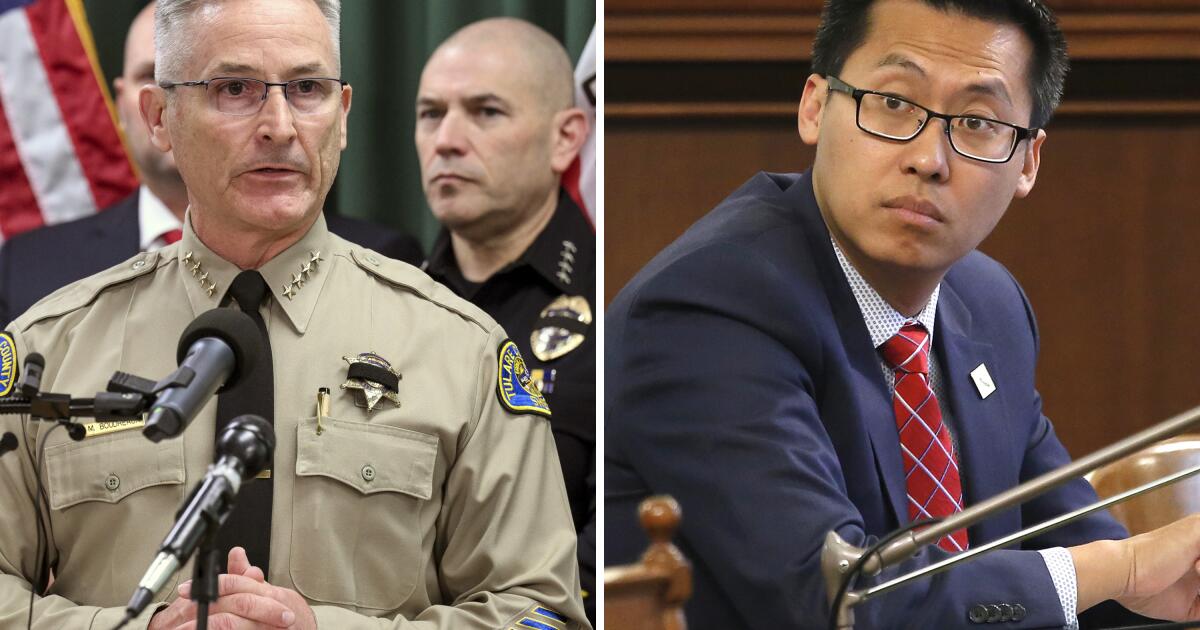
As he stood on a sun-dappled patio overlooking the Visalia Country Club, Tulare County Sheriff Mike Boudreaux didn’t mince words about his chances in his run for Congress.
“I am the underdog,” Boudreaux told a crowd of supporters. “I am pushing back against a machine that is so powerful that it’s very challenging, to say the least.”
The power behind the machine is former Rep. Kevin McCarthy (R-Bakersfield), who resigned from Congress last year after being voted out as House speaker. His name is not on the ballot, but McCarthy’s political influence and campaign funds are still major factors in the fight over who will serve out the remainder of his term in Congress.
Voters in the 20th Congressional District, the most conservative in California, will choose Tuesday between two Republican candidates: Boudreaux, a sheriff from the northern half of the district; and Assemblymember Vince Fong, a lawmaker who represents Bakersfield in Sacramento and previously worked for McCarthy.
The special election is expected to be a relatively low-key, low-turnout affair. But the stakes are high: Whoever wins the special election will be the incumbent on the November ballot, a significant advantage in the race for the full two-year term.
“Boudreaux is the outsider, the David vs. the Goliath,” said Mark Salvaggio, a Bakersfield political commentator and former member of the City Council. “Fong is McCarthy’s heir apparent, and the scales are tilted in his favor.”
Fong and Boudreaux are aligned on most major policy issues: opposing abortion, reducing illegal immigration at the U.S.-Mexico border and securing better water and energy policies for the agricultural Central Valley.
Boudreaux, 57, has been the sheriff of Tulare County for more than a decade and serves as the head of the California State Sheriffs’ Assn.
“I’ve been on the streets, on patrol, enforcing issues of immigration and crime resulting from bad legislation,” Boudreaux said. “I have 38 years of real life experiences that I can take to the Hill.”
Fong, 44, began his career working for McCarthy’s predecessor, then-Rep. Bill Thomas, then worked for nearly a decade as McCarthy’s district director before winning a seat in the state Assembly in 2016.
Fong considers McCarthy a friend and mentor, but said he has spent years building his own track record in Sacramento, where he is the vice chair of the budget committee. He said he has fought for “fiscal sanity” and worked on bills to help the Central Valley address fentanyl, wildfires, supply chain shortages and water storage.
“We need the most experienced and effective voice possible,” Fong said. “We have enough people in Congress that want to be social influencers, but we need more people who are going to be focused on making good policy.”
Fong finished first in the March primary elections for the full two-year term and the remainder of McCarthy’s term. In fundraising he enjoys a wide lead, too.
Boudreaux raised about $425,000 by May 1, according to federal filings. Fong raised almost $1.5 million in the same period.
Fong’s campaign is running ads across the San Joaquin Valley and has hired a fundraiser who has worked for McCarthy, former Gov. Arnold Schwarzenegger and the California Republican Party.
McCarthy and Trump attend a legislation signing rally with local farmers in Bakersfield in 2020.
(David McNew / Getty Images)
A political action committee called Central Valley Values has reported raising an additional $950,000 to support Fong, according to federal filings. Of that, about $450,000 came through McCarthy’s Majority Committee PAC. The other $500,000 came from a new PAC funded by major Republican donors, including Barbara Grimm-Marshall of Bakersfield’s Grimmway Farms, the world’s largest carrot grower.
So far this year, Central Valley Values has spent nearly $400,000 on social media advertising, direct mail and text messages to support Fong, and more than $170,000 to oppose Boudreaux, federal filings show.
“The McCarthy machine is huge,” Boudreaux said. Running against it, he said, is “daunting, to say the least.”
Another sign of McCarthy’s involvement was President Trump’s endorsement of Fong in March. The endorsement was a blow to Boudreaux and a coup for Fong, who has largely avoided the culture wars that dominate factions of the GOP and is now seeking to win over right-wing Republicans skeptical of the political establishment.
McCarthy has previously helped guide Trump’s California endorsements, including persuading him two years ago not to endorse a right-wing challenger to Central Valley Rep. David Valadao (R-Hanford), who voted to impeach Trump after the Jan. 6 insurrection.
Republicans in the northern part of the district in Kings, Tulare and Fresno counties say the Boudreaux campaign is one way to express their frustration with how often their neighbors to the south call the political shots. Kern County, home to Bakersfield, is the traditional seat of power in the 20th District and is home to more than half the registered voters.
Retired Republican Rep. Connie Conway, who replaced former Rep. Devin Nunes after he resigned from Congress, said at the Boudreaux fundraiser, to laughter, that she had encountered “just a little pressure” not to endorse the sheriff.
“Kern County thinks they’re kingmakers,” said Boudreaux supporter Mariann Bettencourt, a former chair of the Tulare County Republican Party. “They don’t much like it when you run against them.”
Fong is well known and popular in Bakersfield. Red, white and blue signs supporting his campaign were visible recently outside homes, offices and businesses like Moo Creamery, a diner known for its homemade ice cream.
Bakersfield resident Marcia Albert, 75, said she had gotten to know Fong’s name over the years from hearing him on the radio and reading his name in the newspaper. She didn’t know much about Boudreaux.
A Republican who retired from the Monterey County district attorney’s office, Albert said she liked that Fong prioritized issues that matter to her, such as small government and immigration, especially the “crisis at the southern border.”
“He’s a strong conservative,” she said. “That’s what Washington needs.”
Bakersfield resident Brenda Popejoy, 74, said she didn’t much like either candidate. The retired government worker voted in the primary for Democrat Marisa Wood, who finished third with 22.6% of the vote. Popejoy said she’s voting Tuesday based on who she does know.
“McCarthy endorsed Fong, and I hate Kevin McCarthy,” Popejoy said. “So I’m voting for the other guy.”
Whether Fong could even enter the race was in question until recently.
Two months after being voted out as speaker of the House, McCarthy announced that he was leaving Congress at the end of 2023.
McCarthy’s retirement extended the filing period for the congressional race by five days. Boudreaux said he started getting calls from politicians who wanted him to run. Fong put out a statement saying he wouldn’t run, and Boudreaux entered the race.
Fong changed his mind four days later and filed to run for Congress. He told The Times that he had expected other candidates to enter the race, and when they didn’t, he had a change of heart after seeing a “massive void in the field, in terms of someone that was going to ensure that our community had an effective voice in Congress.”
Fong said that he tried to withdraw from his Assembly seat, but was blocked by Secretary of State Shirley N. Weber, a Democrat, who argued that the deadline had already passed. She also said that state election law barred candidates from running for two offices at the same time.
Fong’s campaign sued Weber, and won in court in Sacramento County and again in the 3rd District Court of Appeal.
Ken Weir, a member of the Bakersfield City Council and the head of the Kern County GOP, ran a write-in campaign for the 32nd District Assembly seat. He finished second in the primary, with about 15.9% of the vote to Fong’s 82.4%. Weir will appear as a candidate on the November ballot, alongside Fong.
If Fong is elected to both offices, he would resign from the Assembly and head to D.C., and election officials would hold a special election to fill the Assembly vacancy in 2025, a Fong campaign spokesman said.
With the school year inching toward a close and with summer on the horizon, interest in Tuesday’s special election remained faint compared with more day-to-day priorities, including rising costs.
As he played with his two young daughters at a park along the Kern River, Juan Perez, 24, said he had seen signs for Fong’s congressional campaign but didn’t know when the election was being held.
Perez, a landscaper who said he has voted for Republicans and Democrats, said he and his wife had both started working part time as food delivery drivers to help cover the rising cost of daily necessities such as diapers, groceries and gas.
“It feels like we’re falling behind every month,” Perez said. “Whoever wins, I don’t think it’s going to matter for me.”



NEWYou can now listen to Fox News articles!
Several House Republicans are pushing Speaker Mike Johnson, R-La., to go to war with the Senate GOP over an election security bill that has little chance of passing the upper chamber under current circumstances.
House GOP leaders convened a lawmaker-only call on Sunday in the wake of a massive military operation against Iran launched by the U.S. and Israel.
After leaders briefed House Republicans on how the chamber would respond to the ongoing conflict — including a vote on ending Democrats’ weeks-long government shutdown targeting the Department of Homeland Security (DHS) — Fox News Digital was told that several lawmakers raised concerns about the Senate not yet taking up the Safeguarding American Voter Eligiblity (SAVE America) Act. Among other provisions, the act would require voters in federal elections to produce valid ID and proof of citizenship.
Rep. Derrick Van Orden, R-Wis., was among those pushing the House to reject any bills from the Senate until the measure was taken up, telling Johnson according to multiple sources on the call, “If we don’t get this done, or at least show that we’ve got some backbone, we’re done. The midterms are over.”
Speaker of the House Mike Johnson, R-La., pauses for questions from reporters as he arrives for an early closed-door Republican Conference meeting at the Capitol in Washington, Tuesday, Feb. 3, 2026. (J. Scott Applewhite/AP Photo)
At least three other House Republicans shared similar concerns. Sources on the call said Rep. Brandon Gill, R-Texas, argued that GOP voters were “not enthused” heading into November and that “the single biggest thing” to turn that around would be forcing the Senate to pass the SAVE America Act.
The SAVE America Act passed the House last month with support from all Republicans and just one Democrat, Rep. Henry Cuellar, D-Texas.
JEFFRIES ACCUSES REPUBLICANS OF ‘VOTER SUPPRESSION’ OVER BILL REQUIRING VOTER ID, PROOF OF CITIZENSHIP
Republicans have pointed out on multiple occasions that voter ID measures have bipartisan support across multiple public polls and surveys. But Democrats have dismissed the legislation as an attempt at voter suppression ahead of the 2026 midterms.
Senate Majority Leader John Thune speaks at a press conference with other members of Senate Republican leadership following a policy luncheon in Washington, D.C. on Oct. 28, 2025. (Nathan Posner/Anadolu via Getty Images)
The legislation would require 60 votes in the Senate to break filibuster, which it’s likely not to get given Democrats’ near-uniform opposition. But House Republicans have pressured Senate Majority Leader John Thune to use a mechanism known as a standing filibuster to circumvent that — which Thune has signaled opposition to, given the vast amount of time it would take up in the Senate and potential unintended consequences in the amendment process.
It also comes as Congress grapples with the fallout from the strikes on Iran and the need to ensure safety for the U.S. domestically and for service members abroad, both of which will require close coordination between the two chambers.
Johnson told Republicans several times on the Sunday call that he was privately pressuring Thune on the bill but was wary of creating a public rift with his fellow GOP leader, sources said.
HARDLINE CONSERVATIVES DOUBLE DOWN TO SAVE THE SAVE ACT
“If we’re going to go to war against our own party in the Senate, there may be implications to that,” Johnson said at one point, according to people on the call. “So we want to be thoughtful and careful.”
Sen. Mike Lee, R-Utah, talks with a guest during a “Only Citizens Vote Bus Tour” rally in Upper Senate Park to urge Congress to pass the Safeguard American Voter Eligibility (SAVE) Act on Wednesday, Sept. 10, 2025. (Tom Williams/CQ-Roll Call, Inc via Getty Images)
At another point in the call, sources said Rep. Andrew Clyde, R-Ga., suggested pairing a coming vote on DHS funding with the SAVE America Act in order to force the Senate to take it up.
CLICK HERE TO DOWNLOAD THE FOX NEWS APP
But both Johnson and House Homeland Security Committee Chairman Andrew Garbarino, R-N.Y., were hesitant about such a move given the enhanced threat environment in the wake of the U.S. operation in Iran.
Both spoke out in favor of the SAVE America Act, people told Fox News Digital, but warned the current situation merited leaving the DHS funding bill on its own in a bid to end the partial shutdown, so the department could fully function as a national security shield.
Related Article


According to President Trump, the United States attacked Iran because the Islamic Republic posed “imminent threats” to the U.S. and its allies, including through its use of terrorist proxies and continued pursuit of nuclear weapons.
“Its menacing activities directly endanger the United States, our troops, our bases overseas and our allies throughout the world,” he said in a recorded statement Saturday.
According to leading Democrats in Congress, Trump’s justification is questionable, especially given his claims of having “completely obliterated” Iran’s nuclear capabilities in separate U.S. bombings last June.
“Everything I have heard from the administration before and after these strikes on Iran confirms this is a war of choice with no strategic endgame,” said Rep. Jim Himes (D-Conn.), ranking Democrat on the House Intelligence Committee and part of a small group of congressional leaders — the Gang of Eight — who were briefed on the operation by Secretary of State Marco Rubio.
That divide is bound to remain an issue politically heading into this year’s midterm elections, and could be a liability for Republicans — especially considering that some in the “America First” wing of the MAGA base were raising their own objections, citing Trump’s 2024 campaign pledges to extricate the U.S. from foreign wars, not start new ones.
The debate echoed a similar if less immediate one around President George W. Bush’s decision to go to war in Iraq following the Sept. 11, 2001, attacks, also based on claims that “weapons of mass destruction” posed an immediate threat. Those claims were later disproved by multiple findings that Iraq had no such arsenal, fueling recriminations from both political parties for years.
The latest divide also intensified unease over Congress ceding its wartime powers to the White House, which for years has assumed sweeping authority to attack foreign adversaries without direct congressional input in the name of addressing terrorism or preventing immediate harm to the nation or its troops.
Even prior to the weekend bombings, Democrats including Sen. Adam Schiff of California were pushing Congress to pass a resolution barring the Trump administration from attacking Iran without explicit congressional authorization.
“President Trump must come to Congress before using military force unless absolutely necessary to defend the United States from an imminent attack,” Sen. Tim Kaine (D-Va.), a member of the armed services and foreign relations committees, said in a statement Thursday.
In justifying the daylight strikes that killed Supreme Leader Ayatollah Ali Khamenei just two days later, Trump accused the Iranian government of having “waged an unending campaign of bloodshed and mass murder” for nearly half a century — including through attacks on U.S. military assets and commercial shipping vessels abroad — and of having “armed, trained and funded terrorist militias” in multiple countries, including Hezbollah and Hamas.
Trump said that after the U.S. bombed Iran last summer, it had warned Tehran “never to resume” its pursuit of nuclear weapons. “Instead, they attempted to rebuild their nuclear program and to continue developing long-range missiles that can now threaten our very good friends and allies in Europe, our troops stationed overseas, and could soon reach the American homeland,” he said.
Other Republican leaders largely backed the president.
“The United States did not start this conflict, but we will finish it. If you kill or threaten Americans anywhere in the world — as Iran has — then we will hunt you down, and we will kill you,” said Defense Secretary Pete Hegseth.
“Every president has talked about the threat posed by the Iranian regime. President Trump is the one with the courage to take bold, decisive action,” said Atty. Gen. Pam Bondi.
While Iran’s coordination with and sponsorship of groups such as Hezbollah and Hamas are well known, Trump’s claims about Tehran’s ongoing development of nuclear weapons systems are less established — and the administration has provided little evidence to back them up.
Democrats seized on that lack of fresh intelligence in their responses to the attacks, contrasting Trump’s latest statements about imminent threats with his assertion after last year’s bombings that the U.S. had all but eliminated Iran’s nuclear aspirations.
“Let’s be clear: The Iranian regime is horrible. But I have seen no imminent threat to the United States that would justify putting American troops in harm’s way,” said Sen. Mark Warner (D-Va.), vice chairman of the Senate Intelligence Committee and a member of the Gang of Eight. “What is the motivation here? Is it Iran’s nuclear program? Their missiles? Regime change?”
Senate Minority Leader Chuck Schumer (D-N.Y.) said in a statement that the Trump administration “has not provided Congress and the American people with critical details about the scope and immediacy of the threat,” and must do so.
House Minority Leader Hakeem Jeffries (D-N.Y.) said the Trump administration needs congressional authority to wage such attacks barring “exigent circumstances,” and didn’t have it.
“The Trump administration must explain itself to the American people and Congress immediately, provide an ironclad justification for this act of war, clearly define the national security objective and articulate a plan to avoid another costly, prolonged military quagmire in the Middle East,” he said.
After the U.S. military announced Sunday that three U.S. service personnel were killed and five others seriously wounded in the attacks, the demands for a clearer justification and new constraints on Trump only increased.
Rep. Ro Khanna (D-Fremont) said Sunday he is optimistic that Democrats will be unified in trying to pass the war powers resolution, and also that some Republicans will join them, given that the strikes have been unpopular among a portion of the MAGA base.
Rep. Thomas Massie (R-Ky.), who partnered with Khanna to force the release of the Jeffrey Epstein files, has said he will work with him again to push a congressional vote on war with Iran, which he said was “not ‘America First.’”
Benjamin Radd, a political scientist and senior fellow at the UCLA Burkle Center for International Relations, said that whether or not Iran represented an “imminent” threat to the U.S. depends not just on its nuclear capabilities, but on its broader desire and ability to inflict pain on the U.S. and its allies — as was made clear to both the U.S. and Israel after the Hamas attacks on Israel on Oct. 7, 2023, which Iran praised.
“If you are Israel or the United States, that’s imminent,” he said.
What happens next, Radd said, will largely depend on whether remaining Iranian leaders stick to Khamenei’s hard-line policies, or decide to negotiate anew with the U.S. He expects they might do the latter, because “it’s a fundamentalist regime, it’s not a suicidal regime,” and it’s now clear that the U.S. and Israel have the capabilities to take out Iranian leaders, Iran has little ability to defend itself, and China and Russia are not rushing to its aid.
How the strikes are viewed moving forward may also depend on what those leaders decide to do next, said Kevan Harris, an associate professor of sociology who teaches courses on Iran and Middle East politics at the UCLA International Institute.
If the conflict remains relatively contained, it could become a political win for Trump, with questions about the justification falling away. But if it spirals out of control, such questions are likely to only grow, as occurred in Iraq when things started to deteriorate there, he said.
Israel and the U.S. are betting that the conflict will remain manageable, which could turn out to be true, Harris said, but “the problem with war is you never really know what might happen.”
On Sunday, Iran launched retaliatory attacks on Israel and the wider Gulf region. Trump said the campaign against Iran continued “unabated,” though he may be willing to negotiate with the nation’s new leaders. It was unclear when Congress might take up the war powers measure.

new video loaded: Trump’s War of Choice With Iran

By David E. Sanger, Gilad Thaler, Thomas Vollkommer and Laura Salaberry
March 1, 2026

PHOTOS: Long Beach State Dirtbags vs. Washington State, Baseball

Setting sail on iceboats across a frozen lake in Wisconsin

West Virginia Surrenders Six-Run Lead, Falls in Series Finale to Kennesaw State

Meyer’s Late Score Lifts Wyoming past Air Force – SweetwaterNOW

Crypto Sector Suffers Exodus of Reliable Retail Investors | PYMNTS.com

Florida High School Football Rankings: Top 25 teams – Oct. 21

Cleary's 21 help Le Moyne down Central Connecticut State 69-64 in OT

How old is Bo Nix? What to know about Oregon quarterback ahead of 2024 NFL Draft

99th annual Pony Swim held in Virginia

Indiana Members Credit Union announced as new anchor tenant at Bottleworks District

House Republicans push Johnson to go to war with Senate over SAVE Act

Israel FM says Europe too divided, slams Spanish PM

Satellite images provide view inside Iran at war

Video: What the Texas Primary Battle Means for the Midterms

Dems’ potential 2028 hopefuls come out against US strikes on Iran
-

 World4 days ago
Exclusive: DeepSeek withholds latest AI model from US chipmakers including Nvidia, sources say
-

 Massachusetts4 days ago
Mother and daughter injured in Taunton house explosion
-

 Denver, CO4 days ago
10 acres charred, 5 injured in Thornton grass fire, evacuation orders lifted
-

 Louisiana7 days ago
Wildfire near Gum Swamp Road in Livingston Parish now under control; more than 200 acres burned
-

 Technology1 week ago
YouTube TV billing scam emails are hitting inboxes
-

 Politics1 week ago
OpenAI didn’t contact police despite employees flagging mass shooter’s concerning chatbot interactions: REPORT
-

 Technology1 week ago
Stellantis is in a crisis of its own making
-

 News1 week ago
World reacts as US top court limits Trump’s tariff powers