Politics
High-levels talks of U.S. aid to Ukraine, followed by Neil Young guitar riffs in a Kyiv bar

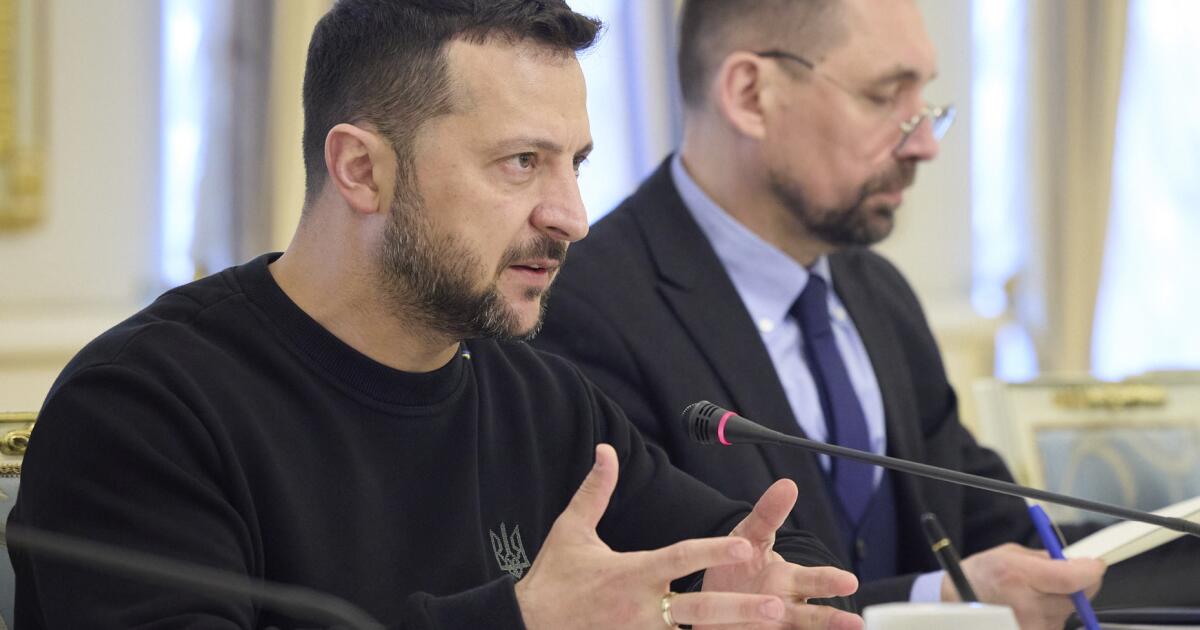
Even as fierce new clashes erupt, one of Ukraine’s toughest fights these days is taking place off the battlefield: persuading allies that its outgunned, outnumbered army can ultimately prevail, and that billions of dollars in Western military assistance is money well spent.
President Volodymyr Zelensky made that case Tuesday to Secretary of State Antony J. Blinken, who was visiting Kyiv for the first time since April’s long-delayed congressional approval of a $61 billion weapons package — perhaps the last major American assistance for some time to come.
The two met as Ukraine was attempting to fend off a Russian cross-border onslaught that began last week in the country’s northeast, the most concerted push of its kind since the early days of the war, which set off street-by-street fighting near the frontier and forced thousands of civilians to flee relentless bombardment.
Despite the war’s grim backdrop, Blinken sought a few moments away from staid diplomacy.
After a day of meetings, the 62-year-old secretary of State, whose Instagram bio identifies him as a “(very) amateur guitarist,” hit a popular Kyiv nightspot to play rhythm guitar with a local band. The song selection: Neil Young’s “Rockin’ in the Free World.”
Accompanied by Ukrainian Foreign Minister Dmytro Kuleba, he also lunched at a pizza parlor owned and operated by military veterans.
But the tone of the day’s talks was undeniably somber.
U.S. Secretary of State Antony J. Blinken, center, surrounded by security officers, walks in Independence Square in Kyiv, Ukraine, on Tuesday.
(Efrem Lukatsky / Associated Press)
“We know this is a challenging time,” Blinken told Zelensky. Arriving U.S. military aid, he said, is “going to make a real difference against the ongoing Russian aggression on the battlefield.”
Zelensky replied with thanks for the new weaponry already beginning to reach Ukraine — coupled with familiar pleas for additional help.
“People are under attack — civilians, warriors, everybody,” the Ukrainian leader said, asking for two Patriot air-defense batteries to protect Kharkiv, Ukraine’s second-largest city, which lies only a few dozen miles from the latest Russian onslaught.
Analysts said if Russia advances farther in Kharkiv province, it will again place the city of more than 1.3 million people, already pummeled by Russian missiles and so-called glide bombs, within range of punishing artillery barrages.
In some ways, the Blinken visit pointed up the same delicate line Zelensky has trod since the start of Russia’s full-scale invasion more than two years ago: impressing upon Western partners that Ukraine’s military needs are urgent and dire, and at the same time asserting that the fight is not a hopeless one.
And even while thanking Western governments for support, Zelensky bluntly declared that delays — whether bureaucratic holdups or political disputes such as the GOP infighting that blocked U.S. assistance for six months — translate directly into loss of civilian and military lives.
“We need to significantly speed up the supply process,” the Ukrainian leader said in an address to compatriots on Tuesday night. “Currently, the time gap between the announcement of packages and the actual appearance of weapons on the front line is too large.”
Blinken had a nuanced message to deliver as well: looking ahead to the day that Ukraine “stands strongly on its own feet militarily, but also economically and democratically” — suggesting that even unstinting support cannot continue indefinitely.
Dignitaries’ war-zone visits like these are commonplace, but traveling to the Ukrainian capital is still dangerous enough that such visits are not announced in advance. It’s not possible to fly in to Kyiv; Blinken arrived via overnight train from Poland.
At the Kremlin, Russian President Vladimir Putin, newly sworn in for an essentially uncontested fifth term in office, was busy signaling his intent to pursue his war aims for as long as necessary.
Over the weekend, the Kremlin announced the appointment of a new defense minister — an economist, Andrei Belousov, who will be tasked with harnessing the power of Russia’s military-industrial complex to sustain the fight.
Putin is also traveling this week to Beijing for a meeting with China’s President Xi Jinping, at which he is expected to press for a continuation of the partnership that has helped the Kremlin escape the effects of Western wartime sanctions, reap robust oil and gas revenues and obtain needed technology and spare parts — though China does not directly supply Russia with weapons.
For all of the solidarity Blinken extended to Zelensky, Ukraine is keenly aware that in a U.S. election year, backing for the war amounts to a significant expenditure of political capital.
Other major Western allies are also calibrating their own longer-term plans for Ukraine with an eye to November’s U.S. election.
Britain was attempting to smooth over a flap that arose over Foreign Secretary David Cameron’s recent pilgrimage to Mar-a-Lago, former President Trump’s Florida resort. Britain’s Sunday Times newspaper reported over the weekend that Cameron had made the case to Trump, the presumptive Republican nominee, that aid to Ukraine now would set favorable terms for Trump to swiftly negotiate a peace deal if he regained office.
The British defense secretary, Grant Shapps, clarified in a radio interview Tuesday that Britain would not try to force Ukraine to accept a peace treaty that entailed a loss of territory.
Ukraine garnered additional support Tuesday from France, whose government on Tuesday announced that unspecified new military aid would be arriving soon, following a phone conversation between Zelensky and President Emmanuel Macron.
Ukraine is also hoping to gain pledges of ongoing support at a peace summit in Switzerland next month — to which Russia has not been invited — and at gatherings this summer, including a NATO summit in July in Washington, marking the alliance’s 75th birthday.
For the government in Kyiv, though, the short-term picture is clouded. Russia has deployed about 2,000 troops in a drive toward the Kharkiv province town of Vovchansk, according to Ukrainian military officials.
The Russian forces were making “tactically significant advances” in what appeared to be an attempt to establish a buffer zone along the frontier north of Kharkiv city, according to the Washington-based Institute for the Study of War.
Ukraine is already struggling to hold key positions in the country’s east, and analysts have said the Russian push in Kharkiv could divert troops needed to blunt advances elsewhere. Ukraine’s general staff on Tuesday reported two dozen separate attacks in the partly Russian-occupied Donetsk province.
The regional governor, Oleh Sinegubov, said on Ukrainian television that the latest fighting in the northeast had set off street-to-street battles on the outskirts of Vovchansk, the largest town in the area, most of whose inhabitants have fled.
The governor reported two deaths in the latest shelling, and the evacuation of more than 7,500 civilians.
The nation’s military intelligence chief, Kyrylo Budanov, said he expected the border situation in Kharviv province to stabilize — but speaking on Ukrainian television, he warned of a new Russian buildup, in the Sumy region to the north.
That could set off a similar scenario to that in Kharkiv: Ukrainian forces stretched even thinner.
“The situation is under control,” Zelensky said in his nightly address. But he added: “Everything is quite tense.”



NEWYou can now listen to Fox News articles!
Dr. Mehmet Oz rushed to help after a woman collapsed during President Donald Trump’s speech in Kentucky on Wednesday.
About halfway through Trump’s remarks at Verst Logistics in Hebron, Kentucky, an older woman behind the president’s riser appeared to need medical attention, prompting Trump to ask the crowd, “Do we have a doctor in the house? Take your time, please.”
A medical team quickly reached her, including Centers for Medicare and Medicaid Services Administrator Dr. Oz.
“First responders are incredible,” Trump said as he turned and watched emergency medical personnel take care of the woman.
DR. OZ REVEALS HOW HE IS BRINGING CHANGE TO DC AND HELPING THE MOST VULNERABLE AMERICANS
Dr. Mehmet Oz, Centers for Medicare and Medicaid Services administrator, gave a thumbs up after helping a woman who fainted while President Donald Trump spoke at Verst Logistics in Hebron, Kentucky, on March 11. (Jim WATSON / AFP via Getty Images)
The president paused his remarks and asked if a song could be played in the meantime.
“Do you think the people backstage are listening to me?” Trump said, adding that if they could hear him, he suggested playing “Ave Maria.”
The song did not play, and Trump continued to watch as the woman received treatment.
DR. OZ WARNS WALZ TO ADDRESS ALLEGED SOMALI MEDICAID FRAUD OR LOSE FEDERAL FUNDING: ‘WE’LL STOP PAYING’
President Donald Trump reacts as Dr. Mehmet Oz joins first responders assisting a woman who collapsed during his speech. (Andrew Harnik/Getty Images)
“Take your time,” he said. “She looks great.”
As first responders began escorting the woman away, Trump noticed Oz was among those helping her.
“It’s Dr. Oz! Can you believe it? Dr. Oz!” Trump said. “He’s a good doctor. Thank you, Oz.”
RFK JR: DR OZ SAYS TRUMP HAS ‘HIGHEST TESTOSTERONE LEVEL’ HE’S SEEN IN A MAN OLDER THAN 70
Dr. Mehmet Oz assisted a woman who collapsed during President Donald Trump’s speech in Hebron, Kentucky, on Wednesday. (Andrew Harnik/Getty Images)
Trump resumed his remarks about seven minutes later, returning to criticism of California Gov. Gavin Newsom.
“We were talking about Gavin New-scum,” Trump said with a laugh. “Doesn’t seem like a very good subject right now. It made that young lady not feel so good.”
Wednesday’s event was not the first time Oz, a former heart surgeon, assisted during a medical episode while serving in the Trump administration.
In April, a young girl fainted near the Resolute Desk in the Oval Office while Trump was speaking during Oz’s swearing-in ceremony.
CLICK HERE TO DOWNLOAD THE FOX NEWS APP
Oz quickly rushed over to assist the child, who was later confirmed to be a member of his family.
In November, a man collapsed in the Oval Office as Trump was giving a press conference, prompting Oz to once again step in to help.

A video circulating online appears to show signature collectors paying people to sign initiative petitions under other people’s names, according to officials, and now the state has opened an investigation.
The video, filmed by self-described street videographer JJ Smith, shows a long queue leading to a table set up at 6th and Mission streets in San Francisco. A man in line says they are being offered $5 to sign petitions. At the table, where there are lists with the information of apparent registered voters, a woman confirms the payment and — using a highlighter — instructs a person on the name and address that she is supposed to use.
“I get $5 too?” the person filming asks.
“Yeah,” says the woman.
“And what is it?”
“Just sign it,” she says.
-
Share via
Petitions connected to at least three ballot campaigns — including the billionaire-backed effort to thwart California’s proposed billionaire tax — appear in the video.
“I approached some people and asked them what they were there for,” Smith told The Times. “They told me they didn’t know what they were signing for, that they just wanted the $5.”
Smith, whose real name is Omar Ward, has been known for posting images on social of people suffering from addiction on San Francisco’s streets.
He said he watched the scene for hours and estimated that a few hundred people cycled through the line over roughly two hours.
Those running the table did not ask for anyone’s identification and gave no explanation of what was actually being signed, he said.
The video showed voter data from San Luis Obispo County that was both visible and, as details were spoken aloud, audible in the footage.
The county acted immediately after becoming aware of the video and initiated an investigation through the fraud unit of the California secretary of state’s office, said Erin Clausen, public information officer for the San Luis Obispo county clerk’s office.
Clausen noted that, although voter registration data can be legally requested from county election offices, the data in this case may have been used inappropriately. The county is also planning on reaching out directly to voters who were specifically mentioned or identified in the video, according to Clausen.
“The activity shown in the video, if verified, would violate California election law,” County Clerk-Recorder Elaina Cano said in a formal statement released Wednesday morning.
The secretary of state’s office confirmed it had opened a formal investigation.
“Under California law, it is illegal to give money or other valuable consideration to another in exchange for their signature on an initiative petition,” a spokesperson said in a statement. “Those who abuse our system will be held accountable.”
The office is working with local officials and encouraged anyone with information to file a complaint.
One political committee, Californians for a More Transparent and Effective Government, confirmed its petitions were among those whose signature gatherers were allegedly paying people to sign and moved quickly to distance itself from the activity.
“Under no circumstance do we tolerate this type of activity in the signature-gathering process,” said spokesperson Molly Weedn. “We’ve taken immediate action and have demanded that the signature gathering firm identify these circulators and reject their petitions.” Weedn said the collectors were subcontractors, not campaign employees, and that attorneys were contacting authorities.
That committee is funded by another group, Building a Better California, also seen in the video. The other was for a proposed initiative called the Retirement and Personal Savings Protection Act of 2026. Representatives for the latter two have not responded to requests for comment.
Smith said this was not the first time he had witnessed this type of activity in the area.
“I saw something similar with ballots three days ago,” he said.
The investigation is ongoing. Anyone with information can submit a complaint to the Office of the California Secretary of State or contact their local county elections office.
Times staff writer Seema Mehta contributed to this report.

NEWYou can now listen to Fox News articles!
Passage of the SAVE America Act is of paramount importance to President Donald Trump and many congressional Republicans.
In his State of the Union speech, the president implored lawmakers “to approve the SAVE America Act to stop illegal aliens and other unpermitted persons from voting in our sacred American elections.”
The House approved the plan to require proof of citizenship to vote last month, 218-213. There’s now a different version of the legislation that’s in play. And, as is often the case, the hurdle is the Senate. Specifically, the Senate filibuster.
Attendees listen as Rep. Chip Roy, R-Texas, speaks at an “Only Citizens Vote” bus tour rally advocating passage of the SAVE Act at Upper Senate Park outside the U.S. Capitol in Washington, D.C., on Sept. 10, 2025. (Kent Nishimura/Getty Images)
So some Republicans are trying to save the SAVE America Act.
It’s important to note that Trump never called for the Senate to alter the filibuster in his State of the Union address. But in a post last week on Truth Social, Trump declared, “The Republicans MUST DO, with PASSION, and at the expense of everything else, THE SAVE AMERICA ACT.”
Again, the president didn’t wade into questions about overcoming a filibuster. But “MUST DO” and “at the expense of everything else” is a clear directive from the commander in chief.
That’s why there’s a big push by House Republicans and some GOP senators to alter the filibuster — or handle the Senate filibuster differently.
It’s rare for members of one body of Congress to tell the other how to execute their rules and procedures. But the strongest conservative advocates of the SAVE America Act are now condemning Senate Republicans if they don’t do something drastic to change the filibuster to pass the measure.
Some Senate Republicans are pushing for changes, or at the very least, advocating that Senate Republicans insist that Democrats conduct what they refer to as a “talking filibuster” and not hold up the legislation from the sidelines. It takes 60 votes to terminate a filibuster. The Senate does that by “invoking cloture.” The Senate first used the cloture provision to halt a filibuster on March 8, 1917. Prior to that vote, the only method to end a filibuster was exhaustion — meaning that senators finally just run out of gas, quit debating and finally voted.
So let’s explore what a filibuster is and isn’t and dive into what Republicans are talking about when they’re talking about a talking filibuster.
The Senate’s leading feature is unlimited debate. But, ironically, the “debate” which holds up most bills is not debate. It’s simply a group of 60 lawmakers signaling offstage to their leaders that they’ll stymie things. No one has to go to the floor to do anything. Opponents of a bill will require the majority tee up a cloture vote — even if legislation has 60 yeas. Each cloture vote takes three to four days to process. So that inherently slows down the process — and is a de facto filibuster.
But what about talking filibusters? Yes, senators sometimes take the floor and talk for a really long time, hence, the “unlimited debate” provision in the Senate. Senators can generally speak as long as they want, unless there’s a time agreement green-lighted by all 100 members.
That’s why a “filibuster” is hard to define. You won’t find the word “filibuster” in the Senate’s rules. And since senators can just talk as long as they want, they might argue that suggesting they are “filibustering” is pejorative. They’re just exercising their Senate rights to speak on the floor.
A true filibuster is a delay. For instance, the record-breaking 25-hour and 8-minute speech last year by Sen. Cory Booker, D-N.J., against the Trump administration was technically not a filibuster. Booker began his oratory on the evening of March 31, ending on the night of April 1. Once Booker concluded, the Senate voted to confirm Matt Whittaker as NATO ambassador. The Senate was supposed to vote on the Whitaker nomination on April 1 anyway. So all Booker’s speech did was delay that confirmation vote by a few hours. But not much.
In October 2013, Sen. Ted Cruz, R-Texas, held the floor for more than 21 hours. It was part of Cruz’s quest to defund Obamacare. But despite Cruz’s verbosity (and a recitation of Green Eggs and Ham by Dr. Suess), the Senate was already locked in to take a procedural vote around 1 p.m. the next day. Preparations for that vote automatically ended Cruz’s speech. Thus, it truly wasn’t a filibuster either.
COLLINS BOOSTS REPUBLICAN VOTER ID EFFORT, BUT WON’T SCRAP FILIBUSTER
Sen. Ted Cruz, R-Texas, during an oversight hearing in Washington, D.C., on Dec. 17, 2025. (Kent Nishimura/Bloomberg via Getty Images)
So, this brings us to the talking filibuster which actually gums up the Senate gearboxes. A talking filibuster is what most Americans think of when they hear the term “filibuster.” That’s thanks to the iconic scenes with Jimmy Stewart in the Frank Capra classic, “Mr. Smith Goes to Washington.”
Most senators filibuster by forcing the Senate to take two cloture votes — spread out over days — to handle even the simplest of matters. That elongates the process by close to a week. But if advocates of a given bill have the votes to break the filibuster via cloture, the gig is up.
However, what happens if a senator — or a group of senators delay things with long speeches? That can only last for so long. And it could potentially truncate the Senate’s need to take any cloture vote, needing 60 yeas.
Republicans who advocate passage of the SAVE America Act believe they can get around cloture — and thus the need for 60 votes — by making opponents of the legislation talk. And talk. And talk.
And once they’re done talking, the Senate can vote — up or down — on the SAVE Act. Passage requires a simple majority. The Senate never even needs to tangle with 60.
Senate Rule XIX (19) states that “no senator shall speak more than twice upon any one question in debate on the same legislative day.”
Easy enough, right? Two speeches per day. You speak twice on Monday, then you have to wait until Tuesday? Democrats would eventually run out of juice after all 47 senators who caucus with Democrats have their say — twice.
But it’s not that simple. Note the part about two speeches per “question.”
Well, here’s a question. What constitutes a “question” in Senate parlance? A “question” could be the bill itself. It could be an amendment. It could be a motion. And just for the record, the Senate usually cycles through a “first-degree” amendment and then a “second-degree” amendment — to say nothing of the bill itself. So, if you’re scoring at home, that could be six (!) speeches per senator, per day, on any given “question.”
Questions?
But wait. There’s more.
Note that Rule XIX refers to a “legislative day.” A legislative day is not the same as a calendar day. One basic difference is if the Senate “adjourns” each night versus “recessing.” If the Senate “adjourns” its Monday session on calendar day Monday, then a new legislative day begins on Tuesday. However, the legislative day of “Monday” carries over to Tuesday if the Senate “recesses.”
It may be up to Senate Majority Leader John Thune, R-S.D., whether the Senate “adjourns” or “recesses.” The creation of a new legislative day inhibits the GOP talking filibuster effort.
SEN LEE DARES DEMOCRATS TO REVIVE TALKING FILIBUSTER OVER SAVE ACT, SLAMMING CRITICISM AS ‘PARANOID FANTASY’
Senate Majority Leader John Thune, R-S.D., center, arrives for a news conference after a policy luncheon on Capitol Hill, Tuesday, Feb. 3, 2026, in Washington. (Mariam Zuhaib/AP Photo)
Democrats would obviously push for the Senate to adjourn each day. But watch to see if talking filibuster proponents object to Thune’s daily adjournment requests. If the Senate votes to stay in session, that forces the legislative day of Monday to bleed over to Tuesday.
Pro tip: Keep an eye on the adjournment vs. recess scenario. If a talking filibuster supporter tries to prevent the Senate from adjourning, that may signal whether the GOP has a shot at eventually passing the SAVE Act. If that test vote fails and the Senate adjourns for the day, the SAVE Act is likely dead in the water.
We haven’t even talked about a custom practiced by most Senate majority leaders to lock down the contours of a bill when they file cloture to end debate.
It’s typical for the presiding officer to recognize the Senate majority leader first on the floor for debate. So Thune and his predecessors often “fill” what’s called the “amendment tree.” The amendment tree dictates how many amendments are in play at any one time. Think of the underlying bill as a “trunk.” A “branch” is for the first amendment. A “sprig” from that branch is the second amendment. Majority leaders often load up the amendment tree with “fillers” that don’t change the subject of the bill. He then files cloture to break the filibuster.
That tactic curbs the universe of amendments. It blocks the other side from engineering controversial amendments to alter the bill. But if Thune doesn’t file cloture to end debate, then the Senate must consider amendment after amendment, repeatedly filling the tree and voting on those amendments. This would unfold during a talking filibuster, not when Thune is controlling the process by filing cloture and “filling the tree.”
This is why Thune is skeptical of a talking filibuster to pass the SAVE Act.
“This process is more complicated and risky than people are assuming at the moment,” said Thune.
In fact, the biggest “benefit” to filing cloture may not even be overcoming a filibuster, but blocking amendments via management of the tree. Republicans are bracing for amendments Democrats may offer.
“If you don’t think Democrats have a laundry list of amendments, talking about who won the 2020 election, talking about the Epstein files — if you don’t think they have a quiver full of these amendments that they’re ready to get Republican votes on the record, then I’ve got a bridge to sell you,” said George Washington University political science professor Casey Burgat.
Plus, forcing a talking filibuster for days precludes the Senate from passing a DHS funding bill. That’s to say nothing of confirming Sen. Markwayne Mullin, R-Okla., as Homeland Security secretary. His confirmation hearing likely comes next Wednesday, but a protracted Senate debate would block a confirmation vote from the floor.
JEFFRIES ACCUSES REPUBLICANS OF ‘VOTER SUPPRESSION’ OVER BILL REQUIRING VOTER ID, PROOF OF CITIZENSHIP
Sen. Markwayne Mullin, Republican from Oklahoma, addresses reporters at the U.S. Capitol after being tapped as President Donald Trump’s new nominee to lead DHS, March 5, 2026. (Anna Moneymaker/Getty Images)
Thune all but killed the talking filibuster maneuver on Tuesday — despite the president’s ultimatum.
“Do you run a risk of being on the wrong side of President Trump and your resistance to do this talking filibuster, tying the Senate in knots for weeks?” asked yours truly.
“We don’t have the votes either to proceed, get on a talking filibuster, nor to sustain one if we got on it,” replied Thune. “I understand the president’s got a passion to see this issue addressed.”
I followed up.
“Does he understand that, though?”
“Well, we’ve conveyed that to him,” answered Thune. “It’s about the math. And, for better or worse, I’m the one who has to be a clear-eyed realist about what we can achieve here.”
And there just doesn’t appear to be any parliamentary way to get there with the talking filibuster.
CLICK HERE TO DOWNLOAD THE FOX NEWS APP
Like many things in Congress, it all boils down to one thing.
As Thune said, “it’s about the math.”

Bill requiring NH voters to consider school tax caps clears House

Gateway Project moves forward as NJ Transit nears completion of Portal Bridge track work

Natt’s 17 lead Sam Houston over New Mexico State in Conference USA Tournament 69-61

Man arrested in months-long arson probe near North Carolina-Georgia line

North Dakota’s new ‘I voted’ sticker says ‘You betcha’

Florida High School Football Rankings: Top 25 teams – Oct. 21

Cleary's 21 help Le Moyne down Central Connecticut State 69-64 in OT

How old is Bo Nix? What to know about Oregon quarterback ahead of 2024 NFL Draft

99th annual Pony Swim held in Virginia

Indiana Members Credit Union announced as new anchor tenant at Bottleworks District
ICE Lawyer Who Told Judge She Was Overwhelmed Is Running for Congress

Dr Oz helps older woman who collapsed during Trump’s speech at Kentucky event

The Ring: Is the EU a spectator or player as war grips Middle East?

The government is investigating new claims that DOGE misused Social Security data

Reporter’s Notebook: Trump’s SAVE Act ultimatum runs into Senate reality
-

 Massachusetts1 week ago
Massachusetts man awaits word from family in Iran after attacks
-

 Detroit, MI6 days ago
U.S. Postal Service could run out of money within a year
-

 Miami, FL1 week ago
City of Miami celebrates reopening of Flagler Street as part of beautification project
-

 Pennsylvania7 days ago
Pa. man found guilty of raping teen girl who he took to Mexico
-

 Sports1 week ago
Keith Olbermann under fire for calling Lou Holtz a ‘scumbag’ after legendary coach’s death
-

 Michigan2 days ago
Operation BBQ Relief helping with Southwest Michigan tornado recovery
-

 Culture1 week ago
Try This Quiz on the Real Locations in These Magical and Mysterious Novels
-

 Virginia1 week ago
Giants will hold 2026 training camp in West Virginia