Politics
Father ripped from family as agents target immigration courts, arresting people after cases dismissed


The man just had his immigration case dismissed and his wife and 8-year-old son were trailing behind him when agents surrounded, then handcuffed him outside the downtown Los Angeles courtroom.
Erick Eduardo Fonseca Solorzano stood speechless. His wife trembled in panic. The federal agents explained in Spanish that he would be put into expedited removal proceedings.
Just moments earlier on Friday, Judge Peter A. Kim had issued a dismissal of his deportation case. Now his son watched in wide-eyed disbelief as agents quickly shuffled him to a service elevator — and he was gone. The boy was silent, sticking close by his mother, tears welling.
“This kid will be traumatized for life,” said Lindsay Toczylowski, chief executive and co-founder of Immigrant Defenders Law Center, who reached out to the family to help them with their case.
A child who’s father was detained by ICE after a court hearing stands inside the North Los Angeles Street Immigration Court on Friday.
(Carlin Stiehl/Los Angeles Times)
Similar scenes are taking place across the country as the Department of Homeland Security asks to dismiss its own deportation cases, after which agents promptly arrest the immigrants to pursue expedited removals, which require no hearings before a judge.
The courthouse arrests escalate the Trump administration’s efforts to speed up deportations. Migrants who can’t prove they have been in the U.S. for more than two years are eligible to be deported without a judicial hearing. Historically, these expedited removals were done only at the border, but the administration has sought to expand their use.
The policies are being challenged in court.
“Secretary [Kristi] Noem is reversing Biden’s catch-and-release policy that allowed millions of unvetted illegal aliens to be let loose on American streets,” said a senior official from the Department of Homeland Security.
The official said most immigrants who entered the U.S. illegally within the last two years “are subject to expedited removals.” But he noted that if they have a valid credible fear claim, as required by law, they will continue in immigration proceedings.
Toczylowski said it was Fonseca Solorzano’s first appearance in court. Like many of those apprehended this week, Fonseca Solorzano arrived in the United States from Honduras via CPB One, an application set up during the Biden administration that provided asylum seekers a way to enter the country legally after going through a background check.

Erendira De La Riva, left, Sarai De La Riva and Maria Elena De La Riva speak to the media Friday about the status of Alvaro De La Riva, who was detained the previous night by ICE and taken to the North Los Angeles Street Immigration Court.
(Carlin Stiehl/Los Angeles Times)
More than 900,000 people were allowed in the country on immigration parole under the app, starting in January 2023. The Trump administration has turned the tool into a self-deportation app.
“We are punishing the people who are following the rules, who are doing what the government asks them to do,” Toczylowski said.
“I think that this practice certainly seemed to have shaken up some of the court staff, because it’s so unusual and because it’s such bad policy to be doing this, considering who it targets and the ripple effects that it will have, it’ll cause people to be afraid to come to court.”
A Times reporter witnessed three arrests on Friday in the windowless court hallways on the eighth floor of the Federal Building downtown. An agent in plain clothes in the courtroom came out to signal to agents in the hallway, one wearing a red flannel shirt, when an immigrant subject to detainment was about to exit.
“No, please,” cried Gabby Gaitan, as half a dozen agents swarmed her boyfriend and handcuffed him. His manila folder of documents spilled onto the floor. She crumpled to the ground in tears. “Where are they taking him?”
Richard Pulido, a 25-year-old Venezuelan, had arrived at the border last fall and was appearing for the first time, she said. He had been scared about attending the court hearing, but she told him missing it would make his situation worse.
Gaitan said Pulido came to the U.S. last September after fleeing violence in his home country.
An immigrant from Kazakhstan, who asked the judge not to dismiss his case without success, walked out of the courtroom. On a bench across from the doors, two immigration agents nodded at each other and one mouthed, “Let’s go.”
They stood quickly and called out to the man. They directed him off to the side and behind doors that led to a service elevator. He looked defeated, head bowed, as they searched him, handcuffed him and shuffled him into the service elevator.
Lawyers, who were at courthouses in Santa Ana and Los Angeles this week, say it appears that the effort was highly coordinated between Homeland Security lawyers and federal agents. Families and lawyers have described similar accounts in Miami, Seattle, New York, San Diego, Chicago and elsewhere.
During the hearing for Pulido, Homeland Security lawyer Carolyn Marie Thompkins explicitly stated why she was asking to dismiss the removal proceedings.
“The government intends to pursue expedited removal in this case,” she said. Pulido appeared confused as to what a dismissal would mean and asked the judge for clarity. Pulido opposed having his case dropped.
“I feel that I can contribute a lot to this country,” he said.
Kim said it was not enough and dismissed the case.
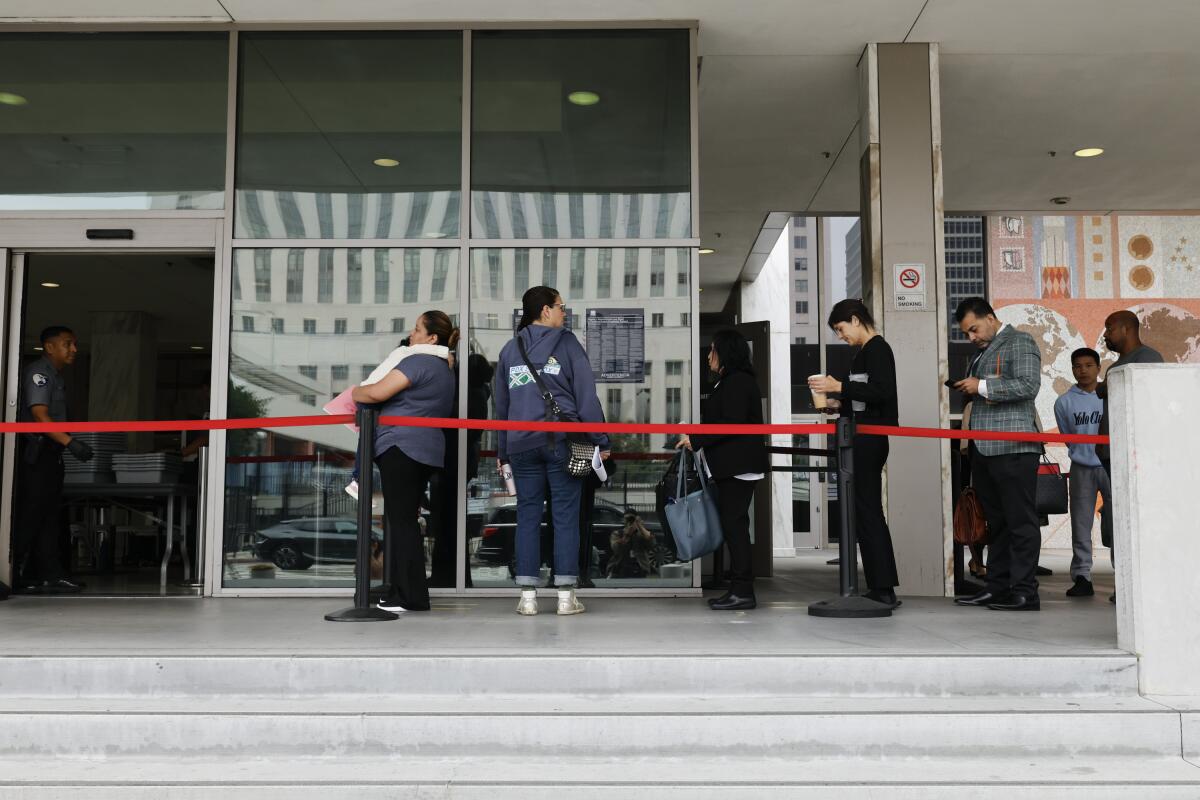
People line up outside the North Los Angeles Street Immigration Court before hearings on Friday.
(Carlin Stiehl/Los Angeles Times)
The courthouse arrests have frustrated immigrant rights advocates who say the rules of the game are changing daily for migrants trying to work within the system.
“Immigration court should be a place where people go to present their claims for relief, have them assessed, get an up or down on whether they can stay and have that done in a way that affords them due process,” said Talia Inlender, deputy director at the Center for Immigration Law and Policy at UCLA School of Law School. “That is being ripped away sort of at every turn.
“It’s another attempt by the Trump administration to stoke fear in the community. And it specifically appears to be targeting people who are doing the right thing, following exactly what the government has asked them to do,” she said.



NEWYou can now listen to Fox News articles!
Minnesota filed a federal lawsuit Monday against the Trump administration, accusing federal health officials of illegally withholding $243 million in Medicaid payments from the state.
Attorney General Keith Ellison and the Minnesota Department of Human Services sued the Centers for Medicare and Medicaid Services (CMS) and the U.S. Department of Health and Human Services (HHS), arguing the funding freeze violates federal law.
The state is seeking a temporary restraining order to immediately block the action.
The dispute stems from a January notice in which the Trump administration said it would withhold more than $2 billion annually from Minnesota’s Medicaid program over what it described as “noncompliance” with federal regulations, specifically, alleged failures to “adequately identify, prevent, and address fraud in its Medicaid program.”
Minnesota Attorney General Keith Ellison speaks during a Senate Homeland Security Committee hearing on Capitol Hill. (Tom Brenner/AP)
State officials say they have not been told specifically how Minnesota is out of compliance or what changes the administration wants to see.
The lawsuit follows a Feb. 25 announcement from CMS that it was deferring roughly $260 million in quarterly federal Medicaid funding to Minnesota, including about $243 million tied to “unsupported or potentially fraudulent” claims.
CMS said the deferral is part of a broader fraud crackdown and cited unusually high spending and rapid growth in personal care services, home- and community-based services, and other practitioner services.
HEAVILY-REDACTED AUDIT FINDS MINNESOTA MEDICAID HAD WIDESPREAD VULNERABILITIES
Vice President JD Vance looks on as Medicare and Medicaid Administrator Mehmet Oz speaks about combating fraud at the White House complex in Washington, D.C., on Feb. 25, 2026. (Oliver Contreras/AFP via Getty Images)
“For decades, Medicare fraud has drained billions from American taxpayers — that ends now,” HHS Secretary Robert F. Kennedy Jr. said in a statement. “We are replacing the old ‘pay and chase’ model with a real-time ‘detect and deploy’ strategy, using advanced AI tools to identify fraud instantly and stop improper payments before they go out the door.”
Minnesota officials contend the move improperly uses a funding “deferral” mechanism and amounts to denying the state due process before any formal finding of noncompliance.
WALZ SLAMS TRUMP ADMIN FOR TEMPORARILY HALTING MEDICAID FUNDING TO MINNESOTA: ‘CAMPAIGN OF RETRIBUTION’
CLICK HERE TO DOWNLOAD THE FOX NEWS APP
The threatened cuts represent about 7% of Minnesota’s quarterly Medicaid funding and could force reductions in health care services for low-income residents, according to Ellison’s office.
“Trump’s M.O. is to cut first, no matter what the law says or who gets hurt, and ask questions later, if at all,” the attorney general said. “These cuts are the latest in a long series of efforts to go around the law to punish Minnesotans — but just as we fought back and won when they illegally tried to cut funding for childcare, hungry families, and our schools, we are suing them again today to make them follow the law.”
Related Article

Politics
Fearing GOP win, California’s Democratic leader urges unviable party candidates for governor to drop out

Fearing the prospect of a Republican winning California’s gubernatorial race, state Democratic Party Chair Rusty Hicks on Tuesday urged his party’s candidates who lack a viable path to victory to drop out.
“It is imperative that every candidate honestly assess the viability of their candidacy and campaign,” Hicks wrote in an open letter to the politicians vying to replace termed-out Gov. Gavin Newsom. “I recognize my suggestions are hard for many to contemplate and may be even viewed as overly harsh by some.”
Hicks did not name the Democrats he wants out of the race, but such a public admonishment by a party leader is a rarity in California politics.
Even though the odds are relatively low, California cannot risk having a Republican elected as the next governor at a time when President Trump is in the White House, Hicks said.
“[S]o much is at stake in our Nation and so many are counting on the leadership of California Democrats to stand up and speak out at this historic moment,” Hicks wrote. “California’s leadership on the world stage is significantly harder if a Democrat is not elected as our next Governor.”
Hicks urged Democrats languishing at the bottom of the field of candidates to drop out before the Friday deadline to officially file to run for governor — to ensure their names do not appear on the June primary ballot.
Under California’s top-two primary system, the two candidates who receive the most votes in the June primary advance to the November general election, regardless of party.
With nine top Democrats running, the fear is that the candidates will splinter their party’s vote and allow the top two Republicans in the race to finish in first and second place. This is despite Democratic registered voters outnumbering Republicans in the state by almost 2 to 1, and no GOP candidate winning a statewide election since 2006.
Having two Republicans competing in the November election would be devastating to Democratic voter turnout and could hurt party candidates in pivotal down-ballot races.
“The result would present a real risk to winning the congressional seats required and imperil Democrats’ chances to retake the House, cut Donald Trump’s term in half, and spare our Nation from the pain many have endured since January 2025,” Hicks said in his letter. “We simply can’t let that happen.”
A recent poll by the Public Policy Institute of California found that five candidates lead the contest — former Rep. Katie Porter, Rep. Eric Swalwell and hedge fund founder Tom Steyer among Democrats and conservative commentator Steve Hilton and Riverside County Sheriff Chad Bianco, both Republicans. Hilton and Bianco have led all candidates in other polls over the last few months. No other candidate received the support of more than 5% of likely voters.
After Hicks issued his directive, two influential leaders in California Democratic politics said they shared his concerns.
Lorena Gonzalez, the head of the California Federation of Labor Unions, said she worries that Democratic candidates who are drawing low single-digit support in the polls and remain in the race could tilt the election.
“You’re in a situation where a candidate who pulls 2 or 3% could make all the difference whether there’s two Republicans and anti-union folks in the runoff or if there’s not,” she said.
Gonzalez said that while she believes the legislature, where Democrats hold super majorities in both chambers, would be a check if a Republican was elected the state’s leader, that might not be enough protect Californians from Trump’s destructive policies.
“We are seeing with Trump how much damage an executive who wants to ignore normal rules of engagement or the Constitution can do,” she said. “We can’t afford that.”
The federation began its endorsement process last week, and there were difficult conversations with gubernatorial candidates not only about their political beliefs, but also about their viability. The umbrella group of unions is expected to make an announcement about any potential endorsement on March 16.
Jodi Hicks, CEO and president of Planned Parenthood Affiliates of California, said it was imperative to block the “real possibility” of two Republicans advancing to the general election because of the deep cuts that the Trump administration has made to health care, including access to abortion.
“Given the severity of this moment, we urge candidates to consider how continuing their candidacy may put California’s values and reproductive freedom at risk,” Jodi Hicks said. “The stakes are too high for all of us, but especially for immigrant communities, transgender individuals, the over 15 million patients enrolled in Medi-Cal, and the over 25,000 patients a week who access essential health care at Planned Parenthood health centers.”
Discussions about the need for some Democrats to exit the race took place at last weekend’s California Democratic Party convention.
But a politically thorny issue is that nearly all of the Democrats lagging in the polls are people of color, as former U.S. Health and Human Services Secretary Xavier Becerra noted at a candidate forum Monday evening.
“There are people who are calling for candidates to get out of the race,” he said at the gathering hosted by Equality California and the Los Angeles LGBT Center at the Renberg Theatre in Hollywood. “Isn’t it interesting that the candidates they are asking get out of the race are the candidates of color?”
Rusty Hicks, asked about the effect on minority candidates who have spent years or decades of their lives in public service, did not directly answer the question but lauded the field’s accomplishments.
“We have a number of strong candidates. They have incredible stories, and they are reflective of the diversity of our party. That being said, there are some political realities of where we are at at this particular moment,” he said in an interview. “I’m not calling on any specific candidates to move in one direction or the other. I’m just calling on them to assess their campaign and determine if they have a viable [path] and if they don’t, to not file.”
During Monday evening’s gubernatorial forum, Porter said she is concerned about the prospect of two Republicans making the top two.
“I hear people say to me, it could never happen, but everybody said that about Trump too,” she said at the forum. “And I look at how much harm we’re suffering, and I think about all the political risks that people are facing every day, the risk of an immigrant to leave their home and walk on our streets, the risk of a kid who’s trans to try to play sports even in this state. And I just don’t think we can take any more political risks.”
Times staff writer Phil Willon contributed to this report.

Since moving back in, President Trump has significantly altered the “People’s House.” East Wing: gone. Oval Office: maximalized. Rose Garden: Mar-a-lago-ified. And the art? Lots of Trump.
Over the last year, The New York Times has captured at least nine paintings, posters, memes, and even a mugshot outside the Oval Office, that Mr. Trump added throughout the historic space.
Many of the selections are gifts from his supporters that highlight his political stature and reinforce the idea that Mr. Trump is invincible.
All presidents or first ladies add to and shuffle the art in the White House.
Barack Obama brought in abstract paintings.
George W. Bush decorated with images from his Texas roots.
In Mr. Trump’s first term, Melania Trump added a sculpture by Isamu Noguchi to the Rose Garden.
But never before has a sitting president displayed so much of his own image on the White House walls.
There is an “assertion of symbolic power that he wants to be on view essentially everywhere in that space,” said Cara Finnegan, a communication professor at the University of Illinois and author of “Photographic Presidents: Making History from Daguerreotype to Digital.”
Even outside his current residence, Mr. Trump’s visage has proliferated in unexpected places — on banners hanging from government buildings, on National Parks passes and on social media, where he has been likened to a king. There has also been talk of a U.S. Treasury-minted coin with Mr. Trump on both sides.
Break with tradition
In recent decades, each president’s official White House portrait has been unveiled in a ceremony hosted by his successor.
The Carters hosted the Fords:
The Clintons hosted the Bushes:
And the Bushes hosted the Clintons:
The mood has often been lighthearted, with political party tensions melting away.
“I am pleased that my portrait brings an interesting symmetry to the White House collection,” George W. Bush joked in a ceremony hosted by the Obamas. “It now starts and ends with a George W.”
In a break with tradition, Mr. Trump did not schedule a ceremony for the unveiling of the Obamas’ portraits during his first term. Joe Biden later did, in a ceremony with a “Welcome Home!” vibe.
Typically, the latest available presidential portrait — often a realistic oil painting — hangs in the main entrance hall, where heads of state are welcomed.
The Obama portrait was in the spot until April …
… when Mr. Trump replaced it with this painting by Marc Lipp, a Florida pop artist, last April.
It depicts a striking moment in 2024 when a bloodied Mr. Trump pumped his fist in defiance, soon after being shot at by a would-be assassin during a campaign event.
Presidential historians have criticized the departure from convention.
Though Mr. Trump had a portrait commissioned for the Smithsonian’s American Presidents collection after his first term, none was confirmed for the permanent White House collection, and the White House said that this is where that portrait would have hung.
It is not totally unprecedented for a president to hang a painting of himself in the White House during his term. Theodore Roosevelt, William Howard Taft and Grover Cleveland all did, according to the White House Historical Association. But more often than not, paintings of presidents and first ladies are hung after they have left office, historians said.
Flags, fists and faith from fans
In what has become something of a muse for many of the president’s artistic supporters, there are at least three other depictions of the fist-pumping scene in the White House.
The image “is in people’s garages when I walk around my neighborhood,” said Leslie Hahner, a Texas resident and communication professor at Baylor University, who studies visual political culture. “People love that image.”
Behind the Oval Office, one is in a small room that houses Trump merchandise:
Another was seen in the West Wing next to a “Still Life with Fruit” painting from 1850:
A statue form was spotted in the Oval Office:
The sculptor, Stan Watts, told a Utah TV station last year that he believes the president was saved by God that day. Many of Mr. Trump’s Christian supporters have echoed that sentiment.
At least two works by a self-described “Christian worship artist,” Vanessa Horabuena, are among Mr. Trump’s White House collection. He has called Ms. Horabuena, who often paints live in front of an audience, “one of the greatest artists anywhere in the world.”
In 2022, she painted a portrait of Mr. Trump at a booth at the Conservative Political Action Conference. When he saw it, he asked to meet her, Ms. Horabuena’s representative said. She most recently painted Mr. Trump live at a New Year’s Eve party at Mar-A-Lago.
One of her portraits was spotted in the Cabinet room in January.
It shows Mr. Trump, his eyes closed, in front of a mountain with a small cross on the top:
Ms. Horabuena hand-delivered it to the White House, according to her website.
Her other painting shows the president walking through a phalanx of flags. It was seen hanging prominently in a hallway leading to the Cabinet Room and the Oval Office:
“He’s positioned as this embattled warrior in a lot of these images,” Dr. Hahner said.
Historical figures Mr. Trump adulates are co-stars in some of the art he has chosen.
In an image created by the team of White House trade adviser Peter Navarro, Mr. Trump is pictured with William McKinley and Henry Clay, who, like the president, championed the use of tariffs:
Here, Mr. Trump is with two other Republican presidents, Abraham Lincoln (to whom he has compared himself) and Ronald Reagan (whom he is a fan of):
Titled “Great American Patriots,” the piece was painted by Dick Bobnick, an illustrator and Trump supporter from Minnesota. He said he mailed several prints to 1600 Pennsylvania Avenue, but he had no idea his work was on the White House walls until a USA Today reporter called him about it.
“I could hardly believe it,” said Mr. Bobnick. (He said the print is now his best-seller.)
If not in portraits, Mr. Trump’s image is reflected on mirrors that he has added to the White House complex.
Two are in the Oval Office …
… making his image visible from the Resolute Desk.
The mirrors, the portraits and the gilding mimic the look of his properties, like Mar-a-Lago, his Florida estate.
“Trump is obsessed with his image,” Dr. Hahner said. “And he is so controlling of his image.”
Trump everywhere, all the time
One portrait seen in the White House has become a communication tool between Mr. Trump and his supporters in the real world.
This is his social media profile picture.
It was seen last October hanging between former first ladies Laura Bush and Barbara Bush in the now-demolished East Wing:
The portrait was painted by Lena Ruseva, an immigrant from the former Soviet Union, who goes by the name MAGALANGELO. Mr. Trump invited her to his Bedminster golf club in 2022, and she gave it to him as a birthday gift.
“Every time social media or the news quotes the president and I see my artwork alongside it, I feel proud and grateful,” she said.
For a time, the same portrait hung next to Hillary Clinton, his political rival and a former first lady.
Supporters at that time lauded the placement on social media:
This example of a positive feedback loop demonstrates how Mr. Trump has used social media to redefine the presidency and presidential communication. Ms. Ruseva’s portrait was used on social media, hung up in the real world, then photographed and put back on social media by supporters who praised the president.
When Mr. Trump was elected to his first term in 2016, Dr. Hahner said that scholars referred to him as the first “meme president.”
Mr. Trump and his internet fans are used to a meme culture based on irony, and rehashing, repurposing and remixing existing images. The collection of White House artwork — much of it originating from his supporters — sits in an uncanny valley between realism and meme-ism, Dr. Hahner said.
Like memes that multiply, Mr. Trump’s image has been reproduced in other ways, outside the White House.
Last month, a huge banner with Mr. Trump’s face was draped outside the Justice Department headquarters …
Last year, similar signage was strung over the Labor Department building …
… and the Agriculture Department building (this one, alongside Lincoln).
At his request, Mr. Trump’s portrait was recently updated at the Smithsonian’s National Portrait Gallery:
Still, Mr. Trump wants more. The White House has suggested that the National Portrait Gallery add a separate section for Trump-related art.

More than 30K FirstEnergy customers without power in Cuyahoga County

Remembering Jorge Pederson: Minnesota MMA fighter killed in Austin, Texas, shooting

3 Alabama players who helped their draft stock at 2026 NFL combine

Alaska lawmakers push Trump administration to waive $100k visa fee for international teachers

Autopsies show Arizona teens were both shot in the head while camping

Florida High School Football Rankings: Top 25 teams – Oct. 21

Cleary's 21 help Le Moyne down Central Connecticut State 69-64 in OT

How old is Bo Nix? What to know about Oregon quarterback ahead of 2024 NFL Draft

99th annual Pony Swim held in Virginia

Indiana Members Credit Union announced as new anchor tenant at Bottleworks District

Fraud-plagued Minnesota sues Trump admin for withholding $243M in Medicaid payments

Is Iran expanding attacks to target energy and civilian sites in the Gulf?

Trump claims US stockpiles mean wars can be fought ‘forever’; Kristi Noem testifies before Congress – US politics live

War in the Middle East: Iran’s broad retaliation in the Gulf • FRANCE 24 English

Trump sends official notification to Congress on strikes against Iran
-

 World6 days ago
Exclusive: DeepSeek withholds latest AI model from US chipmakers including Nvidia, sources say
-

 Massachusetts6 days ago
Mother and daughter injured in Taunton house explosion
-

 Denver, CO6 days ago
10 acres charred, 5 injured in Thornton grass fire, evacuation orders lifted
-

 Louisiana1 week ago
Wildfire near Gum Swamp Road in Livingston Parish now under control; more than 200 acres burned
-

 Oregon4 days ago
2026 OSAA Oregon Wrestling State Championship Results And Brackets – FloWrestling
-

 Florida3 days ago
Florida man rescued after being stuck in shoulder-deep mud for days
-

 Technology1 week ago
Arturia’s FX Collection 6 adds two new effects and a $99 intro version
-

 News1 week ago
Video: How Lunar New Year Traditions Take Root Across America