Politics
Commentary: Donald Trump has a chance to become a true education president


Donald Trump had the right idea about education during his first administration: Judge potential employees by their skills and experience, not their degrees. Open up a world of bright futures to people who don’t have a bachelor’s degree but crave training and work hard.
In fact, aside from starting up Operation Warp Speed to accelerate the development of a COVID-19 vaccine, Trump’s most worthwhile official act was probably signing the rule that federal jobs should not require a bachelor’s degree unless it’s really needed.
Trump and other Republicans saw that the education vision President Obama had pushed — consisting of a vague Common Core public school curriculum followed by “college for all” — had alienated working-class Americans. Well-paid manufacturing jobs had all but disappeared, and people were looking for a new middle-class future.
The growth of tech indicated to Obama’s education advisors that success would depend on a university education, preferably in science, technology, engineering and math, or STEM, fields. But that wasn’t a message that many working-class people wanted to hear. It struck them as an elitist judgment that they’re nothing without a four-year degree.
Obama was right to some extent: The greatest growth in well-paid jobs will be among those that require a college degree. But Trump was right too: 45% of those holding a bachelor’s are underemployed even a decade after they graduate, working in jobs that don’t require a degree, and 28% of people with a two-year associate’s degree earn more than the average four-year-college graduate. More than a third of college students, meanwhile, don’t complete a degree within six years, and almost none of those students ever finish their education.
The problem is that high schools have become so college-focused that students who don’t plan on higher education usually get little to no guidance on what careers they might consider, according to a recent Gallup poll. There is a wide and rapidly expanding variety of possibilities.
So although Trump’s opening of federal jobs to more people without degrees was a start, schools can do far more to prepare young people to be both citizens and members of the workforce. That would be a far more productive path for Trump to take on education during his second administration than the issues he’s been batting around lately — especially because he will have some trouble realizing his ambitions even with a compliant Congress.
Shutting the U.S. Education Department, as the president-elect has threatened to do, would require congressional approval, and eliminating a Cabinet-level agency would be tough to get past even some Republican lawmakers. Its responsibilities could be returned to the Interior Department — where they originated before the Education Department was created, in 1979 — but what would be the point? The laws requiring equal treatment of girls and women in education would still have to be administered; college financial aid applications would still have to be processed; Pell Grants and student loans would still have to be overseen. No matter where the necessary personnel are placed, the work would need to be done.
Even as Trump vows to get the federal government out of the schools — though really, now that the No Child Left Behind Act is dead and gone, the Education Department does little to interfere with public education — he wants to meddle more by pulling funding from any schools that teach about LGBTQ+ issues or “critical race theory.” While these subjects make for provocative talking points, they’re not a major part of learning in most districts. These are decisions to be made at the state and local levels, and voters who don’t like what their school board decides can throw its members out at the next election. They very rarely do so.
Another pillar of Trump’s platform, school choice, appears to be facing public resistance. All three statewide votes on the subject this fall went against choice, two of them in conservative states. Nebraska voters overturned an earlier state decision to spend taxpayer dollars to enable parents to send their children to private schools. Parents rely on and support their local schools more than elected Republicans might understand.
Trump tends to favor disruption over constructive policymaking, but he has already made non-college pathways a signature education statement, and the idea has become popular with both parties. Now is the perfect time to take advantage of that. His administration could use corporate tax credits and public-private partnerships to help create apprenticeships, landing young people in white-collar jobs with a future, as Switzerland has done for years. Instead of deconstructing education, his education appointees could rebuild it through more relevant and exciting curricula with practical applications.
The president-elect’s pick for Education secretary, former pro wrestling executive Linda McMahon, has so far remained quiet about her priorities, though vouchers are likely to be among them. But just before her appointment was announced, she praised Switzerland’s system of white-collar apprenticeships for high school students, which lead to executive and professional jobs. I’ve long thought the United States should emulate the model; a small but very successful program in Denver does so.
Both Presidents George W. Bush and Obama saw education as an important part of their administrations but stumbled on the issue because of sometimes harsh and unrealistic policies. No Child Left Behind and Race to the Top ultimately did very little to improve learning, excite students or close achievement gaps. Trump has a chance to build on what he has already said he believes and become a true education president.





Politics
Graham pushes back on Tillis’ criticism of Noem, Miller for labeling man killed by Border Patrol a ‘terrorist’

NEWYou can now listen to Fox News articles!
Sen. Lindsey Graham, R-S.C., on Tuesday defended Homeland Security Secretary Kristi Noem and Homeland Security Advisor Stephen Miller after Sen. Thom Tillis, R-N.C., criticized the pair for labeling the U.S. citizen killed by Border Patrol agents in Minneapolis as a “domestic terrorist.”
Tillis was the first Senate Republican to call for Noem to be fired after the killing of Alex Pretti, 37, who was shot by federal agents as he was recording immigration enforcement operations in Minneapolis over the weekend.
“What she’s done in Minnesota should be disqualifying. She should be out of a job,” Tillis told reporters earlier on Tuesday. “It’s just amateur-ish. It’s terrible. It’s making the president look bad on policy that he won on. [President Donald Trump] won on a strong message on immigration. Now, nobody’s talking about that. … They’re talking about the incompetence of the leader of Homeland Security.”
Noem and Miller “told the president before they even had an incident report whatsoever that the person who died was a terrorist. That is amateur hour at its worst,” Tillis added.
SENATE GOP CRITICS SAY NOEM ‘NEEDS TO GO’ AMID FALLOUT FROM MINNEAPOLIS SHOOTINGS
Sen. Lindsey Graham defended Homeland Security Secretary Kristi Noem and Homeland Security Advisor Stephen Miller on Tuesday. (AP Photo/Susan Walsh)
Responding to Tillis, Graham said someone “must have a very high opinion of themselves” if they believe they can get President Donald Trump to distance himself from Miller.
“I’ve known Stephen Miller for a very long time. We have our differences, but we have more in common. When the clock strikes midnight for President Trump, there will be very few by his side. One will be Stephen Miller. If you don’t get that, you’ve missed a lot. No one has helped Trump more than Stephen Miller,” Graham told Fox News’ Chad Pergram.
“To convince yourself that you can get Trump to distance himself from Stephen Miller, you must have a very high opinion of themselves,” he continued.
The South Carolina lawmaker added: “To my Republican colleagues, you need to understand that the President’s confidence in Stephen Miller has been rock solid and unshakable. And Miller is part of that group.”
Sen. Thom Tillis was the first Senate Republican to call for DHS Secretary Kristi Noem to be fired after the killing of Alex Pretti. (Tom Williams/CQ-Roll Call, Inc via Getty Images)
Alex Pretti, 37, was shot and killed on Saturday by Border Patrol agents while recording federal immigration operations in Minneapolis. An ICU nurse, Pretti appeared to be attempting to attend to a woman agents knocked down when he was sprayed with an irritant, pushed to the ground and beaten. An agent was seen pulling Pretti’s lawfully owned gun from his waistband before other agents fired several shots and killed him.
Noem was quick to label Pretti a “domestic terrorist,” and Miller characterized him as things such as a “would-be assassin,” both of which are unsubstantiated claims that sparked bipartisan pushback.
The White House has sought to distance itself from the comments by Noem and Miller, with White House press secretary Karoline Leavitt saying she has “not heard the president characterize” Pretti that way.
But despite calls from Democrat and Republican lawmakers to oust Noem over her response to Pretti’s killing, Trump expressed confidence in the secretary to continue leading DHS.
NY POST, WSJ, NY TIMES AND WASHINGTON POST ALIGN AGAINST TRUMP ADMIN OVER ICE OPERATION IN MINNEAPOLIS
President Donald Trump expressed confidence in DHS Secretary Kristi Noem to continue leading the department. (Demetrius Freeman/The Washington Post via Getty Images)
CLICK HERE TO DOWNLOAD THE FOX NEWS APP
“I think she’s doing a very good job. The border is totally secure. You know, you forget we had a border that I inherited where millions of people were coming through. Now we have a border where no one is coming through. They come into our country only legally,” Trump told reporters on Tuesday.
Asked if he agreed with Noem and Miller labeling Pretti as a “domestic terrorist” and an “assassin,” the president said he had not heard those remarks.
“Well, I haven’t heard that. He shouldn’t have been carrying a gun,” Trump said.
Trump also said the shooting was a “very sad situation” and he wants a “very honorable and honest investigation” that he wants to see for himself.

The Los Angeles City Council voted Tuesday to approve a law aimed at boosting transparency at the Charter Reform Commission, by requiring that members of that panel disclose any private talks they have with the city’s elected officials.
The vote comes about two months before the commission, which began its work in July, is scheduled to finish its deliberations and deliver a list of recommendations to the council.
Councilmember Monica Rodriguez, who proposed the ordinance, said she has been trying since August to pass a measure requiring the disclosure of such private conversations, known as “ex parte” communications. That effort was greeted with “nearly six months of stonewalling,” she said.
“While this is an important victory for oversight and transparency, government accountability shouldn’t be this hard to secure,” she said.
The ordinance, which also applies to communications between commissioners and elected officials’ staff, is expected to go into effect in about a month. Meanwhile, the 13-member Charter Reform Commission approved its own policy a week ago requiring the disclosure of private conversations between its members and city elected officials.
Some government watchdogs say the disclosures are needed to prevent council members and other city elected officials from seeking to dictate the details of the recommendations that are ultimately issued by the commission. The volunteer citizens panel is currently looking at such ideas as increasing the size of the council and potentially changing the duties of citywide elected officials.
“If the public is going to trust the outcomes of our charter reform process, it has to be transparent and credible,” Commissioner Carla Fuentes, who pushed for the new disclosure policy at its Jan. 21 meeting.
The commission has not yet voted on a proposal to also require disclosure of communications with elected officials’ staff.
It is also looking at the idea of adopting ranked choice voting, where voters list all of the candidates in order of preference, and switching the city to a multi-year budget process.
Councilmember Bob Blumenfield raised warnings about the council’s vote on Tuesday, saying charter reform is substantively different from the 2021 redistricting process. Council members should be engaging in conversations with its volunteer commissioners, to help them better understand how the city is run, Blumenfield said.
Those communications will ensure the commissioners make an informed decision what to recommend for the ballot later this year.
“I don’t want this message to be that it’s somehow bad for council members and the mayor and elected officials to be engaging in this process,” he said. “To the contrary, I think we need to double down our engagement. We need to speak to those commissioners. They need to learn a lot more about how this city really works for this thing to be effective.”
The commission is scheduled to take up the motion to disclose staffer conversations at its next meeting on Feb. 7.
Rob Quan, an organizer with the group Unrig LA, said he doesn’t want to see a repeat of 2021, when members of the citizens commission on redistricting were regularly contacted by council members’ aides. Those ex parte communications were not disclosed, he said.
“If it didn’t apply to staff, we would simply be reinforcing the power of the staff, which have from Day One been the most problematic aspect of this commission,” said Quan, whose group focuses on government oversight.
He and a group of other transparency activists have proposed a total ban on ex parte communication, which hasn’t been considered by the current commission.

NEWYou can now listen to Fox News articles!
House Democrats ramped up pressure on Department of Homeland Security (DHS) Secretary Kristi Noem on Tuesday, calling for her firing and warning that impeachment proceedings would follow if she remains in office, citing deadly actions by federal agents in Minnesota.
The calls came from both House Democratic leadership and Judiciary Committee Democrats, marking a coordinated escalation from public condemnation to formal impeachment threats.
In a joint statement, House Democratic Leader Hakeem Jeffries, Democratic Whip Katherine Clark and Democratic Caucus Chair Pete Aguilar accused the Trump administration of using federal law enforcement to carry out deadly violence.
“Taxpayer dollars are being weaponized by the Trump administration to kill American citizens, brutalize communities and violently target law-abiding immigrant families,” the leaders said. “The country is disgusted by what the Department of Homeland Security has done.”
NOEM SAYS SHE GRIEVES FOR FAMILY AFTER CBP-RELATED SHOOTING IN MINNEAPOLIS, VOWS THOROUGH INVESTIGATION
House Democrats ramped up pressure on DHS Secretary Kristi Noem on Tuesday. ( Al Drago/Getty Images)
The leaders warned that unless Noem is removed, impeachment proceedings would follow.
“Kristi Noem should be fired immediately, or we will commence impeachment proceedings in the House of Representatives,” the statement said.
“We can do this the easy way or the hard way.”
The demands come as Noem faces widespread criticism after federal agents killed two U.S. citizens in Minnesota this month.
Separately, Rep. Jamie Raskin of Maryland, the ranking Democrat on the House Judiciary Committee, called on Judiciary Committee Chairman Jim Jordan, R-Ohio, to immediately begin impeachment proceedings if Noem is not fired or forced to resign.
“Unless Secretary Noem resigns or is fired, the Judiciary Committee’s Chairman, Jim Jordan, should immediately commence House Judiciary Committee impeachment proceedings to remove her from office,” Raskin said.
BORDER PATROL COMMANDER GREGORY BOVINO TO LEAVE MINNESOTA, AS TOM HOMAN TAKES OVER
Federal agents try to clear demonstrators near a hotel, using tear gas during a noise demonstration protest in response to federal immigration enforcement operations in Minneapolis. (Adam Gray/AP Photo)
Raskin accused Noem of overseeing what he described as unlawful killings and a subsequent cover-up.
“Far from condemning these unlawful and savage killings in cold blood, Secretary Noem immediately labeled Renée Good and Alex Pretti ‘domestic terrorists,’ blatantly lied about the circumstances of the shootings that took their lives, and attempted to cover up and blockade any legitimate investigation into their deaths,” he said.
Separately, Sen. John Fetterman, D-Pa., called on Trump to fire Noem directly on Tuesday.
In a post on X, the senator accused Noem of “betraying” the department’s central mission.
In a joint statement with other Democratic leaders, Hakeem Jeffries, D-N.Y., accused the Trump administration of using federal law enforcement to carry out deadly violence. (Roberto Schmidt/Getty Images)
However, President Donald Trump confirmed on Tuesday that he has no plans to ask Noem to step down from her role.
Trump was asked about Noem’s status during a gaggle with reporters outside the White House. He told the press that he still thinks Noem is doing a “great job.”
CLICK HERE TO DOWNLOAD THE FOX NEWS APP
“Is Kristi Noem going to step down?” a reporter asked.
“No,” Trump responded bluntly.
He later said he believes she is doing a “very good job,” citing her role in closing down the border.
Fox News’ Anders Hagstrom contributed to this report.
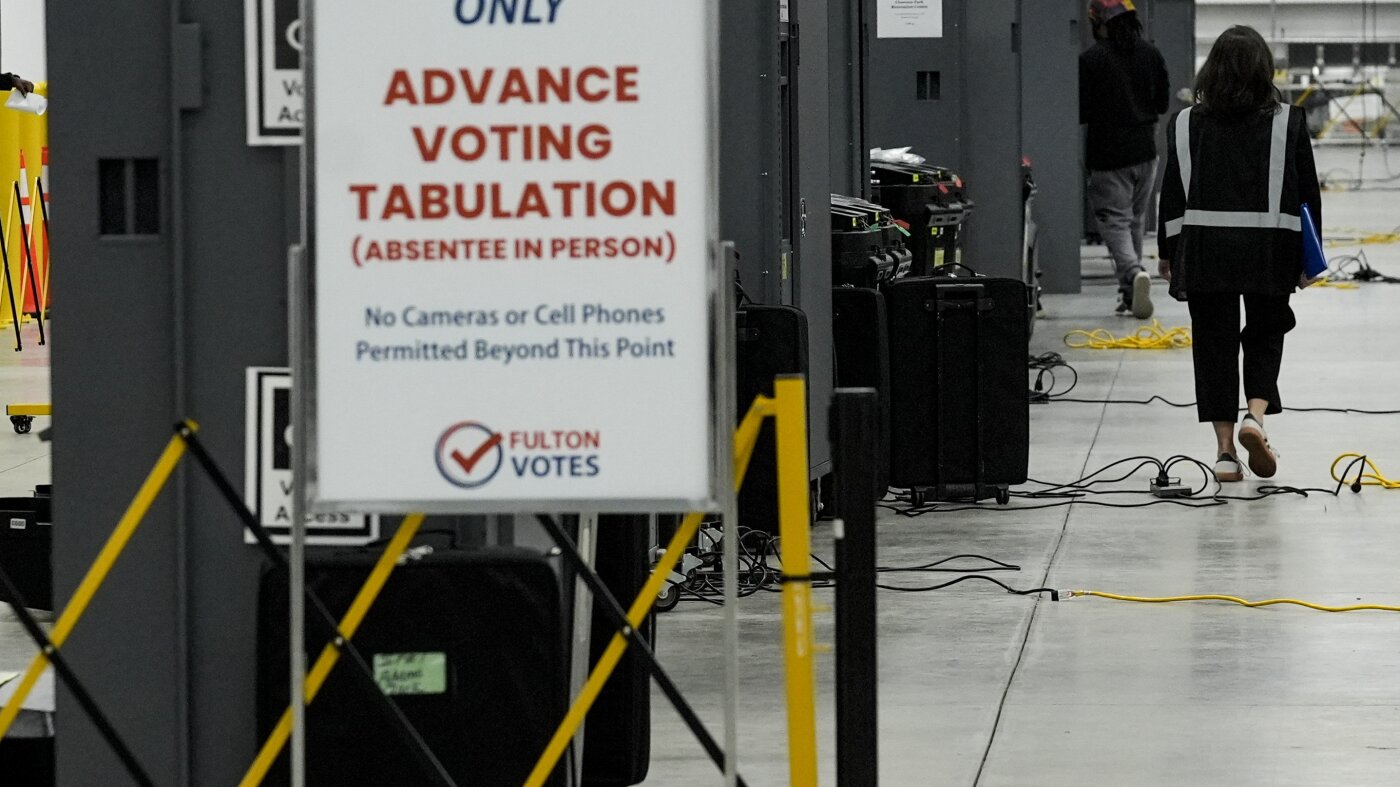
The FBI conducts a search at the Fulton County election office in Georgia

Knife-wielding nut allegedly asked Christian his religion – then stabbed him and dog before police shot him

House Republicans blast Noem impeachment resolution as ‘partisan stunt,’ as Dems fail to reach across aisle

Brother killed after teen becomes ‘enraged’ over video game, stabs sibling: police

Rep Maxwell Frost allegedly assaulted at Sundance Film Festival in racially charged incident

Florida High School Football Rankings: Top 25 teams – Oct. 21

Cleary's 21 help Le Moyne down Central Connecticut State 69-64 in OT

How old is Bo Nix? What to know about Oregon quarterback ahead of 2024 NFL Draft

99th annual Pony Swim held in Virginia

Indiana Members Credit Union announced as new anchor tenant at Bottleworks District
The FBI conducts a search at the Fulton County election office in Georgia

Graham pushes back on Tillis’ criticism of Noem, Miller for labeling man killed by Border Patrol a ‘terrorist’

North Korea’s Kim to outline plans to boost nuclear arsenal

Rep. Ilhan Omar rushed by man on stage and sprayed with liquid at town hall event

Video: F.A.A. Ignored Safety Concerns Prior to Collision Over Potomac, N.T.S.B. Says
-

 Illinois6 days ago
Illinois school closings tomorrow: How to check if your school is closed due to extreme cold
-

 Pittsburg, PA1 week ago
Sean McDermott Should Be Steelers Next Head Coach
-

 Pennsylvania2 days ago
Rare ‘avalanche’ blocks Pennsylvania road during major snowstorm
-

 Lifestyle1 week ago
Nick Fuentes & Andrew Tate Party to Kanye’s Banned ‘Heil Hitler’
-

 Sports1 week ago
Miami star throws punch at Indiana player after national championship loss
-

 Cleveland, OH1 week ago
Northeast Ohio cities dealing with rock salt shortage during peak of winter season
-

 Technology6 days ago
Ring claims it’s not giving ICE access to its cameras
-
 Science1 week ago
Contributor: New food pyramid is a recipe for health disasters