Politics
Column: The presidential race won't be over on election night. Here's what can go wrong after that

The presidential election is still too close to call, but here are three predictions you can take to the bank:
First, we won’t know who won on election night. Three potentially decisive states — Arizona, Pennsylvania and Wisconsin — are notoriously slow at counting. A winner may not emerge before the end of the week.
Second, no matter who wins, Donald Trump will charge that the vote was rigged. He made that claim in 2020, when he lost decisively to Joe Biden. He claimed (again without evidence) that he was robbed of popular votes in 2016, even though he won the election. He has already charged that Democrats will cheat this year. “It’s the only way they’re going to win,” he claimed.
Third, if Trump loses, he will challenge the outcome in the courts, just as he did in 2020. “It’s not over on election day; it’s over on inauguration day,” Trump campaign manager Chris LaCivita said earlier this year. So get ready for long and bitter legal battles that could end up in the Supreme Court with its Trump-friendly majority.
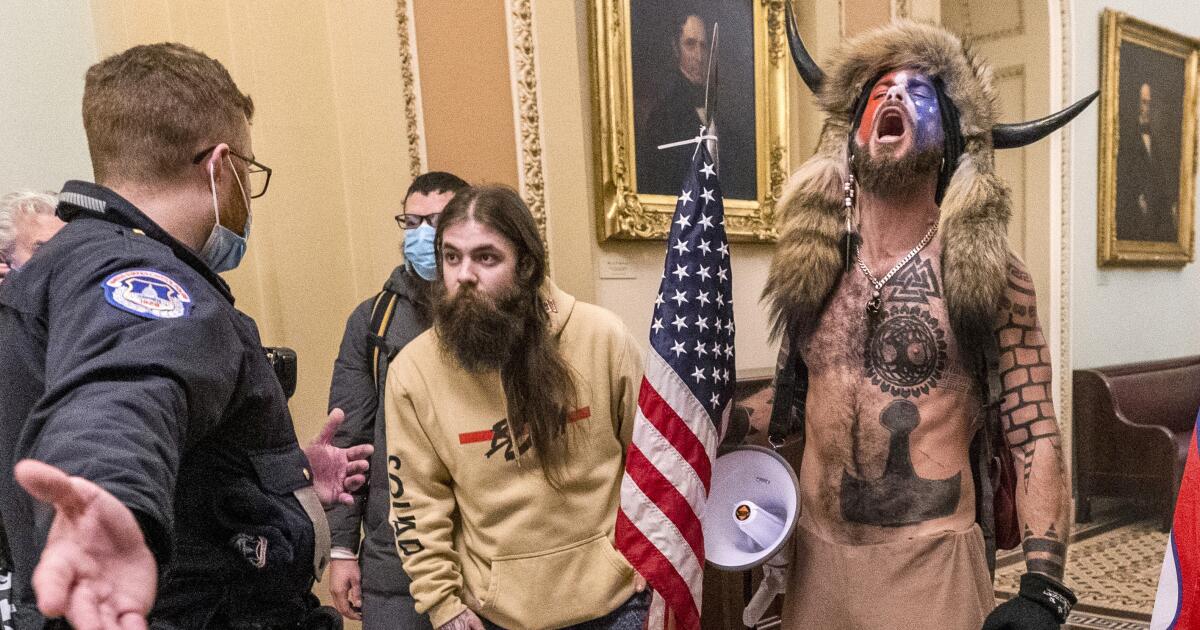
We’ve been here before. Four years ago, Trump tried to undo Biden’s election with a barrage of legal challenges that failed. He asked Republican state legislators to overturn results and demanded that then-Vice President Mike Pence block the count of electoral votes. All refused. A mob of angry, deluded Trump supporters tried to stop the process by invading the Capitol on Jan. 6, 2021; that failed, too.
The guardrails of democracy held — and legal scholars say those guardrails are a little stronger now.
“I’m very confident that the candidate who wins on Nov. 5 will be inaugurated on Jan. 20,” said Justin Levitt, who teaches election law at Loyola Law School in L.A. But a lot can happen between those two dates, he warned.
“There can be litigation. There can be delays. There will be a lot of misinformation, some of it spread on purpose,” he said. “There are real opportunities for unrest, maybe even violence.”
Here are four scenarios in which a close election could run into trouble:
Asking the courts to decide
“There is always the risk of another Bush v Gore,” Rick Hasen of UCLA Law School wrote recently, referring to the 2000 Supreme Court decision that decided that year’s presidential election between George W. Bush and Al Gore. “If the election comes down to a few thousand votes or less in a state that is crucial for an electoral college victory, then we’ll expect both sides to litigate as hard as they can.”
In Pennsylvania, for example, Republicans filed a lawsuit complaining the state’s rules for accepting absentee ballots that arrive with small errors, like a missing date on the envelope, are too lenient. The state Supreme Court left it up to the state’s 67 counties to decide how to handle the ballots.
If those ballots could swing the election, the Trump campaign could argue that it’s unfair for counties to adopt different rules. A similar issue prompted the high court to act in Bush vs. Gore.
Republicans have already filed more than 100 lawsuits challenging election rules in several states to improve their chances after election day.
Refusing to certify results
What if local officials refuse to certify election results they don’t like?
Most legal scholars say courts are almost certain to knock down those attempts — but they could still lead to delays, legal battles and potential unrest.
The once-obscure issue of certification achieved more notoriety after Georgia’s Republican-led election board issued new rules requiring county officials to investigate potential irregularities before they certify results.
Certification has traditionally been an administrative action in which election boards merely confirm that the compiled results match up with what precincts have reported. Investigating allegations of irregularity or fraud is up to law enforcement agencies, not election boards.
In several counties around the country, pro-Trump election officials have briefly refused to certify election results, but courts have uniformly ruled against them. Two Georgia courts have already ruled that the state election board’s new rules are invalid.
“Certification is not likely to produce a [constitutional] crisis,” said Edward Foley, a leading election law expert at Ohio State University. “The courts are going to handle it as they already do.”
The danger of violence
But all those challenges raise the prospect of violence.
On Jan. 6, 2021, Trump told his followers: “If you don’t fight like hell, you won’t have a country anymore.”
This year, he has revived that warning, telling supporters that the stakes of the election are existential — literally. Last month, in Wisconsin, he told a rally that if he doesn’t win, migrants “will walk into your kitchen. They will cut your throat.”
“You won’t have a country anymore,” he said, again.
Violence is always possible, even likely. Trump has already been the target of two assassination attempts. But law enforcement agencies have spent four years preparing to protect polling places, tabulation centers, election officials and judges.
Detroit’s tabulation center, which Trump claimed (without evidence) was a hotbed of fraud, has been outfitted with bulletproof glass. Maricopa County, Ariz., where election officials have been attacked by pro-Trump zealots, is stationing snipers on the roof. The U.S. Capitol Police have worked to ensure that Jan. 6 cannot recur.
In the end, election law scholars say violence need not derail the outcome.
“I do worry about it,” said Levitt. “We live in a climate where some people consider threats of violence an acceptable tactic. … But it’s not going to affect the outcome of the election any more than it did on January 6.”
Congress gets the final say — again
Under the Constitution, Congress formally counts the electoral votes on Jan. 6. That normally ceremonial process almost went off the rails in 2021, when Trump urged Republicans to block legitimately elected Biden electors from swing states. Two-thirds of House Republicans supported the scheme, but Democrats and moderate Republicans quashed it.
That scenario is less likely to recur, thanks to a law Congress passed in 2022, making it harder to challenge electoral votes and clarifying that the vice president has no power to direct the outcome.
Still, if one-fifth of the members of each chamber object to a state’s electoral votes, both houses must vote to accept or reject them. If both chambers have GOP majorities, the outcome could come down to a handful of moderate Republicans like Sens. Susan Collins of Maine and Lisa Murkowski of Alaska.
There’s also a wild card in the list of potential nightmares: What happens if the electoral vote is a tie, 269 to 269?
In that case, the House of Representatives would choose the next president under a rule that would favor Republicans. Instead of a normal vote by individual members of the House, each state’s House delegation would get one vote — meaning California and North Dakota would get equal weight. In the current House, 26 states have mostly Republican House members; only 22, including California’s, are dominated by Democrats. (Two states are evenly divided.)
A tie hasn’t happened since 1800, when Thomas Jefferson tied with Aaron Burr. (Jefferson won the runoff.) Polymarket, a prediction market, puts the odds of a tie this year at 4%.
Misinformation will remain a danger
This is not a “both sides” issue. Only one party has told its followers that if it loses, the only possible reason will be that the election was stolen.
It doesn’t seem to matter whether the challenges are plausible. In 2020, they weren’t, as evidenced by Trump’s long string of losses in the courts. But polls this month have found that most GOP voters believe election fraud is likely to occur this year even though no significant instances have been proven in decades.
Claiming that every election is rigged is not only part of Trump’s political message; it has become part of his business model.
Last time, he raised more than $250 million after election day with his claims. Only $13 million of those donations funded legal efforts to reverse the result. The rest went into Trump’s political coffers, giving him an early start toward his next campaign.
And the misinformation Trump has cultivated won’t go away after inauguration day. He has made bitter post-election battles a durable feature of American politics.
“It is profoundly unhealthy for democracy,” said Levitt. “It is a long-term cancer in the system.”
Read more McManus columns on the election:



NEWYou can now listen to Fox News articles!
Several House Republicans are pushing Speaker Mike Johnson, R-La., to go to war with the Senate GOP over an election security bill that has little chance of passing the upper chamber under current circumstances.
House GOP leaders convened a lawmaker-only call on Sunday in the wake of a massive military operation against Iran launched by the U.S. and Israel.
After leaders briefed House Republicans on how the chamber would respond to the ongoing conflict — including a vote on ending Democrats’ weeks-long government shutdown targeting the Department of Homeland Security (DHS) — Fox News Digital was told that several lawmakers raised concerns about the Senate not yet taking up the Safeguarding American Voter Eligiblity (SAVE America) Act. Among other provisions, the act would require voters in federal elections to produce valid ID and proof of citizenship.
Rep. Derrick Van Orden, R-Wis., was among those pushing the House to reject any bills from the Senate until the measure was taken up, telling Johnson according to multiple sources on the call, “If we don’t get this done, or at least show that we’ve got some backbone, we’re done. The midterms are over.”
Speaker of the House Mike Johnson, R-La., pauses for questions from reporters as he arrives for an early closed-door Republican Conference meeting at the Capitol in Washington, Tuesday, Feb. 3, 2026. (J. Scott Applewhite/AP Photo)
At least three other House Republicans shared similar concerns. Sources on the call said Rep. Brandon Gill, R-Texas, argued that GOP voters were “not enthused” heading into November and that “the single biggest thing” to turn that around would be forcing the Senate to pass the SAVE America Act.
The SAVE America Act passed the House last month with support from all Republicans and just one Democrat, Rep. Henry Cuellar, D-Texas.
JEFFRIES ACCUSES REPUBLICANS OF ‘VOTER SUPPRESSION’ OVER BILL REQUIRING VOTER ID, PROOF OF CITIZENSHIP
Republicans have pointed out on multiple occasions that voter ID measures have bipartisan support across multiple public polls and surveys. But Democrats have dismissed the legislation as an attempt at voter suppression ahead of the 2026 midterms.
Senate Majority Leader John Thune speaks at a press conference with other members of Senate Republican leadership following a policy luncheon in Washington, D.C. on Oct. 28, 2025. (Nathan Posner/Anadolu via Getty Images)
The legislation would require 60 votes in the Senate to break filibuster, which it’s likely not to get given Democrats’ near-uniform opposition. But House Republicans have pressured Senate Majority Leader John Thune to use a mechanism known as a standing filibuster to circumvent that — which Thune has signaled opposition to, given the vast amount of time it would take up in the Senate and potential unintended consequences in the amendment process.
It also comes as Congress grapples with the fallout from the strikes on Iran and the need to ensure safety for the U.S. domestically and for service members abroad, both of which will require close coordination between the two chambers.
Johnson told Republicans several times on the Sunday call that he was privately pressuring Thune on the bill but was wary of creating a public rift with his fellow GOP leader, sources said.
HARDLINE CONSERVATIVES DOUBLE DOWN TO SAVE THE SAVE ACT
“If we’re going to go to war against our own party in the Senate, there may be implications to that,” Johnson said at one point, according to people on the call. “So we want to be thoughtful and careful.”
Sen. Mike Lee, R-Utah, talks with a guest during a “Only Citizens Vote Bus Tour” rally in Upper Senate Park to urge Congress to pass the Safeguard American Voter Eligibility (SAVE) Act on Wednesday, Sept. 10, 2025. (Tom Williams/CQ-Roll Call, Inc via Getty Images)
At another point in the call, sources said Rep. Andrew Clyde, R-Ga., suggested pairing a coming vote on DHS funding with the SAVE America Act in order to force the Senate to take it up.
CLICK HERE TO DOWNLOAD THE FOX NEWS APP
But both Johnson and House Homeland Security Committee Chairman Andrew Garbarino, R-N.Y., were hesitant about such a move given the enhanced threat environment in the wake of the U.S. operation in Iran.
Both spoke out in favor of the SAVE America Act, people told Fox News Digital, but warned the current situation merited leaving the DHS funding bill on its own in a bid to end the partial shutdown, so the department could fully function as a national security shield.
Related Article


According to President Trump, the United States attacked Iran because the Islamic Republic posed “imminent threats” to the U.S. and its allies, including through its use of terrorist proxies and continued pursuit of nuclear weapons.
“Its menacing activities directly endanger the United States, our troops, our bases overseas and our allies throughout the world,” he said in a recorded statement Saturday.
According to leading Democrats in Congress, Trump’s justification is questionable, especially given his claims of having “completely obliterated” Iran’s nuclear capabilities in separate U.S. bombings last June.
“Everything I have heard from the administration before and after these strikes on Iran confirms this is a war of choice with no strategic endgame,” said Rep. Jim Himes (D-Conn.), ranking Democrat on the House Intelligence Committee and part of a small group of congressional leaders — the Gang of Eight — who were briefed on the operation by Secretary of State Marco Rubio.
That divide is bound to remain an issue politically heading into this year’s midterm elections, and could be a liability for Republicans — especially considering that some in the “America First” wing of the MAGA base were raising their own objections, citing Trump’s 2024 campaign pledges to extricate the U.S. from foreign wars, not start new ones.
The debate echoed a similar if less immediate one around President George W. Bush’s decision to go to war in Iraq following the Sept. 11, 2001, attacks, also based on claims that “weapons of mass destruction” posed an immediate threat. Those claims were later disproved by multiple findings that Iraq had no such arsenal, fueling recriminations from both political parties for years.
The latest divide also intensified unease over Congress ceding its wartime powers to the White House, which for years has assumed sweeping authority to attack foreign adversaries without direct congressional input in the name of addressing terrorism or preventing immediate harm to the nation or its troops.
Even prior to the weekend bombings, Democrats including Sen. Adam Schiff of California were pushing Congress to pass a resolution barring the Trump administration from attacking Iran without explicit congressional authorization.
“President Trump must come to Congress before using military force unless absolutely necessary to defend the United States from an imminent attack,” Sen. Tim Kaine (D-Va.), a member of the armed services and foreign relations committees, said in a statement Thursday.
In justifying the daylight strikes that killed Supreme Leader Ayatollah Ali Khamenei just two days later, Trump accused the Iranian government of having “waged an unending campaign of bloodshed and mass murder” for nearly half a century — including through attacks on U.S. military assets and commercial shipping vessels abroad — and of having “armed, trained and funded terrorist militias” in multiple countries, including Hezbollah and Hamas.
Trump said that after the U.S. bombed Iran last summer, it had warned Tehran “never to resume” its pursuit of nuclear weapons. “Instead, they attempted to rebuild their nuclear program and to continue developing long-range missiles that can now threaten our very good friends and allies in Europe, our troops stationed overseas, and could soon reach the American homeland,” he said.
Other Republican leaders largely backed the president.
“The United States did not start this conflict, but we will finish it. If you kill or threaten Americans anywhere in the world — as Iran has — then we will hunt you down, and we will kill you,” said Defense Secretary Pete Hegseth.
“Every president has talked about the threat posed by the Iranian regime. President Trump is the one with the courage to take bold, decisive action,” said Atty. Gen. Pam Bondi.
While Iran’s coordination with and sponsorship of groups such as Hezbollah and Hamas are well known, Trump’s claims about Tehran’s ongoing development of nuclear weapons systems are less established — and the administration has provided little evidence to back them up.
Democrats seized on that lack of fresh intelligence in their responses to the attacks, contrasting Trump’s latest statements about imminent threats with his assertion after last year’s bombings that the U.S. had all but eliminated Iran’s nuclear aspirations.
“Let’s be clear: The Iranian regime is horrible. But I have seen no imminent threat to the United States that would justify putting American troops in harm’s way,” said Sen. Mark Warner (D-Va.), vice chairman of the Senate Intelligence Committee and a member of the Gang of Eight. “What is the motivation here? Is it Iran’s nuclear program? Their missiles? Regime change?”
Senate Minority Leader Chuck Schumer (D-N.Y.) said in a statement that the Trump administration “has not provided Congress and the American people with critical details about the scope and immediacy of the threat,” and must do so.
House Minority Leader Hakeem Jeffries (D-N.Y.) said the Trump administration needs congressional authority to wage such attacks barring “exigent circumstances,” and didn’t have it.
“The Trump administration must explain itself to the American people and Congress immediately, provide an ironclad justification for this act of war, clearly define the national security objective and articulate a plan to avoid another costly, prolonged military quagmire in the Middle East,” he said.
After the U.S. military announced Sunday that three U.S. service personnel were killed and five others seriously wounded in the attacks, the demands for a clearer justification and new constraints on Trump only increased.
Rep. Ro Khanna (D-Fremont) said Sunday he is optimistic that Democrats will be unified in trying to pass the war powers resolution, and also that some Republicans will join them, given that the strikes have been unpopular among a portion of the MAGA base.
Rep. Thomas Massie (R-Ky.), who partnered with Khanna to force the release of the Jeffrey Epstein files, has said he will work with him again to push a congressional vote on war with Iran, which he said was “not ‘America First.’”
Benjamin Radd, a political scientist and senior fellow at the UCLA Burkle Center for International Relations, said that whether or not Iran represented an “imminent” threat to the U.S. depends not just on its nuclear capabilities, but on its broader desire and ability to inflict pain on the U.S. and its allies — as was made clear to both the U.S. and Israel after the Hamas attacks on Israel on Oct. 7, 2023, which Iran praised.
“If you are Israel or the United States, that’s imminent,” he said.
What happens next, Radd said, will largely depend on whether remaining Iranian leaders stick to Khamenei’s hard-line policies, or decide to negotiate anew with the U.S. He expects they might do the latter, because “it’s a fundamentalist regime, it’s not a suicidal regime,” and it’s now clear that the U.S. and Israel have the capabilities to take out Iranian leaders, Iran has little ability to defend itself, and China and Russia are not rushing to its aid.
How the strikes are viewed moving forward may also depend on what those leaders decide to do next, said Kevan Harris, an associate professor of sociology who teaches courses on Iran and Middle East politics at the UCLA International Institute.
If the conflict remains relatively contained, it could become a political win for Trump, with questions about the justification falling away. But if it spirals out of control, such questions are likely to only grow, as occurred in Iraq when things started to deteriorate there, he said.
Israel and the U.S. are betting that the conflict will remain manageable, which could turn out to be true, Harris said, but “the problem with war is you never really know what might happen.”
On Sunday, Iran launched retaliatory attacks on Israel and the wider Gulf region. Trump said the campaign against Iran continued “unabated,” though he may be willing to negotiate with the nation’s new leaders. It was unclear when Congress might take up the war powers measure.

new video loaded: Trump’s War of Choice With Iran

By David E. Sanger, Gilad Thaler, Thomas Vollkommer and Laura Salaberry
March 1, 2026
Missouri Lottery Pick 3, Pick 4 winning numbers for March 1, 2026

Your guide to local sports events, plus what’s on TV
Nebraska Lottery results: See winning numbers for Pick 3, Pick 5 on March 1, 2026

How the strikes on Iran could impact gas prices in northern Nevada

New photo released in unsolved 1997 homicide of a N.H. woman

Florida High School Football Rankings: Top 25 teams – Oct. 21

Cleary's 21 help Le Moyne down Central Connecticut State 69-64 in OT

How old is Bo Nix? What to know about Oregon quarterback ahead of 2024 NFL Draft

99th annual Pony Swim held in Virginia

Indiana Members Credit Union announced as new anchor tenant at Bottleworks District

House Republicans push Johnson to go to war with Senate over SAVE Act

Israel FM says Europe too divided, slams Spanish PM

Satellite images provide view inside Iran at war

Video: What the Texas Primary Battle Means for the Midterms

Dems’ potential 2028 hopefuls come out against US strikes on Iran
-

 World4 days ago
Exclusive: DeepSeek withholds latest AI model from US chipmakers including Nvidia, sources say
-

 Massachusetts5 days ago
Mother and daughter injured in Taunton house explosion
-

 Denver, CO4 days ago
10 acres charred, 5 injured in Thornton grass fire, evacuation orders lifted
-

 Louisiana1 week ago
Wildfire near Gum Swamp Road in Livingston Parish now under control; more than 200 acres burned
-

 Technology1 week ago
YouTube TV billing scam emails are hitting inboxes
-

 Politics1 week ago
OpenAI didn’t contact police despite employees flagging mass shooter’s concerning chatbot interactions: REPORT
-

 Technology1 week ago
Stellantis is in a crisis of its own making
-

 News1 week ago
World reacts as US top court limits Trump’s tariff powers