Politics
Column: The latest sign that Republicans are abandoning even their most deeply held principles

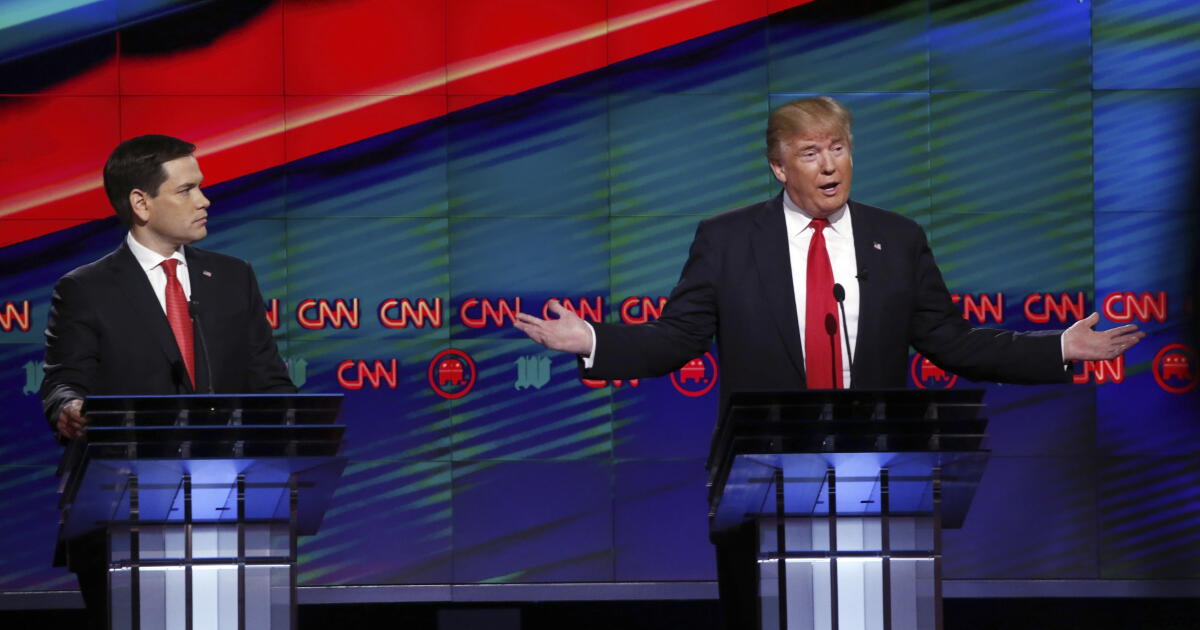
The changing of the conservative mind in recent years could hardly be captured more pithily than in the headline of a recent op-ed: “Why I believe in industrial policy — done right.” So opined Sen. Marco Rubio for the Washington Post and, at greater length, for National Affairs.
Note that I’m not addressing the conservative heart. Calling lawfully convicted violent criminals such as the Jan. 6 rioters “hostages” speaks more to the sad and profound changes of heart on much of the right.
What I’m referring to, rather, are the ideas, arguments and principles that once defined conservatism intellectually, among them rejection of the kind of government intervention in the economy that the Florida Republican now apparently favors.
Modern conservatism — the sort associated with Barry Goldwater, William F. Buckley, George Will, Thomas Sowell, Ronald Reagan and to some extent Rubio when he arrived in Washington — once regarded central economic planning and everything associated with it, including “industrial policy,” to be dangerous folly. Buckley’s 1955 mission statement for National Review declared: “Perhaps the most important and readily demonstrable lesson of history is that freedom goes hand in hand with a state of political decentralization, that remote government is irresponsible government.” He also noted that the “competitive price system is indispensable to liberty and material progress.”
This conviction can be traced back to Edmund Burke and Adam Smith, but it became a defining principle on the American right during the Cold War, against the backdrop of the rise of the Soviet Union as well as the domestic programs of Franklin Roosevelt’s New Deal and Lyndon Johnson’s Great Society.
There are many strands to the conservative argument against state efforts to shape the economy. One is the “knowledge problem,” a phrase adapted from Nobel Prize-winning economist Friedrich Hayek’s brilliant 1945 essay “The Use of Knowledge in Society.”
The knowledge problem, simply put, is that society, including the market, is too complex and too dynamic for government experts to reliably direct it from afar. In a free market, prices capture information that even the best data-gatherers can’t. The closer you are to the problem, the closer you are to the solution.
Public choice theory — what another Nobel laureate economist, James M. Buchanan, called “politics without romance” — adds another layer of reasons to distrust central planning. Government experts and regulators are often “captured” by the industries or activists most affected by their policies. Also, once politicians get involved, policy priorities multiply — extending to boosting employment, expanding diversity, favoring certain states or districts, protecting specific industries and so on — and the government’s stated goals become pretexts for other motives. “Crises” — pandemics, war, unemployment, environmental problems — become excuses to reward favored constituencies.
Take President Biden’s recent announcement that he would rebuild Baltimore’s collapsed Francis Scott Key Bridge both “as rapidly as humanly possible” and “with union labor and American steel.” Well, which is it — rapidly or with those restrictions?
That brings us to Rubio. Take it from a longtime columnist, you can’t always blame writers for the headlines mischievous editors put on our articles. But “Why I believe in industrial policy — done right” perfectly captures the senator’s argument and the trouble with the broader right-wing fad for central planning.
Oh, you want to do it right? Well, that changes everything!
I mean, if only someone had told Hayek and Buchanan that their objections could be answered by just “doing it right.”
The change in the conservative mind goes beyond industrial policy. It’s really about the use of state power generally. Too many Republicans no longer have any problem — moral or otherwise — with government imposing its will on society, so long as the “right” people are doing it “right.” The knowledge problem, they seem to believe, is confined to the left wing.
This is the core conceptual failing of Rubio’s argument, but there are others.
We used to say the left invented crises and distorted facts to justify expanding government. The same can now be said of the right. Rubio suggests that until very recently, America embraced “unfettered free trade.” This is not only untrue but, as Reason’s Eric Boehm suggested, a particularly strange assertion by a leading defender of Florida sugar subsidies.
Rubio also states that American manufacturing has suffered “decades of neglect” and that the “collapse of American manufacturing has … done incalculable harm to our nation’s social fabric.” What collapse? While it’s true that U.S. industrial employment has declined — mostly thanks to automation, not trade — industrial output has been increasing for a century.
I agree with Rubio that we should spend more on defense for national security purposes. But Rubio wants such spending to also mend the nation’s social fabric and serve as a jobs program.
I don’t share the senator’s confidence that Washington could accomplish all that if only people like him were in charge.

Politics
McCarthy says Trump will use ‘everything he can’ to force Senate action on SAVE America Act

NEWYou can now listen to Fox News articles!
As infighting over the SAVE America Act throws congressional Republicans into disarray, President Donald Trump’s bid to get the stalled election bill across the finish line gained one notable ally.
Former House Speaker Kevin McCarthy, R-Calif., told Fox News Digital that he supports the election integrity measure and indicated that Trump should continue to use every available tool to pressure the Senate to pass it.
“He’s going to try everything he can to make sure he passes that through,” McCarthy said in a brief interview outside the U.S. Capitol.
The ex-speaker’s comments came after Trump abruptly called off a signing ceremony Wednesday for a bipartisan housing bill to pressure the Republican-controlled Senate to act on the SAVE America Act.
President Donald Trump boards Air Force One as he departs Reading Regional Airport in Reading, Pa., on June 23, 2026. (Evelyn Hockstein/Reuters)
IRATE REPUBLICANS ACCUSE TRUMP OF HANDING DEMOCRATS A WIN AFTER BLOWING UP HOUSING PACKAGE
The move surprised Republican lawmakers, some of whom were praising the bill’s passage at a press conference when Trump’s Truth Social post broke.
But Trump has repeatedly cast the election measure — requiring proof of citizenship to vote in federal elections and voter identification requirements — as his top legislative priority.
The legislation’s momentum, however, has slowed in the upper chamber, where Republican leadership insists the votes aren’t there amid widespread Democratic opposition. Senate Republicans have also been unwilling to eliminate the legislative filibuster, which requires a 60-vote threshold to pass the legislation.
Former Speaker of the House Kevin McCarthy speaks during a ceremony honoring President Ronald Reagan on the 115th anniversary of his birthday at the Ronald Reagan Presidential Library in Simi Valley, Calif., on Feb. 6, 2026. (Hans Gutknecht/MediaNews Group)
TRUMP CALLS MAIL IN VOTING CORRUPT AS SENATE BEGINS DEBATE ON SAVE ACT REQUIRING VOTER ID
Amid the SAVE standoff, a group of conservative lawmakers effectively shut down the House floor in an effort to force Senate action on the election bill.
But the Senate recessed Wednesday for two weeks over the July 4 holiday, leaving the measure in limbo until lawmakers return.
The conservative-led blockade sparked fierce backlash, with several members inside the GOP conference telling Fox News Digital the move risked torpedoing their own legislative agenda.
Meanwhile, the House has also yet to pass a version of the legislation incorporating several of the president’s priorities, including a mail-in voting crackdown and provisions banning men from competing in women’s sports and child sex change procedures.
Trump has not indicated whether he will sign the 21st Century ROAD to Housing Act, despite the likely existence of a veto-proof majority.
House Speaker Mike Johnson, R-La., told reporters Thursday that the housing bill had been transmitted to the White House for Trump’s signature following a meeting with the president.
Speaker of the House Mike Johnson, R-La., talks with reporters in the U.S. Capitol on June 10, 2026. (Tom Williams/CQ-Roll Call, Inc via Getty Images)
CLICK HERE TO DOWNLOAD THE FOX NEWS APP
Trump now has 10 days to sign the package or veto it. If he does nothing, the legislation automatically becomes law at the end of the 10-day period.

WASHINGTON — California’s two Democratic senators on Thursday criticized the Trump administration after it requested $87.6 billion from Congress to address some of the nation’s most “urgent needs” but omitted funding for victims of last year’s Los Angeles wildfires.
“Donald Trump’s desire to punish Los Angeles and the state of California for not voting for him, means once again that thousands of Angelinos are left watching this administration fight for anything but them, their businesses, and their communities,” Sens. Alex Padilla and Adam Schiff said in a joint statement.
“These fires did not discriminate based on party or political preference. Neither should this administration,” they added.
The omission is the latest strain in a yearlong standoff between California leaders and the Trump administration over federal disaster aid, and it comes after Los Angeles Mayor Karen Bass and Los Angeles County Supervisor Kathryn Barger met with President Trump at the Oval Office in April to request the funding.
At the meeting, Trump signaled his commitment to working with local officials to help with disaster recovery efforts. The officials asked for $16 billion that would be split between the city and county. The money would consist primarily of disbursements from the Federal Emergency Management Agency flagged for communities hit by the fires, part of a $33.9-billion wildfire relief funding request made by Gov. Gavin Newsom.
Two months later, those talks have yet to yield results sought by local leaders.
The budget request, submitted by the Office of Management and Budget on Wednesday, mostly seeks funding for the Pentagon to address costs related to the Iran war. It also includes $11.1 billion in economic assistance for American farmers, $1.4 billion to address the Ebola virus outbreak in Central Africa, $500 million to support “ongoing efforts to complete restorations and construction projects” across the nation’s capital and $1 billion to boost the pensions of workers at General Motors that were cut as a result of the automaker’s bankruptcy.
“I urge the Congress to take action on these important and urgent requests as soon as possible,” White House budget director Russell Vought wrote in a letter addressed to House Speaker Mike Johnson (R-La.).
Vought said the administration was open to discussing “additional relief for other urgent matters.” The White House did not immediately respond when asked why the budget request did not mention the Eaton and Palisades disaster relief funds.
State leaders, including Newsom, have repeatedly accused the Trump administration of stonewalling billions in wildfire aid. The governor visited Washington in December to meet with lawmakers, including three who serve on the Senate and House appropriations committees, to push for the funding.
The governor also attempted to meet with FEMA about the matter, but said his request was denied. Newsom, a political foe of Trump’s, would not say whether he had attempted to meet with Trump to talk about the recovery efforts.
Politics
Trump administration pledges $150M in aid, deploys Navy warships after deadly Venezuela earthquakes

Secretary Rubio details US aid to Venezuela after earthquakes
Secretary Rubio, in Manama, Bahrain, outlines the comprehensive U.S. government response to the devastating back-to-back earthquakes in Venezuela. He confirms immediate deployment of search and rescue teams, medical resources and humanitarian assistance, emphasizing the urgency to save lives. Rubio reiterates President Donald Trump’s commitment to supporting Venezuela and collaborating with international partners on recovery efforts and long-term stability.
NEWYou can now listen to Fox News articles!
Following a catastrophic set of earthquakes that left at least 235 people dead in Venezuela, the Trump administration has activated a government-wide humanitarian response, pledging $150 million in aid and deploying U.S. Navy warships to assist in life-saving rescue operations.
The rapid mobilization Thursday comes after back-to-back magnitude 7.2 and 7.5 earthquakes rocked northern Venezuela roughly 120 miles west of Caracas Wednesday night.
The rare earthquake “doublet” injured more than 940 people and turned the state of La Guaira into a disaster zone, while forcing the closure of the damaged Simón Bolívar International Airport, according to Venezuela’s Health Ministry.
US RESCUE TEAMS TO DESCEND ON HARD-HIT CARIBBEAN AFTER CATASTROPHIC HURRICANE MELISSA’S IMPACT
Rescuers search for victims in a collapsed building following an earthquake in Caracas on June 24, 2026. (Manaure Quintero / AFP via Getty Images)
The U.S. Department of State announced on Thursday it is mobilizing $150 million in aid, which includes $50 million in new bilateral awards for relief partners on the ground — such as Samaritan’s Purse, Catholic Relief Services and World Vision — along with a $100 million contribution to a United Nations humanitarian pooled fund.
To spearhead efforts on the ground, the State Department has deployed a regional Disaster Assistance Response Team alongside two highly specialized urban search-and-rescue teams from fire departments in Fairfax County, Virginia, and Los Angeles County, California.
U.S. WARSHIPS TO PATROL INTERNATIONAL WATERS AROUND VENEZUELA AS TRUMP VOWS TO STOP CARTELS
Members of the County of Los Angeles Fire Department’s international urban search and rescue team (USA-2) prepare to leave for Venezuela, in Pacoima, Calif., Thursday. (Blake Fagan/AFP via Getty Images)
U.S. Southern Command (SOUTHCOM) said it is surging assigned U.S. military forces to the region, directing the USS Fort Lauderdale and the USS Billings to Venezuela to back the State Department-led operations.
The USS Fort Lauderdale will serve as a “floating command center” with a flight deck to support heavy-lift helicopters and a well deck to launch landing craft, according to SOUTHCOM.
Meanwhile, the agile USS Billings will provide critical support close to the shorelines to accelerate the disaster response missions.
U.S. SOUTHCOM said it has directed USS Fort Lauderdale (LPD 28) and USS Billings (LCS 15) to Venezuela to support State Department-led U.S. government relief operations in Venezuela. (@Southcom/X)
SOUTHCOM said it is also sending rotary-wing aircraft, which will provide critical life-saving airlift support, transporting U.S. government response personnel, search and rescue teams and partners during relief operations.
Amid the crisis, the State Department emphasized that the safety of U.S. citizens remains the administration’s highest priority.
“The Trump Administration has no higher priority than the safety and security of Americans. The Department of State is working tirelessly to provide consular assistance to U.S. citizens and their families in the affected areas,” officials wrote in a statement. “The United States remains steadfast in its commitment to helping Venezuela recover from this devastating disaster and will continue to explore additional ways to provide meaningful assistance during this critical time.”
CLICK HERE TO DOWNLOAD THE FOX NEWS APP
U.S. citizens in Venezuela are urged to enroll in the Smart Traveler Enrollment Program (STEP) and can contact the State Department 24/7 at 202-501-4444 for emergency assistance.
Family members in the U.S. seeking information on loved ones can call toll-free at 888-407-4747.
-

 World2 minutes ago
‘Eddie Cochran: Don’t Forget Me’ Director Kirsty Bell on How Legendary Musician Influenced New Generation of ‘Rock Stars’ Like Yungblud
-
 Lifestyle40 minutes ago
‘Supergirl’ has a solid hero but could use a better villain : Pop Culture Happy Hour
-

 Technology50 minutes ago
Of course Meta thinks gambling is the future
-

 World55 minutes ago
Death toll from Venezuela earthquakes rises to at least 589, with thousands reported missing
-

 Politics1 hour ago
McCarthy says Trump will use ‘everything he can’ to force Senate action on SAVE America Act
-

 Health1 hour ago
Switching from cigarettes to vapes linked to higher risk of major eye diseases, large study finds
-

 Sports1 hour ago
2026 World Cup Odds: Which Nations are Favored to Reach Semifinals?
-

 Technology1 hour ago
World Cup ticket scams target desperate fans

