Politics
Column: How the massive New York business fraud verdict will do real damage to Trump's empire

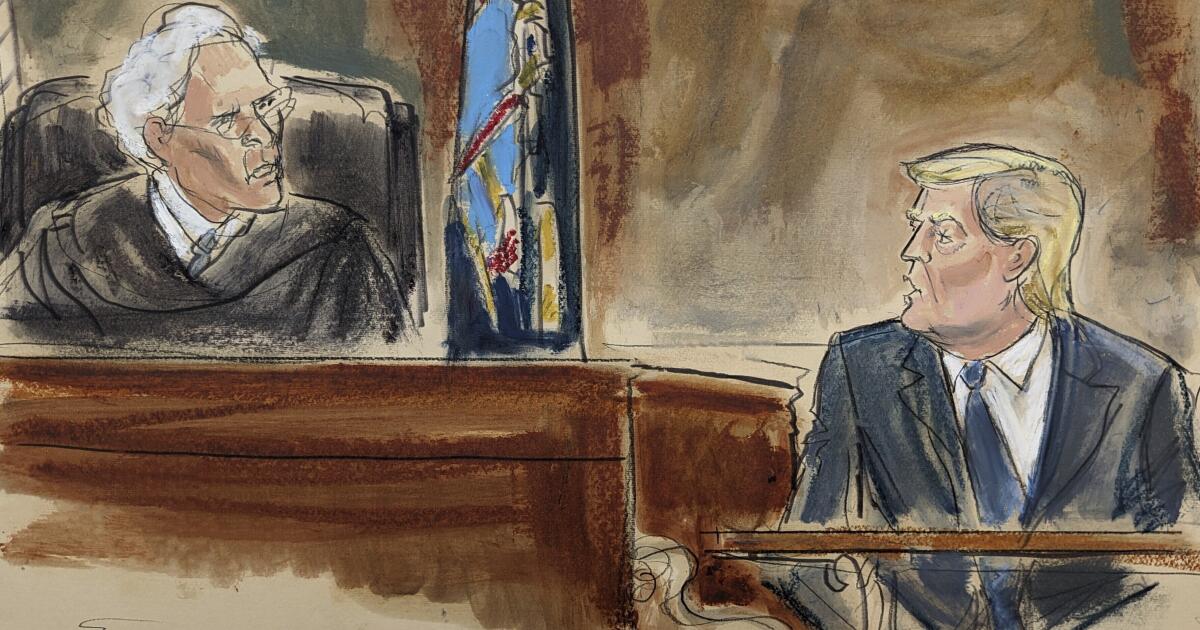
Over the course of an 11-week fraud trial before New York Justice Arthur Engoron, Donald Trump practically begged for a harsh verdict. On Friday, he got his wish and then some.
Engoron issued a scathing 92-page decision that ordered Trump and his co-defendants to pay $364 million for defrauding the people of New York. And that gargantuan figure actually understates the price tag: With the addition of prejudgment interest required under New York law, Trump is looking at closer to $500 million.
Combined with the $83 million a jury ordered Trump to pay last month for defaming the writer E. Jean Carroll, the former president faces a financial hit that exceeds even his own likely inflated account of his empire’s cash on hand.
Like Carroll, the people of New York might not see the money soon; Trump has promised to appeal the verdict, though he will have to pay the penalty or at least secure a bond to do so.
The decision nevertheless delivers real accountability for a man who has managed to dodge it again and again. Engoron’s opinion pillories Trump for his unresponsive, stream-of-consciousness testimony and seems to regard him as a truant child in need of unstinting oversight and stern punishment.
While the financial aspect of the penalty captured the headlines, it’s just one of several ways in which Engoron clobbered the former president.
The verdict further punishes Trump with a loss of control over his business. Engoron appointed a second monitor, styled as an independent director of compliance, to join former judge Barbara Jones in overseeing Trump’s empire. The net effect is that Trump, after a lifetime of doing whatever he felt like regardless of the rules, will have to come down from his perch and ask someone else’s permission for all sorts of previously unilateral business decisions, at least in New York.
Engoron put the remedy into place to safeguard assets now provisionally owed to the people of the state. They’re no longer Trump’s to do with as he likes.
The judge further prohibited Trump from serving as a director or officer of any New York company for three years. That means he can’t try to maneuver his way out of trouble and oversight by forming another company.
The opinion also constitutes a body blow to the brand that Trump has spent a lifetime mythologizing. Titans of commerce don’t tend to cough up huge fraud judgments or ask anyone’s permission to write a check.
The extent to which the Trump brand is propped up by lies has always been open to question. After today’s verdict, the brand is propped up by even less.
Nor was Engoron’s judgment limited to Trump himself. His sons also face large financial penalties and are barred from holding senior offices in any New York business for two years.
And Trump’s troubles are really only beginning. The day before the verdict, another New York judge ordered him to stand trial next month in the Stormy Daniels hush money case, which could result in a felony conviction and even a jail sentence. Also on the horizon are three other criminal trials, civil litigation over the events of Jan. 6, 2021, and the results of a potentially devastating tax audit.
Even his only apparent long-term defense strategy — returning to the White House to avoid further prosecution — would fail to undo a lot of the damage.
Engoron’s stinging verdict left no doubt that Trump’s characteristic arrogance and slash-and-burn politics played a significant role in the judgment. The judge noted his “complete lack of contrition and remorse,” which he said “borders on the pathological.”
In this respect, he compared Trump unfavorably with the criminal mastermind Bernie Madoff, who at least had the humility to appreciate the damage he had inflicted and apologize to the court and his victims.
Trump, by contrast, has only one speed. He can be counted on to continue to approach the campaign and his serial court appearances with his signature brand of in-your-face, outrageously dishonest braggadocio. If the other cases go the way this one did, it may yet prove to be his undoing.
Harry Litman is the host of the “Talking Feds” podcast. @harrylitman

Politics
Fetterman unleashes on ‘dirtbag’ wing of Dems after far-left victories: ‘Orgy of socialism’

NEWYou can now listen to Fox News articles!
Sen. John Fetterman, D-Pa., unloaded on his own party on Sunday evening, blasting a series of victories for progressives he called “anti-America.”
“Big night for the dirtbag left,” Fetterman said, referring to New York’s recent primaries, where two members of the Democratic Socialists of America (DSA) won primaries.
“I’ve said the party is becoming an orgy of socialism. Clearly anti-America, anti-Western Civilization,” Fetterman said.
Fetterman’s striking calls give a rare look at how some moderates may view the developments on their far-left flank that have dominated the party’s momentum in recent months, sparking concern that their high visibility is dragging the party further and further left.
FETTERMAN WARNS DEMOCRATS ‘DRIFTING FIRMLY INTO COMMUNISM’ AFTER SOCIALIST PRIMARY WINS
Sen. John Fetterman, D-Pa., speaks to reporters outside the Senate Chamber during votes on Nov. 10, 2025, on Capitol Hill in Washington, D.C. (Andrew Harnik/Getty Images)
His comments come on the heels of a handful of key progressive victories.
In Maine, Graham Platner, a controversial Democratic candidate for U.S. Senate, has attracted controversy for denying knowledge of the meaning behind a Nazi-linked tattoo, for off-color comments about race and calling himself a “communist” in a deleted Reddit post.
In New York, one DSA member, Claire Valdez, won a primary on a platform of abolishing ICE and a Green New Deal-style approach to climate change. Similarly, Darializa Avila-Chevalier, another DSA candidate, beat out incumbent Rep. Adriano Espillat, D-N.Y., a high-ranking Democrat and the chair of the Congressional Hispanic Caucus.
WINNERS AND LOSERS EMERGE AFTER SOCIALIST EARTHQUAKE ROCKS NYC PRIMARIES
Graham Platner, Democratic Senate candidate for Maine, speaks at a primary election night event at the Blue Hill YMCA in Blue Hill, Maine, on June 9, 2026. Platner won the party’s Senate primary after a campaign marked by accusations of past misbehavior and voter concerns. (Graeme Sloan/Bloomberg via Getty Images)
Both Chevalier and Valdez had the backing of New York Mayor Zohran Mamdani, himself a socialist.
The wins have captured national attention and drawn criticisms from Republicans who have pointed to their success as emblematic of the direction of the Democratic Party.
Fetterman, who has not shied away from confrontations, has been one of the few Democrats to express alarm about the kind of candidates carrying the party’s banner.
“I mean, you look at some of the things that people have said. Abolish prison, abolish the border, abolish ICE, I mean these crazy people — I have colleagues in my caucus that refuse to even call this out,” Fetterman said.
FETTERMAN REACTS TO MAMDANI’S REFUSAL TO ACCEPT SUPREME COURT’S IMMIGRATION RULING
U.S. Sen. John Fetterman, D-Pa., walks through the Senate Subway during the Senate War Powers vote on April 22, 2026, in Washington, D.C. (Heather Diehl/Getty Images)
CLICK HERE TO DOWNLOAD THE FOX NEWS APP
“Between P-hustle in Maine and some of the other winners in New York, they should form their own party and run on all the things that they’ve had to delete on social media,” Fetterman said, referring to Platner.
“That’s where our party has moved,” he added.
WASHINGTON — The Supreme Court cast doubt Monday on whether police may obtain cellphone data to find crime suspects.
In a 6-3 decision, the justices said this location information showing where a cellphone user has traveled is personal and private and subject to the protection of the 4th Amendment’s ban on unreasonable searches.
Justice Elena Kagan said these “records serve as a personal journal of a user’s movements.”
She said the information “resembles other private materials — think of emails, documents, photographs, or calendars—that even if stored on Google’s servers, a user reasonably views as his own…and reasonably expects to be shielded from the inquisitive eyes of the government.”
Because an “individual has a legitimate expectation of privacy in his cellphone location data,” she said police investigators need a valid search warrant from a magistrate.
The court stopped short of deciding the proper basis for a search warrant in such cases. Instead, the justices sent the case back to judges in Virginia.
But the outcome casts doubt on “geofence warrants.”
In recent years, police have gone to Google and cellphone companies seeking tracking data on cellphones that were at a crime scene. Sometimes, they have had a warrant from a magistrate.
Civil libertarians say the use of this tracking data raises the specter of mass surveillance on innocent people.
Police and government lawyers say no one has a reasonable right to privacy when they are walking on a sidewalk or driving down the street.
The case before the court arose from the armed robbery conviction of a Virginia man who stole $195,000 from a credit union in a small town near Richmond.
By the time police arrived, the robber had fled. But surveillance cameras showed he was carrying a gun and a cellphone.
Lacking other leads, detective Joshua Hilton asked a judge to issue a special type of warrant seeking information from Google.
Referred to as a “geofence warrant,” it seeks data from phones in a particular area at a particular time.
The detective sought data on phones that were within 150 yards of the credit union within one hour of the late afternoon robbery.
After examining and paring down the data, the detective asked for the phone records of Okello Chatrie. Then, with a search warrant of his home, investigators found two robbery-style demand notes, a semi-automatic pistol and about $100,000 in cash.
A judge refused to suppress the evidence from an allegedly unconstitutional search, and Chatrie entered a conditional guilty plea.
The full 4th Circuit Court of Appeals split evenly on the legality of the geofence warrant, and the Supreme Court agreed to decide the issue in Chatrie vs. U.S.
Usually investigators obtain warrants to search the home or vehicle of a known crime suspect.
The new and disputed geofence warrants seek to find a suspect by examining data on the cellphones that were at the scene of a crime.
The FBI used this cellphone data in 2021 to identify suspects who broke through police barricades on Jan. 6, 2021, and pushed their way into the Capitol to disrupt the official counting of electoral votes.
Chief Justice John G. Roberts Jr. and Justices Sonia Sotomayor, Neil M. Gorsuch, Brett M. Kavanaugh and Ketanji Brown Jackson agreed on the outcome in Chatrie vs. U.S.
In a 21-page dissent, Justice Samuel A. Alito Jr. said the court had “carefully set the stage for its planned performance: striking a pose as a great champion of privacy in the digital age. I cannot support this irresponsible escapade.”
Justice Clarence Thomas agreed.
Justice Amy Coney Barrett agreed in a one-paragraph dissent. “Chatrie had no reasonable expectation of privacy in data about his public movements that he voluntarily disclosed to Google,” she said.
The Supreme Court ruled 6-3 that President Trump could fire independent regulators for any reason. But the justices carved out an exception for the Federal Reserve, preventing the immediate removal of Lisa D. Cook, a Federal Reserve governor.
-

 World3 minutes ago
UK asylum seekers could have to pay government $13K before applying for settlement
-

 Politics10 minutes ago
Fetterman unleashes on ‘dirtbag’ wing of Dems after far-left victories: ‘Orgy of socialism’
-

 Health12 minutes ago
Doctors thought man had brain cancer — they found live tapeworms instead
-

 Sports18 minutes ago
Paraguay stuns four-time World Cup champions Germany in penalty shootout after controversial call
-
 Business28 minutes ago
Comcast is spinning off NBCUniversal media and entertainment assets
-
 Entertainment33 minutes ago
Alannah Keyser is latest fired ‘Love Island USA’ contestant to apologize for using a racist slur
-

 Lifestyle40 minutes ago
Chanel’s Bruno Pavlovsky on Reengineering an Iconic Brand
-
Politics43 minutes ago
Supreme Court limits police use of cellphone data to find crime suspects

