Politics
Column: Fani Willis' prosecution of Donald Trump may be alive, but it isn't well

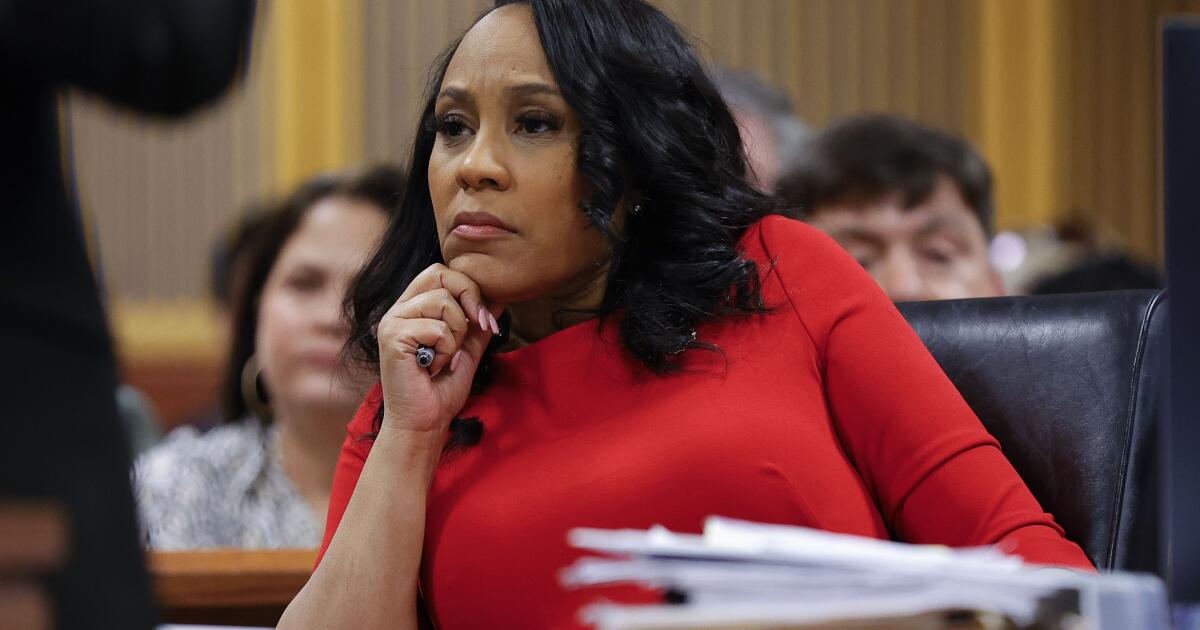
Special prosecutor Nathan Wade’s resignation Friday from the Georgia racketeering prosecution of Donald Trump and others was the right decision and, indeed, a virtually forced one. Judge Scott McAfee’s resolution of a defense motion to disqualify Wade’s boss, Fulton County Dist. Atty. Fani Willis, left no practical alternative.
But it would be a mistake to assume that Wade’s withdrawal puts an end to the ugliness and doubt surrounding Willis’ handling of the case.
To dispel the appearance of a conflict of interest arising out of a romantic relationship between the two prosecutors, McAfee held that either Wade or Willis, along with her entire office, would have to step aside. That made Wade’s withdrawal, which many observers had been urging, the best way to begin to clean up a distracting mess while allowing Willis to continue leading her office and its highest-profile prosecution.
But the order, and the circus-like atmosphere of the multiday evidentiary hearing that preceded it, in some ways served only to intensify the controversy surrounding the case and ensure that the rhetorical challenges will continue.
Notwithstanding the decorous and professional language of McAfee’s order, it lands several haymakers on Willis’ judgment and probity. Probably the most notorious and enduring is his assertion that “an odor of mendacity remains” around the testimony of Willis and Wade, specifically as to the timing of their relationship. It’s a phrase that could have a continuing political impact in Georgia and nationally.
Whatever the judge’s intent, his analysis bolsters Trump and other Republicans in Georgia, which is among the most fiercely contested states in the coming election. With a special committee created by the state Senate investigating Willis and a new law enabling oversight of district attorneys’ offices, Georgia Republicans will have plenty of opportunities to keep sounding the refrain that the problem is not Trump but Willis. A prosecution revolving around an infamous Trump sound bite — “I just need 11,780 votes” — is now tainted by an “odor of mendacity.”
That reality may be deeply unfair, and it is certainly steeped in a Southern stew of racial and sexual politics, but Willis’ conduct will continue to be under intense and even undue scrutiny, particularly as both she and McAfee face an election this year. The motion to disqualify her has already drawn attention to questions that really had no bearing on the legal issues at hand, including precisely when she and Wade began their relationship.
Part of the responsibility for the abiding eyesore that the case has become must be laid at the feet of McAfee. The Fulton County Superior Court judge has earned generally high marks for his even temper and solid preparation for a monster of a case. But the meager allegations in Trump co-defendant Michael Roman’s original motion could have been resolved without the chaotic evidentiary hearing that McAfee convened. The judge even could have denied the motion to disqualify and left it at that.
McAfee’s ultimate rejection of the motion is unassailable because there never was a plausible claim of a financial conflict of interest in Willis’ relationship with Wade, and nothing short of that could justify disqualifying the district attorney. Whatever Wade spent on Willis — for flowers, fancy meals or even airfare — it was not just baseless but also silly to suggest that such benefits drove the district attorney’s management of the case. And that’s all the judge needed to know to reject the defendants’ far-fetched argument.
McAfee, however, permitted the show to go on. And though he properly rejected the claim of a conflict, he roamed into amorphous “appearance of conflict” territory to justify the difficult choice he served up to Willis and Wade in forcing one of them to exit the case.
But Wade’s withdrawal can’t cleanse the case of the stink bomb dropped into the proceedings by Roman and Trump. Even if Willis retakes the reins and pursues the case with impeccable judgment and prudence from this point forward — as there’s no reason to doubt she will — it will be while Trump and his champions shout this counternarrative from the rooftops.
The whole misadventure is only the latest in a recent series of unearned breaks for Trump in his single-minded quest to keep all his trials from going forward before the November election. Willis and a Fulton County grand jury leveled grave charges against the former president. The odds that they will reach trial and a verdict that the American people can consider in choosing their next president are now perilously close to zero.
Harry Litman is the host of the “Talking Feds” podcast and the new Talking San Diego speaker series. @harrylitman


The June 16 appearance by Vance gave the program its most-watched episode since November 2024.
The first appearance by Vice President JD Vance on ABC’s “The View” delivered the most-watched edition of the talk show since November 2024.
The June 16 program averaged 3.3 million viewers, according to Nielsen data. The figure was well above the average of 2.6 million viewers for “The View” in the 2025-26 season.
Vance appeared on the liberal-leaning program to promote his new book on his decision to become a Catholic. While the co-hosts mostly questioned him on the Trump administration’s policies on immigration and race, the discussion was cordial.
The panel of co-hosts — Whoopi Goldberg, Joy Behar, Ana Navarro, Sunny Hostin and Alyssa Farah Griffin — did not ask Vance to address the program’s ongoing tension with the Federal Communications Commission.
FCC Chairman Brendan Carr has questioned whether “The View” should have the status of news programs, which are exempt from giving equal time to the opponents of political candidates who appear as guests.
ABC has asked the FCC to rule on the status of “The View,” which received an exemption from the rarely enforced equal time provision in 2002. ABC has maintained that “The View” books politicians based on newsworthiness and not partisanship.
The FCC is currently taking comments from the public on the matter. ABC is running on-air spots urging viewers to support the program.
“‘The View’ has welcomed your favorite guests and covered the issues you care about for nearly 30 years,” the spot says. “Now the FCC wants to control who is allowed to appear on the show.”
The National Republican Senatorial Committee and the National Republican Congressional Committee submitted comments Monday, asserting that “The View” takes advantage of its exemption and favors Democratic candidates and permits “only rare appearances by Republican-aligned figures.”
ABC has told the FCC that “The View” has invited politicians from both sides of the aisle to appear on “The View,” including Health Secretary Robert F. Kennedy Jr., Secretary of State Marco Rubio and entrepreneur Elon Musk. They have declined the invitation as did Vance before his appearance last week.
The letter from the GOP committees also cited the ideological leanings of the co-hosts, saying they are “not selected for their journalistic talent or excellence in commentary, but for their partisan tilt.”
Over the last two decades, “The View” has used five liberal hosts and filled one seat designated for a conservative voice. The right-leaning co-host role has had the most turnover.
“The View” has been the most-watched daytime program for the last nine years. As a live, topical program, it has remained an important media platform while the rest of the talk show genre has largely faded due to diminishing audiences.
Carr’s targeting of “The View” is part of his ongoing criticism of broadcast platforms that annoy President Trump, who has urged that TV station licenses be pulled when he’s been unhappy with coverage.
Politics
Trump to kick off Great American State Fair as 250th anniversary celebrations take over National Mall

Washington DC to host Great American State Fair for America250
Ambassador Monica Crowley discusses the Great American State Fair, set to transform the National Mall in Washington D.C. from June 25 to July 10. Celebrating America’s 250th anniversary, the 16-day event will feature pavilions from all 50 states and six territories, a 110-foot Ferris wheel, traditional games, and rodeo competitions, aiming to unite the country.
NEWYou can now listen to Fox News articles!
President Donald Trump will kick off the Great American State Fair Wednesday evening as part of celebrations surrounding the nation’s 250th anniversary.
“President Trump promised the greatest 250th birthday celebration in American history, and Freedom 250 is proud to help deliver it for the American people,” Freedom 250 CEO Keith Kranch told Fox News Digital.
“This celebration is about what makes America exceptional—our freedom, our faith, our optimism, and our people. We are honored to welcome President Trump as he helps kick off these historic festivities tomorrow and begin a nationwide celebration of our Nation’s 250th birthday,” Krach added.
The fair brings together all 50 states and six U.S. territories for a national celebration stretching from the Capitol to the Washington Monument featuring military flyovers, musical performances and civic programming. Trump announced he will deliver remarks after a handful of musical artists pulled out of their musical performances, turning the bash into a “Make America Great Again Rally.”
TRUMP FLOATS REPLACING 250TH ANNIVERSARY CONCERT WITH MASSIVE MAGA RALLY AFTER ARTISTS PULL OUT
Organizers describe the Great American State Fair as a modern-day World’s Fair celebrating America’s 250th anniversary. (Aaron Schwartz/Bloomberg via Getty Images)
The event is scheduled to run from June 25 through July 10, 2026, celebrating patriotism to bring together the nation for a celebration of unity.
TRUMP’S DC BEAUTIFICATION PUSH WINS RARE DEM PRAISE AS PRESIDENT SNAPS LANDMARKS BACK TO LIFE
U.S. President Donald J. Trump watches the UFC lightweight championship fight during the UFC Freedom 250 event on the South Lawn at the White House on June 14, 2026 in Washington, DC (Jeff Bottari/Zuffa LLC)
Trump’s anticipated remarks follow his signature last week on a Memorandum of Understanding with Iran, launching a 60-day negotiating period aimed at preventing Tehran from ever obtaining nuclear weapons capability.
The world’s fair-scale event will have pavilions touching on five national themes: Made in America, American Heartland, American Innovates, The American Canvas, and Faith & Family.
There will also be a 110-foot Ferris wheel and the refurbished Smithsonian carousel for families to enjoy.
Rending of 110-foot ferris wheel coming to National Mall for “Great American State Fair.” (Freedom250)
The U.S. has hosted over two dozen variations of the world’s fair since first hosted in Philadelphia in 1876, according to the State Department.
CLICK HERE TO DOWNLOAD THE FOX NEWS APP
Freedom250, the nonpartisan group helping coordinate the broader America250 effort, said the fair will feature food, games, exhibits and themed attractions designed to showcase the country’s culture, history and innovation.
Politics
Why your food scraps travel more than 100 miles — and how an L.A. council member wants to stop it

Bob Blumenfield would like to see Angelenos’ old banana peels and moldy bread stay local.
On Tuesday morning, the City Council member told a small crowd of waste advocates in front of city hall that he was introducing a motion to reduce the city’s greenhouse gas emissions by strengthening local composting infrastructure and decreasing reliance on distant facilities.
Currently, when city residents separate their food waste and yard clippings, chances are it’s being trucked to faraway processing facilities in Bakersfield or Lancaster.
The motion would help the city meet targets set by California’s Short-Lived Climate Pollutant Reduction Strategy, or Senate Bill 1383, which phases out sending green waste to the landfill, because it is a major source of the powerful climate pollutant methane.
It also would help meet Mayor Bass’ Climate Action Plan, which aims to use at least 50% of locally produced compost and mulch within Los Angeles by 2030. Currently, only 25% to 30% of the city’s material is applied to land locally.
The city produces approximately 350,000 tons of organic material a year, Blumenfield told the crowd, which he said equates to roughly 1.2 to 1.5 million metric tons of carbon dioxide.
“That’s a big number, and when you do the math,” he said, that’s roughly the same amount of carbon dioxide released by the entire country of Belize, the entirety of Humboldt County or the equivalent of burning 1.6 billion pounds of coal per year.
As the announcement was underway, in the background a fire burned for a sixth day in a Boyle Heights warehouse, where 85 million pounds of frozen food was thawing and beginning to rot.
Signed into law in 2016, the state’s composting bill mandated a gradual increase in the amount of organic waste that must be diverted away from landfills. It required 50% of all green and food waste be diverted by 2020; by 2025, that number was supposed to hit 75%.
But it hasn’t. Although Los Angeles has pushed to get a residential curbside bin program in place — recall the “Great Green Bin Apocalypse of 2025” — it has struggled to get people to comply.
According to reports for the recycLA program, a commercial and multifamily waste collection franchise program, only about half of households and business are separating their compostable waste.
Alex Helou, assistant general manager of L.A. Sanitation & Environment, provided a much brighter picture of the city’s food waste situation. L.A. is the first major city to provide green bins to 750,000 residential customers, he said. The city has “exceeded expectations” in food recovery, he said, saving 80 million meals that would have been thrown out and redirecting them to people in need.
Helou said Blumenfield’s motion completes the loop by keeping food waste close to home, creating more local composting and reducing greenhouse gas emissions from transporting waste outside of the city. It doesn’t directly affect the city’s compliance with SB 1383, but that isn’t necessary, he said. “We’re meeting that and exceeding that at multiple fronts.”
Blumenfield’s initiative directs the Bureau of Sanitation to develop a plan for expanding local composting across the city. It would also increase the use of locally produced compost and mulch.
For instance, the motion would encourage using the compost on urban farms and at community gardens and city parks. It also would be used to replace artificial grass and turf.
It will support a “citywide transition away from artificial turf and towards nature-based solutions, such as California native plants and natural grass plant fields, and ensure everyone has access to safer, cooler, and sustainable parks, schools, and communities,” said Terry Saucier, a Tarzana resident and member of the Neighborhood Council Sustainability Alliance and the Tarzana Neighborhood Council.
The state’s composting law has proved challenging on several fronts.
The Antelope Valley has become a dumping site for many of the city’s haulers looking to cut transport and facility costs — causing concern among environmentalists and others who say the material is destroying fragile ecosystems.
Complying has been particularly difficult for Los Angeles and much of coastal Southern California, where there are few large composters and low demand for compost. Unlike areas to the north, there is little agricultural demand for compost and mulch.
Experts say dumping in the desert has always been a problem, but the law made it worse by making it more expensive and difficult to deal with.
In addition, composters are struggling with the amount of plastic and other debris that people and businesses put in the food waste bins.
According to a report by Closed Loop Partners, which partners with companies such as Pepsico and McDonald’s, nearly 4% of food waste is contaminated with other materials — most of it plastic. State law requires that finished compost contains no more than 0.5% by dry weight of physical contaminants.
-

 Technology5 minutes ago
FCC phone ID plan could end burner phones
-
 Business8 minutes ago
Sony Pictures invests $100 million in virtual reality venue Cosm
-
 Entertainment13 minutes ago
Culture Clash knows the end is near. It wants to go out with a bang
-
Politics23 minutes ago
Vice President JD Vance’s visit gives ‘The View’ a ratings boost
-
 Sports35 minutes ago
‘Super blessed’: Karim López makes NBA history as first Mexican-born first-round draft pick
-

 World43 minutes ago
Will the UK rejoin the European Union? MEPs debate Brexit on The Ring
-
News1 hour ago
Federal judge bars Trump from implementing proof of citizenship requirement to vote
-

 Los Angeles, Ca2 hours ago
Clue may identify SUV in Long Beach hit-and-run that left woman injured


