Politics
Column: A trip to the U.S. Capitol reminds me what I celebrate this Fourth of July

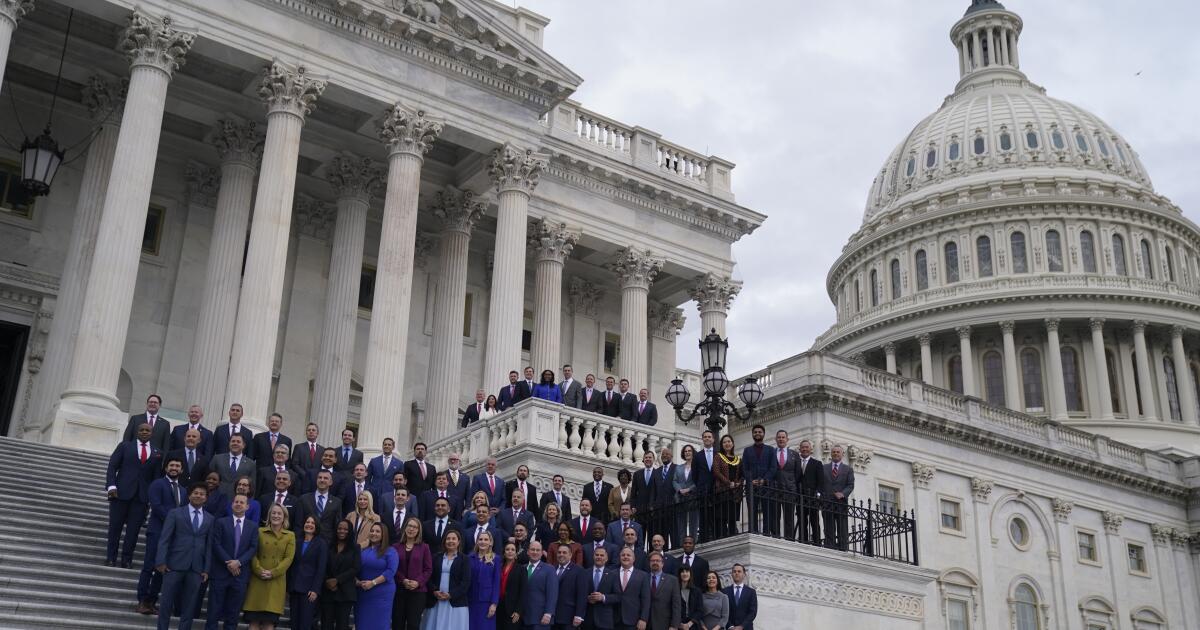
The air was muggy, and the afternoon sun baked the streets of the nation’s capital. But when I visited last month, I made a point to walk the two miles from my hotel to the U.S. Capitol instead of taking an Uber, so I could see it in all its glory.
I didn’t have much time for sightseeing, but a pilgrimage to the seat of American government was a must. Since Jan. 6, 2021, when a mob of thousands stormed it to try to stop the electoral vote count that would officially make Joe Biden president, the symbol of our democracy has stood as a reminder of how tenuous it is.
Before that wannabe coup, the U.S. Capitol was an abstraction for me, a series of images — that stunning dome, those imposing columns, but especially the magnificent steps — where a bunch of politicians passed laws but mostly grandstanded. Hell, I didn’t even know there was a front and back entrance until I approached from Pennsylvania Avenue. I had been to D.C. before but hit the Lincoln Memorial, the Washington Monument and a few other landmarks, not the Capitol.
It’s huge! The white building gleams like a promontory of power, with trees from across the U.S. spread across the grounds below. Its magnetism was such that I paid no attention to the Reflecting Pool, the Ulysses S. Grant Memorial or the Peace Monument below it.
What broke the spell was the people around me.
Filipino men in barongs and Muslim women in hijabs. Argentines joking around in lilting Spanish and Australians with their distinctive garrulous accent. I’m not sure if they were foreign tourists or immigrants, but it was easy to distinguish them from the locals, who rushed toward the rest of their day uninterested in the splendor the rest of us basked in. We lookie-loos used the Capitol as the backdrop for group photos and selfies, paying little attention to the barricades and police officers blocking us from ascending the steps of the West End.
That scene is on my mind on the 248th birthday of this country, especially after the horror show that was last week’s presidential debate between Biden and the man the insurrectionists wanted to keep in office, Donald Trump. All anyone talked about in the immediate aftermath was Biden’s performance, with some, including Democrats, deriding it as akin to the Crypt Keeper from “Tales from the Crypt.”
Biden was no silver-tongued Socrates — but he never has been, and the commander in chief improved as the night went along. Besides, I’ll take his fuddy-duddiness over the dictatorial doom-and-gloom and lies Trump offered that night.
But Biden broke my heart, because he stayed mostly silent while Trump lambasted immigrants as the gravest threat this nation has ever faced. The convicted felon barely bothered to distinguish legal from illegal immigrants. He claimed Biden “open[ed] up our country to people that are from prisons, people that are from mental institutions, insane asylums, terrorists,” going on to mention “mental institutions” two more times, as if mentally ill people are subhuman. He described the U.S.-Mexico border as “the worst … in the history of the world” and “the most dangerous place anywhere in the world,” which will come as news to residents of Gaza and those on the front lines of the Ukraine war.
When we needed someone to stand up for our nation’s newcomers, to brag about how this country remains a beacon for the tired and poor huddled masses of the world instead of the “failing nation” Trump thinks we are (a point he repeated five times), Biden instead insisted he was far better at cracking down on illegal immigration than Trump made him out to be.
Trump’s most damning line of the night — “I really don’t know what he [Biden] said at the end of that sentence. I don’t think he knows what he said either” — was in response to the president mumbling his way through a boast about increasing the number of Border Patrol agents and making it harder to claim asylum.
If Biden won’t stand up to xenophobic bull spouted by a bully, who will?
Supporters of then-President Trump try to break through a police barrier on Jan. 6, 2021, at the Capitol in Washington.
(Julio Cortez / Associated Press)
I’ve lived my life hearing that unchecked immigration, legal or not, will ruin the United States. I’ve never seen this apocalypse come. Nah, it’s been mostly native-born white Americans who keep whining that we’re no longer great, yet do little to make things better, other than moving to Tennessee or Idaho. It’s immigrants and their descendants who have kept the embers of the American way from dying by emphasizing hard work, community and personal responsibility.
Newcomers who want to better their lives are who we should celebrate on the Fourth of July. Yet multiple polls show that a majority of Americans — even Latinos — feel our borders are under assault. The temperature around immigration is even nastier than during the days of Prop. 187, the ballot initiative that California voters passed 30 years ago in an attempt to make life miserable for undocumented immigrants. Back then, people banded together to fight back. Now? Few seem to care.
The weight of it hit me as I walked around the Capitol to see its official entrance, where the insurrectionists invaded on Jan. 6. The sun was setting right behind the dome, casting a long, frigid shadow even on a hot day. Police were everywhere. Metal barricades blocked people from climbing the steps that led to the House of Representatives and the Senate chambers, and the Rotunda. A few tourists lingered alongside me but quickly left.
I approached an unfenced area, and a police officer politely but firmly told me to move on. It felt like a crime scene — and the victims are us.
Both sides of the political aisle claim it’s now evening in America, but I’ll forever remain an optimist. What else can I do? This country exceeded the expectations of my Mexican immigrant parents, and mine. It’s nowhere near perfect, but that’s what makes it so great — the United States belongs to those who work it, those who hope.
The day after my Capitol visit, I walked past the tourist entrance to the White House. The free public tours didn’t start until 9:30 in the morning, but the line to enter wound up and down the gate two hours before. Men in turbans stood next to college students wearing University of Wisconsin T-shirts. English and Spanish and Mandarin filled the air.
The American flags some people sported on their hats or as jewelry didn’t come off as a political statement but rather a symbol of communion. The guards who stood sentry were jovial. There were no complaints, nothing but excitement at the shared joy of what they were about to see.
That is the America I celebrate this Fourth of July — and pray that remains, come election day.



Plaintiff Council for Opportunity in Education
Defendant U.S. Department of Education
Filed in the District of Columbia on Oct. 14, 2025
Injunction
Plaintiff Dallas County, Tex.
Defendant Kennedy
Filed in the District of Columbia on Dec. 5, 2025
Plaintiff Rhode Island Coalition Against Domestic Violence
Defendant Kennedy Jr.
Filed in the District of Rhode Island on July 21, 2025
injunction
Plaintiff Colorado
Defendant Department of Health and Human Services
Filed in the District of Rhode Island on April 1, 2025
injunction
Plaintiff Housing Authority of the County of San Diego
Defendant Turner
Filed in the Northern District of California on Oct. 15, 2025
injunction
Plaintiff National Alliance to End Homelessness
Defendant Department of Housing and Urban Development
Filed in the District of Rhode Island on Dec. 1, 2025
injunction
Plaintiff Washington
Defendant Federal Emergency Management Agency
Filed in the District of Massachusetts on July 16, 2025
lost
Plaintiff Arizona
Defendant Environmental Protection Agency
Filed in the Western District of Washington on Oct. 16, 2025
Plaintiff Open Technology Fund
Defendant Lake
Filed in the District of Columbia on March 20, 2025
injunction
Plaintiff National Public Radio
Defendant Trump
Filed in the District of Columbia on May 27, 2025
Plaintiff San Francisco Unified School District
Defendant AmeriCorps
Filed in the Northern District of California on March 10, 2025
injunction
Plaintiff Maine
Defendant National Oceanic and Atmospheric Administration
Filed in the District of Maine on June 17, 2025
Plaintiff Rhode Island Latino Arts
Defendant National Endowment for the Arts
Filed in the District of Rhode Island on March 6, 2025
lost
President Trump has tried to withhold billions of dollars in federal funding to coerce states, punish opponents, remake programs and impose his views. His targets have repeatedly sued to stop him, and the courts have repeatedly rebuked him — only for the president to try again and again.
Take just these seven cases, all of them tied to the administration’s efforts to block funds from “sanctuary” communities, those that restrict cooperation with federal immigration enforcement.
Last February, a coalition of cities and counties sued over executive orders directing agencies to shut off such funds.
Plaintiff City and County of San Francisco
Defendant Trump
Filed in the Northern District of California on Feb. 7, 2025
injunction
A judge issued a preliminary injunction, halting those directives while the case proceeded.
The same day, the Department of Transportation told communities they must cooperate with immigration enforcement to get federal transportation dollars.
Twenty states, led by California, soon sued …
Plaintiff California
Defendant Department of Transportation
Filed in the District of Rhode Island on May 13, 2025
lost
… and the administration lost in district court.
The Department of Homeland Security tried to withhold emergency management funds. Another lawsuit followed …
Plaintiff Illinois
Defendant FEMA
Filed in the District of Rhode Island on May 13, 2025
lost
… and the administration lost.
Then D.H.S. tried reducing counterterrorism grants to sanctuary states instead …
Plaintiff Illinois
Defendant Noem
Filed in the District of Rhode Island on Sept. 29, 2025
lost
… and again, the administration lost.
In the past year, funds for housing, transit, health and public safety have all been conditioned on cooperation with immigration.
Plaintiff King County
Defendant Turner
Filed in the Western District of Washington on May 2, 2025
injunction
Plaintiff Fresno
Defendant Turner
Filed in the Northern District of California on Aug. 20, 2025
injunction
Plaintiff Chicago
Defendant Department of Justice
Filed in the Northern District of Illinois on Nov. 12, 2025
injunction
Injunctions regularly followed.
These are among 198 lawsuits in the past year identified by The New York Times that challenge how Mr. Trump has leveraged federal funding to carry out his agenda without the consent of Congress. And they reflect one remarkable feature of the campaign: It has proceeded undeterred by losses in court.
With that persistence, the administration has been hammering away at a new kind of reality in Washington, one where the president wields far more control over spending, and where his opponents aren’t entitled to the services of their federal government.
“Anyone in the country who relies on federal dollars is depending on the president to get that money,” said Matthew Lawrence, a law professor at Emory University. “And that’s a new thing.”
The president has threatened money to states that don’t adopt his policies, universities that don’t bend to his will, hospitals that don’t alter their services, school districts that don’t abandon diversity efforts, nonprofits that don’t embrace his gender views, and researchers who study the wrong subjects.
These moves have tested whether Congress, granted the “power of the purse,” still holds the ultimate authority over spending. And they have challenged the courts with a flood of cases — 37 separate suits from the state of California; four from the Association of American Universities on virtually the same question; one from King County, Wash., that has grown to include as plaintiffs 75 communities and agencies.
“You would think there would be some conditioning here: You do an action, you get sued, you lose, maybe you don’t do that action anymore,” said Rob Bonta, who as California’s attorney general has brought many of those suits. “He’s continued to repeat offend. And repeat lose.”
The administration’s approach has amounted to “a game of three-card monte” in the courts, said Samuel Bagenstos, a law professor at the University of Michigan. Each injunction covers the parties suing and the specific programs at issue, but doesn’t necessarily stop the administration from blocking funds to other groups it disfavors. The result, Mr. Bagenstos said: “‘Oh, well, you think I can’t do this thing over there? Well I’m going to do it over here.’”
Presidents have long sought to steer funding to advance their priorities, designing programs with Congress or awarding competitive grants to communities that emphasize certain ideas. But the Trump administration has gone much further: terminating en masse funds that were already awarded; imposing new conditions on future grants that flout federal rule making; and blocking money to whole programs and agencies created by Congress.
The groups that have sued represent a fraction of everyone affected; many have lacked the means or the will to go to court. But these 198 cases, as of the beginning of March, have pried open a public view into the breadth of the administration’s tactics. And one year in, they have produced a lopsided record of rulings.
When plaintiffs have sought immediate relief, district court judges have temporarily blocked the administration’s actions 79 percent of the time, signaling plaintiffs’ likely success on the merits. In the 26 instances where district judges have issued partial or final rulings, the administration lost 23.
Planned Parenthood of Greater New York v. Department of Health and Human Services
Just because a pronouncement comes from the president does not make it true, even if expressed in the form of an executive order, and even then, does not supersede the law.
lost
American Federation of Teachers v. U.S. Department of Education
By leapfrogging important procedural requirements, the government has unwittingly run headfirst into serious constitutional problems.
lost
Michigan v. Noem
None of this appears consistent with Congressional intent or FEMA’s mission.
lost
The administration declined to comment on the record. But a White House official authorized to describe the strategy said the Trump administration is restoring power to the presidency that previous presidents have shied away from, while tapping that power to prevent fraud and steward taxpayer dollars. The groups bringing all these lawsuits, that person said, are the ones using the courts in a hostile campaign to hamstring the president.
The administration has notably walked away from some defeats without appealing them. But it is counting on a better record before appeals court judges, as has been the case more broadly. Among cases it has appealed, appellate courts have reversed or paused orders against the administration in about 40 percent of their rulings, often with judges appointed by Mr. Trump in his favor.
But even when it is losing in court, plaintiffs’ attorneys and legal scholars said, the administration may still find it is winning on its own terms.
‘Undeserving recipients’
Alongside that first sanctuary cities directive, early executive orders outlining the president’s core agenda aimed to end all “diversity, equity and inclusion” in the government, to eradicate “gender ideology,” to reverse the “green new deal,” and to enforce “election integrity.” All of them proposed leveraging federal funds to do it.
These cases show the administration pulling that lever in numerous ways.
It has tried to set conditions with no clear relationship to program goals (like immigration requirements for highway funds). It has threatened funding to force states to share information (voter rolls, food aid lists). It has told grantees they must pledge to comply with orders the president hasn’t issued yet. And it has invoked criminal and financial penalties if they break those pledges.
It has terminated even small sums, targeting with laser precision opponents of the president (who then sued):
The American Bar Association lost $3.2 million in domestic violence training grants after the administration attacked the group.
Plaintiff American Bar Association
Defendant Department of Justice
Filed in the District of Columbia on April 23, 2025
injunction
The American Academy of Pediatrics lost nearly $12 million in grants in apparent retaliation for its advocacy of vaccines and gender-affirming care.
Plaintiff American Academy of Pediatrics
Defendant Department of Health and Human Services
Filed in the District of Columbia on Dec. 24, 2025
injunction
Maine lost access to support for school meals as Gov. Janet Mills was fighting with the president over transgender athletes.
Plaintiff Maine
Defendant Department of Agriculture
Filed in the District of Maine on April 7, 2025
injunction
The government backed down with the American Bar Association and Maine after judges issued initial rulings, only to turn its focus elsewhere.
“You can see that the government’s posture is essentially: Do the thing that’s going to make the White House happy, or get the press release about sticking it to trans people,” said Kevin Love Hubbard, a former D.O.J. attorney who represented the government before leaving in August. Agencies are doing that, he said, “without thinking about then having to go into court.”
Today, he is suing the government in several funding cases with the Lawyers’ Committee for Rhode Island.
Most of these nearly 200 cases are about disfavored categories of recipients like sanctuary jurisdictions, Harvard researchers or organizations serving transgender people.
“We are the undeserving recipients, at least in the mind of our current administration,” said Leesa Manion, the prosecuting attorney in King County, Wash., which encompasses Seattle. “The goal all along was to ensure that we — the undesirables — do not get our fair share. Whether it works or doesn’t work, if that’s your overarching goal, you just keep evolving your technique.”
The administration is now increasingly targeting blue states as such a category, too.
That began during the government shutdown last October, when the White House budget director Russell Vought announced the administration would cancel nearly $8 billion in energy projects in 16 states — all where voters had supported Kamala Harris in 2024.
A small group of grantees, including the city of St. Paul, Minn., sued in response.
Plaintiff St. Paul, Minnesota
Defendant Wright
Filed in the District of Columbia on Nov. 10, 2025
lost
In January, the administration lost in district court, where a judge said it had violated the Constitution.
But officials were already preparing other cuts to blue states. H.H.S. froze $10 billion in child care and family assistance funds to five states. The states sued …
Plaintiff New York
Defendant Administration for Children and Families
Filed in the Southern District of New York on Jan. 8, 2026
injunction
… and a judge issued an injunction.
The D.O.T. suspended funding to the $16 billion Gateway Tunnel project connecting New Jersey and New York. Both states sued …
Plaintiff New Jersey
Defendant Department of Transportation
Filed in the Southern District of New York on Feb. 3, 2026
injunction
… and secured another injunction.
Even after those setbacks, in early February the administration told Congress it would cut more than $600 million in public health grants to four blue states. They sued …
Plaintiff Illinois
Defendant Vought
Filed in the Northern District of Illinois on Feb. 11, 2026
injunction
… and the next day, a judge issued another injunction in the form of a temporary restraining order.
Still, last week, the administration said it would withhold about $250 million in Medicaid funds from Minnesota (prompting another lawsuit).
These moves, citing a mix of fraud and immigration policies, follow the president’s vow to block all funding to sanctuary jurisdictions — a group, under the D.O.J.’s definition, that could encompass one-third of the U.S. population.
“They can sue us and maybe they’ll win,” the president said in January. “But we’re not giving money to sanctuary cities anymore.”
Arbitrary and capricious
At stake in many cases are weighty constitutional principles: the separation of powers; the right to due process when the government says grantees have done something wrong; the First Amendment protections for organizations to advocate their views without government retaliation.
In the St. Paul suit, a district judge, Amit P. Mehta, ruled in January for the first time in one of these cases that the administration had violated the Fifth Amendment’s equal protection clause by singling out states for their partisan lean. During the litigation, the government didn’t deny doing that. Rather, it argued it was allowed to.
St. Paul, Minnesota v. Wright
Defendants freely admit that they made grant-termination decisions primarily — if not exclusively — based on whether the awardee resided in a state whose citizens voted for President Trump in 2024. There is no rational relationship between that classification and defendants’ stated governmental interest.
lost
But that ruling covered only seven canceled grants worth about $27.5 million out of the nearly $8 billion total terminated. Now a coalition of 13 states is suing with the same constitutional argument in a new case about the same cuts.
The constant that is running through most of these cases, however, is the more mundane-sounding Administrative Procedure Act. That 1946 law says that the federal government must be reasoned and document its thinking according to transparent rules — in short, that it shouldn’t be slapdash and secretive.
These cases are full of examples of it doing just that. When the Department of Homeland Security tried last year to reduce counterterrorism grants to sanctuary states, the agency appeared to arrive at the lower award sums by simply lopping digits off the original values.
Illinois v. Noem
Neither a law degree nor a degree in mathematics is required to deduce that no plausible, rational formula could produce this result.
lost
Officials have sent out directives with copy-and-pasted typos, termination letters without agency letterhead and bare explanations with boilerplate rationale.
“You had literally grants for millions of dollars being canceled in a single vague paragraph: ‘This no longer comports with administration priorities, thank you very much,’” said Claudia Polsky, a law professor at the University of California at Berkeley, who has led a class-action lawsuit among University of California researchers that has restored, for now, at least a thousand grants worth about a billion dollars.
The administration has given grantees new mandates — and prohibitions — so vague that they haven’t known how to comply.
“‘Promote gender ideology’ — what does that mean?” said Maria Corona, the head of the Iowa Coalition Against Domestic Violence, which has challenged new conditions on grants. “When you’re talking about ‘violence against women,’ in the language itself we’re already talking about a gender issue.”
Last February, the National Institutes of Health issued a seismic policy change on a Friday night, to take effect the following Monday, slashing payments to universities for research overhead, drawing several lawsuits.
Plaintiff Massachusetts
Defendant National Institutes of Health
Filed in the District of Massachusetts on Feb. 10, 2025
lost
Plaintiff Association of American Medical Colleges
Defendant National Institutes of Health
Filed in the District of Massachusetts on Feb. 10, 2025
lost
Plaintiff Association of American Universities
Defendant Department of Health and Human Services
Filed in the District of Massachusetts on Feb. 10, 2025
lost
In April, the administration lost these cases, consolidated under one judge (an appeals court upheld the decision this year).
But after the district court ruling, the Department of Energy, followed by the National Science Foundation and then the Department of Defense, each rolled out an identical policy.
Plaintiff Association of American Universities
Defendant Department of Energy
Filed in the District of Massachusetts on April 14, 2025
lost
Plaintiff Association of American Universities
Defendant National Science Foundation
Filed in the District of Massachusetts on May 5, 2025
lost
Plaintiff Association of American Universities
Defendant Department of Defense
Filed in the District of Massachusetts on June 16, 2025
lost
As these cases accumulated, so did the judges’ irritation.
Association of American Universities v. Department of Defense
The Court does not write upon a blank slate but instead follows three other courts in this district who have come to similar conclusions with respect to different federal agencies’ attempts to enact virtually identical policies. Notably, defendants ignored these obviously relevant — and at least reasonable — analyses before adopting this policy.
lost
Success for the administration has seldom involved winning on the merits. Rather, the administration has argued in most of these cases that district judges have no business hearing them at all. Cases seeking money, it says, belong instead in the Court of Federal Claims, a specialized court dedicated to financial contract disputes with the government.
Supreme Court Justice Amy Coney Barrett breathed life into that argument, concurring in a preliminary ruling last summer that surprised some legal experts. Her opinion — suggesting policies should be litigated in district court, while payouts resulting from them belong in the Court of Federal Claims — has further complicated these cases. So has the Supreme Court’s ruling last year ending nationwide injunctions.
Winning while losing
By the time grantees have gone to court, they have already lost much. Researchers have halted studies. Nonprofits have laid off staff. The core expectation that the government is a reliable partner has already been undercut.
“The result is a corrosive uncertainty that undermines the basic functioning of government,” said Jacob Leibenluft, a former official in the Biden White House budget office.
That uncertainty sets in the moment money isn’t on time, or when grantees start to think it won’t be in the future. Other changes take root, too: Grantees rethink what’s in their mission statements; professors shift what they teach.
American Association of University Professors v. Trump
Numerous U.C. faculty and staff have submitted declarations describing how defendants’ actions have already chilled speech throughout the U.C. system.
injunction
The administration is advancing these changes even when it’s losing particular funding cases in court. And it has successfully blocked money to groups who haven’t sued, further entrenching the president’s expanded power over spending.
Whether this dynamic sticks depends as much on Congress as on the courts. If legislators were more actively guarding programs they had funded themselves, many of these lawsuits likely wouldn’t exist.
New York v. Trump
The interaction of the three co-equal branches of government is an intricate, delicate and sophisticated balance — but it is crucial to our form of constitutional governance. Here, the Executive put itself above Congress.
injunction
In rare cases, Republicans in Congress have pushed back against the administration and been able to reverse billions in cuts far more quickly than courts could, including from after-school programs and mental health and addiction treatment.
For most programs targeted by the administration, however, Republicans have publicly said little, and that’s unlikely to change as the president now targets blue states more explicitly. Republican and Democratic appropriators have together quietly tucked some new guardrails into spending bills this year. But it is Democrats, primarily, who have spoken up for the larger principle that lawmakers set the terms of federal spending — not the president.
“We have to guard that with our lives,” said Rosa DeLauro, the top Democratic appropriator in the House. The alternative, she said, is that funding becomes a tool to silence dissent. “‘Don’t speak out — or I’ll cancel your grant.’”
Absent bipartisan clamor in Congress, cases like King County v. Turner grind on. The case was brought last May by eight local governments challenging new conditions on housing and transportation grants. Then they added H.H.S. as a defendant. And 23 more local governments and transit and housing agencies joined as plaintiffs. Then another 29 came on board. Then 15 more. Each one has had to explain the harms it has faced. The judge has had to review each claim, alongside the details of dozens of grant programs, while crafting what are now four successive injunctions. All that is just one lawsuit.
“Should we have to do that 200 times, 300 times?” said Erin Overbey, the general counsel with the King County Prosecuting Attorney’s Office. “What’s the number where we reach critical mass?”

NEWYou can now listen to Fox News articles!
AUSTIN, TEXAS – The expensive and contentious battle for the Republican Senate nomination in Texas is headed to a May runoff, after none of the three major candidates in the crowded field of contenders topped 50% of the vote in Tuesday’s primary election.
Longtime incumbent Sen. John Cornyn will face off with Texas Attorney General Ken Paxton after they finished in the top two in the primary, with Rep. Wesley Hunt in third place, according to unofficial primary election results.
The winner will face off with either progressive firebrand Rep. Jasmine Crockett, a vocal critic and foil of President Donald Trump, or rising star state Rep. James Talarcio, who were vying for the Democratic Senate nomination. Both were trying to become the first Democrat in nearly four decades to win a Senate election in right-leaning Texas.
This year’s Senate showdown in Texas is one of a handful across the country that could determine if Republicans hold their majority in the chamber in the midterm elections. The GOP currently controls the chamber 53-47.
The Cornyn campaign and aligned super PACs spent nearly $100 million to run ads attacking Paxton and Hunt, with the senator charging in the closing weeks of the primary campaign that Democrats will flip the seat in the general election if Paxton’s the GOP’s nominee.
Cornyn, his allies, and the National Republican Senatorial Committee, the campaign arm of the Senate GOP, repeatedly pointed to the slew of scandals and legal problems that have battered Paxton over the past decade, as well as his ongoing messy divorce.
TRUMP’S IRAN STRIKE ROCKS SENATE PRIMARIES IN TEXAS
“If I’m the nominee, I’ll help President Trump by making sure that we carry the five new congressional seats as well as maintain this Senate seat and will help him continue his agenda through the last two years of his term of office,” Cornyn touted in a Fox News Digital interview on Sunday.
Sen. John Cornyn, R-Texas, speaks during a campaign stop in The Woodlands, Texas, Saturday, Feb. 28, 2026. (Annie Mulligan/AP Photo)
And, he argued, “If the Democrats win, because we nominate a flawed candidate with incredible baggage like the attorney general, then that last two years of [Trump’s] agenda is jeopardized, as well as everybody down ballot that we need to continue to elect as Republicans.”
PAXTON DEMANDS STRICTER VETTING AFTER DEADLY TEXAS RAMPAGE
Paxton, a MAGA firebrand who grabbed significant national attention by filing lawsuits against the Obama and Biden administrations, pushed back, telling Fox News Digital on the eve of the primary that “I’m 3-0. I’ve won three statewide races.”
Pointing to public opinion polls suggesting he has the edge over Cornyn, Paxton argued, “it’s really easy for him to say that when he’s losing a primary, because he’s not delivered for the people of Texas, and he’s going to find out tomorrow what that means. He’s going to end up losing.”
Texas Attorney General Ken Paxton, a Republican Senate candidate, speaks to supporters at a campaign event on primary eve, in Waco, Texas, on March 2, 2026. (Paul Steinhauser/Fox News)
“This idea that I can’t win a race is not true… there’s no evidence of what he’s saying is being true. As a matter of fact, the evidence is just the opposite,” Paxton added.
Paxton was boosted a few weeks ago by an endorsement from the political wing of Turning Point USA, the powerful grassroots conservative organization that was long steered by the late Charlie Kirk.
The GOP nomination battle was a two-person race until Hunt, a West Point graduate and military veteran who flew helicopters during his service and who represents a solidly red district in suburban Houston, announced his candidacy last autumn.
“I think there’s going to be a runoff, no matter what happens,” Cornyn predicted on Sunday.
Paxton, speaking to supporters on primary eve, touted that “if we go to a runoff, the odds get better for me,” as he pointed to what will likely be a smaller electorate for the May 26 runoff.
Republican Senate candidate Rep. Wesley Hunt of Texas, at a primary eve campaign event, in Houston, Texas on March 2, 2026 (Paul Steinhauser/Fox News)
Hunt, in a Fox News Digital interview on the eve of the primary, argued that he’s “the best candidate to win the primary and win the general.”
TRUMP’S IRAN STRIKE ROCKS TEXAS SENATE RACE AS DEMS DEMAND ‘WAR POWERS,’ GOP APPLAUDS PRESIDENT
And pointing to the negative ads from Cornyn and his allies that have targeted him the past couple of weeks, Hunt said, “They have spent tens of millions of dollars against me in the state of Texas, which means that I must be doing the right thing, and I must be a threat. DC will not decide who will be the next senator from Texas. Texans will and that’s why I got in this race.”
But Hunt fell short, coming in third place.
Trump, whose clout over the GOP remains immense, stayed neutral to date in the Republican primary. All three candidates, who sought the president’s endorsement, were in attendance Friday as Trump held an event in Corpus Christi, Texas.
“They’re in a little race together,” Trump said of Cornyn and Paxton. “You know that, right? A little bit of a race. It’s going to be an interesting one, right? They’re both great people, too.”
Trump also complimented Hunt, and said that all three contenders were engaged in an “interesting election.”
President Donald Trump shakes hands with Sen. Ted Cruz, R-Texas, in a Whataburger restaurant in Corpus Christi, Texas, on Feb. 27, 2026. (Mandel Ngan/AFP via Getty Images)
While Trump stayed neutral, his top pollster, Tony Fabrizio, helped the Cornyn campaign. And veteran Republican strategist Chris LaCivita, who served as co-campaign manager of Trump’s 2024 White House bid, consulted for a top Cornyn-aligned super PAC.
CLICK HERE TO DOWNLOAD THE FOX NEWS APP
The big questions going forward as the runoff campaign gets underway are whether Trump will make an endorsement, and whether the major outside groups that supported Cornyn will continue to throw resources into the extended nomination battle.
Related Article


NEW YORK — U.S. and Israeli officials are privately casting doubt on projections from the Trump administration that the war with Iran could end within a matter of weeks — instead warning that a months-long campaign may be required to destroy the country’s ballistic missile capabilities and install a pliant government, multiple sources told The Times.
The prospect of extended combat creates political risks and uncertainties for President Trump, whose penchant for dramatic, short-term military operations has suddenly given way to a full-scale assault on the Islamic Republic, shocking a MAGA base that for years supported his calls to end forever wars in the Middle East.
One Israeli official told The Times — despite internal guidance among Israeli officials to adhere to the U.S. president’s stated time frame — that the war “definitely could be longer” than the four-week window that Trump repeatedly offered to reporters.
A U.S. official said that in private conversations, top administration officials presume the campaign will require a longer runway now that remnants of Iran’s government have chosen to resist rather than acquiesce to Washington.
Protracted war was always a possibility. Trump was presented with U.S. intelligence assessments gaming out the potential conflict that emphasized how highly unpredictable the results of an attack would be — an analysis the intelligence community believes has borne out on the ground in the chaotic early days of the conflict.
A longer conflict could create diplomatic space between Trump and Israel’s prime minister, Benjamin Netanyahu, who has advocated for the overthrow of the Islamic Republic for over 30 years.
The Israeli leader has succeeded in convincing Trump to take military actions in Iran that American presidents have rejected for decades, from bombing its nuclear facilities to assassinating its leadership, including Ayatollah Ali Khamenei, who was killed in an opening strike over the weekend.
Goal of a change of government fades
Yet, mere days into the war, White House officials have all but ceased references to a democratic spring that could sweep Iran’s government aside.
A set of four U.S. goals for the mission no longer calls for changing the regime itself. Still, Netanyahu’s government remains keen on replacing the government, and the nation’s longest-serving premier sees the current war as his best opportunity to do so, one official said.
Speaking with reporters Tuesday, Trump rejected reports that the Israelis had convinced him to launch the attack.
“No, I might have forced their hand,” Trump said. “Based on the way the negotiations were going, I think they were going to attack first, and I didn’t want that to happen. So if anything, I might have forced Israel’s hand, but Israel was ready, and we were ready, and we’ve had a very, very powerful impact because virtually everything they have has been knocked out.”
In a series of interviews this week, Trump said he had been given projections of a four- or five-week war, while noting he is prepared to go longer if necessary.
Michael Rubin, a former Pentagon official who is Iran expert at the American Enterprise Institute, said that projecting a deadline to the conflict at its start would be a strategic mistake for the Trump administration, as it would in effect give Iran’s remaining leadership an end date to wait out the fighting.
“Successive presidents have shown that America has strategic attention deficit disorder,” Rubin said. “If that was the case in Iraq and Afghanistan, it’s especially true under Trump. He imposed a ceasefire on Gaza that let Hamas survive to fight another day; they still haven’t disarmed.”
The duration of the war will depend, in part, on Iran’s ability to resist and defend its remaining capabilities — but also on the president’s willingness to accept an outcome that leaves the Islamic Republic in place.
That decision has not yet been made by Trump, who has vacillated between calls for a democratic uprising across Iran — and U.S. military options to support resistance groups inside the country — as opposed to a shorter campaign that cripples Iran’s political leadership and Islamic Revolutionary Guard Corps.
“I can go long and take over the whole thing, or end it in two or three days and tell the Iranians, ‘See you again in a few years if you start rebuilding,’” Trump told Axios.
One of Israel’s primary goals is to effectively eliminate the country’s ballistic missile program, and progress on that score is ahead of schedule, another source familiar with the operation said. “Things are going very well at the moment,” the source added. “Great pace.”
An Israeli military source noted to The Times that the stated goal of the mission is to significantly degrade, but not necessarily destroy, Iran’s ballistic missile capabilities, a goal the source said could be accomplished within Trump’s preferred time frame.
“Israel was quite unhappy Trump ordered the [June 2025] 12-day war ended when it did,” said Patrick Clawson, director of the Iran program at the Washington Institute for Near East Policy. He said he expected the current war would “take time” to comprehensively set back Iran’s ballistic missile capabilities, after a series of Israeli missions in 2024 against the missile program failed to set them back by more than a matter of months.
“Some Israelis think before the recent strikes, Iranian production was fully restored,” Clawson said. “So a really comprehensive attack on Iranian missiles is an important Israeli objective.”
The Maduro model
But no one inside the Islamic Republic system has emerged so far to serve in a supplicant role to Trump in the way that Delcy Rodríguez has stepped in as acting president of Venezuela, after U.S. forces captured that country’s strongman president, Nicolás Maduro, in an audacious overnight raid in January.
Since then, the Stars and Stripes have flown alongside the Venezuelan tricolor at government buildings in Caracas, where senior Trump administration officials have been welcomed to discuss lucrative opportunities in Venezuela’s oil industry.
Trump is now looking for an Iranian counterpart to Rodríguez, he said Tuesday, suggesting he is willing to keep the Islamic Republic in place despite encouraging its citizens to rise up against their government.
“Most of the people we had in mind are dead,” Trump said in the Oval Office. “We had some in mind from that group that is dead. And now we have another group. They may be dead also…. Pretty soon we’re not gonna know anybody.”
“I mean, Venezuela was so incredible because we did the attack and we kept the government totally intact,” he added.
Dennis Ross, a veteran diplomat on the Israeli-Palestinian conflict who served in the George H.W. Bush, Clinton and Obama administrations, expressed doubt that Trump would be willing to proceed with a months-long campaign, regardless of Israel’s aspirational objectives.
“I believe President Trump doesn’t define clear objectives so he can decide to end the war at a time of his choosing, and declare the objective at that point, announcing we have achieved what we sought to do,” said Ross, noting that finding a figurehead in Iran as he did in Venezuela was always “a long shot.”
“Unilaterally, he could declare we made the regime pay a price for killing its citizens, and we have weakened Iran to the point that it is not any longer a threat to its neighbors,” Ross added. “He could then say, if Iran continues the war, we will hit them even harder.”

Detroit Pistons’ loss to Cavs shows weaknesses before playoffs

Floats for San Francisco Chinese New Year Parade get finishing touches

Hip-hop hitmaker Cardi B coming to AAC in Dallas

Shooting in northwest Miami-Dade leaves man in critical condition, sheriff’s office says

Charlotte plays Boston on 5-game win streak

Florida High School Football Rankings: Top 25 teams – Oct. 21

Cleary's 21 help Le Moyne down Central Connecticut State 69-64 in OT

How old is Bo Nix? What to know about Oregon quarterback ahead of 2024 NFL Draft

99th annual Pony Swim held in Virginia

Indiana Members Credit Union announced as new anchor tenant at Bottleworks District

Video: Senators Question Kristi Noem on ICE Immigration Tactics

Combustible Republican Senate primary in Texas heading into overtime

Hungarian veto proves EU needs less unanimity, says new Dutch PM

Pregnant migrant girls are being sent to a Texas shelter flagged as medically risky

Fraud-plagued Minnesota sues Trump admin for withholding $243M in Medicaid payments
-

 World6 days ago
Exclusive: DeepSeek withholds latest AI model from US chipmakers including Nvidia, sources say
-

 Massachusetts7 days ago
Mother and daughter injured in Taunton house explosion
-

 Denver, CO7 days ago
10 acres charred, 5 injured in Thornton grass fire, evacuation orders lifted
-

 Louisiana1 week ago
Wildfire near Gum Swamp Road in Livingston Parish now under control; more than 200 acres burned
-

 Oregon5 days ago
2026 OSAA Oregon Wrestling State Championship Results And Brackets – FloWrestling
-

 Florida3 days ago
Florida man rescued after being stuck in shoulder-deep mud for days
-

 Maryland3 days ago
AM showers Sunday in Maryland
-

 Culture1 week ago
Try This Quiz on Thrilling Books That Became Popular Movies