Politics
Celebrities and Notable Faces in the Crowd at the Democratic Convention


Thousands of Democrats — delegates, party members, politicians and celebrities — filled Chicago’s United Center this week to nominate Vice President Kamala Harris and Governor Tim Walz of Minnesota for president and vice president. Here are some of the notable people spotted in the arena.
Thursday
Ms. Harris accepted her party’s nomination, speaking about her middle-class roots and calling for unity with a “new way forward.” Before she spoke, members of her family took turns at the lectern, including her sister Maya, niece Meena and step-daughter Ella. Several celebrities were spotted in the crowd.
Doug Emhoff, the second gentleman
Maya Harris, Tony West and Meena Harris
Vice President Harris’s grand-niece Gov. Tim Walz and his children, Gus and Hope
Padma Lakshmi, television personality
Sheryl Lee Ralph, actor and singer
Wednesday
The convention’s third night featured speeches by several up-and-coming party stars, former President Bill Clinton and a surprise appearance by Oprah Winfrey. After several guests highlighted Mr. Walz’s average-Joe persona and background as a football coach, he officially accepted the Democrats’ vice-presidential nomination.
Senator Amy Klobuchar of Minnesota helped to introduce Mr. Walz before he took the stage, emphasizing his Midwestern roots.
Mr. Walz’s wife and children: Gwen, Gus and Hope Senators Tina Smith and Amy Klobuchar of Minnesota
Senator Elizabeth Warren of Massachusetts
Senator Mark Kelly of Arizona and former Rep. Gabby Giffords of Arizona
Julian Castro, former HUD secretary, and Rep. Joaquin Castro of Texas
Rep. Ilhan Omar of Minnesota
Tuesday
Several Democratic governors, including J.B. Pritzker from the convention’s host state of Illinois, were seated with their delegations during a ceremonial roll call. A playlist of songs and a performance by the rapper Lil Jon soundtracked the night.
Before speeches by the former first lady Michelle Obama and former President Barack Obama capped the evening, Doug Emhoff, the second gentleman, spoke about how Ms. Harris took on the role of “Momala” to his children, Cole and Ella.
Gov. J.B. Pritzker of Illinois
Mr. Emhoff’s daughter, Ella, and parents, Barbara and Michael
Cole, Mr. Emhoff’s son, and his wife
Gov. Gretchen Whitmer of Michigan
Gov. Wes Moore of Maryland
Gov. Tony Evers of Wisconsin
Gov. Andy Beshear of Kentucky
Rep. Maxine Waters of California
Monday
The convention’s first night featured remarks by Hillary Clinton and a torch-passing speech by President Biden. “America, I gave my best to you,” he said, reciting a phrase from the song “American Anthem” by Gene Scheer. Several members of Mr. Biden’s family were among the crowd, and audience members held up signs reading, “Thank you Joe.”
Nancy Pelosi, a key figure in pushing for Mr. Biden to exit the race, held up a “We [Heart] Joe” sign.
Jill Biden, the first lady
President Biden’s grandchildren
Rep. Nancy Pelosi of California
Gov. Josh Shapiro of Pennsylvania
Gov. Gavin Newsom of California Senator Chuck Schumer of New York
Rep. Lucy McBath of Georgia





Since moving back in, President Trump has significantly altered the “People’s House.” East Wing: gone. Oval Office: maximalized. Rose Garden: Mar-a-lago-ified. And the art? Lots of Trump.
Over the last year, The New York Times has captured at least nine paintings, posters, memes, and even a mugshot outside the Oval Office, that Mr. Trump added throughout the historic space.
Many of the selections are gifts from his supporters that highlight his political stature and reinforce the idea that Mr. Trump is invincible.
All presidents or first ladies add to and shuffle the art in the White House.
Barack Obama brought in abstract paintings.
George W. Bush decorated with images from his Texas roots.
In Mr. Trump’s first term, Melania Trump added a sculpture by Isamu Noguchi to the Rose Garden.
But never before has a sitting president displayed so much of his own image on the White House walls.
There is an “assertion of symbolic power that he wants to be on view essentially everywhere in that space,” said Cara Finnegan, a communication professor at the University of Illinois and author of “Photographic Presidents: Making History from Daguerreotype to Digital.”
Even outside his current residence, Mr. Trump’s visage has proliferated in unexpected places — on banners hanging from government buildings, on National Parks passes and on social media, where he has been likened to a king. There has also been talk of a U.S. Treasury-minted coin with Mr. Trump on both sides.
Break with tradition
In recent decades, each president’s official White House portrait has been unveiled in a ceremony hosted by his successor.
The Carters hosted the Fords:
The Clintons hosted the Bushes:
And the Bushes hosted the Clintons:
The mood has often been lighthearted, with political party tensions melting away.
“I am pleased that my portrait brings an interesting symmetry to the White House collection,” George W. Bush joked in a ceremony hosted by the Obamas. “It now starts and ends with a George W.”
In a break with tradition, Mr. Trump did not schedule a ceremony for the unveiling of the Obamas’ portraits during his first term. Joe Biden later did, in a ceremony with a “Welcome Home!” vibe.
Typically, the latest available presidential portrait — often a realistic oil painting — hangs in the main entrance hall, where heads of state are welcomed.
The Obama portrait was in the spot until April …
… when Mr. Trump replaced it with this painting by Marc Lipp, a Florida pop artist, last April.
It depicts a striking moment in 2024 when a bloodied Mr. Trump pumped his fist in defiance, soon after being shot at by a would-be assassin during a campaign event.
Presidential historians have criticized the departure from convention.
Though Mr. Trump had a portrait commissioned for the Smithsonian’s American Presidents collection after his first term, none was confirmed for the permanent White House collection, and the White House said that this is where that portrait would have hung.
It is not totally unprecedented for a president to hang a painting of himself in the White House during his term. Theodore Roosevelt, William Howard Taft and Grover Cleveland all did, according to the White House Historical Association. But more often than not, paintings of presidents and first ladies are hung after they have left office, historians said.
Flags, fists and faith from fans
In what has become something of a muse for many of the president’s artistic supporters, there are at least three other depictions of the fist-pumping scene in the White House.
The image “is in people’s garages when I walk around my neighborhood,” said Leslie Hahner, a Texas resident and communication professor at Baylor University, who studies visual political culture. “People love that image.”
Behind the Oval Office, one is in a small room that houses Trump merchandise:
Another was seen in the West Wing next to a “Still Life with Fruit” painting from 1850:
A statue form was spotted in the Oval Office:
The sculptor, Stan Watts, told a Utah TV station last year that he believes the president was saved by God that day. Many of Mr. Trump’s Christian supporters have echoed that sentiment.
At least two works by a self-described “Christian worship artist,” Vanessa Horabuena, are among Mr. Trump’s White House collection. He has called Ms. Horabuena, who often paints live in front of an audience, “one of the greatest artists anywhere in the world.”
In 2022, she painted a portrait of Mr. Trump at a booth at the Conservative Political Action Conference. When he saw it, he asked to meet her, Ms. Horabuena’s representative said. She most recently painted Mr. Trump live at a New Year’s Eve party at Mar-A-Lago.
One of her portraits was spotted in the Cabinet room in January.
It shows Mr. Trump, his eyes closed, in front of a mountain with a small cross on the top:
Ms. Horabuena hand-delivered it to the White House, according to her website.
Her other painting shows the president walking through a phalanx of flags. It was seen hanging prominently in a hallway leading to the Cabinet Room and the Oval Office:
“He’s positioned as this embattled warrior in a lot of these images,” Dr. Hahner said.
Historical figures Mr. Trump adulates are co-stars in some of the art he has chosen.
In an image created by the team of White House trade adviser Peter Navarro, Mr. Trump is pictured with William McKinley and Henry Clay, who, like the president, championed the use of tariffs:
Here, Mr. Trump is with two other Republican presidents, Abraham Lincoln (to whom he has compared himself) and Ronald Reagan (whom he is a fan of):
Titled “Great American Patriots,” the piece was painted by Dick Bobnick, an illustrator and Trump supporter from Minnesota. He said he mailed several prints to 1600 Pennsylvania Avenue, but he had no idea his work was on the White House walls until a USA Today reporter called him about it.
“I could hardly believe it,” said Mr. Bobnick. (He said the print is now his best-seller.)
If not in portraits, Mr. Trump’s image is reflected on mirrors that he has added to the White House complex.
Two are in the Oval Office …
… making his image visible from the Resolute Desk.
The mirrors, the portraits and the gilding mimic the look of his properties, like Mar-a-Lago, his Florida estate.
“Trump is obsessed with his image,” Dr. Hahner said. “And he is so controlling of his image.”
Trump everywhere, all the time
One portrait seen in the White House has become a communication tool between Mr. Trump and his supporters in the real world.
This is his social media profile picture.
It was seen last October hanging between former first ladies Laura Bush and Barbara Bush in the now-demolished East Wing:
The portrait was painted by Lena Ruseva, an immigrant from the former Soviet Union, who goes by the name MAGALANGELO. Mr. Trump invited her to his Bedminster golf club in 2022, and she gave it to him as a birthday gift.
“Every time social media or the news quotes the president and I see my artwork alongside it, I feel proud and grateful,” she said.
For a time, the same portrait hung next to Hillary Clinton, his political rival and a former first lady.
Supporters at that time lauded the placement on social media:
This example of a positive feedback loop demonstrates how Mr. Trump has used social media to redefine the presidency and presidential communication. Ms. Ruseva’s portrait was used on social media, hung up in the real world, then photographed and put back on social media by supporters who praised the president.
When Mr. Trump was elected to his first term in 2016, Dr. Hahner said that scholars referred to him as the first “meme president.”
Mr. Trump and his internet fans are used to a meme culture based on irony, and rehashing, repurposing and remixing existing images. The collection of White House artwork — much of it originating from his supporters — sits in an uncanny valley between realism and meme-ism, Dr. Hahner said.
Like memes that multiply, Mr. Trump’s image has been reproduced in other ways, outside the White House.
Last month, a huge banner with Mr. Trump’s face was draped outside the Justice Department headquarters …
Last year, similar signage was strung over the Labor Department building …
… and the Agriculture Department building (this one, alongside Lincoln).
At his request, Mr. Trump’s portrait was recently updated at the Smithsonian’s National Portrait Gallery:
Still, Mr. Trump wants more. The White House has suggested that the National Portrait Gallery add a separate section for Trump-related art.

NEWYou can now listen to Fox News articles!
President Donald Trump on Monday sent an official notification to Congress about the U.S. strikes against Iran, in which he attempted to justify the military action in the now expanding conflict in the Middle East.
In a letter obtained by FOX News, Trump told Senate President Pro Tempore Chuck Grassley, R-Iowa, that “no U.S. ground forces were used in these strikes” and that the mission “was planned and executed in a manner designed to minimize civilian casualties, deter future attacks, and neutralize Iran’s malign activities.”
This comes after joint U.S.-Israeli strikes against Iran on Saturday as part of Operation Epic Fury, triggering a response from Tehran and a wider conflict in the region. The strikes killed the Islamic Republic’s Supreme Leader Ali Khamenei and other military leaders.
President Donald Trump on Monday sent an official notification to Congress about the U.S. strikes against Iran. (AP Photo/Alex Brandon)
Trump wrote that it is not yet possible to know the full scope of military operations against Iran and that U.S. forces are prepared to take potential further action.
“Although the United States desires a quick and enduring peace, not possible at this time to know the full scope and duration of military operations that may be necessary,” Trump wrote. “As such, United States forces remain postured to take further action, as necessary and appropriate, to address further threats and attacks upon the United States or its allies and partners, and ensure the Government of the Islamic Republic of Iran ceases being a threat to the United States, its allies, and the international community.”
“I directed this military action consistent with my responsibility to protect Americans and United States interests both at home and abroad and in furtherance of United States national security and foreign policy interests,” he added. “I acted pursuant to my constitutional authority as Commander in Chief and Chief Executive to conduct United States foreign relations.”
A general view of Tehran with smoke visible in the distance after explosions were reported in the city, on March 2, 2026, in Tehran, Iran. (Contributor/Getty Images)
Trump said he was “providing this report as part of my efforts to keep the Congress fully informed, consistent with the War Powers Resolution,” as some Republican and Democrat lawmakers attempt to restrain the president’s military action, which they affirm is unconstitutional without congressional approval.
The president also accused Iran of being among the largest state sponsors of terrorism in the world and purported that the “Iranian regime continues to seek the means to possess and employ nuclear weapons,” even after the White House said in June that precision strikes at the time “obliterated” Iran’s nuclear enrichment facilities.
US SURGES FORCES TO MIDDLE EAST AS PENTAGON WARNS IRAN FIGHT ‘WILL TAKE SOME TIME’
A person holds an image of Iran’s Supreme Leader Ayatollah Ali Khamenei as Iranian demonstrators protest against the U.S.-Israeli strikes, in Tehran, Iran, Feb. 28, 2026. (Majid Asgaripour/WANA (West Asia News Agency) via Reuters)
CLICK HERE TO DOWNLOAD THE FOX NEWS APP
“As I previously communicated to the Congress, Iran remains one of the largest, if not the largest, state-sponsors of terrorism in the world,” Trump said in the letter on Monday. “Despite the success of Operation MIDNIGHT HAMMER, the Iranian regime continues to seek the means to possess and employ nuclear weapons. Its array of ballistic, cruise, anti-ship, and other missiles pose a direct threat to and are attacking United States forces, commercial vessels, and civilians, as well as those of our allies and partners.”
“Despite my Administration’s repeated efforts to achieve a diplomatic solution to Iran’s malign behavior, the threat to the United States and its allies and partners became untenable,” he continued.
Fox News’ Tyler Olson contributed to this report.
Related Article

Northern California Rep. Kevin Kiley (R-Rocklin), whose congressional district was carved up in the redistricting ballot measures approved by voters last year, announced Monday that he would not challenge fellow Republican Rep. Tom McClintock of Elk Grove. Instead, he plans to run in the Democratic-leaning district where he resides.
“It’s true that I was fully prepared to run in [McClintock’s district], having tested the waters and with polls showing a favorable outlook in a ‘safe’ district. But doing what’s easy and what’s right are often not the same,” Kiley posted on the social media site X. “And at the end of the day, as much as I love the communities in [that] District that I represent now – and as excited as I was about the new ones – seeking office in a district that doesn’t include my hometown didn’t feel right.”
Kiley, 41, currently represents a congressional district that spans Lake Tahoe to Sacramento. He did not respond to requests for comment.
But after California voters in November passed Proposition 50 — a ballot measure to redraw the state’s congressional districts in an effort to counter Trump’s moves to increase the numbers of Republicans in Congress — Kiley’s district was sliced up into other districts.
As the filing deadline approaches, Kiley pondered his path forward in a decision that was compared by political insiders to the reality television show “The Bachelor.” Who would receive the final rose? McClintock’s new sprawling congressional district includes swaths of gold country, the Central Valley and Death Valley. The district Kiley opted to run in includes the city of Sacramento and the suburbs of Roseville and Rocklin in Placer County.
Kiley was facing headwinds because of the Republican institutional support that lined up behind McClintock, 69, who has been in Congress since 2009 and served in the state Legislature for 26 years previously. President Trump, the California Republican Party and the Club for Growth’s political action committee are among the people and groups who have endorsed McClintock.
Conservative strategist Jon Fleischman, a former executive director of the state GOP, said he was thrilled by Kiley’s decision, which avoids a divisive intraparty battle.
“If you open up the dictionary and look for the word conservative, it’s a photo of Tom McClintock. He is the ideological leader of conservatives, not only in California but in Congress for many, many years,” Fleischman said, adding that the endorsements for McClintock purposefully came because Kiley was considering challenging him.
Kiley, who grew up near Sacramento, attended Harvard University and Yale Law School. A former Teach for America member, he served in the state Assembly for six years before being elected to Congress in 2022 with Trump’s backing. But he has bucked the president, notably on tariffs. He also unsuccessfully ran to replace Gov. Gavin Newsom during the 2021 recall, and has been a constant critic of the governor.
Kiley is now running in a Sacramento-area district represented by Rep. Ami Bera (D-Elk Grove). Democrats in the newly drawn district had a nearly 9-point voter registration edge in 2024. Bera is now running in the new version of Kiley’s district.
In Kiley’s new race, his top rival is Dr. Richard Pan of Sacramento, a former state senator and staunch supporter of vaccinations.
“Kevin Kiley can try to rebrand himself, but voters know his extreme record,” Pan said in a statement. “He has stood with Donald Trump 98% of the time and was named a ‘MAGA Champion.’ The people of this district deserve better than political opportunism disguised as moderation. This race is about who will actually fight for healthcare, public health, and working families. I’ve done that my entire career. Kevin Kiley has not.”

Is Iran expanding attacks to target energy and civilian sites in the Gulf?

Trump claims US stockpiles mean wars can be fought ‘forever’; Kristi Noem testifies before Congress – US politics live

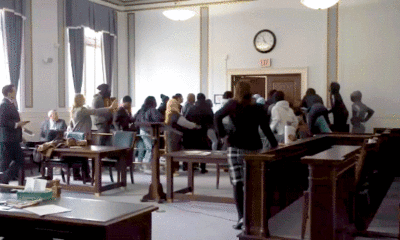
Ohio courtroom devolves into chaos after sentencing in death of teen

Travis County DA faces renewed ‘soft on crime’ criticism after career criminal charged with murder

Alleged criminal history of missing mom found after 24 years catches up with her

Florida High School Football Rankings: Top 25 teams – Oct. 21

Cleary's 21 help Le Moyne down Central Connecticut State 69-64 in OT

How old is Bo Nix? What to know about Oregon quarterback ahead of 2024 NFL Draft

99th annual Pony Swim held in Virginia

Indiana Members Credit Union announced as new anchor tenant at Bottleworks District
Is Iran expanding attacks to target energy and civilian sites in the Gulf?
Trump claims US stockpiles mean wars can be fought ‘forever’; Kristi Noem testifies before Congress – US politics live

War in the Middle East: Iran’s broad retaliation in the Gulf • FRANCE 24 English

Trump sends official notification to Congress on strikes against Iran

Unexpected birth brings hope to near-extinct Amazon tribe
-

 World5 days ago
Exclusive: DeepSeek withholds latest AI model from US chipmakers including Nvidia, sources say
-

 Massachusetts6 days ago
Mother and daughter injured in Taunton house explosion
-

 Denver, CO6 days ago
10 acres charred, 5 injured in Thornton grass fire, evacuation orders lifted
-

 Louisiana1 week ago
Wildfire near Gum Swamp Road in Livingston Parish now under control; more than 200 acres burned
-

 Oregon4 days ago
2026 OSAA Oregon Wrestling State Championship Results And Brackets – FloWrestling
-

 Technology1 week ago
Arturia’s FX Collection 6 adds two new effects and a $99 intro version
-

 News1 week ago
Video: How Lunar New Year Traditions Take Root Across America
-

 Florida2 days ago
Florida man rescued after being stuck in shoulder-deep mud for days