Politics
California Sen. Alex Padilla convinces colleagues to vote against bipartisan border bill

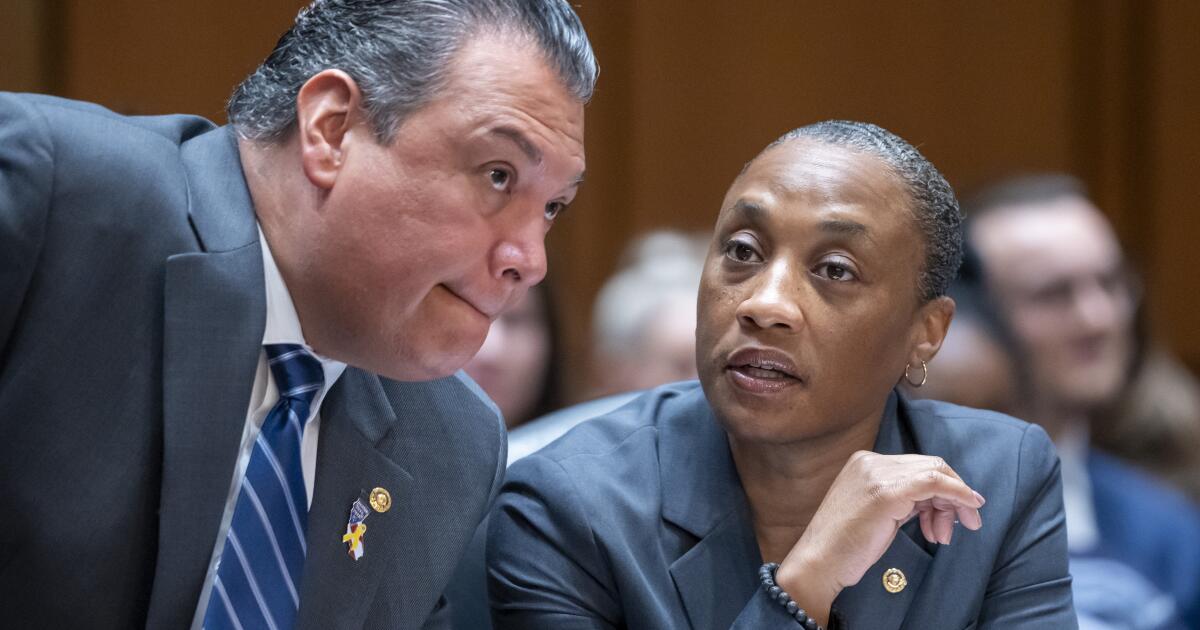
Breaking with his own party’s leadership and the Biden administration, California’s Democratic Sen. Alex Padilla helped lead an effort to defeat the bipartisan border security bill that again failed to advance on Thursday.
In an impassioned Senate floor speech, Padilla criticized the legislation as inadequate and encouraged his fellow senators to “do what’s right for Dreamers, farmworkers and other long-term undocumented members of our communities.”
The remarks were his strongest public rebuke yet of the first major immigration reform proposal in years to make headway in Congress.
Padilla’s vigorous opposition to the compromise is the latest example of his willingness to stake out an aggressive position on principle on an issue critical to his state. He was joined by most Republicans, who voted against the bill because they said it did not do enough to secure the border.
The bill included significant provisions to tighten security but none to help change the status of immigrants in the country illegally.
“So the Senate is voting on this package for a second time, but still no vote on the DREAM Act?” he said. “It’s hard to swallow.”
Senate Majority Leader Charles E. Schumer (D-N.Y.) said he sought Thursday’s floor vote to make the point that Democrats want solutions on the border issue.
Senators voted 50 to 43 against the bill, which Sens. James Lankford (R-Okla.), Christopher S. Murphy (D-Conn.) and Kyrsten Sinema (I-Ariz.) had negotiated for months starting last fall.
A previous vote in February failed by a tally of 49 to 50, well shy of the 60 votes needed to pass. Lankford and Sinema flipped their votes to oppose their measure this time, as did Republican Sens. Susan Collins of Maine and Mitt Romney of Utah.
Padilla played a role in encouraging his colleagues to go against the plan. An aide said the senator had held private conversations with Democrats in the last few months and had contributed to Sens. Cory Booker of New Jersey and fellow Californian Laphonza Butler flipping their votes and opposing the bill.
In a statement after the vote, Butler echoed Padilla’s language, saying the bill “failed to provide comprehensive solutions for critical communities — DACA recipients, farmworkers, and longterm U.S. residents.”
“While there are elements of this bill I support, including funding for our border communities and efforts to prevent the flow of fentanyl, this measure simply misses the mark,” she wrote.
The Senate bill would toughen screenings for asylum and speed up the process, and let presidents immediately expel migrants if arrivals surpass a certain daily threshold.
Immigration has been a core issue of Padilla’s political identity. In his speech, he recalled returning home to California from college “to find hateful TV ads warning of an ‘invasion’ at our border.” The ads were in support of Proposition 187, the 1994 law that sought to deny medical care, social services and education to immigrants suspected of lacking lawful status.
Padilla said that seeing public officials scapegoat and demonize families like his convinced him to join an ensuing movement to bring more Latinos into positions of power.
That hateful rhetoric is back, Padilla said. He pointed to former President Trump’s statement — echoing those by Adolf Hitler — that immigrants are “poisoning the blood” of the country, and Republicans’ declarations that there is an “invasion” at the southern border.
Padilla said such claims are undeniably part of the context in which the border bill was written.
The senator’s independent streak is significant, coming in a critical election year in which Republicans have seized on the issue of immigration, rallying against Democrats for what they see as soft border policies.
The bipartisan legislation was a fundamental piece of the Biden administration’s shift toward more conservative immigration policies — an effort to help Democrats in vulnerable seats maintain control of the Senate and regain the House.
Padilla’s public opposition to the president on this issue reflects a growing rift among Democrats.
The senator campaigned in 2022 on his desire to reform the immigration system, and personally warned Biden in mid-December not to fold to the GOP.
In his speech Thursday, Padilla pointed out that the immigration proposal was originally meant as a concession to get Republicans to agree to send more aid to Ukraine.
“But guess what, Mr. President? We passed the foreign aid!” he said. “And so I can’t help but ask, what’s this concession for now?”
He also critiqued executive actions on immigration that Biden reportedly plans to announce in the coming weeks, calling them “extreme.” Thursday’s vote was widely seen as a leadup to those measures, which could include a provision that would allow the administration to broadly block migrants from entering the country.
Before the vote, Padilla warned colleagues that history would judge them.
“We should be better than this,” he said.



Politics
Mamdani ripped for claiming victory over capitalism after NYC’s multi-billion dollar taxpayer funded bailout

NEWYou can now listen to Fox News articles!
New York City’s mayor is again under fire after spewing outlandish claims that his socialist policies are to credit for a balanced budget in the Big Apple, just after the city received a multi-billion dollar bailout from the state.
“In January, our administration inherited a $12 billion budget deficit — a fiscal crisis greater than the Great Recession,” Mayor Zohran Mamdani said in a Tuesday post on X announcing that the debt had been cleared.
“We balanced the budget by taxing the rich and making government more efficient,” Mamdani continued. “We did not balance this budget on the backs of working people, and we never will.”
New York City Mayor Zohran Mamdani speaks during a primary-night watch party for NYC Congressional candidate Claire Valdez at 99 Scott Studio on June 23, 2026 in the East Williamsburg neighborhood of the Brooklyn borough in New York City. (Michael M. Santiago/Getty Images)
MAMDANI ALLOCATES $500K FOR REPARATIONS TALKS AS NYC FACES $5.4B DEFICIT
But the real reason the budget it balanced is because the city was handed $1.5 billion by the state of New York in January — funded by working class taxpayers across the state — as part of a multi-year plan to bail out the fiscally-challenged city. In late May, the city received another $4 billion.
Of the combined $8 billion provided to the city’s bailout fund under former Mayor Eric Adams’ tenure and now Mamdani’s mayorship, $5 billion was directly earmarked for the city to address fiscal measures. This includes allowing city government to defer pension contributions to close the budgetary gap.
Mamdani’s claims about socialist policies producing results — and his failure to mention the massive bailouts provided by taxpayer dollars — did not fly on social media.
New York Gov. Kathy Hochul holds media availability press conference and makes an announcement on abortion rights at the office on 633 3rd Avenue. (Lev Radin/Pacific Press/LightRocket via Getty Images)
MAMDANI ALLOCATES $500K FOR REPARATIONS TALKS AS NYC FACES $5.4B DEFICIT
“This is a lie,” independent journalist Nick Shirley said in a reply to the mayor.
“You balanced the budget by borrowing billions from the NY state government which pushed back pension payments, so you literally took money from ‘the backs of hardworking people.’ Don’t get it twisted,” he added.
Commentator and journalist Nick Sortor also flamed the mayor over the loan and his classification of the bailout.
“Are you saying New Yorkers can ‘balance their budgets’ by taking out massive credit card loans?” he asked sarcastically.
Independent journalist Nick Shirley sat down for an interview with Riley Gaines as part of the launch of Outkick’s “The Riley Gaines Show.” (OutKick)
BROADCAST NETWORKS TOUT MAMDANI’S VICTORIES, PROCLAIM SOCIALISM IS ‘RESONATING’
“Mamdani balanced the budget by taking money from Albany, who in turn taxed Rochester and Buffalo” another social media user said. “That’s who is paying for all of Mamdani’s free crap.”
In a press conference earlier in the day, Mamdani claimed victory over capitalism.
“Throughout this process I have been reminded of the words of the Austrian economist Friedrich Hayek: ‘if socialists understood economics, they wouldn’t be socialists.’”
A man sleeps on the E train, one of the subway lines most utilized by homeless New Yorkers for shelter, in Queens, New York, on Monday, April 7, 2025. (Victor J. Blue for The Washington Post/Getty Images)
After the Republican National Convention (RNC) posted that clip, Mamdani also faced ridicule for that.
“It always looks good at first until the chickens come home to roost,” one person replied.
CLICK HERE TO DOWNLOAD THE FOX NEWS APP
“He’ll soon ‘deliver’ bread lines instead,” said another.
Mamdani’s office did not return Fox News Digital’s request for comment.

In 1913, Antonino Alati left southern Italy to find a better life in a land where many people regarded him as little better than scum.
He joined millions of his fellow countrymen in the United States, where the press vilified Italians as poor, swarthy, violent Catholics who had too many babies, refused to assimilate and could never possibly be considered “white.”
Politicians were already working to shut the door on them. A congressional report released two years before Alati’s arrival cited southern Italians as evidence that “the new immigration as a class is far less intelligent than the old.” They came to the U.S., the report asserted, “with the intention of profiting, in a pecuniary way, by the superior advantages of the new world and then returning to the old country.”
Alati wouldn’t let bigotry win. He soon sent for his wife and children, including his infant son Salvatore. Alati turned to Alito, Salvatore became Samuel. A generation later, the family had a Supreme Court justice in Samuel A. Alito Jr. — the second Italian American, after Antonin Scalia, to sit on the highest court in the land.
During his 2005 confirmation hearings, Alito praised his father as an “extraordinary man who came to the United States as a young child and overcame many difficulties” to ensure a better life for him and his sister. By then, Italian Americans were established as an essential part of this country’s fabric, from music to politics to food.
It’s the most American of tales — which is why it’s so surprising, yet not, to read Alito’s blistering dissent in the Supreme Court’s 6-3 decision rejecting President Trump’s effort to end birthright citizenship.
If there’s one constant in this country besides death and taxes, it’s how quickly descendants of immigrants, and sometimes immigrants themselves, forget how loathed their ethnic group was and how they proved the haters wrong. Too many become uncharitable to the policies that helped them and the immigrants who followed.
But Alito’s stance against birthright citizenship goes beyond just forgetting his roots. His 39-page opinion describes the supposed impact of undocumented migrants on the U.S., using words — “overran,” “soared,” “exploded,” “massive,” “a stream,” “huge” — that read like the same invective used against Italians in his grandfather and father’s time.
The justice channels anti-Italian conspiracies of the past by casting doubt on the national allegiances of the U.S.-born children of Mexican, Guatemalan and Salvadoran immigrants — the same patriotism test that Italian Americans faced generations ago when xenophobes questioned their Catholicism. Alito claims without evidence that millions of agricultural workers were able to apply for American citizenship after President Reagan’s 1986 amnesty “at least in part because of fraud” — a charge also leveled against Italians who sought to naturalize back in the day.
And so it goes, each passage a jumbled argument dressed up in judicial interpretations largely rejected by his fellow Catholic Supreme Court justices John Roberts, Amy Coney Barrett and Brett Kavanaugh. Coney Barrett signed on to the majority opinion that Roberts wrote, and Kavanaugh concurred.
Rev. William Barber II speaks during a rally outside the U.S. Supreme Court on April 1 while justices heard oral arguments on birthright citizenship.
(Al Drago / Getty Images)
I know how quickly families forget their own immigrant histories. Yet I look at people like Alito and wonder how they ended up thinking the way they do, because I could never imagine doing the same.
My maternal grandmother was born in Arizona to parents who fled their home country during the Mexican Revolution, becoming an American citizen by birthright. My father, who crossed the border in the trunk of a Chevy, legalized his status in an era when it was far easier to do so.
Like Alito’s paisanes, my Mexican family was also demonized for supposedly being insufficiently American and posing a threat to national unity. They also sacrificed their own dreams so their children and grandchildren could achieve theirs.
And just like Alito, some members of my family have forgotten our history and support Trump or favor some of his immigration policies, dismissing new arrivals as criminals or lazy. That’s why I will always side with undocumented people and welcome anyone who gives birth in this country with the hope that their newborn finds a better life.
It seems from his dissent that Alito somewhat agrees with me. He posits that millions of Americans who were born in this country to parents without papers “have a strong moral claim to be able to remain in the land where they grew up.” Congress “can and should address their situation,” he writes.
The justice blasts birth tourism, where women from China and other countries travel to the U.S. to have a baby, then return home, benefiting from our generosity and offering nothing in return.
I agree that’s a mockery of what being an American should be and ruins it for people who want to contribute to building a better nation. But Alito throws out the baby with the bathwater by failing to recognize that Trump’s attempt to erase birthright citizenship via executive order is presidential overreach based on bigotry, not rule of law. He’d rather cut up the Constitution to spite something he doesn’t like. Thank God his side lost, yet it’s sad that Trump’s pathetic attempt to define who can be an American went as far as it did.
Alito concludes by stating that the court’s decision to uphold the 14th Amendment is “a mistake that will seriously affect the country’s future.”
What new immigrants might inflict on this country is the perpetual worry of immigration restrictionists — and yet history keeps proving them wrong. Alito’s family did; so did mine. Only in these United States can the progeny of people once portrayed as parasites and invaders side with those making the same argument about the latest batch of newcomers.
History will see Alito’s vote for what it is: a forsaking of the promise his family once fulfilled, to support the people who never wanted them here in the first place.

NEWYou can now listen to Fox News articles!
Rep. Diana DeGette, D-Colo., a 30-year incumbent, lost to a Democratic Socialists of America (DSA)-backed challenger in a high-profile primary on Tuesday evening.
Melat Kiros, a 29-year-old socialist, defeated DeGette in a Democratic primary for a deep-blue House seat anchored in Denver, according to The Associated Press, scoring a major victory for the socialist left on Tuesday evening.
The DSA had been aiming to cast DeGette’s loss as evidence of its growing momentum after a slate of socialist candidates won Democratic primaries in New York City last week.
“Today, the East Coast, next week the Mountain West,” the DSA wrote in a social media post last week.
Rep. Diana DeGette speaks during a press conference outside the U.S. Capitol building in Washington, D.C., on Jan. 10, 2024. (Samuel Corum/Getty Images)
SOCIALISTS CHEER ‘SHOCKWAVE’ PRIMARY NIGHT AS DSA-BACKED CANDIDATES WIN, ADVANCE ACROSS THE MAP
If elected in November, Kiros, who was born in Ethiopia, will likely join the ranks of the far-left group known as the Squad and become one of a handful of the House chamber’s outspoken socialists.
The millennial challenger was endorsed by Sen. Bernie Sanders, I-Vt., Rep. Alexandria Ocasio-Cortez, D-N.Y., and the anti-incumbent leftist organization Justice Democrats. Controversial socialist streamer Hasan Piker, who has said Hamas is “a thousand times better” than Israel and praised the Chinese Communist Party, also backed Kiros’ insurgent primary run.
DeGette, a member of the Congressional Progressive Caucus who supports abolishing Immigration and Customs Enforcement (ICE), sought to win a 16th House term by flexing her leftist bona fides. She argued her seniority on an influential House committee would allow her to push for Medicare-for-All legislation — a longtime priority of the party’s far-left flank.
DeGette, who was endorsed by former CPC Chairwoman Pramila Jayapal, D-Wash., also spotlighted her experience as an impeachment manager during Trump’s second impeachment trial in 2021.
Though DeGette and Kiros shared few policy disagreements, they diverged sharply over Israel and antisemitism. Kiros also sharply criticized DeGette for accepting corporate PAC contributions.
Kiros, a PhD student and lawyer, was fired from a New York firm in 2023 after publishing an open letter, arguing that pro-Palestinian student protesters calling for the elimination of Israel were not antisemitic and appearing to defend Hamas.
Melat Kiros participated in a League of Women Voters Congressional District 1 candidate forum at Montview Presbyterian Church in Denver on May 28, 2026. (RJ Sangosti/MediaNews Group/The Denver Post)
WATCH: HOUSE DEMS UNLOAD ON TEXAS DEMOCRAT OVER ‘DEMENTED’ ANTISEMITIC COMMENTS
She has also described the Oct. 7, 2023, attacks against the Jewish state as the “inevitable consequence of apartheid” and declined to characterize the deadly firebombing of protesters in Boulder last year who were urging the release of hostages held by Hamas in Gaza as antisemitic.
“I don’t know what was in the heart of the perpetrator,” Kiros told Colorado’s 9News in a recent television interview. “All I know is that he went and attacked innocent people because of what they might have believed.”
A June 2025 bipartisan resolution condemning the attack as part of a “rise in ideologically motivated attacks on Jewish individuals” won every present lawmaker’s support, except for Reps. Rashida Tlaib, D-Mich., and Thomas Massie, R-Ky., who voted present.
Kiros has also suggested the United States deserved 9/11.
“Inevitable in the sense that we destabilized a lot of the Middle East that forced people to believe that another act of violence was the only response,” Kiros told 9News when asked if she thought the terror attack was “the inevitable consequence of American foreign policy.”
“And again, just like I said before, our responsibility is to get rid of those conditions that lead to violence in the first place,” Kiros continued.
DeGette argued that Kiros’ embrace of Piker and her comments about antisemitism and 9/11 were disqualifying.
“I’m shocked and disgusted that Kiros is doubling down on excusing terrorism and the murder of innocent people,” the 30-year incumbent wrote on Facebook earlier this month.
Streamer and creator Hasan Piker speaks at a press conference during day two of Web Summit Vancouver at the Vancouver Convention Centre in Vancouver, Canada, on May 13, 2026. (Sam Barnes/Web Summit via Sportsfile via Getty Images)
CLICK HERE TO DOWNLOAD THE FOX NEWS APP
Colorado’s 1st Congressional District is the most liberal seat in the state and voted for former Vice President Kamala Harris by 56 points in 2024.
The primary fight was further scrambled by University of Colorado Regent Wanda James, also running for DeGette’s seat. Though James did not pose the same threat as Kiros, her vote share could ultimately have swayed the contest.
-

 New Hampshire1 minute ago
Have You Ever Actually Talked to a New Hampshire Police Officer? Here’s Your Chance
-

 New Jersey4 minutes ago
Exclusive | NJ’s suburbs are in a full-blown bidding war frenzy — with houses going 33% above asking
-

 New Mexico9 minutes ago
Dispatches from Route 66: Finding queer hope in New Mexico and Arizona
-

 North Dakota19 minutes ago
WATCH LIVE: Trump speaks in North Dakota ahead of July Fourth
-
Ohio24 minutes ago
Children found in ‘deplorable’ Ohio home were part of same family
-

 Oklahoma31 minutes ago
Oklahoma opens Taiwan Regional Trade Office at State Capitol
-

 Oregon34 minutes ago
Strict fire restrictions in effect on BLM lands in Washington, Oregon ahead of July 4
-
Pennsylvania39 minutes ago
From Chocolate Avenue to the World Cup, how Hershey, Pennsylvania, shaped Christian Pulisic


