Politics
As questions of temperament persist, Katie Porter tries to regain edge in governor’s race

In Congress, Katie Porter’s blunt, combative style helped rocket her to progressive stardom. It has also become her biggest vulnerability as she campaigns to be California’s next governor.
Her brusque approach, prosecutorial instincts and suburban mom appeal fueled Porter’s rise during her three terms in the U.S. House of Representatives, where she rattled CEOs and Trump administration leaders and batted away GOP challengers in a competitive Orange County district.
Her tack, however, made her a polarizing force within her own party, where fidelity remains an essential currency of success and power. In Congress, Porter clashed with then-House Speaker Nancy Pelosi and L.A.’s Rep. Maxine Waters.
The same rough edges that endeared Porter to many voters have also alienated some Democratic insiders and interest groups whose support could prove critical in the race to replace outgoing Gov. Gavin Newsom.
Then-Rep. Katie Porter meets with parents, doctors and diabetic patients in her Irvine office in 2019.
(Mark Boster / For The Times)
“She came in [to the governor’s race] as an outsider, as a mom, as a fighter. She wasn’t pulled into the establishment,” said Lorena Gonzalez, president of the California Federation of Labor Unions. “I think that’s why she’s popular with voters, because they want somebody who’s going to fight, and sometimes that ruffles feathers.”
In the campaign for governor, Porter, a single mother of three, has struggled to convert grassroots popularity into broader institutional support. Even after former Rep. Eric Swalwell dropped out of the race amid allegations of sexual assault, she has yet to see a major surge in support or endorsements from Democratic power brokers.
A pair of embarrassing videos continue to hang over her campaign. The videos, which surfaced in October, showed Porter yelling at a staff member and threatening to walk out of a television reporter’s interview.
As former U.S. Health and Human Services Secretary Xavier Becerra has ascended and she remained stagnant in polls following Swalwell’s exit, Porter has increasingly sought to redeem her image. She poked fun at the incident with her staffer in an ad, smilingly asking a group of whiteboard-wielding supporters behind her to “please get out of my shot.”
In recent debates, Porter has sought to play up the qualities that made her a standout among resistance-era progressives, needling former hedge fund executive Tom Steyer over his past investments in private prisons and pressing Becerra for a “yes” or “no” on statewide single-payer healthcare. Porter emphasizes her support for single-payer healthcare, providing free child care and college tuition and making wealthy corporations pay their “fair share” in taxes.
Porter said she wants to increase taxes on the state’s wealthiest residents but doesn’t support the proposed billionaire’s tax ballot measure because it is a “one-time tax” that won’t solve the state’s underlying budget issues.
During a particularly chaotic debate last week, she scolded her opponents’ incessant interruptions and called out what she considered a double standard over her behavior.
“I can’t believe, with [the] interrupting and name-calling and shouting and disrespect for everyone up here who’s stepping into public service that anyone wants to talk about my temperament,” she said during the May 5 debate on CNN.
Though she acknowledged she mishandled both caught-on-tape situations and said she apologized to the staffer, the videos hindered her early momentum and have undercut her efforts to make inroads with potential allies in the race.


Porter speaks at a gubernatorial candidates forum on Sept. 28, 2025, in Los Angeles.
(Carlin Stiehl / Los Angeles Times)
Influential lawmakers, labor groups and party insiders have coalesced behind Becerra and Steyer, her top Democratic rivals.
Porter has scored some key endorsements. She is one of three candidates backed by the California Federation of Labor Unions, along with Steyer and former Los Angeles Mayor Antonio Villaraigosa. She also has support from Teamsters California, the National Union of Healthcare Workers and progressive groups such as Emilys List and California Environmental Voters, which dual-endorsed her and Steyer.
Union support is pivotal for Democratic candidates in California, sending a clear signal that they support the priorities of working-class voters. For Porter, who has proudly refused to accept corporate donations throughout her political career, the labor endorsements also help her attract the small-dollar donations that are essential to her campaign.
While in Congress, Porter proved to be a prodigious fundraiser. In her last reelection campaign for the House of Representatives in 2022, she raised more than $25.6 million in contributions — the second-most in Congress, behind only Bakersfield’s Rep. Kevin McCarthy, who was then the House Republican leader.
Still, her backing from elected Democrats remains comparatively thin. Along with her mentor, Sen. Elizabeth Warren (D-Mass.), just three members of Congress have endorsed her gubernatorial bid: Reps. Robert Garcia of Long Beach, Dave Min of Irvine and Derek Tran of Huntington Beach. She also picked up an endorsement from Assemblywoman Cottie Petrie-Norris (D-Irvine) after Swalwell dropped out.
Though none would speak publicly, multiple sources who work in and around the state Capitol expressed concerns about Porter’s temperament and her willingness to work collaboratively with people she disagrees with.
“Katie Porter hurt herself big time because she needs anger management and she doesn’t have the temperament” to be governor, Democratic former Sen. Barbara Boxer said during a recent interview with NewsNation’s Leland Vittert.
Through her campaign spokesperson, Porter declined to be interviewed for for this story.

Porter questions Tim Sloan, president and chief executive officer of Wells Fargo, during a House Financial Services Committee hearing in Washington in 2019.
(Andrew Harrer / Bloomberg)
Defenders argue the backlash reflects a double standard for women in politics — a salient point in a state that, despite its liberal reputation, has never elected a woman as governor.
“Sacramento sizes up every gubernatorial candidate the same way: Can they win, and is this someone I actually want to work with?” said Elizabeth Ashford, a Democratic consultant who is not working with any of the candidates running for governor. “The videos showed an angry woman, and for a lot of people that translated to ‘I don’t want her as my boss.’
“It’s a double standard that dogs women in politics. Jerry Brown was famous for his loud, unfiltered outbursts and nobody questioned whether he was up to the job,” said Ashford, who served as the former governor’s deputy press secretary.
Gonzalez agreed, arguing that women who stand up for themselves “are often labeled as ‘difficult.’ Probably a lot of people think I’m difficult,” the labor leader added with a laugh.
Born in Iowa, Porter often connects her politics to her family’s financial struggles after losing their farm during the 1980s farm crisis. She earned degrees from Yale and Harvard, where she studied bankruptcy law under Warren. In 2012, while working as a law professor at UC Irvine, Porter was appointed by then-Atty. Gen. Kamala Harris to oversee California’s $18-billion mortgage settlement.
After defeating Republican incumbent Rep. Mimi Walters in 2018, Porter quickly emerged as one of the Democratic Party’s most recognizable progressives. Armed with a whiteboard and other visual aids in congressional hearings, she confronted banking and pharmaceutical executives over drug prices, consumer debt and corporate profits.
The props, theatrical at times, seemed to aggravate Waters, then the Democratic chairwoman of the Financial Services Committee. On several occasions, Waters sided with Republicans who challenged Porter’s use of visual and audio aids during hearings.
“Please do not raise your board. We’ve talked about this before,” the chairwoman scolded when Porter tried to hold up a “Financial Services Bingo” card during a 2019 hearing on debt collection. (She later got to show the board on “Late Night with Seth Meyers.”)
Eager to force change they campaigned on, Porter and other freshmen, including members of “The Squad,” at times clashed with Pelosi and other Democratic leaders.

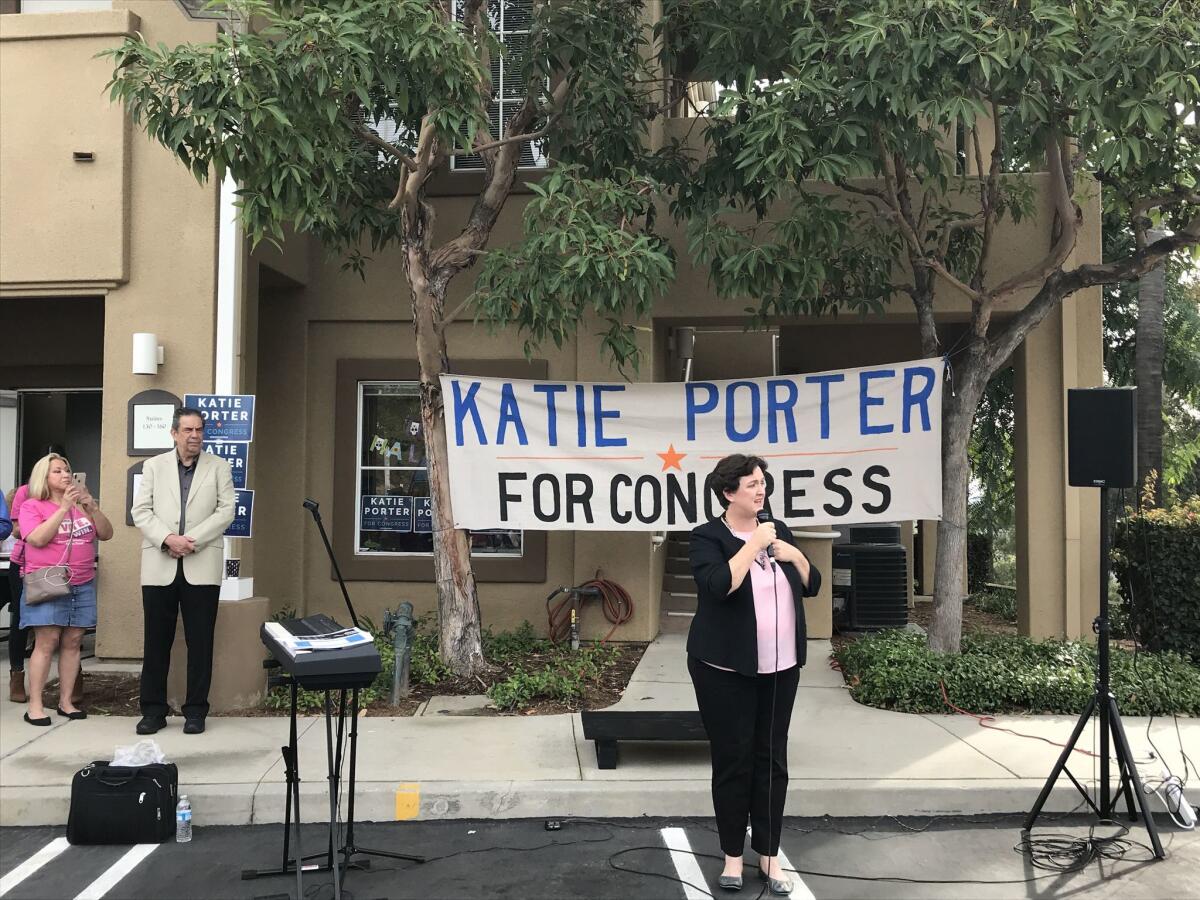
Porter speaks to volunteers while campaigning in Mission Viejo in 2018.
(Victoria Kim / Los Angeles Times )
Porter has slammed lawmakers, including Democrats, for stock trading and funneling earmark funding to their home districts, arguing that such practices breed corruption and mistrust in Congress. The critiques irked Pelosi, a powerful force in California politics.
In her second term, the Orange County Democrat lost her coveted spot on the Financial Services Committee after she listed it as her third choice and requested a waiver to stay on it. Typically, members prioritize such high-profile committees and request waivers to serve on lesser ones in addition. The move was seen as a risk, the result a check on Porter’s ambition.
“So many of us, regardless of ideology, run on ‘shaking up Washington.’ But then when you actually come here, there’s a lot of consequences for doing that,” Rep. Alexandria Ocasio-Cortez (D-N.Y.) told The Times after Porter lost the committee position.
Porter’s willingness to buck party norms also raised eyebrows during her Senate campaign, when she entered the race for Sen. Dianne Feinstein’s seat before Feinstein had announced retirement plans in early 2023. Although then-Rep. Adam Schiff also launched an early campaign, he did so only after privately seeking Feinstein’s blessing. She ultimately finished third in the primary.
Her decision to run for Senate did not ingratiate her with Washington’s Democratic leadership. The party was forced to spend millions to ensure another Democrat was elected to her contested Orange County congressional seat, and Schiff, her top rival in the race, was a close ally of Pelosi — who endorsed him — and helped lead the first impeachment effort against President Trump.
Controversy surrounding Porter’s personal relationships have also surfaced during previous campaigns. In 2024, she obtained a five-year restraining order against a former boyfriend who she said bombarded her and her children with threatening messages.
When a whisper campaign about the end of her marriage threatened her first House run, Porter shared details of her 2013 divorce with the Huffington Post, including that her ex-husband, Matthew Hoffman, physically intimidated and verbally abused her. Hoffman also claimed to be the victim of abuse, including an incident in which Porter allegedly threw hot mashed potatoes at him. Both filed for restraining orders and sought anger management during the divorce.
Former employees have also rallied to her defense. In an open letter last month, 30 former staffers described Porter as a “workhorse” who “asked of us what she expected of herself.”
“She demanded a lot, but she also fought for us, mentored us, and stood by us when life got hard,” the former aides wrote. “We believe the public should understand the full person we know, not a caricature built from a few clips on a bad day.”
Porter has argued that voters are looking for someone willing to challenge powerful interests rather than accommodate them.

Katie Porter is interviewed after the California Gubernatorial debate at Skirball Cultural Center on Wednesday.
(Jason Armond/Los Angeles Times)
“It’s on me to keep campaigning and keep demonstrating that,” she told reporters after a recent gubernatorial debate in San Francisco. “It’s also not lost on me that the last time the Democratic Party had a woman nominee for governor was 1994, when I was in college.”
The affordability crisis is at the forefront of the race to replace term-limited Newsom. As a single parent, Porter argues she is acutely aware of gas and grocery prices — as well as higher-stakes consequences.
She described feeling shocked when, during a recent conversation with her 17-year-old son, he asked if she would visit him if he moved to another state.
“I said, ‘Paul, you love California, why would you leave California?’ And he said, ‘Well, I’m thinking I might want to have a family and I might want to have a house, and I know that means I’ll have to leave California,’” Porter recounted at a March forum hosted by the California Assn. of Realtors. “We need to be a state that doesn’t just retain people like my son … but welcomes new families.”
The centerpiece of her proposed “affordability solutions” are free child care, free tuition at UC and CSU schools for students who complete two years of community college, and ending income taxes for those who earn less than $100,000 — an idea she acknowledges she “stole” from Republican candidate Steve Hilton. “I will take a good idea anywhere I can get it,” she said at a recent forum.
To pay for it, Porter would impose a progressive corporate tax, meaning more profitable businesses and corporations would pay a higher rate. A less than 1% tax hike on businesses that earn hundreds of millions in profit would bring in around $8 billion, according to her website.
“I think she deeply and personally understands the everyday struggles that so many Californians are grappling with right now,” said Petrie-Norris, who last month became the first state legislator to endorse Porter.
While Petrie-Norris describes herself as more politically moderate than Porter, the Irvine assemblywoman praised her as a “pragmatic problem-solver” and “proven fighter” who has taken on corporate interests and the Trump administration.
For a while, Porter was one of four women among the major candidates running for governor. One by one they have dropped out of the race, citing difficulties raising money and support.
After sharing the debate stage with five men recently, Porter was asked whether California is ready for a female governor.
“I sure as hell hope so,” she said.