Connect with us

Northeast

Woman heading to church randomly shoved down steps, robbed, video shows

Published

on

Woman heading to church randomly shoved down steps, robbed, video shows

A 68-year-old woman was pushed down a flight of steps and robbed as she walked into a church in Queens, the NYPD said.

The suspect, who remains on the loose, shoved the woman Sunday morning and stole $300 from her purse, her cellphone and her car while the woman writhed in agony on the ground, security video shows. 

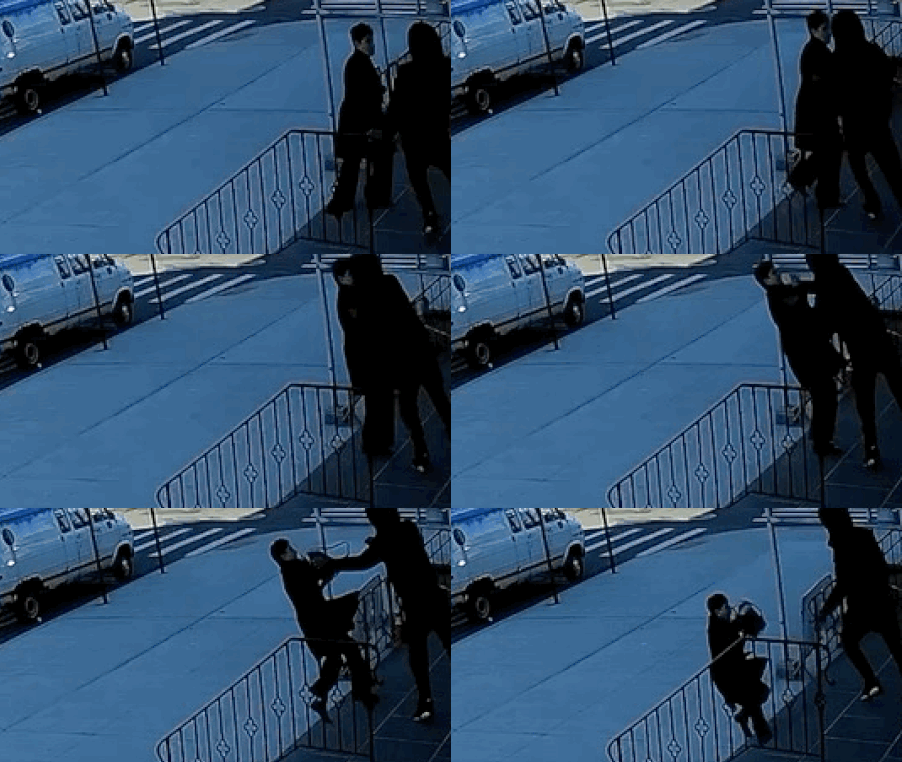
The attacker followed the unsuspecting victim up the steps of St. Demetrios Greek Orthodox Church in the Jamaica section of Queens, New York, and then jumped in front of her and knocked her down.

She went airborne over all three steps and landed on her back. The thief is seen in the security video rummaging through her purse and running away.

BAT-WIELDING NYC HOMEOWNER CATCHES PORCH PIRATE BY SETTING TRAP, VIDEO SHOWS

Advertisement

The NYPD is looking for this man, who pushed a 68-year-old woman down the stairs in Queens and stole money, video shows. (NYPD)

He ultimately stole the woman’s 2006 Nissan Altima to make his getaway, according to police. 

The suspect is described as a man with a “dark complexion,” 18 to 25 years old, 5-foot 8-inches in height with a medium build, according to the NYPD. 

TEACHER’S CHILDREN FOUND WITH SLAIN MOM AFTER ‘DISGUISED’ HUSBAND KIDNAPPED THEM: POLICE 

WATCH FULL ATTACK

Advertisement

He was last seen wearing a red hooded sweatshirt underneath a black jacket, black pants, black face mask and black Jordans with red trim.

The woman was rushed to a hospital in critical condition. 

The NYPD’s wanted poster for a man who shoved a 68-year-old woman down a flight of church steps and stole from her. (NYPD)

The Rev. Konstantinos Kalogridis told ABC 7 that he visited the parishioner, and she’s awake and recovering.

“I visited her yesterday at the hospital,” Kalogridis told the local news outlet on Monday. “She was alert. She was conscious. I gave her, you know, a blessing, gave her holy communion and gave her a little prayer and an icon.”

Advertisement

FORT LAUDERDALE POLICE, GUNMAN EXCHANGE FIRE IN HOTEL AFTER PHONY ‘MURDER’ 911 TEXT, BODYCAM SHOWS

The woman’s nephew shared the NYPD’s wanted poster and video on X and said, “My aunt is in critical condition after being robbed yesterday in broad daylight. I’m asking everyone to please share this info from the NYPD. Let’s find this POS.”

Anyone with information on the incident is asked to call the NYPD’s Crime Stoppers Hotline at 1-800-577-TIPS (8477) or for Spanish, 1-888-57-PISTA (74782).

A man knocked down a 68-year-old woman going to church, stole from her and fled the scene. (NYPD)


Advertisement

The public can also submit their tips by logging onto the Crime Stoppers website at https://crimestoppers.nypdonline.org/, on X @NYPDTips. 

All calls are confidential. 

Fox News Digital’s Mitch Picasso contributed to this report.

Read the full article from Here

Continue Reading
Click to comment

Leave a Reply

Your email address will not be published. Required fields are marked *

This site uses Akismet to reduce spam. Learn how your comment data is processed.

Pennsylvania

Geospatial Study Ties Melanoma Hot Spots to Farming Practices in Pennsylvania | Managed Healthcare Executive

Published

on

Geospatial Study Ties Melanoma Hot Spots to Farming Practices in Pennsylvania | Managed Healthcare Executive


Melanoma, a cancer most often associated with sun exposure and individual risk factors, appears to follow the contours of Pennsylvania’s agricultural landscape, according to a new analysis that highlights striking regional differences in incidence. Adults living in counties with more cultivated land and heavier herbicide use had significantly higher melanoma rates, even after researchers accounted for ultraviolet radiation and social vulnerability.

The study, published in November 2025 in JCO Clinical Cancer Informatics, identified a 15-county cluster in South Central Pennsylvania where melanoma incidence among adults ages 50 years and older was 57% higher than in the rest of the state. Counties with larger shares of cultivated acreage and herbicide-treated land consistently showed higher rates, suggesting that agricultural practices may contribute to geographic disparities in melanoma risk.

Melanoma incidence in the United States has tripled since the mid-1970s. Although advances in treatment have improved survival, the disease is still expected to claim thousands of lives this year. Ultraviolet radiation is the leading environmental risk factor, but studies of outdoor workers, including those in agriculture, have produced mixed results. That inconsistency has fueled interest in whether farming-related exposures, such as pesticides, may play a role alongside sun exposure.

To examine that question at the population level, a team of researchers at Penn State College of Medicine conducted an ecologic analysis using county-level data from across Pennsylvania. The team analyzed invasive melanoma incidence from 2017 through 2021 among adults 50 years and older and paired those data with measures of agricultural land use, pesticide application, ambient ultraviolet radiation and socioeconomic vulnerability.

Advertisement

Using geospatial clustering techniques, the researchers identified a statistically significant melanoma hot spot spanning 15 counties in South Central Pennsylvania. Eight of those counties are designated as metropolitan, challenging the assumption that agriculture-related cancer risks are confined to rural areas. Compared with counties outside the cluster, those within it had nearly three times more cultivated land and more than double the proportion of herbicide-treated acreage.

In statistical models adjusted for ultraviolet radiation and social vulnerability, each 10% increase in cultivated land corresponded to a 14% increase in melanoma incidence. A roughly 9% increase in herbicide-treated acreage was associated with a similar 14% rise. Herbicides showed the strongest and most consistent association, while smaller positive associations were also observed for insecticide-, fungicide- and manure-treated land.

The authors noted that the entire high-incidence cluster falls within the 28-county catchment area of the Penn State Cancer Institute. That alignment, they wrote, creates an opportunity to integrate research, outreach and prevention efforts in a region with elevated melanoma burden.

Because the study used an ecologic design, it cannot establish cause and effect or assess individual-level exposures, the authors cautioned. The analysis also could not account for personal behaviors, genetic risk or direct measures of pesticide exposure. Still, the findings add to a growing body of literature linking agricultural practices, particularly pesticide use, with melanoma risk in farming regions.

Taken together, the results support a broader One Health approach to cancer control, one that considers how environmental, occupational and behavioral factors intersect. For agricultural regions such as South Central Pennsylvania, the authors suggest melanoma prevention strategies may need to extend beyond sun protection alone to include safer pesticide practices, environmental monitoring and community-based education tailored to populations affected by agricultural exposure.

Advertisement


Source link

Continue Reading

Rhode Island

CRMC asks RI Superior Court to force Quidnessett Country Club to take down rock wall

Published

on

CRMC asks RI Superior Court to force Quidnessett Country Club to take down rock wall


The Rhode Island Coastal Resources Management Council (CRMC) filed a counterclaim against Quidnessett Country Club in Providence County Superior Court Tuesday. It wants a judge to force the North Kingstown country club to remove the 600-foot stone wall built without permission roughly three years ago.


Source link

Continue Reading

Vermont

Vermont medical cannabis patients on the rise

Published

on

Vermont medical cannabis patients on the rise


MONTPELIER — As medical dispensaries dwindle but retailers receive medical use endorsements, a data point sticks out. 

“The number of medical patients continues to grow,” Olga Fitch, executive director of the Cannabis Control Board, said at the Dec. 17 board meeting. 

About 3,043 patients were registered for the program at the time of the meeting, according to a slide show presentation. More than 40 patients were added to the count since the November board meeting, Fitch said.

Advertisement

Looking at data starting in 2011, Fitch said the medical program peaked around 2018 with 5,300 patients. She noted November 2023 is the last time, before now, that the state recorded more than 3,000 patients. 

Vermont now has 20 retailers with medical use endorsements. They’re in Bennington, Brattleboro, Manchester Center, Middlebury, Montpelier, Rutland, St. Johnsbury, South Hero, Bethel, Brandon, Burlington, Essex, Essex Junction, Johnson, White River Junction, Winooski and Woodstock. Five of them received the endorsement in December. 

A law passed this year by the Vermont Legislature established the program, which allows approved retailers the opportunity to sell higher potency products and offer curbside, delivery and drive-thru services to patients. Registered medical cannabis patients in Vermont are also exempt from paying the state’s cannabis excise tax and the standard sales tax. 


Vermont rolls out cannabis medical-use endorsement program

Retail establishments with the medical use endorsement are gearing up for the new initiative. 

Advertisement

The first Enhanced Budtender Education course was held during the first week of December, a CCB newsletter stated, “paving the way for medical cannabis sales at medical-use-endorsed retailers.”

The CCB thanked “the budtenders and licensees who took the time to register, attend, and successfully complete the multi-hour course.”

“We are excited to roll out better access for patients and caregivers in the Medical Cannabis Program,” the CCB said.

Advertisement

At least one employee at an endorsed retailer is required to go through enhanced budtender training, which is offered through a contract with Cannify. To qualify, retailers must be in good standing for six months, with a clean compliance record and up-to-date tax payments.


Source link

Continue Reading
Advertisement

Trending