Sign up for Scenic Six
Navigate the endless possibilities of New England travel with Boston.com.


Scenic Six
You’re reading Scenic Six, Boston.com’s guide to New England travel. Sign up to get hidden gems, travel tips, and must-visit spots in your inbox every week.
Welcome back to Scenic Six.
This week, we’ll discuss beautiful Boston, a picturesque Christmas getaway, and the most affordable New England ski resorts this season. How does a day on the slopes for $4 sound? We’ll discuss that too.

For those who dream of skiing for Christmas, it doesn’t get much prettier than the powder-filled slopes in Stowe, Vermont. Travel + Leisure magazine just named Stowe one of the best Christmas getaways on the planet, calling it “one of the most picture-perfect places to go for Christmas.” Travelers looking for ski-in, ski-out access can stay at the Lodge at Spruce Peak.
Speaking of skiing, we all know the sport can be pricey. HomeToGo released a list of the most affordable ski resorts in the U.S. and three New England spots made the top 10: Maine’s Sugarloaf Mountain and Sunday River and Vermont’s Jay Peak. At Sugarloaf, the region’s most affordable, a one-day lift pass is $124 and an overnight stay is $105.37, for a total of $229.37 per person.
I’ve lived here for a long time and still don’t take Boston’s beauty for granted. When skating on the Frog Pond during the wintertime, I often pause to appreciate the twinkling trees and lit up city beyond. Travel publication Afar just called Boston one of the world’s most beautiful places for a winter getaway. What do you think is the most beautiful spot in Boston during the winter months?
I’ll leave you with this photo of a warm fall evening on the Charles River Esplanade, taken by Julie Ross.
Where have you traveled lately? Please share your photos by sending them to [email protected] and they may be featured in an upcoming Scenic Six newsletter.
Whether you’re traveling this week or planning your next escape, enjoy the journey.
— Kristi Palma
Navigate the endless possibilities of New England travel with Boston.com.


Authorities have identified the girl and her older brother who died in a Vermont river after going missing last week.
Sandro Lala, 25, had jumped into the Lamoille River to save his sister, 11-year-old Yazmin Yupangui, when she fell into the Lamoille River near Arrowhead Mountain Lake in Georgia, Vermont, on Wednesday, according to the Vermont State Police.
Autopsies determined that the siblings, who both lived in Cambridge, Vermont, died in accidental drownings, according to police.
Yazmin’s body was found Thursday by a police underwater recovery team, while Lala’s body was found in Arrowhead Mountain Lake on Saturday morning.
Police had previously said a group of relatives were fishing along the shore when a young girl fell into the water, and a man jumped in to try to rescue her. Neither resurfaced after that, prompting a large search, including multiple agencies, on the water near where Lamoille River empties into the lake.

Mountain bike enthusiasts have been working for years on an ambitious 485-mile multi-use trail known as the Velomont that will span the length of Vermont.
When finished, the collaborative project will knit together existing trail networks, connect 27 communities, and include 30 new huts and five downtown hostels for overnight stays.
New trail construction is finally ramping up after years spent on permits, plans and public input. And organizers say they’re focused on ensuring the Velomont is accessible for everyone.
“For us, it’s not a huge lift to just be mindful when we’re trying to build trail or improve trail to think about the adaptive rider,” said Angus McCusker, the Velomont trail director with the nonprofit Vermont Huts and Trails.
McCusker is referring to the growing number of athletes with disabilities who mountain bike with specially designed equipment.
“The challenge,” he said, “is we’re connecting to existing trail networks that were never intended for adaptive bikes. So, where we can, we’re trying to do adaptive assessments.”
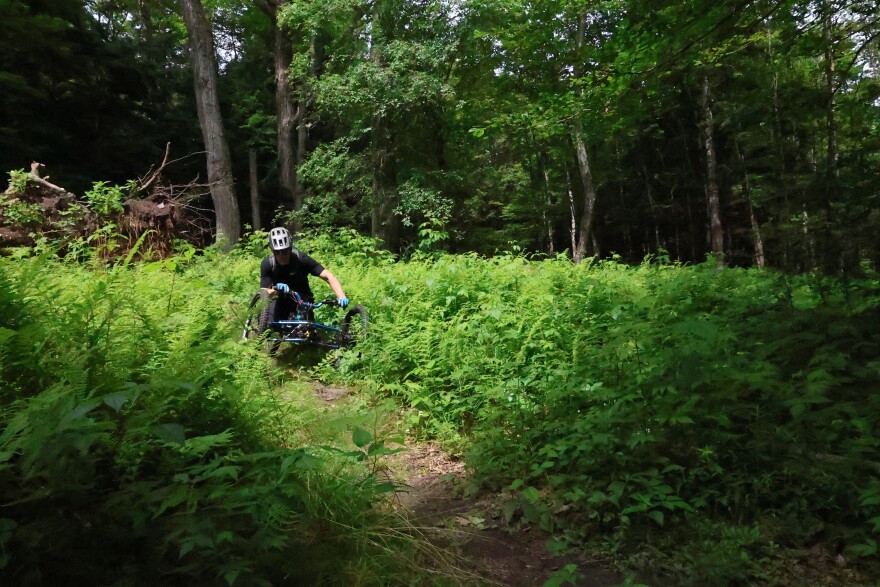
Louis Arevalo of Essex Junction is one of several adaptive athletes helping with that, most recently on some slightly overgrown trails in the Randolph Town Forest.
Zoe McDonald
/
Vermont Public
Arevalo was paralyzed in a skiing accident six years ago. An avid mountain biker before, he now rides a recumbent-style three wheeler that sits low to the ground. Arevalo pedals and steers with his arms, and gets a boost from an electric motor.
“Once you realize what these bikes are capable (of) or this equipment actually opens up, it kind of blows your mind,” he said.
But adaptive rigs like Arevalo’s are wider and heavier than regular mountain bikes, and not all trails are user-friendly.

Zoe McDonald
/
Vermont Public

Zoe McDonald
/
Vermont Public
Nick Bennette, who tested a different type of adaptive bike that day, got hung up on several tight turns.
Bennette is executive director of the Vermont Mountain Bike Association, another nonprofit spearheading efforts around the Velomont. He and others involved in the assessment have been taking detailed notes on ways to make the trails more accessible.
“Just scalloping out a bit of material on the outside of that corner,” said Bennette, pointing to the area the bike got caught. “That will allow adaptive bikes to make that corner without really changing the way the trail rides.”
This type of work is not just happening on the trails. Organizers are also trying to reduce barriers at overnight accommodations along the network.

Zoe McDonald
/
Vermont Public
This summer, contractors are turning an old office building near the trail in downtown Randolph into an ADA accessible hostel. And two remote huts along the trail in Stratton and Chittenden will have locked sheds with off-road wheelchairs so bikers don’t have to haul their own.
At the Chittenden Brook Hut, McCusker highlighted a new ramp and wider driveway.
“So if you’re an adaptive rider, you can imagine rolling right up here and you can transfer to your chair that’s available here, and then roll down the ramp and go down to the fireplace, to the privy, to make your meal,” he said.

Zoe McDonald
/
Vermont Public
Louis Arevalo stayed at the hut last summer with other adaptive riders — his first camping trip since his accident.
“It was really refreshing to have easy access to a beautifully built hut that was easy to navigate, and then have these world-class trails right out the door,” he said. “And with these Velomont trails, I can actually plan a hut-to-hut trip with other people.”
Jeff Alexander is counting on it. He’s director of strategic partnerships with Vermont Adaptive Ski and Sports, a nonprofit that helps people with disabilities access outdoor recreation.
An economic impact analysis the group commissioned estimates their programming generated more than $10 million last year.
“So the adaptive community has money, they travel, they want to travel and they want to play with everybody,” Alexander said. “We just need to level the playing field so that everyone can play together.”
Zoe Mcdonald
/
Vermont Public

RUTLAND, Vt. (WCAX) – Vermont State Police are asking the public for help locating a 71-year-old Rutland man who has not been seen since Thursday evening.
Mark P. Herring was last seen between 6:30 and 7 p.m. on July 2. He was last connected to the area around Coolidge State Park Road in Plymouth but is believed to have returned to Rutland City.
Investigators said the circumstances do not appear suspicious, but they are concerned about Herring’s health.
Anyone who has seen Herring or knows his whereabouts is asked to contact the Vermont State Police Rutland Barracks.
Copyright 2026 WCAX. All rights reserved.
Preliminary Hearing for Man Accused of Killing Charlie Kirk Starts in Utah

What a divorce coach wishes couples knew before ending a marriage


Hoto’s PixelDrive screwdriver is down to $60, matching its best price


Cuba plunges into third major blackout this year as power crisis worsens


Top Platner ally turns on him after bombshell rape allegation rocks campaign: ‘Red line’


Experimental vaccine shows promise against dangerous intestinal illness


England’s Jordan Henderson officially ruled out after freak fall causes fracture, opts for surgery


Starship delivery robots leave campuses for cities

