Vermont
USDA to provide $31.7M flood relief to Vermont farmers – Valley News


Vermont farmers impacted by sweeping floods in 2023 and 2024 will receive more than $30 million in specialized relief funding from the U.S. Department of Agriculture, the office of U.S. Sen. Peter Welch, D-Vt., confirmed Wednesday.
In a Senate committee hearing on Wednesday with Agriculture Secretary Brooke Rollins, Welch asked for an update on the status of the more than $62 million the state had requested from the USDA.
“We signed Vermont yesterday,” Rollins said, regarding the $31.7 million that was secured through a disaster assistance block grant.
The state received confirmation of the funding Tuesday evening, according to a Welch spokesperson who deferred to the state on when the funds will be made available.
The $31.7 million will go toward flood relief, specifically for farmers who have limited access to Federal Emergency Management Agency funds. The funding will support farmers who have faced infrastructure damage, flood-related losses or market losses.
Wednesday’s announcement came after Tuesday’s word of $4 million in FEMA funds for the Vermont Studio Center, the Vermont Agency of Transportation, and the Washington Electric Cooperative to support flood recovery and restoration.
“As a member of the Agriculture Committee, I worked across the aisle to secure this dedicated funding for small states like Vermont, and am encouraged to hear directly from Secretary Rollins that millions will soon be headed our way,” Welch wrote in a Wednesday statement to VtDigger about the USDA funding.
Anson Tebbetts, Vermont’s secretary of agriculture, food and markets, told VtDigger that the grant will be administered to his agency to “sustain damages” for the severe weather losses in 2023 and 2024, including two significant floods and a hard frost.
Tebbetts added that Gov. Phil Scott helped ensure the funding, along with Welch, in his role as co-chair of the National Governors Association’s Public Health and Disaster Response Task Force.
Douglas Farnham, the state’s chief recovery officer, also welcomed news of the funding. “I think this is an excellent award that we’re very grateful for,” he told VtDigger. “I know that our agency’s been working with the federal agency for months to get this right, and we’re really happy to be moving forward with it.”
Farnham said the next step is for the state’s Office of Disaster Recovery to get authorization from the Vermont Legislative Joint Fiscal Committee to accept the USDA award.
“I think they’ll be excited about it as well, so I don’t see any challenges there, right?” he said. “We just need to make sure they’re aware of it and approve it.”
Farnham confirmed that all parts of the award are designed to help farmers, specifically to address crop losses incurred in 2023.
Back-to-back summer floods in 2023 and 2024 devastated communities across Vermont, swamping towns, destroying homes and businesses, and causing nearly $1 billion in damage to public infrastructure.
For farmers, the U.S. Department of Agriculture’s primary relief tool at the time was not grants, but emergency loans that carried interest. Then-Agriculture Secretary Tom Vilsack’s disaster designation for all of Vermont’s 14 counties came nearly two months after the 2023 floods.
A second disaster declaration followed the 2024 floods. But the direct, interest-free aid required action by Congress, which came in the form of a disaster relief package lawmakers passed in December of that year. A state analysis has found Vermont faces more than $350 million in unmet needs from the 2023 storm alone.
Still unresolved is the second half of the $62 million that Vermont had requested from the USDA Rural Development Disaster Assistance Fund, roughly $31 million that Rollins did not confirm on Wednesday. Welch asked whether both pots were “on track for deployment quite soon,” and Rollins committed only to the block grant.
“We don’t have word on the other money ($31 million), which is more focused on wastewater facilities and municipal community facilities like municipally owned buildings,” Farnham said. “I think we’re still trying to figure out what the status of that is.”
Tebbetts added that the state is developing an application for farmers to receive the funds, as well as outreach materials for when it’s finalized.
“There’ll be some time for producers and farmers to apply, and when they apply, we’ll review the applications, and then start sending money to those eligible farmers and producers,” Tebbetts said.
This story was republished with permission from VtDigger, which offers its reporting at no cost to local news organizations through its Community News Sharing Project. To learn more, visit vtdigger.org/community-news-sharing-project.



Powerball, Mega Millions jackpots: What to know in case you win
Here’s what to know in case you win the Powerball or Mega Millions jackpot.
Just the FAQs, USA TODAY
The Vermont Lottery offers several draw games for those willing to make a bet to win big.
Those who want to play can enter the MegaBucks and Lucky for Life games as well as the national Powerball and Mega Millions games. Vermont also partners with New Hampshire and Maine for the Tri-State Lottery, which includes the Mega Bucks, Gimme 5 as well as the Pick 3 and Pick 4.
Drawings are held at regular days and times, check the end of this story to see the schedule.
Here’s a look at July 6, 2026, results for each game:
Winning Powerball numbers from July 6 drawing
17-44-63-66-67, Powerball: 04, Power Play: 2
Check Powerball payouts and previous drawings here.
Winning Gimme 5 numbers from July 6 drawing
04-12-30-34-38
Check Gimme 5 payouts and previous drawings here.
Winning Pick 3 numbers from July 6 drawing
Day: 5-7-2
Evening: 5-7-8
Check Pick 3 payouts and previous drawings here.
Winning Pick 4 numbers from July 6 drawing
Day: 7-9-1-6
Evening: 9-8-4-1
Check Pick 4 payouts and previous drawings here.
Winning Megabucks Plus numbers from July 6 drawing
01-06-24-32-37, Megaball: 04
Check Megabucks Plus payouts and previous drawings here.
Winning Millionaire for Life numbers from July 6 drawing
02-08-32-54-56, Bonus: 03
Check Millionaire for Life payouts and previous drawings here.
Feeling lucky? Explore the latest lottery news & results
Are you a winner? Here’s how to claim your lottery prize
For Vermont Lottery prizes up to $499, winners can claim their prize at any authorized Vermont Lottery retailer or at the Vermont Lottery Headquarters by presenting the signed winning ticket for validation. Prizes between $500 and $5,000 can be claimed at any M&T Bank location in Vermont during the Vermont Lottery Office’s business hours, which are 8a.m.-4p.m. Monday through Friday, except state holidays.
For prizes over $5,000, claims must be made in person at the Vermont Lottery headquarters. In addition to signing your ticket, you will need to bring a government-issued photo ID, and a completed claim form.
All prize claims must be submitted within one year of the drawing date. For more information on prize claims or to download a Vermont Lottery Claim Form, visit the Vermont Lottery’s FAQ page or contact their customer service line at (802) 479-5686.
Vermont Lottery Headquarters
1311 US Route 302, Suite 100
Barre, VT
05641
When are the Vermont Lottery drawings held?
- Powerball: 10:59 p.m. Monday, Wednesday, and Saturday.
- Mega Millions: 11 p.m. Tuesday and Friday.
- Gimme 5: 6:55 p.m. Monday through Friday.
- Lucky for Life: 10:38 p.m. daily.
- Pick 3 Day: 1:10 p.m. daily.
- Pick 4 Day: 1:10 p.m. daily.
- Pick 3 Evening: 6:55 p.m. daily.
- Pick 4 Evening: 6:55 p.m. daily.
- Megabucks: 7:59 p.m. Monday, Wednesday and Saturday.
- Millionaire for Life: 11:15 p.m. daily
What is Vermont Lottery Second Chance?
Vermont’s 2nd Chance lottery lets players enter eligible non-winning instant scratch tickets into a drawing to win cash and/or other prizes. Players must register through the state’s official Lottery website or app. The drawings are held quarterly or are part of an additional promotion, and are done at Pollard Banknote Limited in Winnipeg, MB, Canada.
This results page was generated automatically using information from TinBu and a template written and reviewed by a Vermont editor. You can send feedback using this form.

Authorities have identified the girl and her older brother who died in a Vermont river after going missing last week.
Sandro Lala, 25, had jumped into the Lamoille River to save his sister, 11-year-old Yazmin Yupangui, when she fell into the Lamoille River near Arrowhead Mountain Lake in Georgia, Vermont, on Wednesday, according to the Vermont State Police.
Autopsies determined that the siblings, who both lived in Cambridge, Vermont, died in accidental drownings, according to police.
Yazmin’s body was found Thursday by a police underwater recovery team, while Lala’s body was found in Arrowhead Mountain Lake on Saturday morning.
Police had previously said a group of relatives were fishing along the shore when a young girl fell into the water, and a man jumped in to try to rescue her. Neither resurfaced after that, prompting a large search, including multiple agencies, on the water near where Lamoille River empties into the lake.

Mountain bike enthusiasts have been working for years on an ambitious 485-mile multi-use trail known as the Velomont that will span the length of Vermont.
When finished, the collaborative project will knit together existing trail networks, connect 27 communities, and include 30 new huts and five downtown hostels for overnight stays.
New trail construction is finally ramping up after years spent on permits, plans and public input. And organizers say they’re focused on ensuring the Velomont is accessible for everyone.
“For us, it’s not a huge lift to just be mindful when we’re trying to build trail or improve trail to think about the adaptive rider,” said Angus McCusker, the Velomont trail director with the nonprofit Vermont Huts and Trails.
McCusker is referring to the growing number of athletes with disabilities who mountain bike with specially designed equipment.
“The challenge,” he said, “is we’re connecting to existing trail networks that were never intended for adaptive bikes. So, where we can, we’re trying to do adaptive assessments.”
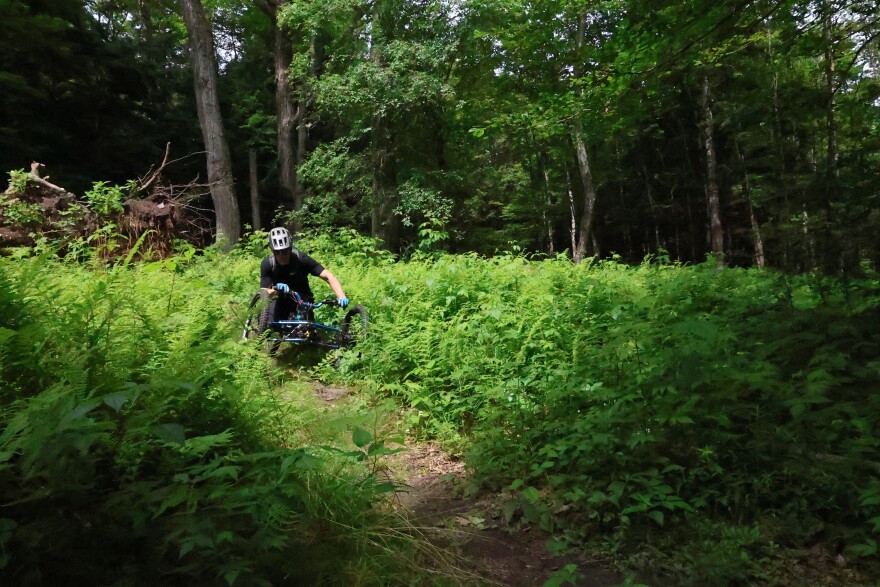
Louis Arevalo of Essex Junction is one of several adaptive athletes helping with that, most recently on some slightly overgrown trails in the Randolph Town Forest.
Zoe McDonald
/
Vermont Public
Arevalo was paralyzed in a skiing accident six years ago. An avid mountain biker before, he now rides a recumbent-style three wheeler that sits low to the ground. Arevalo pedals and steers with his arms, and gets a boost from an electric motor.
“Once you realize what these bikes are capable (of) or this equipment actually opens up, it kind of blows your mind,” he said.
But adaptive rigs like Arevalo’s are wider and heavier than regular mountain bikes, and not all trails are user-friendly.

Zoe McDonald
/
Vermont Public

Zoe McDonald
/
Vermont Public
Nick Bennette, who tested a different type of adaptive bike that day, got hung up on several tight turns.
Bennette is executive director of the Vermont Mountain Bike Association, another nonprofit spearheading efforts around the Velomont. He and others involved in the assessment have been taking detailed notes on ways to make the trails more accessible.
“Just scalloping out a bit of material on the outside of that corner,” said Bennette, pointing to the area the bike got caught. “That will allow adaptive bikes to make that corner without really changing the way the trail rides.”
This type of work is not just happening on the trails. Organizers are also trying to reduce barriers at overnight accommodations along the network.

Zoe McDonald
/
Vermont Public
This summer, contractors are turning an old office building near the trail in downtown Randolph into an ADA accessible hostel. And two remote huts along the trail in Stratton and Chittenden will have locked sheds with off-road wheelchairs so bikers don’t have to haul their own.
At the Chittenden Brook Hut, McCusker highlighted a new ramp and wider driveway.
“So if you’re an adaptive rider, you can imagine rolling right up here and you can transfer to your chair that’s available here, and then roll down the ramp and go down to the fireplace, to the privy, to make your meal,” he said.

Zoe McDonald
/
Vermont Public
Louis Arevalo stayed at the hut last summer with other adaptive riders — his first camping trip since his accident.
“It was really refreshing to have easy access to a beautifully built hut that was easy to navigate, and then have these world-class trails right out the door,” he said. “And with these Velomont trails, I can actually plan a hut-to-hut trip with other people.”
Jeff Alexander is counting on it. He’s director of strategic partnerships with Vermont Adaptive Ski and Sports, a nonprofit that helps people with disabilities access outdoor recreation.
An economic impact analysis the group commissioned estimates their programming generated more than $10 million last year.
“So the adaptive community has money, they travel, they want to travel and they want to play with everybody,” Alexander said. “We just need to level the playing field so that everyone can play together.”
Zoe Mcdonald
/
Vermont Public
-

 Movie Reviews5 minutes ago
Gail Daughtry and the Celebrity Sex Pass (2026) | Movie Review | Deep Focus Review
-
 Lifestyle55 minutes ago
10 new books you won’t want to miss in July
-

 Technology1 hour ago
Discord accidentally banned over 8,000 people for posting grids and other ‘benign’ images
-

 World1 hour ago
Video shows bomb rock Damascus hotel where French President Macron is staying during Syrian state visit
-

 Politics1 hour ago
Trump could hand prized stealth jets to NATO ally once seen as alliance headache
-

 Health1 hour ago
Common gym supplement could help fight depression, new research suggests
-

 Sports1 hour ago
SJSU was told of decades-old allegations against volleyball coach during controversial 2024 season
-
 Business2 hours ago
Commentary: How right-wing anti-transgender attacks led to a Supreme Court ruling upholding sex discrimination

