Vermont
The James Beard effect: Restaurant awards come with lots of excitement, some challenges


The owners of the Randolph restaurant Saap traveled to Chicago in the spring of 2022 to attend the James Beard Awards. The Northern Thai eatery’s chef, Nisachon “Rung” Morgan, was nominated for Best Chef: Northeast by the annual awards honoring the American hospitality industry.
Morgan won. By the time she and her husband, Steve Morgan, returned to central Vermont, their business and their lives had changed.
“We came back from Chicago,” according to Steve Morgan, “and there were 67 messages on my phone.” Most of those messages were for reservations in the 60-seat dining room. Revenue at Saap soared 300% after the restaurant won the award.
The Morgans were and remain ecstatic to have won. But soon after winning, what might qualify as good problems started to settle in.
Saap had to turn away potential customers “right and left,” Morgan said, as diners were suddenly drawn in droves to their prize-winning restaurant. Sometimes, he said, Saap had to stop accepting takeout orders because the dining room was full and the small staff was stretched thin. Morgan said that on a couple of occasions, Saap made the mistake of overbooking the dining room, making customers wait longer than they should have.
“There’s obviously cons to everything,” according to Matthew Peterson, owner of May Day, a restaurant in the Old North End of Burlington whose chef, Avery Buck, is nominated this year in the Best Chef: Northeast category. The restaurant finds out April 2 if it and other Vermont semifinalists advance to the finals, with overall winners announced June 16.
May Day’s previous chef, Mojo Hancy-Davis, was a semifinalist for Best Chef: Northeast two years ago. Despite recognizing there are cons to everything, Peterson sees almost nothing but positives in being a nominee in the most prestigious hospitality award competition in the country.
“Two separate chefs (nominations) in three years feels more like a holistic representation of what we’re doing here,” Peterson said.
The James Beard ‘bump’
Peterson admits he didn’t take full advantage of Hancy-Davis’ nomination in 2023. May Day closed temporarily for previously planned renovations three days after the nod was announced. Any James Beard “bump,” as Peterson called it, passed May Day by.
“I didn’t necessarily know how to leverage that as an owner,” he said.
Months after that nomination, Hancy-Davis bought the Henry Street Deli in Burlington and left to run that business.
“It took the wind out of my sails a little bit,” Peterson said. Soon, though, he soon landed Buck, with whom he had worked at Hen of the Wood, which has restaurants in Burlington and Waterbury and has been nominated for multiple James Beard prizes over the years.
The wind is back in Peterson’s sails now that Buck, like Hancy-Davis, is a James Beard nominee. “It feels very validating to have another chef get that,” he said.
Peterson feels he’s better at leveraging the honor to benefit May Day. After learning of Buck’s nomination, he reached out to Hello Burlington, a website that highlights the city’s restaurants and events. The night a video about May Day went live on that website, Peterson said customers came into his homey North Winooski Avenue eatery saying they had just seen the video.
“There has been a bump for sure,” according to Peterson, who said the nomination that mentions Buck by name is about more than one person. “It just feels like a whole team working together.”
‘A monumental moment’
Christian Kruse felt the bump when he was a semifinalist for Best Chef: Northeast in 2022, the same year Morgan at Saap won. At the time, he was chef at Black Flannel Brewing & Distilling in Essex.
“It certainly was a monumental moment to me,” said Kruse, who left Black Flannel to work at The Big Spruce and Hatchet Tavern in Richmond, which have since closed. “It’s certainly something that I’ve worked hard to try to achieve. It is the Oscars of the hospitality industry. Any chef/owner/whatever that’s been working hard in their field and doing their craft, I think it’s something they want to achieve.”
Kruse is seeking investors to help fund his own restaurant in The Big Spruce location.
“It’s an accolade that really opens the door to have conversations with people,” he said.
An invitation from Kamala Harris
Kruse, Peterson and Morgan all mentioned the same relatively minor negative aspect of being a James Beard Award nominee. It isn’t so much about the impact it has on the restaurant as the impact on the customer.
“People come in with a different expectation once you’ve won a James Beard Award,” according to Morgan. He said some customers think of the awards as honoring only elegant dining rooms with linen on the tables, or French- or Italian-trained chefs unlike his wife who’s cooking elevated versions of Thai food from her homeland.
Once those customers taste the food at Saap, Morgan said, their response is usually something like “Oh, I get it now.” He noted that the year Saap won was when the James Beard Foundation started recognizing more diverse cuisine than it had before; customers had not yet adjusted to that new way of thinking about the nominations.
“The (James Beard) Foundation is broadening the scope of what good food looks like,” according to Peterson of May Day.
Kruse heard comments from Black Flannel customers about a brewpub not being what they expected for such a prestigious nomination. He noted that one of this year’s nominees, Canteen Creemee – which dispenses ice cream and fried chicken from a takeout space in a Waitsfield shopping plaza – isn’t known for impeccable service but for its creative, innovative offerings.
Peterson said his restaurant that aims for “fun, approachable food” has had “self-proclaimed foodies” come in expecting the elegance they might find in Boston or New York.
“We get a lot of that,” Peterson said of “self-proclaimed foodies.” That just encourages him and his staff to rise to the occasion.
“I like high expectations,” Peterson said, especially when the crew at May Day delivers what the customer wants.
A James Beard nomination does set a restaurant up for closer scrutiny, according to Morgan. “It kind of puts a bullseye on your back,” he said.
But the award also set Saap up for opportunities it might not have otherwise had. Just before President Biden left office in January, Morgan said Saap was invited to an Asian-heritage celebration at the home of then-Vice President Kamala Harris in Washington, D.C. Restaurants representing the cuisine of 25 countries served small plates that night, and Morgan said Saap likely would not have been included had it not won a James Beard Award three years ago.
“It’s been quite the crazy ride,” he said.
And the nominees are…
This year’s Vermont semifinalists for the James Beard Award (finalists to be announced April 2):
- Outstanding Restaurateurs: Cara Chigazola-Tobin and Allison Gibson, Honey Road and The Grey Jay, Burlington
- Outstanding Bar: Wolf Tree, White River Junction
- Best Chef, Northeast: Avery Buck, May Day, Burlington; Charlie Menard, Canteen Creemee, Waitsfield
www.jamesbeard.org
Contact Brent Hallenbeck at bhallenbeck@freepressmedia.com.



Authorities have identified the girl and her older brother who died in a Vermont river after going missing last week.
Sandro Lala, 25, had jumped into the Lamoille River to save his sister, 11-year-old Yazmin Yupangui, when she fell into the Lamoille River near Arrowhead Mountain Lake in Georgia, Vermont, on Wednesday, according to the Vermont State Police.
Autopsies determined that the siblings, who both lived in Cambridge, Vermont, died in accidental drownings, according to police.
Yazmin’s body was found Thursday by a police underwater recovery team, while Lala’s body was found in Arrowhead Mountain Lake on Saturday morning.
Police had previously said a group of relatives were fishing along the shore when a young girl fell into the water, and a man jumped in to try to rescue her. Neither resurfaced after that, prompting a large search, including multiple agencies, on the water near where Lamoille River empties into the lake.

Mountain bike enthusiasts have been working for years on an ambitious 485-mile multi-use trail known as the Velomont that will span the length of Vermont.
When finished, the collaborative project will knit together existing trail networks, connect 27 communities, and include 30 new huts and five downtown hostels for overnight stays.
New trail construction is finally ramping up after years spent on permits, plans and public input. And organizers say they’re focused on ensuring the Velomont is accessible for everyone.
“For us, it’s not a huge lift to just be mindful when we’re trying to build trail or improve trail to think about the adaptive rider,” said Angus McCusker, the Velomont trail director with the nonprofit Vermont Huts and Trails.
McCusker is referring to the growing number of athletes with disabilities who mountain bike with specially designed equipment.
“The challenge,” he said, “is we’re connecting to existing trail networks that were never intended for adaptive bikes. So, where we can, we’re trying to do adaptive assessments.”
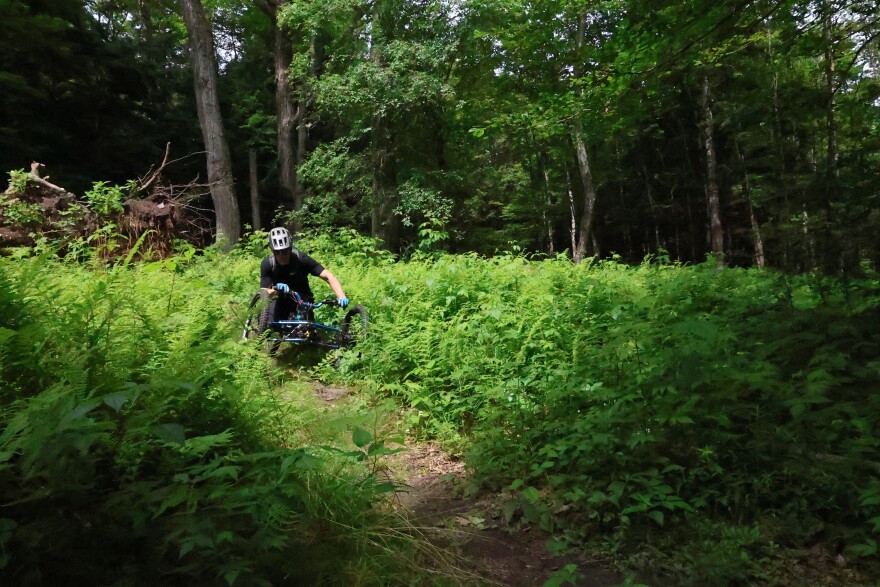
Louis Arevalo of Essex Junction is one of several adaptive athletes helping with that, most recently on some slightly overgrown trails in the Randolph Town Forest.
Zoe McDonald
/
Vermont Public
Arevalo was paralyzed in a skiing accident six years ago. An avid mountain biker before, he now rides a recumbent-style three wheeler that sits low to the ground. Arevalo pedals and steers with his arms, and gets a boost from an electric motor.
“Once you realize what these bikes are capable (of) or this equipment actually opens up, it kind of blows your mind,” he said.
But adaptive rigs like Arevalo’s are wider and heavier than regular mountain bikes, and not all trails are user-friendly.

Zoe McDonald
/
Vermont Public

Zoe McDonald
/
Vermont Public
Nick Bennette, who tested a different type of adaptive bike that day, got hung up on several tight turns.
Bennette is executive director of the Vermont Mountain Bike Association, another nonprofit spearheading efforts around the Velomont. He and others involved in the assessment have been taking detailed notes on ways to make the trails more accessible.
“Just scalloping out a bit of material on the outside of that corner,” said Bennette, pointing to the area the bike got caught. “That will allow adaptive bikes to make that corner without really changing the way the trail rides.”
This type of work is not just happening on the trails. Organizers are also trying to reduce barriers at overnight accommodations along the network.

Zoe McDonald
/
Vermont Public
This summer, contractors are turning an old office building near the trail in downtown Randolph into an ADA accessible hostel. And two remote huts along the trail in Stratton and Chittenden will have locked sheds with off-road wheelchairs so bikers don’t have to haul their own.
At the Chittenden Brook Hut, McCusker highlighted a new ramp and wider driveway.
“So if you’re an adaptive rider, you can imagine rolling right up here and you can transfer to your chair that’s available here, and then roll down the ramp and go down to the fireplace, to the privy, to make your meal,” he said.

Zoe McDonald
/
Vermont Public
Louis Arevalo stayed at the hut last summer with other adaptive riders — his first camping trip since his accident.
“It was really refreshing to have easy access to a beautifully built hut that was easy to navigate, and then have these world-class trails right out the door,” he said. “And with these Velomont trails, I can actually plan a hut-to-hut trip with other people.”
Jeff Alexander is counting on it. He’s director of strategic partnerships with Vermont Adaptive Ski and Sports, a nonprofit that helps people with disabilities access outdoor recreation.
An economic impact analysis the group commissioned estimates their programming generated more than $10 million last year.
“So the adaptive community has money, they travel, they want to travel and they want to play with everybody,” Alexander said. “We just need to level the playing field so that everyone can play together.”
Zoe Mcdonald
/
Vermont Public

RUTLAND, Vt. (WCAX) – Vermont State Police are asking the public for help locating a 71-year-old Rutland man who has not been seen since Thursday evening.
Mark P. Herring was last seen between 6:30 and 7 p.m. on July 2. He was last connected to the area around Coolidge State Park Road in Plymouth but is believed to have returned to Rutland City.
Investigators said the circumstances do not appear suspicious, but they are concerned about Herring’s health.
Anyone who has seen Herring or knows his whereabouts is asked to contact the Vermont State Police Rutland Barracks.
Copyright 2026 WCAX. All rights reserved.
-

 Michigan6 minutes ago
J Batt still heading to Kentucky, which owes $5M buyout with Guskiewicz staying at MSU
-

 Massachusetts9 minutes ago
Another shark species off Massachusetts is taking striped bass from fishermen
-

 Minnesota14 minutes ago
1 arrested after shooting injures 32-year-old man in Oakdale
-

 Mississippi21 minutes ago
Mississippi Bar wants Jody Owens suspended from law after guilty plea
-

 Missouri24 minutes ago
Missouri cannabis workers notch union wins as organizing spreads
-

 Montana29 minutes ago
Flathead River to close temporarily for Sportsman’s Bridge beam work
-

 Nebraska36 minutes ago
Four former Nebraska men’s basketball players set for 2026 NBA Summer League
-

 Nevada39 minutes ago
U. Nevada Reno department merger will study social life via ‘intersectional, decolonial, humanistic’ lens | The College Fix

