Vermont
Blue Cross VT CEO: Progress has been made, but health care costs ‘simply unsustainable’


Blue Cross Blue Shield of Vermont CEO Don George has been ringing the alarm on the finances of the state’s largest health insurance provider since last July, when he sent an open letter via email describing Blue Cross VT’s “fragile financial situation.”
George said the insurer was being battered by escalating prices for hospital services and extraordinary markups in prescription medications, depleting its member reserves, driving up premiums and making health insurance all but unaffordable.
He said Blue Cross VT found itself in the “unprecedented position” of being forced to file an amended request to the Green Mountain Care Board for an additional 4% increase in contributions to its reserve fund, which comes from premiums paid by policy holders. The reserve fund is used to cover unexpected levels of claims, which Blue Cross VT was experiencing.
This week, George sent another open letter via email, thanking “stakeholders across Vermont” for the overwhelming response to his raising the alarm.
“We want to express our appreciation to our regulators, legislators, government and health care partners across the state for their willingness to advance difficult but meaningful changes for our health system,” George wrote.
Blue Cross VT would like to see revenue caps on hospital expenses
George outlined the steps that have been taken to stabilize Blue Cross VT and avert a crisis:
- Establishing, in coordination with the Vermont Department of Financial Regulation (DFR), a comprehensive capital recovery plan to ensure our long-term stability.
- Expanding the value of our Blue Cross Blue Shield of Michigan affiliation, a key enabler of our mission to make health care work better for all Vermonters.
- Reducing our financial risk in Vermont Blue Advantage, our Medicare Advantage plan.
- Limiting our already lean administrative expenses.
- Actively supporting legislation to protect our members and safeguard our position within the marketplace.
- Continuing to offer the highest quality health plans and customer service to our members.
- Proposing and supporting systemic changes in our healthcare system, including urging the Green Mountain Care Board to implement hospital/payer-specific revenue caps − an important step toward affordability.
High prices, sicker patients, more patients all lead to financial crisis for Blue Cross VT
Blue Cross VT’s financial challenges were a long time coming, according to George, who said high hospital prices, increased utilization, sicker patients and premiums insufficient to cover escalating claims, all spelled trouble.
“Additionally, we’ve seen an increase in members with complex care needs and catastrophic conditions,” George continued. “In 2024, 15% of our members met these criteria and accounted for 54% of total claims cost. We’re incredibly proud to support Vermonters who are most in need of care. The high costs of these claims, however, requires a significant and steady draw on our finances.”
In 2024, George said that Blue Cross VT’s member reserves fell to $58.4 million, with the inclusion of a $30 million loan, “triggering regulatory solvency oversight by the DFR.” As a result, the portion of member premiums placed into the reserve fund rose to 7%.
“The DFR will determine when we can return to normal funding levels,” George said.
We’ve made some progress, but health care costs remain alarmingly high
While there were some “positive developments” in the first quarter of 2025, George said the cost of care remains “alarmingly high.”
“We currently pay $35 million per week in claims for our members, an amount fueled by hospital and drug costs that show no sign of slowing,” he said. “The cost of healthcare is putting tremendous pressure on Vermonters − our people, our businesses and organizations that fund benefits, and our economy. It’s simply unsustainable.”
George called out a recent settlement between the UVM Health Network and the Green Mountain Care Board as a “chance to reset,” but not a solution to the rising trajectory of health care spending.
“The $12 million promised to Blue Cross VT to resolve 2022 and 2023 overcharges is an important step, however, these funds are not nearly enough to offset our $62.1 million loss in 2024 or the cumulative millions over the past three years,” George said. “More deliberate, long-term actions are required to limit pricing, curb unnecessary utilization and ensure long-term stability of our organization and our health system.”
Contact Dan D’Ambrosio at 660-1841 or ddambrosio@gannett.com. Follow him on Twitter @DanDambrosioVT.



Powerball, Mega Millions jackpots: What to know in case you win
Here’s what to know in case you win the Powerball or Mega Millions jackpot.
Just the FAQs, USA TODAY
The Vermont Lottery offers several draw games for those willing to make a bet to win big.
Those who want to play can enter the MegaBucks and Lucky for Life games as well as the national Powerball and Mega Millions games. Vermont also partners with New Hampshire and Maine for the Tri-State Lottery, which includes the Mega Bucks, Gimme 5 as well as the Pick 3 and Pick 4.
Drawings are held at regular days and times, check the end of this story to see the schedule.
Here’s a look at July 9, 2026, results for each game:
Winning Gimme 5 numbers from July 9 drawing
08-15-26-27-30
Check Gimme 5 payouts and previous drawings here.
Winning Pick 3 numbers from July 9 drawing
Day: 1-5-4
Evening: 6-2-8
Check Pick 3 payouts and previous drawings here.
Winning Pick 4 numbers from July 9 drawing
Day: 5-0-2-1
Evening: 2-6-7-6
Check Pick 4 payouts and previous drawings here.
Winning Millionaire for Life numbers from July 9 drawing
02-15-22-54-58, Bonus: 04
Check Millionaire for Life payouts and previous drawings here.
Feeling lucky? Explore the latest lottery news & results
Are you a winner? Here’s how to claim your lottery prize
For Vermont Lottery prizes up to $499, winners can claim their prize at any authorized Vermont Lottery retailer or at the Vermont Lottery Headquarters by presenting the signed winning ticket for validation. Prizes between $500 and $5,000 can be claimed at any M&T Bank location in Vermont during the Vermont Lottery Office’s business hours, which are 8a.m.-4p.m. Monday through Friday, except state holidays.
For prizes over $5,000, claims must be made in person at the Vermont Lottery headquarters. In addition to signing your ticket, you will need to bring a government-issued photo ID, and a completed claim form.
All prize claims must be submitted within one year of the drawing date. For more information on prize claims or to download a Vermont Lottery Claim Form, visit the Vermont Lottery’s FAQ page or contact their customer service line at (802) 479-5686.
Vermont Lottery Headquarters
1311 US Route 302, Suite 100
Barre, VT
05641
When are the Vermont Lottery drawings held?
- Powerball: 10:59 p.m. Monday, Wednesday, and Saturday.
- Mega Millions: 11 p.m. Tuesday and Friday.
- Gimme 5: 6:55 p.m. Monday through Friday.
- Lucky for Life: 10:38 p.m. daily.
- Pick 3 Day: 1:10 p.m. daily.
- Pick 4 Day: 1:10 p.m. daily.
- Pick 3 Evening: 6:55 p.m. daily.
- Pick 4 Evening: 6:55 p.m. daily.
- Megabucks: 7:59 p.m. Monday, Wednesday and Saturday.
- Millionaire for Life: 11:15 p.m. daily
What is Vermont Lottery Second Chance?
Vermont’s 2nd Chance lottery lets players enter eligible non-winning instant scratch tickets into a drawing to win cash and/or other prizes. Players must register through the state’s official Lottery website or app. The drawings are held quarterly or are part of an additional promotion, and are done at Pollard Banknote Limited in Winnipeg, MB, Canada.
This results page was generated automatically using information from TinBu and a template written and reviewed by a Vermont editor. You can send feedback using this form.
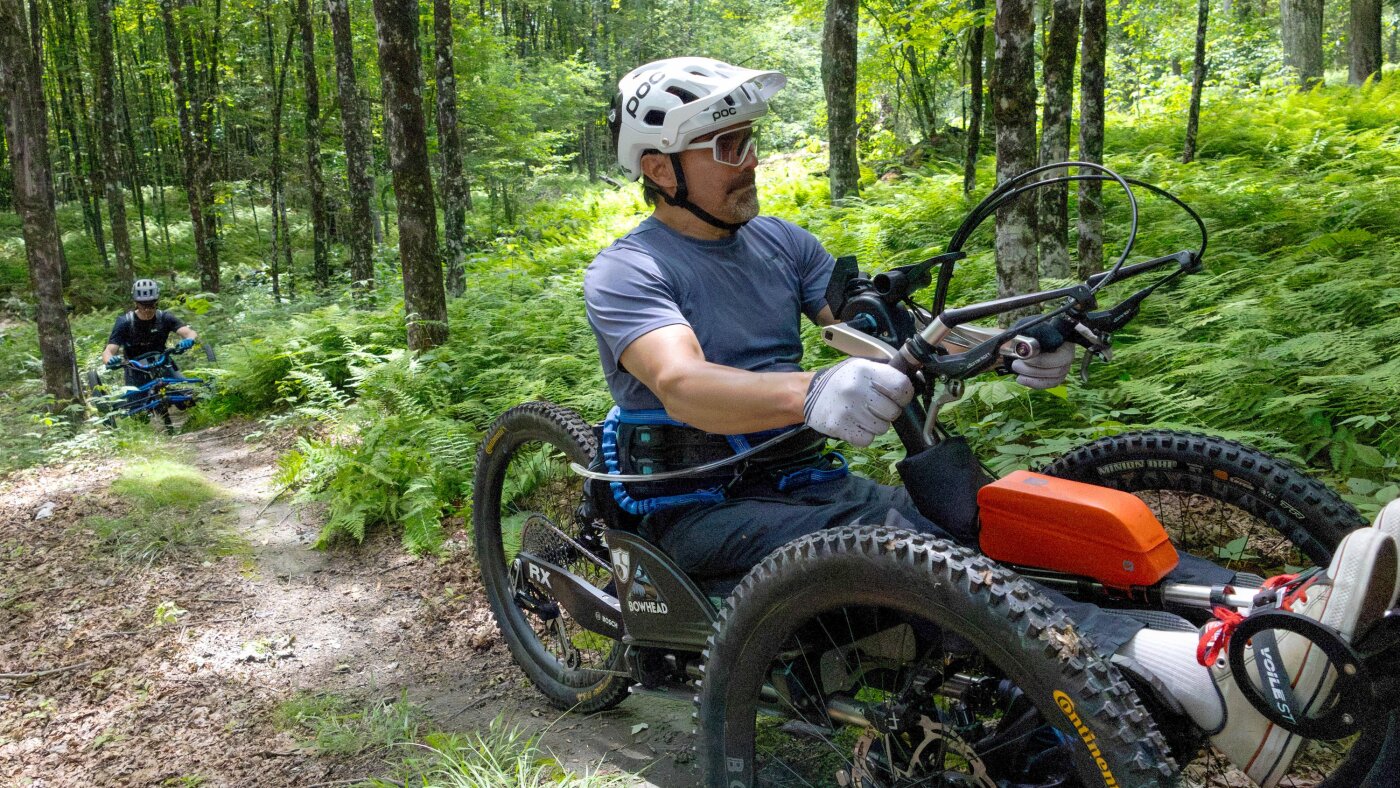
Louis Arevalo rides his adaptive mountain bike through the trails at Randolph Town Forest during an adaptive assessment on Thursday, June 25. Nick Bennette, with the Vermont Mountain Bike Association, rides behind.
Zoe McDonald/Vermont Public
hide caption
toggle caption
Zoe McDonald/Vermont Public
Mountain bike enthusiasts have been working for years on an ambitious 485-mile, multi-use trail called The Velomont that will span the length of the state.
When finished, the collaborative project will knit together existing trail networks, connect 27 communities and include huts and hostels for overnight stays.
New trail construction is finally ramping up after years spent on permits, plans and public input. And organizers say they want to make it as user-friendly as possible.
“For us, it’s not a huge lift to just be mindful when we’re trying to build trail or improve trail to think about the adaptive rider,” said Angus McCusker, the Velomont trail director with the nonprofit Vermont Huts and Trails.
McCusker is referring to the growing number of disabled athletes who mountain bike with specially designed equipment.
“The challenge,” said McCusker, “is we’re connecting to existing trail networks that were never intended for adaptive bikes. So, where we can, we’re trying to do adaptive assessments.”
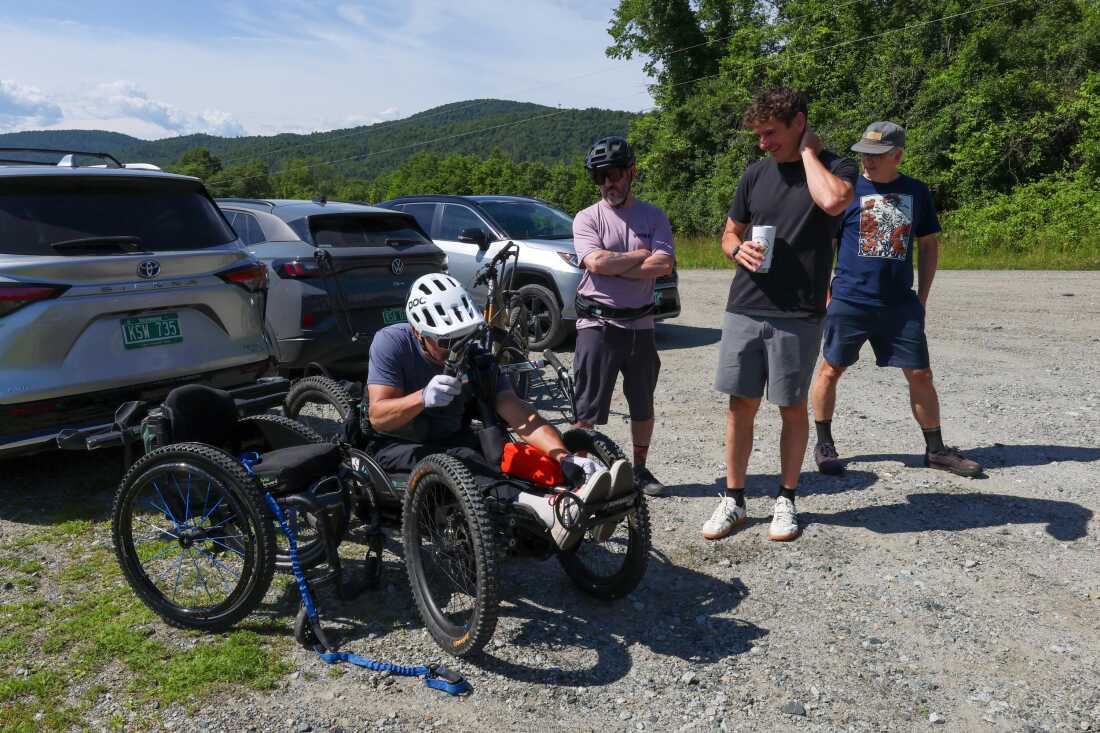
Louis Arevalo, left, straps into his adaptive mountain bike and chats with Jeff Dickson of the Vermont Mountain Bike Association, Angus McCusker with Vermont Huts and Trails, and volunteer Thatcher Hinman (all from left) ahead of a trail accessibility assessment in Randolph, Vermont, on Thursday, June 25, 2026.
Zoe McDonald/Vermont Public
hide caption
toggle caption
Zoe McDonald/Vermont Public
Louis Arevalo of Essex Junction is one of several adaptive athletes helping with that, most recently on some slightly overgrown single track trails in Randolph, a central Vermont town nestled along the eastern edge of the Green Mountains.
Arevalo pedals with his hands. He rides an electric powered recumbent-style three-wheeler that sits low to the ground. His service dog Azul chases along nearby.
“Once you realize what these bikes are capable (of) or this equipment actually opens up, it kind of blows your mind,” he said.
Arevalo was paralyzed in a skiing accident six years ago. Being able to get back on the trails has been a game changer, he said smiling.
“There’s a reason we live in the Green Mountain state. It’s because we like to get outside…you know, seeing the squirrels and chipmunks and birds… I mean, it’s life.”
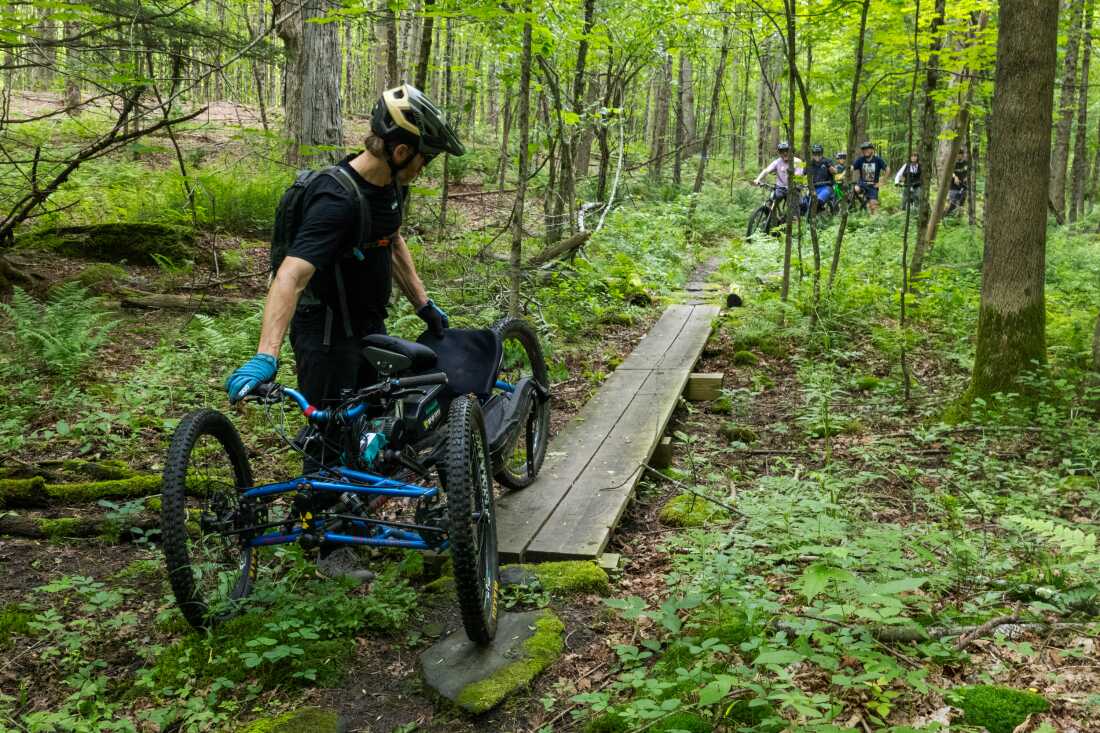
Nick Bennette, of the Vermont Mountain Biking Association, guides an adaptive bike over a narrow bridge, pointing out that other adaptive riders may have trouble getting across.
Zoe McDonald/Vermont Public
hide caption
toggle caption
Zoe McDonald/Vermont Public
But adaptive rigs like Arevalo’s are wider and heavier than regular mountain bikes, and not all trails are user-friendly.
Nick Bennette, who was testing a different type of adaptive bike, got hung up on several tight turns.
“It’s helpful to have different kinds of adaptive bikes on these tests because they all handle a little differently,” he said.
Bennette is executive director of the Vermont Mountain Bike Association, another nonprofit spearheading efforts around the Velomont. He and others involved in the assessment are taking detailed photos and notes on ways to make the trails more accessible.
“Just scalloping out a bit of material on the outside of that corner,” said Bennette, pointing to the area the bike got caught. “That will allow adaptive bikes to make that corner without really changing the way the trail rides.”
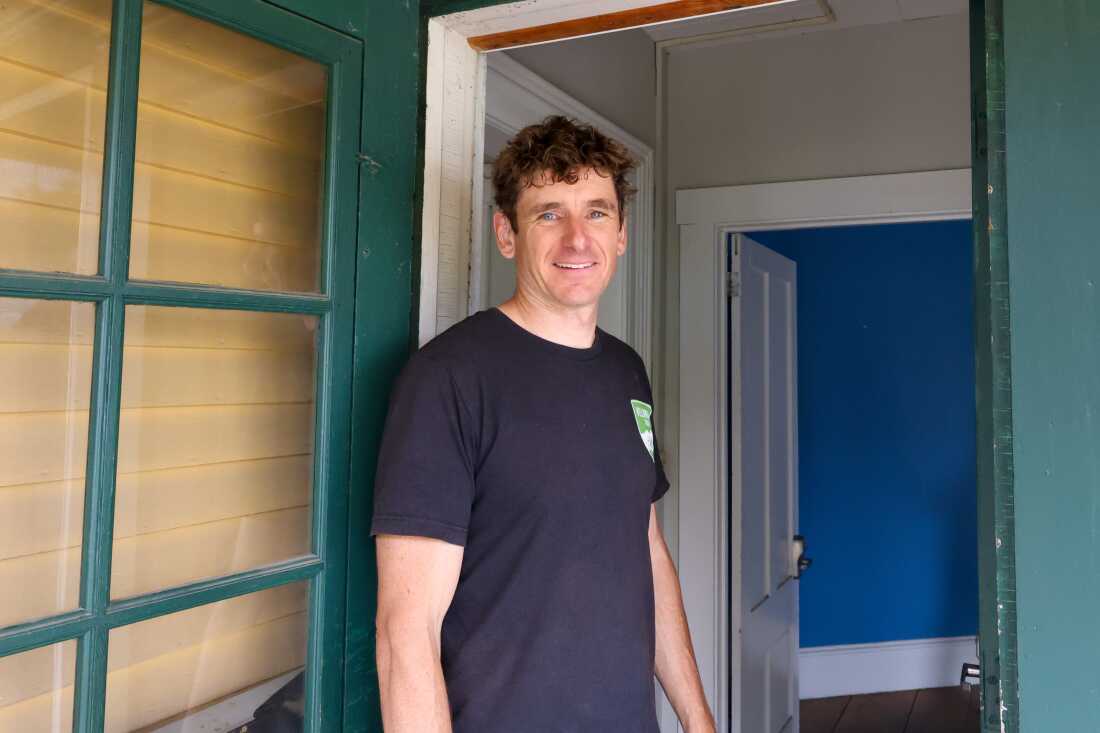
Angus McCusker with Vermont Huts and Trails is working to create accessible accommodations along the Velomont Trail, including a multi-group space in Randolph and a hut in Chittenden that has been outfitted with accessibility in mind.
Zoe McDonald/Vermont Public
hide caption
toggle caption
Zoe McDonald/Vermont Public
Contractors are also trying to reduce barriers at the trail’s overnight accommodations. This summer, contractors are building a new ADA accessible hostel in downtown Randolph.
And two remote huts along the trail will have locked sheds with off-road wheelchairs so bikers don’t have to haul their own.
At the Chittenden Brook Hut, McCusker highlighted a new ramp and wider driveway.
“So if you’re an adaptive rider, you can imagine rolling right up here and you can transfer to your chair that’s available here, and then roll down the ramp and go down to the fireplace, to the privy, to make your meal,” he said.
Louis Arevalo stayed at the hut last summer with other adaptive riders — his first camping trip since his accident.
“There was a babbling brook right there…and it was really refreshing to have easy access to a beautifully built hut that was easy to navigate, and then have these world-class trails right out the door,” he said. “And with these Velomont trails, I can actually plan a hut-to-hut trip with other people.”
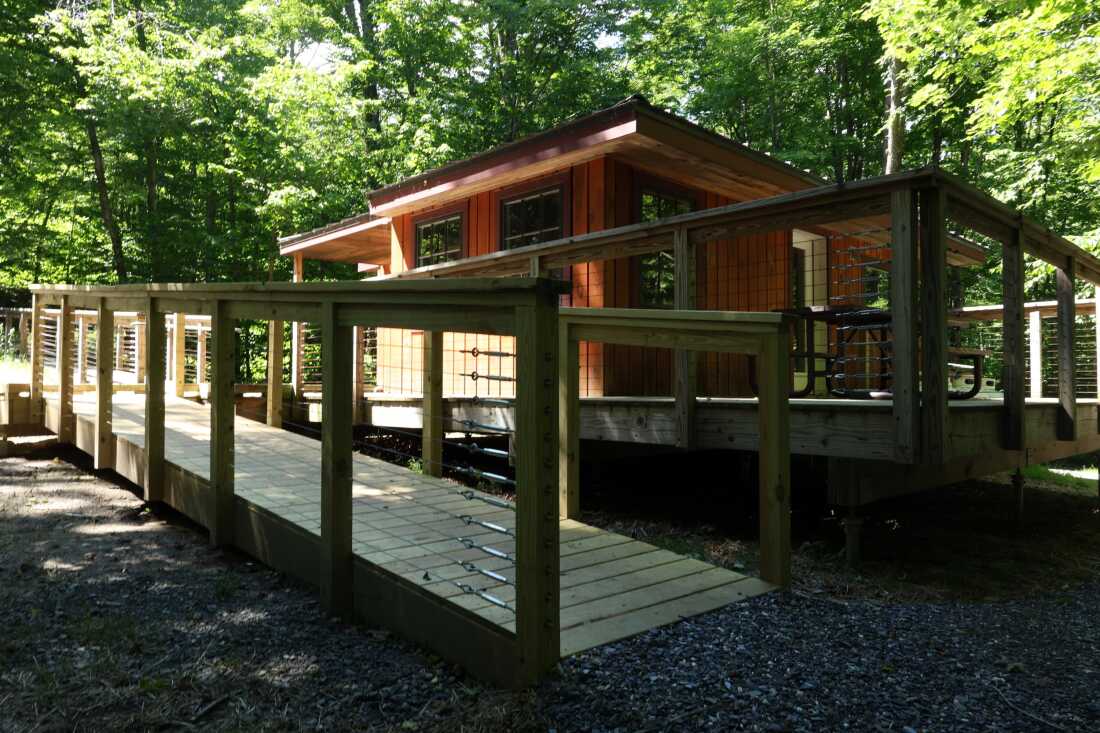
The Chittenden Brook Hut includes accessible ramps, storage for adaptive bikes and specialized off-road wheelchairs for visitors.
Zoe McDonald/Vermont Public
hide caption
toggle caption
Zoe McDonald/Vermont Public
Jeff Alexander is counting on it. He’s director of strategic partnerships with Vermont Adaptive Ski and Sports, a nonprofit that helps people with disabilities access outdoor recreation.
An economic impact analysis the group commissioned estimates their programming generated more than $10 million last year.
“So the adaptive community has money, they travel, they want to travel and they want to play with everybody,” Alexander said. “We just need to level the playing field so that everyone can play together.”
Powerball, Mega Millions jackpots: What to know in case you win
Here’s what to know in case you win the Powerball or Mega Millions jackpot.
Just the FAQs, USA TODAY
The Vermont Lottery offers several draw games for those willing to make a bet to win big.
Those who want to play can enter the MegaBucks and Lucky for Life games as well as the national Powerball and Mega Millions games. Vermont also partners with New Hampshire and Maine for the Tri-State Lottery, which includes the Mega Bucks, Gimme 5 as well as the Pick 3 and Pick 4.
Drawings are held at regular days and times, check the end of this story to see the schedule.
Here’s a look at July 8, 2026, results for each game:
Winning Powerball numbers from July 8 drawing
12-29-37-43-55, Powerball: 18, Power Play: 4
Check Powerball payouts and previous drawings here.
Winning Gimme 5 numbers from July 8 drawing
01-05-23-36-38
Check Gimme 5 payouts and previous drawings here.
Winning Pick 3 numbers from July 8 drawing
Day: 0-1-3
Evening: 2-4-0
Check Pick 3 payouts and previous drawings here.
Winning Pick 4 numbers from July 8 drawing
Day: 3-9-5-9
Evening: 9-2-0-9
Check Pick 4 payouts and previous drawings here.
Winning Megabucks Plus numbers from July 8 drawing
12-15-23-27-40, Megaball: 03
Check Megabucks Plus payouts and previous drawings here.
Winning Millionaire for Life numbers from July 8 drawing
16-18-43-48-50, Bonus: 01
Check Millionaire for Life payouts and previous drawings here.
Feeling lucky? Explore the latest lottery news & results
Are you a winner? Here’s how to claim your lottery prize
For Vermont Lottery prizes up to $499, winners can claim their prize at any authorized Vermont Lottery retailer or at the Vermont Lottery Headquarters by presenting the signed winning ticket for validation. Prizes between $500 and $5,000 can be claimed at any M&T Bank location in Vermont during the Vermont Lottery Office’s business hours, which are 8a.m.-4p.m. Monday through Friday, except state holidays.
For prizes over $5,000, claims must be made in person at the Vermont Lottery headquarters. In addition to signing your ticket, you will need to bring a government-issued photo ID, and a completed claim form.
All prize claims must be submitted within one year of the drawing date. For more information on prize claims or to download a Vermont Lottery Claim Form, visit the Vermont Lottery’s FAQ page or contact their customer service line at (802) 479-5686.
Vermont Lottery Headquarters
1311 US Route 302, Suite 100
Barre, VT
05641
When are the Vermont Lottery drawings held?
- Powerball: 10:59 p.m. Monday, Wednesday, and Saturday.
- Mega Millions: 11 p.m. Tuesday and Friday.
- Gimme 5: 6:55 p.m. Monday through Friday.
- Lucky for Life: 10:38 p.m. daily.
- Pick 3 Day: 1:10 p.m. daily.
- Pick 4 Day: 1:10 p.m. daily.
- Pick 3 Evening: 6:55 p.m. daily.
- Pick 4 Evening: 6:55 p.m. daily.
- Megabucks: 7:59 p.m. Monday, Wednesday and Saturday.
- Millionaire for Life: 11:15 p.m. daily
What is Vermont Lottery Second Chance?
Vermont’s 2nd Chance lottery lets players enter eligible non-winning instant scratch tickets into a drawing to win cash and/or other prizes. Players must register through the state’s official Lottery website or app. The drawings are held quarterly or are part of an additional promotion, and are done at Pollard Banknote Limited in Winnipeg, MB, Canada.
This results page was generated automatically using information from TinBu and a template written and reviewed by a Vermont editor. You can send feedback using this form.
-

 South-Carolina3 minutes ago
South Carolina Lottery Pick 3, Pick 4 results for July 9, 2026
-

 South Dakota10 minutes ago
Iverson Ford Welcomes the 2027 Ford Expedition to Drivers Across Eastern South Dakota
-

 Tennessee13 minutes ago
Tennessee Highway Patrol holds open house at Jackson district office
-

 Texas25 minutes ago
Longhorns Daily News: Texas coach Steve Sarkisian named among Dodd Trophy watch list
-

 Utah27 minutes ago
Utah Jazz vs Washington Wizards recap: Darryn Peterson is only a man
-
Vermont33 minutes ago
VT Lottery Gimme 5, Pick 3 results for July 9, 2026
-

 Virginia40 minutes ago
Virginia cannabis budget language triggers legal confusion, political fallout
-

 Washington43 minutes ago
Trump’s proposed 250ft Washington arch clears key planning hurdle

