Northeast
Two former NCAA wrestlers among those arrested in alleged mafia-led New Jersey sports gambling ring

NEWYou can now listen to Fox News articles!
Among the 14 people arrested Thursday for their alleged involvement in an illegal sports gambling ring were two former wrestlers at Rutgers University.
Nicholas Raimo, 25, and Michael Cetta, 23, were identified as alleged sub-agents of the ring that was allegedly operated by Joseph M. “Little Joe” Perna, identified as a member of the Lucchese crime family.
Raimo was a two-time state champion at Hanover Park High School and previously wrestled at Arizona State before transferring closer to home. He never competed as a Scarlet Knight, however, missing out on the 2021-22 season due to injury. He went 132-5 in his high school career, according to Arizona State’s website.
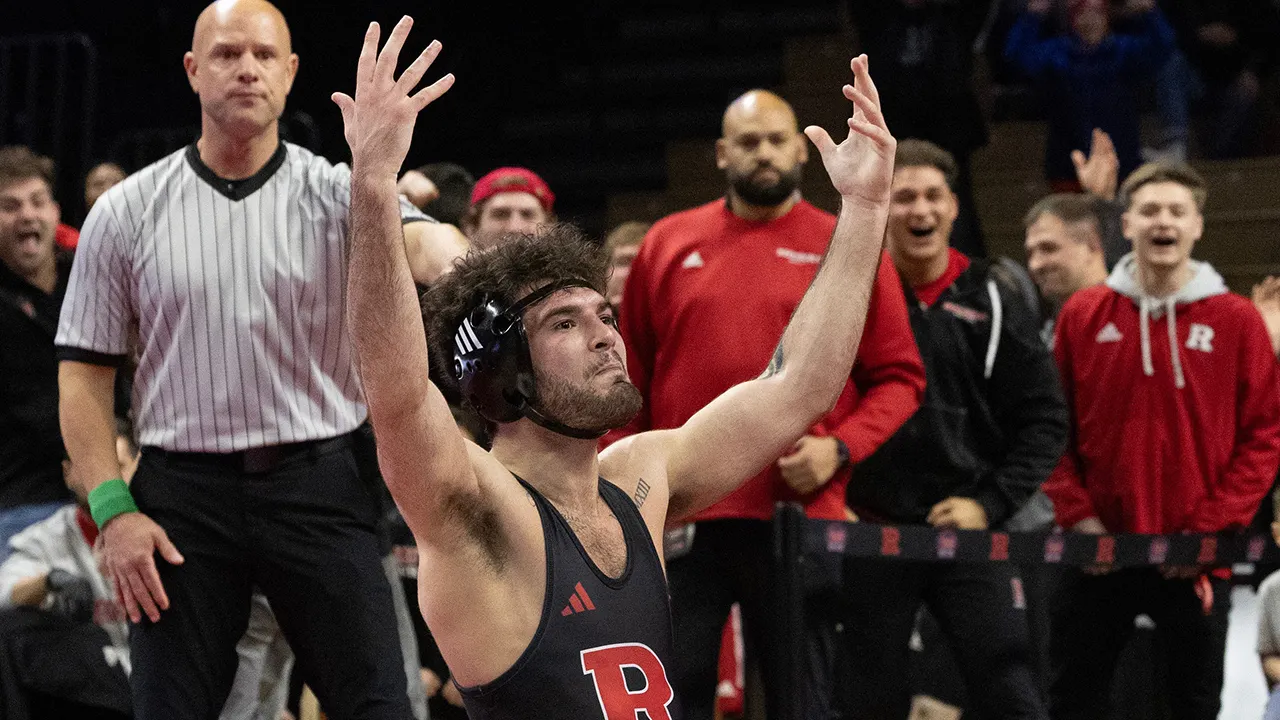
Michael Cetta is one of two former Rutgers wrestlers arrested Thursday. (Peter Ackerman/USA Today Network)
As for Cetta, he was ranked as high as 26th in the nation in the 149-pound class. He was an NCAA qualifier his junior year, when he racked up nine victories. In his college career, he went 40-27.
Both former wrestlers were charged with racketeering in the first degree, money laundering by promoting in the first degree, conspiracy in the second degree, promoting gambling by bookmaking in the third degree, and possession of gambling records in the third degree.
Rutgers University did not immediately respond to a request for comment.
Perna is being charged along with his sons, stepson, nephews and others with racketeering, conspiracy, money laundering and gambling offenses. Perna’s wife and ex-wife are also being charged independently of the scheme.
Documents filed in the case allege that, in January 2024, members of the Port Investigations Unit of the State Police Port Security Section began investigating an illegal sports betting ring operating out of Essex and Bergen counties.
Nicholas Raimo won two state titles attending Hanover Park High School. (Derik Hamilton/Imagn Images)
The scheme allegedly enticed individuals to place bets, and proceeds were used to operate the enterprise and enrich its members.
Between 2022 and 2024, the gambling ring reportedly transferred an estimated $2 million in suspected gambling transactions.
MIAMI GOLF COACH PRAISES KAI TRUMP’S POISE, POTENTIAL AS SHE MAKES LPGA DEBUT
The enterprise had “a nationwide web of bookmakers” who worked under Perna, a soldier in the Lucchese crime family.
“Perna acted as the ‘financier,’ who supported the operation,” the Office of the Attorney General said. “Perna’s son, Joseph R. Perna, 25, of Oakland, N.J., conducted the daily operations of the sportsbook, facilitating dozens of subordinate agents, including his brother, Anthony Perna, 23, of Oakland; his stepbrother, Frank Zito, 23, of Fairfield; and his cousins, Dominic Perna, 23, of Newark, N.J.; and Michael Cetta, 23, of North Haledon, N.J.”
The Rutgers Scarlet Knights logo is shown on concrete before the game between the Rutgers Scarlet Knights and the Oregon Ducks at SHI Stadium on Oct. 18, 2025, in Piscataway, New Jersey. (Getty Images)
First-degree crimes in the case carry a prison sentence of 10 to 20 years and a fine of up to $200,000. First-degree money laundering carries a $500,000 fine. Second- through fourth-degree charges also carry prison time.
Fox News’ Scott Thompson contributed to this report.
Follow Fox News Digital’s sports coverage on X, and subscribe to the Fox News Sports Huddle newsletter.
Read the full article from Here



Boston, MA
A crowd scientist is helping the Boston Marathon manage a growing field of 30,000-plus runners

BOSTON (AP) — Running the Boston Marathon is tough enough without having to jostle your way from Hopkinton to Copley Square.
So race organizers this year turned to an expert in crowd science to help them manage the field of more than 32,000 as it travels the 26.2 miles (42.195 kilometers) through eight Massachusetts cities and towns — some of it on narrow streets laid out during Colonial times.
“There are certain things that we can’t change — that we don’t want to change — because they make the Boston Marathon,” said Marcel Altenburg, a senior lecturer of crowd science at Manchester Metropolitan University in Britain. “Like, I’m a scientist, but I can’t be too science-y about the race. It should stay what it is because that’s what I love. That’s what the runners love.”
The world’s oldest and most prestigious annual marathon, the Boston race was inspired by the endurance test that made its debut at the inaugural modern Olympics in 1896 — itself a tribute to the route covered by the messenger Pheidippides, who ran to Athens with news of the Greek victory over the Persians in Marathon.
After sharing the news — “Rejoice, we conquer!” — Pheidippides dropped dead.
Organizers of the Boston race would prefer a more pleasant experience for their runners, even as the field has ballooned from 15 in 1897 to as many as 38,000 to meet demand for the 100th edition in 1996. It has settled at around 30,000 since 2015.
As the race grew, it tested the limits of the narrow New England roads and the host cities and towns, which are eager to reopen their streets for regular commutes and commerce as quickly as possible.
“It would be kind of great someday to be able to grow the race a little bit more,” race director Dave McGillivray said. “The problem with this race is that it’s about two things: time and space. We don’t have either. … So, we’re trying to be innovative.”
That’s where Altenburg comes in.
A former German army captain who runs ultra marathons himself, Altenburg has worked with all of the major races, other large sporting events, and airports and exhibitions that tend to attract large crowds on ways to keep things safe and flowing smoothly.
For the Boston Marathon, which draws hundreds of thousands of spectators in addition to the runners, his models allow him to run simulations that help him see how the race might play out under different conditions.
“We have simulated the Boston Marathon more than 100 times to run it once for real. That is the one that counts,” Altenburg said in a telephone interview. “They gave me, pretty much, all creative freedom to simulate more waves, simulate more runners and — within the existing time window — they allowed me to change pretty much anything for the betterment of the running experience.
“And then we checked every aid station, every mile, the finish, every important point, (asking): Is the result better for the runner? Is that something that we should explore further?”
The most noticeable difference on Monday will be that the runners are starting in six waves — groups organized by qualifying time — instead of three. The waves, which were first used in Boston in 2011, help spread things out so that runners don’t have to walk after the start, when Main Street in Hopkinton squeezes to just 39 feet wide.
Other, less obvious changes involve the unloading of the buses at the start, the placement of the water and aid stations, and the finish line chutes, where runners get their medals, perhaps a mylar blanket or a banana, and any medical treatment they might need.
“For an event that’s as old as ours, 130 years, it allowed us to be a startup all over again,” said Lauren Proshan, the chief of race operations and production for the Boston Athletic Association.
“The change isn’t meant to be earth-shattering. It’s to be a smooth experience from start to finish,” she said. “It’s one of those things that you work really, really hard behind the scenes and hope that no one notices — a behind-the-curtain change that makes you feel as if you’re just floating and having a great day.”
Shorter porta potty lines would also be nice.
“What I loved about working with the BAA was how aware they are of what the Boston Marathon is. And they won’t change anything lightly,” Altenburg said. “So it was very detailed work from literally the moment the race last year ended to now. That we check every single option. That we really make sure that if we change something about this historic race, then we know what we’re doing.”
The BAA will look at the feedback over the next three years before deciding about expansion or other changes.
“Fingers crossed, hope for the best, but we’ll get feedback from the participants,” McGillivray said. “And they’ll let us know whether or not it worked or not.”
But keeping the course open longer isn’t an option. And the route isn’t going to change. So there’s only so much that crowd science can help with at one of the toughest tests in sports.
“I can talk. I’m a scientist. I just press a button and it’s going to be,” Altenburg said. “But the runners still have to do it.”
___
AP sports: https://apnews.com/hub/sports

Location: PNC Park, Pittsburgh, PA
Broadcast: KDKA AM/FM, Sportsnet Pittsburgh
The Pittsburgh Pirates are at home today against the Pittsburgh Pirates looking to grab a win against the Tampa Bay Rays.
Please remember our Game Day thread guidelines.
Advertisement
-
Don’t troll in your comments; create conversation rather than destroying it
-
Remember Bucs Dugout is basically a non-profanity site
-
Out of respect to broadcast partners who have paid to carry the game, no mentions of “alternative” (read: illegal) viewing methods are allowed in our threads
-
The commenting system was updated during the summer. They’re still working on optimizing it for Game Day Threads like ours. If you don’t like clicking “Load More Comments”, remember that the “Z” key can be your friend. It loads up the latest comments automatically.
BD community, this is your thread for today’s game against the Rays. Enjoy!

Naugatuck Police say one person has been arrested after a multi-car accident on Route 63 Saturday afternoon.
According to police, they responded to the area of Route 63 and Cherry Street around 1 p.m. for reports of a collision with injuries.
They say a 30-year-old man from Waterbury was arrested and charged with operating under the influence of drugs/alcohol, operating under the influence with a child passenger, illegal possession of prescription drugs, failure to keep narcotics in the original container, risk of injury to a child and distracted driving.
Police say he is being held on a $10,000 Surety Bond.
This is all the information at this time.
-

 Dallas, TX3 minutes ago
Dallas Mavericks Owners Might Be Making Big Mistake in Search for New GM
-

 Miami, FL9 minutes ago
Defense dominates, Mensah flashes in Miami’s spring game – The Miami Hurricane
-
Boston, MA14 minutes ago
A crowd scientist is helping the Boston Marathon manage a growing field of 30,000-plus runners
-

 Denver, CO21 minutes ago
Denver Nuggets Altitude broadcasts now being offered in Spanish for first time ever
-

 Seattle, WA27 minutes ago
Need to shred? Free drive-up/ride-up shredding Wednesday at Village Green West Seattle
-

 San Diego, CA33 minutes ago
Game 21: San Diego Padres at Los Angeles Angels
-
 Milwaukee, WI39 minutes ago
One person injured following early Sunday morning shooting in Milwaukee
-

 Atlanta, GA44 minutes ago
Play Fair ATL kicks off ‘The People’s Cup’ in Candler Park

