Northeast
NTSB says lack of 'vulnerability assessment' by Maryland officials preceded deadly Key Bridge collapse

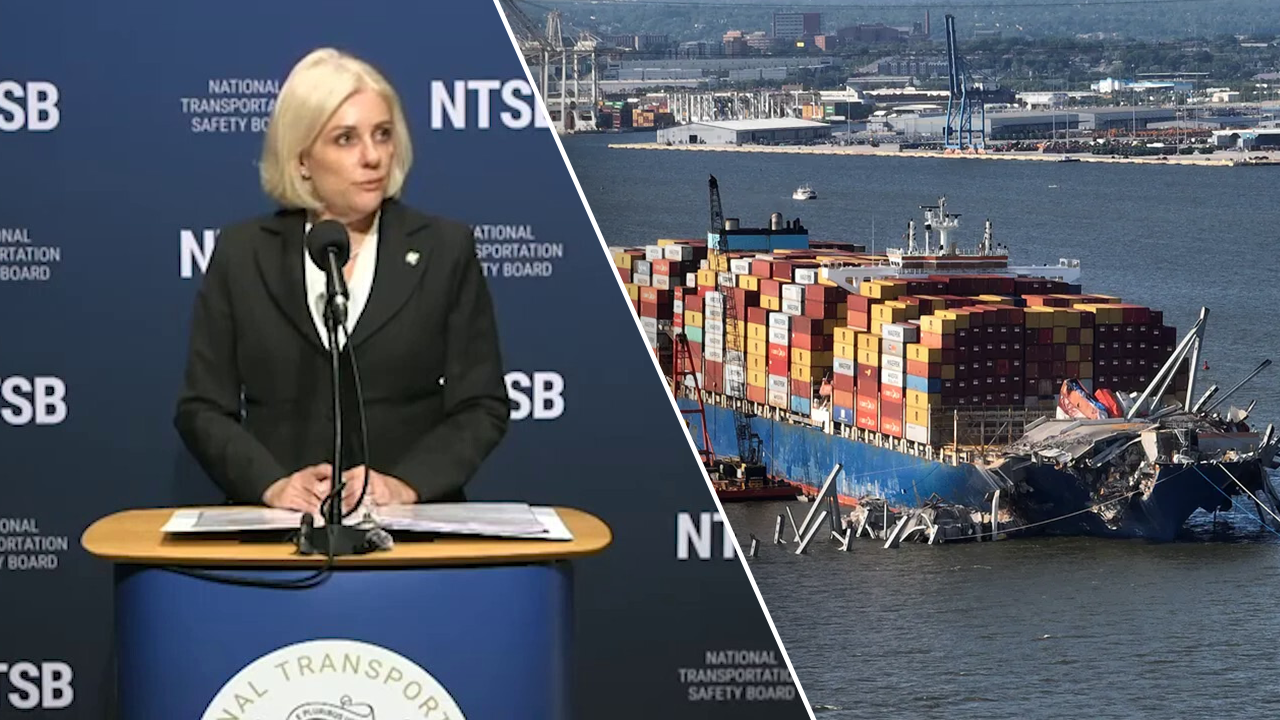
The National Transportation Safety Board (NTSB) sounded an alarm during a news conference Thursday, warning 30 owners of 68 bridges across 19 states to conduct vulnerability assessments to determine the risk of a bridge collapsing due to being struck by a ship.
The NTSB also cited a Maryland state authority’s lack of an assessment that may have prevented the deadly collapse of the Francis Scott Key Bridge in Baltimore.
The 984-foot Singapore-flagged cargo vessel Dali was moving out of Baltimore Harbor March 26, 2024, when it experienced a loss of electrical power and propulsion and struck the southern pier supporting the central truss spans of the Francis Scott Key Bridge on the Patapsco River.
The bridge collapsed, killing six construction crew members and injuring two other people.
The cargo ship Dali is stuck under part of the structure of the Francis Scott Key Bridge after the ship struck the bridge March 26, 2024. (AP Photo/Mark Schiefelbein, File)
FAA ‘PERMANENTLY RESTRICTING’ WASHINGTON HELICOPTER TRAFFIC AFTER FATAL MIDAIR COLLISION NEAR DC AIRPORT
NTSB Chair Jennifer Homendy said Thursday the Key Bridge was almost 30 times above the “acceptable risk threshold” for critical or essential bridges, according to guidance from the American Association of State Highway and Transportation Officials (AASHTO).
While the bridges that have not been evaluated are not certain to collapse, the NTSB said “had the Maryland Transportation Authority (MDTA) conducted a vulnerability assessment on the Key Bridge based on recent vessel traffic, MDTA would have been aware that the Key Bridge was beyond the acceptable risk and would have had information to proactively reduce the bridge’s risk of a collapse and loss of lives associated with a vessel collision with the bridge.”
“Frankly, we’ve been sounding the alarm on this since the tragedy occurred,” Homendy said. “We need action. Public safety depends on it.”
In this aerial view, a steel truss from the destroyed Francis Scott Key Bridge pinned the container ship Dali in place in the Patapsco River May 13, 2024, in Baltimore. (Chip Somodevilla/Getty Images)
The NTSB over the last year identified 68 bridges designed before AASHTO guidance was established that do not have a current vulnerability assessment.
The NTSB is recommending that the 30 bridge owners evaluate whether their bridges are above the AASHTO acceptable level of risk, and, if so, develop and implement a comprehensive risk reduction plan.
AASHTO developed and published the vulnerability assessment calculation for new bridges on the National Highway System in 1991 in response to the NTSB’s investigation of the Sunshine Skyway Bridge collapse in Florida.
Explosive charges are detonated to bring down sections of the collapsed Francis Scott Key Bridge May 13, 2024, in Baltimore. (AP Photo/Mark Schiefelbein)
NTSB: BLACK HAWK WAS FLYING TOO HIGH WHEN IT COLLIDED WITH PASSENGER PLANE OVER WASHINGTON DC, KILLING 67
At the time, AASHTO also recommended that all bridge owners conduct a vulnerability assessment on existing bridges to “evaluate their risk of catastrophic collapse in the event of a vessel collision.”
Decades later, in 2009, AASHTO reiterated that recommendation again.
Since 1994, the Federal Highway Administration (FHWA) has required new bridges be designed to minimize the risk of a catastrophic bridge collapse from a vessel collision, “given the size, speed and other characteristics of vessels navigating the channel under the bridge,” according to the NTSB.
Wreckage of the Francis Scott Key Bridge rests on the container ship Dali as President Joe Biden takes an aerial tour of the collapsed bridge in Baltimore April 5, 2024. (AP Photo/Manuel Balce Ceneta)
Homendy added that the NTSB is also recommending the FHWA, U.S. Coast Guard and U.S. Army Corps of Engineers establish an “interdisciplinary team” to provide guidance and assistance to bridge owners in evaluating and reducing the risk.
Reducing the risk could mean infrastructure improvements or operational changes, according to the NTSB.
The NTSB will also be releasing more than 1,000 pages of investigative material on the public docket Thursday, including the bridge report and some interviews.
This 3D imagery shows the wreckage of the Francis Scott Key Bridge resting at the bottom of the Patapsco River. (U.S. Navy’s Naval Sea Systems Command Supervisor of Salvage and Diving )
Next week, the NTSB intends to release the hazardous materials, meteorological and survival factors factual reports and a study conducted by its office of engineering on vessel size increases and associated safety risk.
Voyage data recorder audio transcripts and associated data will follow, leading up to the NTSB releasing its final report, which will likely happen in the fall.
The MDTA did not immediately respond to Fox News Digital’s request for comment Thursday afternoon.
Read the full article from Here


When Americans think of the beverage that fueled the American Revolution, they usually picture black tea — but it turns out that green tea was just as popular.
The Founding Fathers and their contemporaries drank both types of tea, Bruce Richardson, the Kentucky-based founder of Elmwood Inn Fine Teas, told Fox News Digital.
British subjects “were as likely to be drinking green tea as black tea, whether you were in Jane Austen [era] England … or you were in colonial Boston,” he added.
“There were five teas, all from China, because that was the only country that was exporting tea,” Richardson said. “And of those five different teas, two of them were green and three of them were black.”
Richardson, a tea historian who works as the tea master at the Boston Tea Party Ships & Museum, said the five types of tea dumped into Boston Harbor in protest of the Tea Act of 1773 included three black varieties — Bohea, Souchong and Congou — as well as the green teas Hyson and Singlo.
Bohea, the most common and least expensive black tea of the era, was often made from older tea leaves harvested after the highest-quality leaves of the season had already been picked.
Most of the tea dumped into Boston Harbor was Bohea, Richardson said — and it was so ubiquitous that he compared it to the way Kleenex has become synonymous with tissues today.
“It was so common that often teapots at the time, or some that I’ve seen, would say Bohea on the side of the teapot,” he said. “If they wanted tea, they’d say, ‘I’ll have a cup of Bohea.’ It was that common.”
Not only did colonial Americans distinguish between green and black tea, they even stored them differently.
“They still wanted their tea time, but they didn’t want to support the British government.”
“The well-to-do people would have a tea caddy – a wooden, beautifully made tea caddy to store their tea in,” he said.
“It was kept under lock and key. And in that tea caddy, [there] would be two compartments, one for green tea and one for black tea.”

Merchants often favored black tea because it held up better during the long voyage from China to Europe and onward to the American colonies, Richardson said.
“The green tea was what China had always drunk,” he said.
“And so they were exporting that as well, but they found that the black tea actually made the voyage better than the green teas.”
Even after many colonists swore off British tea, they kept the ritual of drinking it — or at least a close substitute.
Many patriots brewed so-called “Liberty Teas” made from ingredients such as dried apples, blueberries, chamomile and herbs grown in their gardens.
“They still wanted their tea time, but they didn’t want to support the British government,” Richardson said.


-

 World6 minutes ago
Neon Closing in on Luca Guadagnino’s Sam Altman Open AI Movie ‘Artificial’ After Amazon Drops Controversial Film
-
 Lifestyle48 minutes ago
‘Dead but Dreaming of Electric Sheep’ is full of beautifully written grotesqueries
-

 Technology56 minutes ago
Google’s NotebookLM can sum up your research in a TikTok-style clip
-

 World1 hour ago
Trump admin backs Bolivia state of emergency as leftist ex-leader’s loyalists fracture nation
-

 Politics1 hour ago
Congress eyes rare bipartisan housing win with or without Trump’s help
-

 Health1 hour ago
America’s national parks could add years to your life — here’s how they boost health
-

 Sports1 hour ago
LeBron James Next Team Odds: Warriors, Cavaliers, Heat In Mix
-

 Technology1 hour ago
The trick to smoother streaming at home and on the road

