Northeast
Newly reported transcripts depict communication breakdown hindering law enforcement at Butler Trump rally

CONNOQUENESSING, Pa. – Newly reported transcripts of law enforcement communications at the Butler, Pennsylvania, Trump rally depict a communications structure that essentially isolated local and federal law enforcement from each other at key times.
Communications reported Sunday by the Washington Post also highlight the effect spotty cellular service in the rural Allegheny Valley purportedly had on preventing transmission of key messages like an officer’s photo of then-suspicious individual Thomas Crooks.
According to encrypted radio communications obtained by the newspaper, at 5:42 p.m. ET on July 13, a counter-sniper from a local law enforcement agency alerted that a “younger White male [with] long hair” was “lurking” around the AGR glass company building adjacent to the Butler Farm Show grounds – but had since disappeared from view.
Within a half-hour, that suspicious individual – Thomas Crooks – would fire shots at former President Trump from atop that low-rise building and kill a local firefighter in the process.
BUTLER LAWMAKER SLAMS ‘INAPPROPRIATE’ TREATMENT OF LOCAL POLICE AFTER TRUMP INCIDENT: ‘THROWN UNDER THE BUS’
A flag is lowered to half-mast at the front entrance of the Butler Farm Show in Butler, Pennsylvania, on Monday, July 22, 2024. (Derek Shook for Fox News Digital )
However, that local officer’s warning would go unheard by U.S. Secret Service because the transmission went to a trailer from which local police commanders were operating – separate from the president’s detail, the paper reported, citing Butler County District Attorney Richard Goldinger and a separate law enforcement source.
According to the Post, the police commander in the trailer telephoned a Pennsylvania state trooper to pass the message along.
There were at least three other key moments when communications had to be transmitted by cellphone, at a venue where – like sporting events – crowds often overwhelm the frequency.
The director of emergency services in neighboring Beaver County – which also lent personnel for the event – told the paper that agencies should not be separated from each other and instead have representatives in “the same room.”
TOP DEM WHO VISITED BUTLER SAYS LOCAL OFFICIALS TOLD HIM ‘WE NEED TO TALK MORE’ ABOUT USSS FAILURES
Rep. Glenn Ivey, left, speaks with Rep. Bennie Thompson in Butler, Pennsylvania, on July 22, 2024. A bipartisan group of lawmakers was visiting the site of the July 13 assassination attempt. (Derek Shook for Fox News Digital )
Butler County Sgt. Edward Lenz, commander of the “ESU” or emergency services unit, had been monitoring the radio traffic, and telephoned a state police sergeant after Crooks was seen milling around with a range-finder.
The sergeant then passed along the message to Secret Service officials in the trailer where he was stationed, according to the report.
Attempts to reach Lenz with further questions were unsuccessful.
Spotty cell service continued to hamper the investigation of Crooks, as a local law enforcement officer transmitted that he was trying to share a photo via phone.
A Beaver County sniper later spotted Crooks by the glass company building with a backpack and began moving around within the building where he was stationed to try to keep eyes on him. The sniper, Sgt. Greg Nicol, was later praised by Beaver County officials for his “old-fashioned police work.”
Nicol then transmitted that Crooks “went toward the Sheetz” – referring to the Altoona-based gas station chain’s outpost just over a city block east of the AGR building.
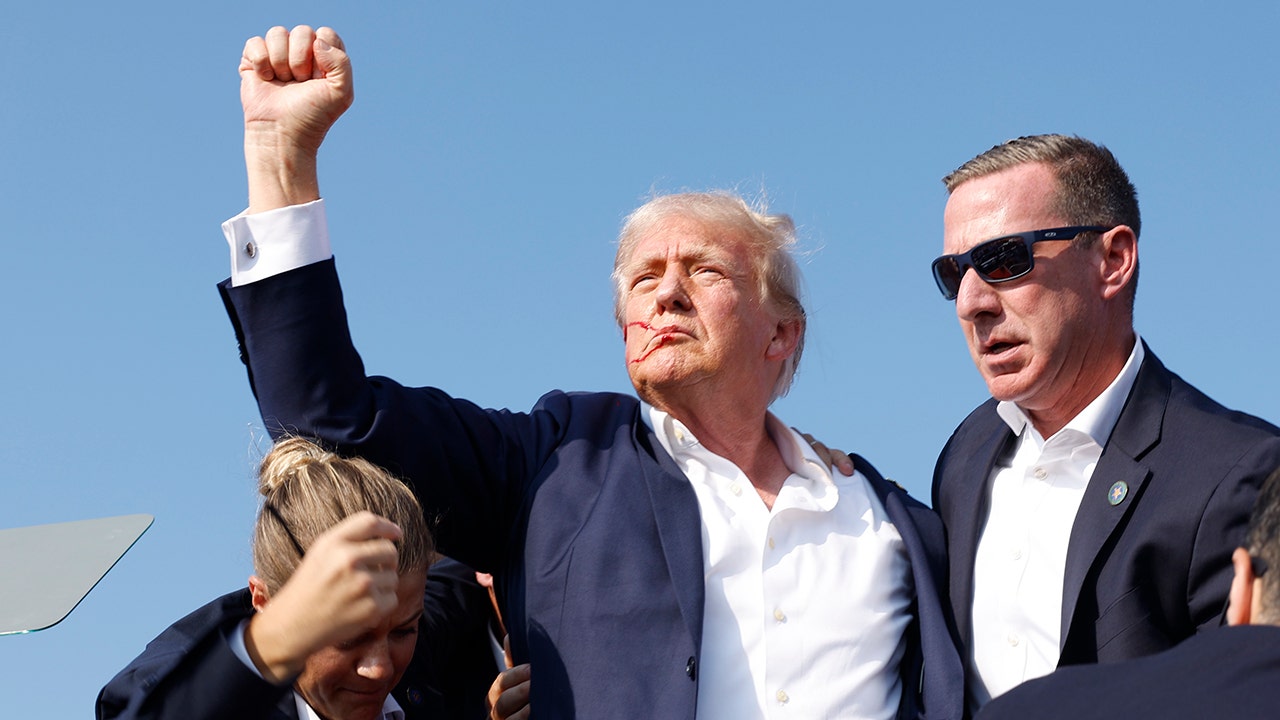
Former President Trump gestures with a bloodied face after multiple shots rang out during a campaign rally in Butler, Pennsylvania. (Reuters/Brendan McDermid)
Via a graphic, the Post reported Crooks may have moved over and used an HVAC unit on the far side of the AGR glass complex to get on the roof.
Various videos have shown Crooks around that time moving about the roof.
Once a police officer was able to peek over the top of the roof, as previously reported, Crooks was seen with his rifle.
According to the Post report, as Lenz radioed the QRF or “quick response force” about the now-armed threat, shots rang out.
On Wednesday, District Attorney Goldinger said concerns from local officials went unheeded by federal agents, and that it essentially left the locals to set up their own command post, according to the Pittsburgh Tribune-Review.
Law enforcement from Butler, Beaver and Washington Counties reportedly set up their post the morning of the rally. The Secret Service’s command post was set up at the rear of the site – toward where Trump would face from the dais – while the county command trailer was stage-left of the former president. Crook’s perch atop the AGR glass company building was stage-right.
In response to questions about the Post report from Fox News Digital, Secret Service spokesman Anthony Guglielmi said the agency is “committed to better understanding what happened before, during, and after the assassination attempt of former President Trump to ensure that it never happens again.”
“This includes a robust mission assurance investigation by our Office of Professional Responsibility that will meticulously examine all aspects of the event and complete cooperation with Congress, the FBI and other relevant investigations.”
Read the full article from Here


When Americans think of the beverage that fueled the American Revolution, they usually picture black tea — but it turns out that green tea was just as popular.
The Founding Fathers and their contemporaries drank both types of tea, Bruce Richardson, the Kentucky-based founder of Elmwood Inn Fine Teas, told Fox News Digital.
British subjects “were as likely to be drinking green tea as black tea, whether you were in Jane Austen [era] England … or you were in colonial Boston,” he added.
“There were five teas, all from China, because that was the only country that was exporting tea,” Richardson said. “And of those five different teas, two of them were green and three of them were black.”
Richardson, a tea historian who works as the tea master at the Boston Tea Party Ships & Museum, said the five types of tea dumped into Boston Harbor in protest of the Tea Act of 1773 included three black varieties — Bohea, Souchong and Congou — as well as the green teas Hyson and Singlo.
Bohea, the most common and least expensive black tea of the era, was often made from older tea leaves harvested after the highest-quality leaves of the season had already been picked.
Most of the tea dumped into Boston Harbor was Bohea, Richardson said — and it was so ubiquitous that he compared it to the way Kleenex has become synonymous with tissues today.
“It was so common that often teapots at the time, or some that I’ve seen, would say Bohea on the side of the teapot,” he said. “If they wanted tea, they’d say, ‘I’ll have a cup of Bohea.’ It was that common.”
Not only did colonial Americans distinguish between green and black tea, they even stored them differently.
“They still wanted their tea time, but they didn’t want to support the British government.”
“The well-to-do people would have a tea caddy – a wooden, beautifully made tea caddy to store their tea in,” he said.
“It was kept under lock and key. And in that tea caddy, [there] would be two compartments, one for green tea and one for black tea.”

Merchants often favored black tea because it held up better during the long voyage from China to Europe and onward to the American colonies, Richardson said.
“The green tea was what China had always drunk,” he said.
“And so they were exporting that as well, but they found that the black tea actually made the voyage better than the green teas.”
Even after many colonists swore off British tea, they kept the ritual of drinking it — or at least a close substitute.
Many patriots brewed so-called “Liberty Teas” made from ingredients such as dried apples, blueberries, chamomile and herbs grown in their gardens.
“They still wanted their tea time, but they didn’t want to support the British government,” Richardson said.


-

 Movie Reviews6 minutes ago
Young Washington (Christian Movie Review) – The Collision
-

 World16 minutes ago
Neon Closing in on Luca Guadagnino’s Sam Altman Open AI Movie ‘Artificial’ After Amazon Drops Controversial Film
-
 Lifestyle58 minutes ago
‘Dead but Dreaming of Electric Sheep’ is full of beautifully written grotesqueries
-

 Technology1 hour ago
Google’s NotebookLM can sum up your research in a TikTok-style clip
-

 World1 hour ago
Trump admin backs Bolivia state of emergency as leftist ex-leader’s loyalists fracture nation
-

 Politics1 hour ago
Congress eyes rare bipartisan housing win with or without Trump’s help
-

 Health1 hour ago
America’s national parks could add years to your life — here’s how they boost health
-

 Sports1 hour ago
LeBron James Next Team Odds: Warriors, Cavaliers, Heat In Mix

