Northeast
New Jersey girl, 6, remembered as 'bubbly' with 'haunting beauty' following tragic badminton accident: family

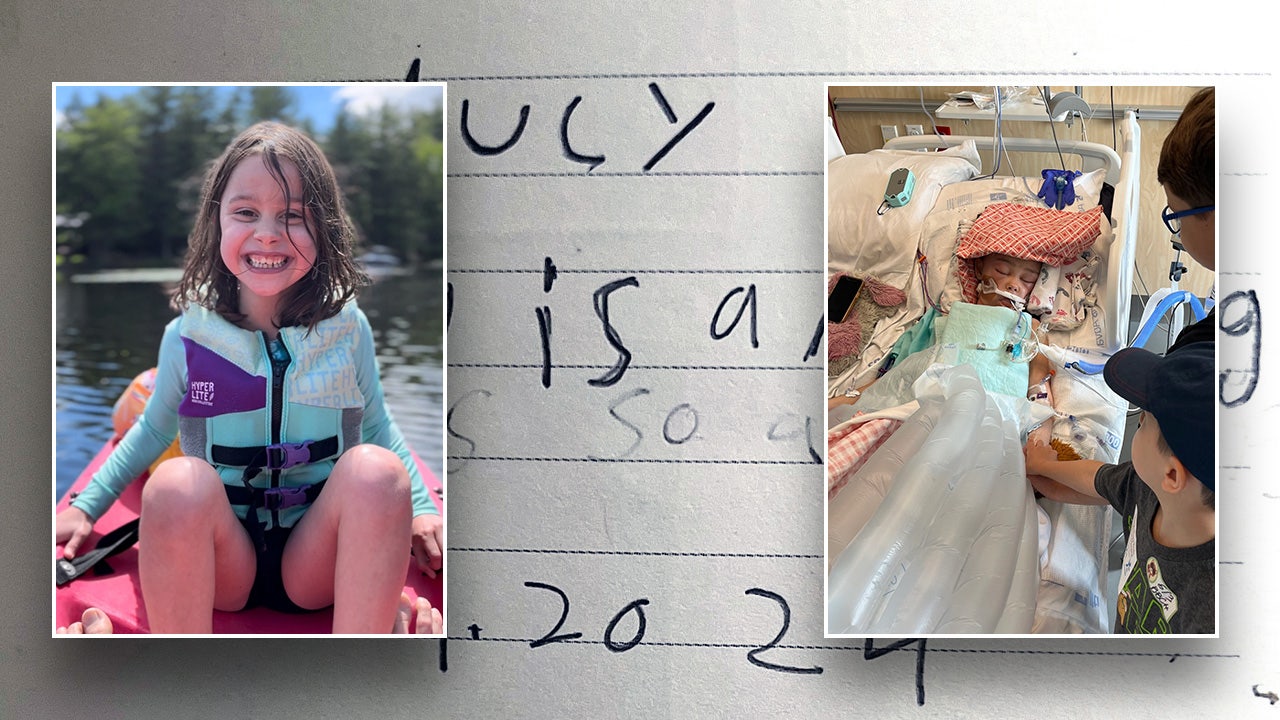
The father of a 6-year-old New Jersey girl who died from head trauma after a freak accident involving a badminton racket on the final day of a family vacation recalled his daughter’s “bubbly” personality and the afternoon their family changed forever.
Jesse Morgan, whose 6-year-old daughter Lucy unexpectedly died after playing with her siblings, shared with Fox News Digital memories about his daughter.
“Her personality was very bubbly and also reserved at times,” he said. “Once you got to know her, she was very, very outspoken and a lot of fun. She was a tough kid and played soccer really hard.”
NEW JERSEY GIRL, 6, DIES IN TRAGIC BADMINTON ACCIDENT 4 WEEKS AFTER ASKING ‘HOW TO BE WITH GOD AND BE SAVED’
Lucy Morgan, 6, during the family’s vacation in Maine. (Jesse Morgan via New Creation Living Blog)
Jesse recalled looking at pictures of Lucy with his daughter and wife, Bethany.
“My wife just made the comment that her beauty is haunting. Some of those pictures are just, she’s just so gorgeous, and her personality is so incredible,” he said.
Jesse recalled that Lucy was the “main cuddler” of their family of six.
“I just remember her coming up with her bedhead [hair] and just wanting to sit with you for a long time. Not restless, just wants to lie with you and snuggle up.”
Lucy with her three siblings while on vacation in Maine. Lucy told her parents the day of the accident it was the “best week of her life.” (Jesse Morgan via New Creation Living Blog)
Lucy with her two brothers and her father while on vacation in Limerick, Maine. Lucy was taken by medical helicopter to a nearby pediatric hospital before being transferred to a hospital in Portland, Maine. (Jesse Morgan via New Creation Living Blog)
Jesse, a pastor at Green Pond Bible Chapel in Rockaway, New Jersey, told Fox News Digital the family’s vacation was part of his sabbatical.
PASTOR BASED IN DALLAS SHARES DEPRESSION JOURNEY, URGES OTHERS TO SEEK HELP: ‘DON’T HESITATE’
“We were on our first week [of sabbatical] and it was, according to her, the best week of her life,” he said. “We did so many fun things.”
Photos shared by the family showed Lucy and her three siblings, Silas, Shiloh and Atticus, fishing and kayaking in Limerick, Maine, before tragedy struck.
“It was, according to her, the best week of her life.”
Lucy and her mother, Bethany, and sister. Jesse Morgan said he and his wife were reading and relaxing when the badminton accident happened. (Jesse Morgan via New Creation Living Blog)
The family’s idyllic vacation came to a sudden halt May 30, after the family enjoyed a leisurely lunch.
Jesse said he and his wife were reading and resting in the backyard, and the children were playing badminton, when their son came to them “very concerned.”
“We went out, and we saw what had happened, which was just indescribable terror going from so quiet, so calm to an incredibly traumatic experience,” Jesse said.
Four days later, Lucy died from her injuries, the family said. (Jesse Morgan via New Creation Living Blog)
Lucy was unexpectedly struck when the shaft of the racket, which was being used by her 10-year-old brother, broke apart and flew into her skull.
“Due to a freak accident with a racquet that broke on a downward swing, a sharp piece had entered Lucy’s skull while she was sitting on the sideline and caused catastrophic injury,” Jesse explained in a series of blog posts on his blog, New Creation Living. “She was still breathing but unresponsive as I held her with Bethany crying out to God.”
AMERICAN MISSIONARIES KILLED BY HAITIAN GANG ‘GAVE EVERYTHING’ FOR PEOPLE THERE: FAMILY
Lucy was taken to a local hospital before being moved to a hospital in Portland, Maine.
Lucy had a prayer journal that she wrote and drew in. (Jesse Morgan via New Creation Living Blog)
Four days after the accident, Lucy succumbed to her injury.
“After significant thorough testing and even more repeated tests to be certain, brain death was declared at 1:32 a.m. on June 5, and her heart stopped beating around 4 a.m.,” Jesse wrote.
“Lucy was with Jesus.”
The parents held onto the hope that Lucy “believed in Jesus’ death and resurrection.”
“Lucy was with Jesus.”
SOUTH CAROLINA WOMAN’S HAND AMPUTATED AFTER BURNING IT IN FREAK ACCIDENT WITH HAIR DRYER
“Four weeks ago she asked Bethany how to be with God and be saved,” Jesse wrote. “Bethany explained it to her and offered to pray with her, but ‘Miss Independent’ wanted to do it herself. She went to her room and prayed to God to forgive her and that she believed in Jesus’ death and resurrection.”
“What a gift,” he said.
Lucy Morgan wrote in her prayer journal that “God loves me.” (Jesse Morgan via New Creation Living Blog)
Lucy’s prayer journal also contained drawings of the family and the Bible, her father said. (Jesse Morgan via New Creation Living Blog)
Jesse wrote that he and his wife were comforted after finding her prayer journal, saying it felt “as if God was writing with her.”
“How a 6-year-old journals like this is beyond me. After that, she seemed to get writer’s block and just draw beautiful pictures of Bible stories and hearts.”
Read the full article from Here


PORTLAND (WGME) — Maine Governor Janet Mills has not yet decided whether the state will opt into a new federal tax credit program that would help fund private school tuition, tutoring and other educational services.
The program, called the Educational Choice for Children Act, would start next year. In states that opt in, individuals can receive up to $1,700 in tax credits for donations they make to scholarship-granting organizations, also known as SGOs. Those SGOs would then award grants to students to cover private school tuition, tutoring and other educational services.
Families earning up to 300 percent of the area median income can qualify for the scholarships in states that opt in.
Under the current framework, donors contribute to SGOs and receive federal tax credits, and SGOs use the funds to award scholarships for qualifying educational expenses, including tuition, fees, tutoring, curriculum materials and educational therapy for K-12 students. SGOs can also use donated money to award scholarships for educational expenses, including everything from private school tuition to special needs services and educational therapy.
Each state’s governor must opt in by filing IRS Form 15714. Once opted in, the state designates SGOs to operate within its borders and distribute EFTC scholarships to eligible families.
Republican State Senator James Libby of Cumberland, a member of the Education and Cultural Affairs Committee, says he is interested in bringing the program to Maine.
“What it really does is it takes dollars that would normally go to pay for taxes and put them directly into education,” Libby said. “The program itself allows for expenditures for other things besides school choice, so the states can set it up the nonprofit to have goals for whatever they want. There’s a lot of good parts to this legislation and I truly hope Maine will get involved.”
Democratic Rep. Kelly Murphy, who chairs the state’s education committee, says she believes the program would hurt Maine students.
“The Education Freedom Tax Credit favors families that already have the ability to pay for private schools at the expense of families with students enrolled in public schools,” Murphy said. “A decline in public school enrollment would result in a loss of state funding for local SAUs, as the costs for running schools continue to increase, putting additional pressure on property taxpayers to make up the gap. This program and others like it would hurt the majority of Maine students, especially those in small, rural schools across our state.”
The U.S. Department of the Treasury is in the process of finalizing rulemaking for the program. Currently, 30 states have opted into the program, and four states have opted out. In New England, New Hampshire is the only state that has opted in so far.
It is unclear if there is a hard deadline for states to opt in, but Mills is facing pressure to sign off this year so the Department of the Treasury can approve scholarship organizations before scholarships become available in January.

Local News
Voters have passed several major laws by initiative in past elections. A 2016 initiative legalized marijuana, and a 2022 initiative created a tax on millionaires.
This year, eight initiative petitions are likely headed to voters on the November ballot. The Legislature, which had a chance to approve the measures last month, opted not to approve any of them, requiring ballot committees to gather additional signatures this month.
Massachusetts voters have passed several major laws by initiative in past elections. A 2016 initiative legalized marijuana, and a 2022 initiative created a tax on millionaires.
But as the number of initiatives on the ballot has increased, lawmakers have grown frustrated with the system. House Speaker Ron Mariano and Senate President Karen Spilka criticized the ballot measure process in February, with Mariano describing it as “fraught with peril.” And the Legislative committee tasked with voting on potential initiatives — some of which targeted the Legislature — held a series of tense hearings in March.
Several elected officials and scholars have called for reform to the ballot measure process.
The Massachusetts Legislature is not the only state government critical of the initiative process. An increasing number of states have attempted to restrict the practice.
Still, direct democracy advocates say ballot measures serve as a check and balance on representative government.
“We believe that representative government is one of the most fundamental, best ways to govern,” said Dane Waters, founder of the Initiative and Referendum Institute. “But lawmakers, for whatever reason, whether through personal interest or conflict, sometimes just choose not to do things, and there needs to be a mechanism for the people to hold them accountable.”
What is an initiative?
Ballot initiatives allow citizens to adopt laws or constitutional amendments, depending on the state. Massachusetts permits both.
The ballot measure process emerged during the Populist and Progressive movements in the 1890s and early 1900s because the reformers believed state governments were controlled by moneyed special interests rather than the people.
In 1912, an Oregon initiative gave women the right to vote. A 1996 California initiative banned affirmative action. In 2012, Maine voters legalized same-sex marriage.
Initiative petitions can be direct or indirect, depending on the state. Direct initiatives are placed on the ballot without any legislative say. Indirect initiatives — Massachusetts’ approach — are first presented to the Legislature. The process of how a state legislature handles an indirect petition varies by state.
In every state with an initiative process, citizens must collect signatures to qualify for the ballot, though the requirements vary by state.
Initiatives are distinct from referendums, which ask voters to accept or reject legislation recently adopted by the Legislature.
Which states allow initiatives?
Twenty-three states have some form of initiative process, the majority of which are in the West. According to Waters, many of these states entered the union during the Progressive Era and were “more prone to want to have that mechanism versus states that had been around since the founding of our nation.”
Eastern states with initiative processes include Massachusetts, Florida and Maine, though those states tend to have more stringent processes.
From 1904 to 2024, California had the most initiatives (396), followed by Oregon (379), with approval rates of 35% and 36%, respectively. Colorado (259), North Dakota (202) and Washington (192) follow.
“If you were to factor out California and Oregon, I think it would probably represent like 30% to 40% of all the initiative usage ever,” Waters said.
He added that no state stands out as more likely to respond to ballot proposals with a legislative compromise.
“I respect representative government, but I seriously am hard pressed to find a single legislature that is supportive or sympathetic to the people using the process,” Waters said.
New Bedford lawmakers support ballot measure process
Despite legislative leaders’ opposition, several New Bedford lawmakers told The New Bedford Light they don’t view the ballot measure process as a threat.
Rep. Antonio F.D. Cabral, D-New Bedford, said ballot measures are a “useful democratic barometer” that informs the Legislature of residents’ priorities.
“At the core of our democracy is the belief that every resident deserves a meaningful voice in the decisions that shape their lives,” Cabral said in a written statement. “The ballot initiative process is an alternative avenue, alongside direct engagement between constituents and their elected officials, and stands as a valuable component of the democratic system in Massachusetts.”
Rep. Christopher Hendricks, D-New Bedford, said the ballot measure process can “nudge the Legislature sometimes in the right direction, where it otherwise wouldn’t happen.” He pointed to the Fair Share Amendment, which voters passed in 2022, creating an additional tax on millionaires.
Rep. Christopher Markey, D-Dartmouth, echoed this sentiment, using the 2016 initiative that legalized marijuana as an example.
Hendricks and Markey both argued that some issues are too complex to be decided at the ballot box, including a proposal to cut the state income tax from 5% to 4%, which the Supreme Judicial Court recently struck from the ballot.
“I think when you start to get into technical bills, where there’s a lot of issues, it’s really difficult for someone to understand the entire bill and understand the nuances that (lawmakers) get,” Markey said. “We get lots of meetings with people in special interest groups and advocacy groups so that we can learn the pluses and minuses of a particular bill in more detail.”
Waters disputes this commonly used argument.
“For democracy to work, you have to have faith in the voters,” he said. “If you’re going to trust voters to choose among a candidate, then you have to have faith in them that they can choose among an issue.”
Rep. Steven Ouellette, D-Westport, said that as long as a question is legal and constitutional, the Legislature should institute it. “Unless there’s some kind of legal issue argument, we are planning on going forward with what the people want,” he said.
Rep. Mark Syvlia, D-Fairhaven, told The Light that the ballot measure process is “important,” but that he appreciates that the Legislature has a chance to weigh in on the questions.
“(The Legislative review educates) the public about what a ballot question does and doesn’t do, and also identifies for the Legislature where there may be an opportunity to enact a potential ballot initiative that would be really beneficial,” Sylvia said.
He said he believes that the Legislature didn’t approve any of the November questions because of their substance, not out of disdain for the initiative process.
Massachusetts’ approach
Massachusetts has one of the most difficult initiative processes in the country.
The process begins with 10 petitioners who submit a proposed law or amendment to the attorney general for approval.
If the initiative is certified, petitioners must collect signatures equal to 3% of the total votes cast for governor at the last election — 74,574 signatures for the November 2026 election.
Massachusetts only allows indirect initiatives. If lawmakers don’t pass the initiative, petitioners must collect additional signatures — 0.5% of the gubernatorial votes, or 12,429, for the November election.
Initiatives for constitutional amendments require only one round of signatures, but must be approved by two consecutively elected legislatures.
Waters pointed to North Dakota — which has an indirect initiative process — as one of the easiest states to place a question on the ballot.
Massachusetts limits how many signatures can come from one county, but North Dakota has no distribution requirements.
According to Waters, signatures in North Dakota are presumed valid, but in Massachusetts, they must be certified.
Petitioners in North Dakota have one year to collect signatures — significantly more time than in Massachusetts, where petitioners have nine weeks to collect the first round of signatures and eight weeks in the second round.
Threats to the ballot measure process
Waters and other direct democracy advocates warn of growing threats to the ballot measure process.
“There’s been this full frontal attack in trying to make the process more difficult,” Waters said, noting that many ballot measure requirements don’t apply to the legislative process.
A 2026 report from the Ballot Initiative Strategy Center says states are “deploying a shared and increasingly sophisticated playbook to limit voter power.”
Several states have tried to regulate the signature gathering process, restricting how and where petitioners can collect signatures.
Lawmakers in states including Arizona, Florida and North Dakota have adopted or proposed supermajority requirements for citizen-led initiatives — meaning at least 60% of voters must approve them.
Other states have adopted single-subject rules, which “grant courts and officials wide discretion,” according to the report.
According to Waters, the threat to ballot measures stems from “an inherent conflict between lawmakers and the people.”
“Lawmakers typically … don’t like the people messing with them when they’ve been elected to enact laws,” he said.
In 2023, just months before Ohio voters were to decide on a measure to keep abortion legal in the state, legislators held a special election to try to raise the total signatures requirement, require signatures from each of the state’s counties, and raise the approval threshold to 60%. (Voters rejected the rule change, then approved the abortion-rights measure.)
After Nebraska and Missouri voters overwhelmingly passed paid sick leave initiatives in 2024, both state legislatures adopted bills to undermine the measures.
Critics call for reform
Lawmakers, scholars and the attorney general have called for various reforms to the state’s initiative process.
In March, the Massachusetts Senate passed a bill seeking to limit paid signature gatherers, including a prohibition on paying workers based on the number of signatures collected.
Ten states prohibit ballot committees from using paid signature-gathering firms, and Sylvia said he would be open to Massachusetts doing the same after reviewing the practice’s impact.
“(Paying signature gatherers) doesn’t feel democratic to me,” he said.
Markey also said paid signature gatherers undermine the grassroots nature of the process, but Ouellette argued that it’s not a problem as long as it’s done legally.
“When you need 1,000 or 10,000 signatures, that’s a lot of work,” Ouellette said.
Waters of the Initiative and Referendum Institute shares Ouellette’s view.
“We pay Uber drivers, we pay people to pick up our laundry, we pay dog walkers … Why is it wrong to pay people to collect signatures?” Waters said. “It doesn’t matter who collects the signatures. The reality is, only Massachusetts voters get to vote on it.”
Instead, Waters suggested other reforms to make the ballot measure process more accessible, including extending circulation periods and allowing digital signatures.
Criticism of Massachusetts’ initiative process — Article 48 in the state constitution — has intensified since a 2024 initiative law granted State Auditor Diana DiZoglio authority to audit the Legislature’s performance. Many experts and most lawmakers say the question violated the state constitution’s separation of powers.
Ballot measures can’t infringe on certain constitutional rights — such as freedom of speech — or involve excluded subjects. But the attorney general can’t weigh in on whether the questions propose laws that would violate the state constitution.
Instead, she certifies the proposal if it is in proper form, isn’t similar to initiatives from the past two elections, and adheres to subject matter regulations. Her office also writes a summary of the proposal, which appears on the ballot. Attorney General Andrea Campbell said in May that the process should change to allow her office to analyze the proposal’s legality.
Sylvia shares this view, noting that petitioners would benefit from knowing earlier in the process whether their question is constitutional. He pointed to the unresolved question about the audit and to a proposal to reform legislative stipends, which the state’s Supreme Judicial Court deemed unconstitutional in May.
The House, the Senate, or the governor can request an advisory opinion from the Supreme Judicial Court about a ballot proposal before it goes to voters.
In mid-June, the court struck a proposed income tax cut from the November ballot, because the justices concluded that the attorney general’s summary of the initiative proposal was “significantly misleading.” Taxpayers for an Affordable Massachusetts, one of the supporters of the tax cut initiative, said afterward that it will consider “advocating for procedural reforms” for ballot preparations.
Jerold Duquette — a political scientist who lives in Massachusetts and teaches at Central Connecticut State University — has also pushed for Article 48 reforms. However, he doesn’t advocate for eliminating the initiative process.
Since the audit question passed, Duquette and other experts have argued that the state constitution should be amended to exclude ballot questions that concern constitutional provisions about legislative functioning and the separation of powers.
Duquette noted that ballot question committees are not solely at fault for the trouble with Article 48.
“The politicians, journalists, and newspaper editors who play along without giving sufficient critical attention to the constitutional questions raised by experts share blame with the sponsors of constitutionally questionable ballot measures,” he said.
This year’s initiatives
This November, voters will likely consider eight initiative petitions on the ballot.
They include: • repealing the law that legalized recreational marijuana • applying the public records law to the Legislature and governor’s office • creating an “all-party” primary ballot system • allowing voters to register on Election Day • overriding local zoning laws to reduce barriers to single-family starter homes • changing the method of calculating the state tax revenue limit • giving Committee for Public Counsel Services workers the right to collectively bargain • redirecting sales tax on sport and outdoor recreational equipment into a conservation fund
Their second-round signatures, which were due June 17, need to be certified by the Secretary of State in July. Legislative compromises could result in a ballot committee agreeing to withdraw a proposal before then.
Three other initiative questions were rejected from the ballot due to Supreme Judicial Court decisions: rent control, an income tax cut, and reform of legislators’ stipends.
___
This story was originally published by The New Bedford Light and distributed through a partnership with The Associated Press.

Gold medalist Bode Miller of the United States celebrates after the Alpine Skiing Men’s Super Combined Slalom on day 10 of the Vancouver 2010 Winter Olympics at Whistler Creekside on February 21, 2010 in Whistler, Canada. (Photo by Clive Mason/Getty Images)
-

 Maine5 minutes ago
Gov. Mills to decide on Maine school choice tax credit program
-

 Maryland8 minutes ago
Maryland Lottery Mega Millions, Pick 3 results for June 26, 2026
-
Michigan13 minutes ago
Michigan Lottery Daily 3, Daily 4 results for June 26, 2026
-

 Massachusetts20 minutes ago
As Mass. ballot initiatives multiply, critics want to limit them
-

 Minnesota23 minutes ago
Minnesota man accused in a $250M fraud scheme taken into custody in Somalia | CNN
-

 Mississippi28 minutes ago
10-year-old seriously injured in Mississippi County UTV crash
-

 Missouri35 minutes ago
First-generation-American students remind Missouri politicians why unity, freedom of speech are so important ahead of the nation’s 250th anniversary
-
Montana38 minutes ago
Montana Lottery Mega Millions, Big Sky Bonus results for June 26, 2026

