Maine
Trump policies expected to cause 25% drop in Canadian tourism to Maine


Maine could see a 25% drop in Canadian tourists this year because of economic insecurity, the prospect of higher prices driven by new tariffs and lingering animosity over President Donald Trump’s talk of annexing their country, the state’s top tourism official said Friday.
In a typical year, about 900,000 Canadians vacation in Maine, supporting local economies in beach communities like Old Orchard Beach, said Carolan Ouellette, director of the Maine Office of Tourism. But she expects to see 225,000 fewer visitors this year because of federal policy changes and political rhetoric that have upended relations with Maine’s northern neighbor and most important trading partner.
That drop is likely to be part of a larger decline in international visitors more broadly. Ouellette had expected an 8.8% increase in international visitation, but now she expects it to drop by about 9.5%.
Canadians account for about 5% of Maine’s overall tourist visits, but they are a vital piece of the market from some communities and businesses.
“Anecdotally, we are hearing stories about cancellations that are occurring,” she said. “It’s a very mixed impact across the state. In some areas and some properties, this is critically part of their visitor base overall in Maine.”
Ouellette’s sober assessment comes as state lawmakers are grappling to understand how Trump’s first few months in office will impact the state revenues.
In addition to the tariffs announced this week, Trump has worked to slash federal spending and the federal workforce, and his administration has been threatening to pull other funding from Maine because of an ongoing dispute with state officials over transgender athletes and diversity, equity and inclusion policies.
The state’s independent, nonpartisan economic forecasting commission met earlier this week and made modest downward adjustments to income projections and increasing expectations of inflation. But it remains unclear which of Trump’s policies, especially his sweeping tariffs and his efforts to cut federal grants from Maine, are here for the long haul.
That economic outlook is a key component for the nonpartisan panel trying to provide the Legislature with a revenue forecast so lawmakers know how much — or how little — additional tax revenue they will have to supports state programs and services. The Revenue Forecasting Committee is expected to meet April 28 and deliver its report to lawmakers by May 1.
Sheena Bunnell, an economic professor at the University of Maine in Farmington and chair of the Consensus Economic Forecasting Commission, said the state and national economies have strong foundations that will likely withstand the effects of Trump’s new tariff regime in the long term and that they could even prosper if companies bring manufacturing operations back to the U.S., as the administration hopes.
But Bunnell also criticized Trump’s “sledgehammer” approach to tariffs as a “very painful way” of resetting the economy and predicted that Maine residents and business could experience financial pain and uncertainty in the short-term.
Expectations for short-term pain is reflected in the stock markets, which this week experienced their largest declines since the COVID-19 pandemic shut down the economy. And the countries targeted by Trump’s tariffs are already announcing retaliation, escalating the global trade war.
But Maine’s economy has weathered similar storms in the past, Bunnell said.
“We have been through pretty tough times in the past, including the financial crisis, COVID and now this. So we’ve had three shocks since 2007, and we have done fine,” she said.
It’s unclear how long that short-term uncertainty and pain will last, however. Bunnell predicted uncertainty about the direction of the economy could last six months or so, but Trump himself has indicated it could take two years before the U.S. could see any manufacturing resurgence resulting from the tariffs.
Even six months of uncertainty would be hard for Maine tourism businesses to swallow.
“That six months of uncertainty is our prime travel season,” Ouellette said.
Republicans on the Appropriations and Financial Affairs Committee, which heard presentations Friday form tourism officials and the state economist, were more optimistic that Maine would weather the drastic changes in federal policy, especially in terms of tourism. They expect tourists from other states, as well as locals, will fill the void being created by a drop in Canadian tourists.
Rep. Amy Arata, R-New Gloucester, said she was looking forward to a summer with fewer tourists.
“I’ve lived in Vacationland most of my life and often during the best time of year I can’t find a room anywhere and the beaches are crowded, there’s no parking,” Arata said. “So, on the bright side, I look forward to taking my family and having some staycations in Maine … and I think that other Mainers will do the same thing.”
Filling the gap with tourists from other states may not be easy.
Ouellette said that the overall drop in international tourism will cause larger states, including New York, Florida, California and Texas, to also ramp up marketing efforts aimed at U.S. tourists.
Ouellette said that about 80% of tourists drive to Maine, and other states will be targeting the same travelers in the greater New England and mid-Atlantic areas.
“Everyone targets that market heavily,” she said. “So it will be a very competitive landscape, particularly with destinations up and down the East Coast looking to target that same drive market.”

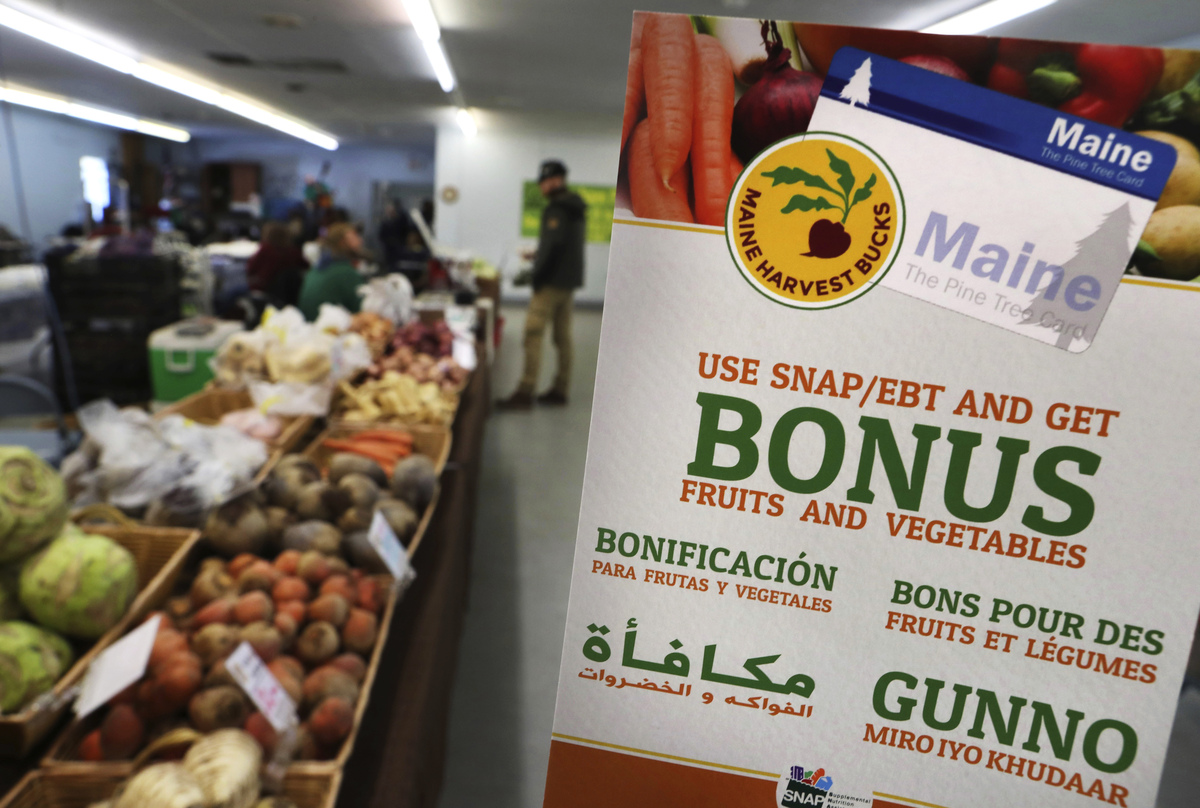
Maine could face up to $50 million in penalties next year due to errors in its payments for federal food benefits under the Supplemental Nutrition Assistance Program.
Newly released data from the U.S. Department of Agriculture find that Maine’s error rate last year was nearly 11%, the bulk of which were overpayments. That’s in line with the U.S. average. But starting in October of next year, states with error rates above 6% must cover a portion of the SNAP benefits.
Anna Korsen, executive director of Full Plates, Full Potential, said the overpayments aren’t fraud — they’re human error. She said this new cost-shifting policy enacted last year under the Trump administration further complicates the SNAP application process.
“Instead, we could make this program more accessible and more efficient,” Korsen said. “And that would reduce the number of errors and also ensure that Mainers who are eligible for SNAP have access to it.”
She’s urging Congress to delay or reverse the policy under the farm bill that’s currently under consideration.
Maine’s Department of Health and Human Services said it’s taking steps to reduce the error rate, including modernizing its systems and hiring an additional 40 eligibility specialists.
This story appears through a media partnership with Maine Public.

PORTLAND (WGME) — The third annual Celebration of America 300 is set for Thursday night at Oxford Plains Speedway.
This race was a favorite of NASCAR star Kyle Busch, who tragically passed away back in May. He was just 41.
Now, a Maine-born driver who worked on Busch’s team is ready to take the 8 car into victory lane.
For the past five years, Windham native Derek Kneeland was Busch’s eye in the sky, working as a spotter for the cup star. Kneeland says his relationship with Busch was like a brotherhood.
“I was fortunate enough where I got to have a personal relationship with him,” Kneeland said. “He came up, and he ran several races with me in late models and stuff at Oxford and Lee Speedway, and we got to do a lot of cool things together.”
Kneeland says dealing with the sudden loss has been both painful and difficult.
“It’s still hard,” Kneeland said. “I’m having a hard time with it. The weekdays are the hardest. At the track is where I’m most comfortable.”
Kneeland will be at the track and behind the wheel Thursday night, competing in the Celebration of America 300, driving the number 8 car.
“You know, a few days after everything went down, his dad called me, and his dad is a man of very few words, and I said, ‘You know, I’m thinking about running the 8 or 51 as long as I have your guys’ blessing, I would like to do that.’ And he said, ‘Short track world knows him as 51, but the world knows him as 8,’” Kneeland said.
Kneeland says it will be an emotional race, but he’s confident he’ll have a special co-pilot leading the way.
“Hoping he’s going to be on my shoulder and give me the guiding way and but to win it for Kyle, I think that would put the stamp on it,” Kneeland said.

FRIENDSHIP, Maine — A federal judge has ordered U.S. Immigration and Customs Enforcement not to relocate a Friendship man who ICE agents arrested Saturday.
Dhavalkumar Kalidas Patel was seized by four ICE agents at Wallace’s Market, which Patel and his wife operate on Harbor Road in Friendship.
His wife said the agents did not say why he was being taken away in handcuffs.
Attorney Audrey Richardson of Greater Boston Legal Services filed a motion for habeas corpus, meaning he is to be brought to a court in person.
U.S. District Court Judge Indira Talwani of Massachusetts issued an emergency order hours after Patel was seized that prohibits him from being moved elsewhere.
“To provide a fair opportunity for the judge who will be randomly assigned to this case to review the merits of the petition and to rule on any contested issues of jurisdiction, unless otherwise ordered by the assigned judge, respondents will not remove the petitioner from the jurisdiction of the United States or transfer petitioner to a judicial district outside that of Massachusetts for a period of at least 72 hours from the time this Order is docketed,” Talwani wrote.
Patel is being held at the Plymouth County Correctional Facility in Plymouth, Massachusetts.
The petition filed by the attorney representing Patel argues that he is being held unlawfully.
No further hearing dates have been scheduled, but the federal government has until July 6 to file a response.
Richardson issued a statement on the arrest.
“This is another example of ICE illegally and illegitimately taking someone who is working hard to support their family,” she said, including a child born in the United States. “The family is a critical part of the fabric of a small community.”
The Patels have operated the store since 2024. The attorney said ICE agents initially did not even identify themselves. They did not say where he was being taken but he was allowed to make a call when they stopped in Scarborough.
Rob Sample, a customer of the store, said he could not understand why such an action was taken.
“We appreciate them,” he said of the Patel family, adding that they work hard to provide a community service by operating the store.
Knox County Sheriff Patrick Polky said ICE notified his department after its action. He noted the agency is not required to notify the department.
Patel is a native of India.
This story appears through a media partnership with Midcoast Villager.
-

 California2 minutes ago
Southern California residents say HOA made them take down American flags
-

 Colorado9 minutes ago
Colorado’s Most Beautiful State Parks, Ranked By A Colorado Local
-

 Connecticut12 minutes ago
CT poised to invest again in childcare, pay down pension debt
-

 Delaware17 minutes ago
Delaware on Main Street Program Grows as 17 Communities Earn National Designations – State of Delaware News
-

 Florida24 minutes ago
Fast-growing South Florida wildfire consumes over 4,000 acres
-

 Georgia27 minutes ago
Aleks Arwood named runner-up at Miss Georgia – Thomasville Times-Enterprise
-

 Hawaii27 minutes ago
Maunakea Access Road proposals include toll booth, cultural center | Honolulu Star-Advertiser
-

 Illinois37 minutes ago
Serial Springfield Township sex offender faces public indecency charge

