Maine
Preparing for the Emerald Ash Borer: Announcing our spring webinar series – Maine Audubon


Background:
Emerald Ash Borer poses a uniquely devastating threat to Maine’s ecology, economy, and cultural history. Three native species of ash, all of which are key ecological and economic keystones, are being destroyed by the invasive pest which has been introduced in North American temperate forests. Climate change has aided the insect’s broadening range, while also adding to other stresses these trees and our forests face. International governments have been observing, studying, and responding to the EAB crisis for over a decade. As the borer advances east from Michigan, we have learned from federal, state, and tribal officials and experts what to expect, how we can prepare, and actions we can take to make our forests and communities more resilient. Through this partnership, this project will help develop a response to the EAB crisis as it unfolds across Maine, and will also contribute to the broader continental response by indigenous and settler governments and communities.
The Franxinus or Ash genus is unique in several ways. It is among the most abundant trees in Maine forests. Two species, F. pennsylvanica and F. americana, are also prolific street and landscape trees in developed areas. The third species, F. nigra, is a species central to the origins and culture of indigenous nations, communities, and people that continue to thrive and use Brown Ash for medicine, ceremony, artwork, and forest products throughout the entire region affected by EAB. These three attributes of Ash convey the magnitude of what is at stake when an entire genus of trees is potentially wiped from diverse landscapes which depend on it.
Announcing our Spring 2025 Webinar Series: Preparing for EAB
Since the earliest documented occurrences of Emerald Ash Borer (EAB) in Maine in 2013, Maine Audubon has been working with federal, state, and municipal forestry staff, as well as with indigenous scholars, cultural knowledge sharers, and basketmakers to better understand and plan our response to the ecological, cultural, and economic threats this invasive insect poses for the three species of Ash (Fraxinus spp.) native to Maine.
During May and June, Maine Audubon and partners will host a four-part series of evening webinars, each of which will focus on a specific aspect of the looming EAB crisis. Leaders from government, research, and cultural organizations will educate and inspire us about ash trees and what can be done to conserve them. The webinars will take place at 6 pm every other Thursday evening starting on May 8 and run through June 19.
Register for these free webinars:
May 8: Allison Kanoti, MFS – Impacts and response in Maine
Maine Forest Service entomologist Allison Kanoti will introduce us to the importance of Fraxinus (all three species) to forests, developed landscapes, and the economy. Allison will also cover the history of EAB presence and impacts in Maine to date, the state response, and how we all can get involved to help. Register >
May 22: Tony D’Amato, University of Vermont—Benefits and ecosystem services of Ash
Tony D’Amato is a regionally esteemed forest ecologist who will share the natural history of Fraxinus and present for us the innumerable benefits of having Ash in our forests and in our neighborhoods. Register >
June 5: APCAW panel—Cultural importance of Ash, multicultural response to EAB
Ash Protection Collaboration Across Wabanakik presents a panel of basketmakers, scholars, foresters, and researchers to share and discuss the importance and benefits of a blended, multicultural approach to protecting our ash, as well as how people can get involved to support this work. Register >
June 19: Theresa Secord—Honoring basketmakers, MIBA, and our shared cultural heritage
Founder of the Maine Indian Basketmakers Alliance (MIBA) and recent recipient of a $100,000 award from the Ruth Foundation for the Arts, Penobscot basketmaker Theresa Secord will offer a culminating presentation on the cultural and community implications of conserving Brown Ash. Theresa will share her craft and connections related to the tree at the center of Wabanaki origins. Register >
Thanks to a new grant from the Maine Outdoor Heritage Fund, Maine Audubon is partnering with our friends at Ash Protection Collaboration Across Wabanakik, a group of Indigenous and non-indigenous researchers, Tribal members, and forest caretakers, to develop new educational programming, community science, school curricula, and publications which will help leaders, land managers, and the general public understand, honor, and conserve our beloved and critically important Ash trees in forests and communities throughout Maine and beyond.
Look for more news on our website and at Maine Audubon centers and sanctuaries starting this summer.

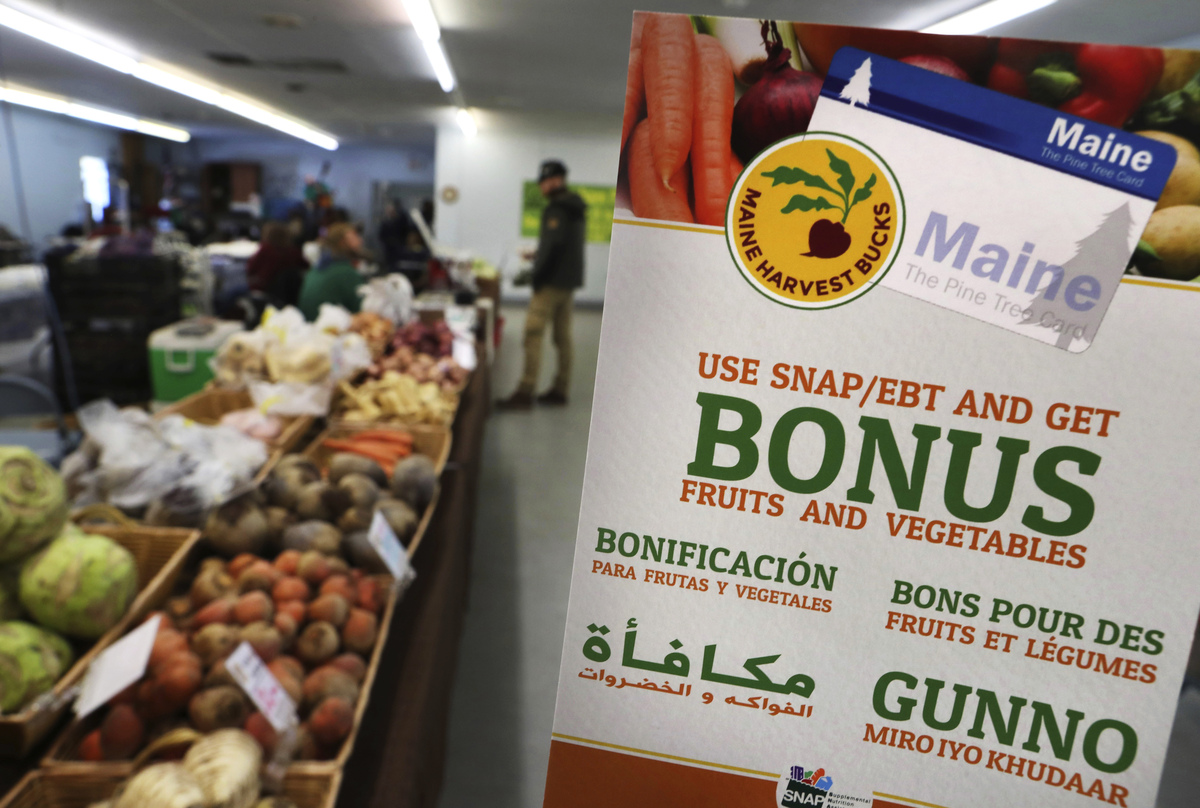
Maine could face up to $50 million in penalties next year due to errors in its payments for federal food benefits under the Supplemental Nutrition Assistance Program.
Newly released data from the U.S. Department of Agriculture find that Maine’s error rate last year was nearly 11%, the bulk of which were overpayments. That’s in line with the U.S. average. But starting in October of next year, states with error rates above 6% must cover a portion of the SNAP benefits.
Anna Korsen, executive director of Full Plates, Full Potential, said the overpayments aren’t fraud — they’re human error. She said this new cost-shifting policy enacted last year under the Trump administration further complicates the SNAP application process.
“Instead, we could make this program more accessible and more efficient,” Korsen said. “And that would reduce the number of errors and also ensure that Mainers who are eligible for SNAP have access to it.”
She’s urging Congress to delay or reverse the policy under the farm bill that’s currently under consideration.
Maine’s Department of Health and Human Services said it’s taking steps to reduce the error rate, including modernizing its systems and hiring an additional 40 eligibility specialists.
This story appears through a media partnership with Maine Public.

PORTLAND (WGME) — The third annual Celebration of America 300 is set for Thursday night at Oxford Plains Speedway.
This race was a favorite of NASCAR star Kyle Busch, who tragically passed away back in May. He was just 41.
Now, a Maine-born driver who worked on Busch’s team is ready to take the 8 car into victory lane.
For the past five years, Windham native Derek Kneeland was Busch’s eye in the sky, working as a spotter for the cup star. Kneeland says his relationship with Busch was like a brotherhood.
“I was fortunate enough where I got to have a personal relationship with him,” Kneeland said. “He came up, and he ran several races with me in late models and stuff at Oxford and Lee Speedway, and we got to do a lot of cool things together.”
Kneeland says dealing with the sudden loss has been both painful and difficult.
“It’s still hard,” Kneeland said. “I’m having a hard time with it. The weekdays are the hardest. At the track is where I’m most comfortable.”
Kneeland will be at the track and behind the wheel Thursday night, competing in the Celebration of America 300, driving the number 8 car.
“You know, a few days after everything went down, his dad called me, and his dad is a man of very few words, and I said, ‘You know, I’m thinking about running the 8 or 51 as long as I have your guys’ blessing, I would like to do that.’ And he said, ‘Short track world knows him as 51, but the world knows him as 8,’” Kneeland said.
Kneeland says it will be an emotional race, but he’s confident he’ll have a special co-pilot leading the way.
“Hoping he’s going to be on my shoulder and give me the guiding way and but to win it for Kyle, I think that would put the stamp on it,” Kneeland said.

FRIENDSHIP, Maine — A federal judge has ordered U.S. Immigration and Customs Enforcement not to relocate a Friendship man who ICE agents arrested Saturday.
Dhavalkumar Kalidas Patel was seized by four ICE agents at Wallace’s Market, which Patel and his wife operate on Harbor Road in Friendship.
His wife said the agents did not say why he was being taken away in handcuffs.
Attorney Audrey Richardson of Greater Boston Legal Services filed a motion for habeas corpus, meaning he is to be brought to a court in person.
U.S. District Court Judge Indira Talwani of Massachusetts issued an emergency order hours after Patel was seized that prohibits him from being moved elsewhere.
“To provide a fair opportunity for the judge who will be randomly assigned to this case to review the merits of the petition and to rule on any contested issues of jurisdiction, unless otherwise ordered by the assigned judge, respondents will not remove the petitioner from the jurisdiction of the United States or transfer petitioner to a judicial district outside that of Massachusetts for a period of at least 72 hours from the time this Order is docketed,” Talwani wrote.
Patel is being held at the Plymouth County Correctional Facility in Plymouth, Massachusetts.
The petition filed by the attorney representing Patel argues that he is being held unlawfully.
No further hearing dates have been scheduled, but the federal government has until July 6 to file a response.
Richardson issued a statement on the arrest.
“This is another example of ICE illegally and illegitimately taking someone who is working hard to support their family,” she said, including a child born in the United States. “The family is a critical part of the fabric of a small community.”
The Patels have operated the store since 2024. The attorney said ICE agents initially did not even identify themselves. They did not say where he was being taken but he was allowed to make a call when they stopped in Scarborough.
Rob Sample, a customer of the store, said he could not understand why such an action was taken.
“We appreciate them,” he said of the Patel family, adding that they work hard to provide a community service by operating the store.
Knox County Sheriff Patrick Polky said ICE notified his department after its action. He noted the agency is not required to notify the department.
Patel is a native of India.
This story appears through a media partnership with Midcoast Villager.
-

 Iowa3 minutes ago
Laid-off Iowa state IT workers receive offers from private company
-

 Kansas6 minutes ago
2 rescued from roof as house fire breaks out in Kansas City
-

 Kentucky6 minutes ago
Kentucky Wildcat News: Milan Momcilovic explains why he chose UK
-

 Louisiana18 minutes ago
Louisiana is epicenter for red snapper fishing in Gulf of America
-

 Maine21 minutes ago
Maine could face $50M in penalties from federal food assistance policy changes
-

 Maryland26 minutes ago
Hutzell: The best, worst and just plain weird of Maryland’s weak primary
-

 Michigan33 minutes ago
Michigan firefighter among 3 killed in Colorado. What we know
-

 Massachusetts36 minutes ago
Who will take care of our older and disabled people? – The Boston Globe

