The Senate held a rare Sunday session this weekend in hopes of finding a deal to end the government shutdown, which has lasted a record 40 days. (Mariam Zuhaib/Associated Press)
A group of moderate Democrats has a tentative deal to reopen the government if Republicans promise to hold a vote on expiring health care subsidies by December, a potential breakthrough as lawmakers seek to end the shutdown.
The group of three former governors — New Hampshire Sen. Jeanne Shaheen, New Hampshire Sen. Maggie Hassan and Independent Sen. Angus King of Maine — has a deal to pass three annual spending bills and extend the rest of government funding until late January, according to three people familiar with the agreement who requested anonymity until the deal is made public.
The deal was far from final, and final passage of the legislation could take several days. Republicans had not yet said whether they support the deal, and it was unclear whether there would be enough Democrats to support it absent their central demand through the now 40-day shutdown — an extension of the Affordable Care Act tax credits that expire Jan. 1.
After Democrats met for over two hours to discuss the proposal, Senate Democratic leader Chuck Schumer emerged to say he would vote “no.” Independent Sen. Bernie Sanders of Vermont, who caucuses with the Democrats, said as he walked into the meeting that it would be a “horrific mistake to cave in to Trump right now.”
Advertisement
Republicans have been working with the group of moderates as the shutdown continued to disrupt flights nationwide, threaten food assistance for millions of Americans and leave federal workers without pay. But many Democrats have warned their colleagues against giving in, arguing that they can’t end the fight without an agreement to extend the health subsidies.
Majority Leader John Thune, R-S.D., said earlier in the day that a potential deal was “coming together.” But he has not yet publicly endorsed it.
“We’ll see where the votes are,” Thune said.
Returning to the White House on Sunday evening after attending a football game, Trump did not say whether he endorsed the deal. But he said, “It looks like we’re getting close to the shutdown ending.”
Democrats have now voted 14 times not to reopen the government as they have demanded the extension of tax credits that make coverage more affordable for health plans offered under the Affordable Care Act. Republicans have refused to negotiate on the health care subsidies while the government is closed, but they have so far been supportive of the proposal from moderate Democrats as it emerged over the last several days.
Advertisement
The contours of a deal
The agreement would fund parts of government — food aid, veterans programs and the legislative branch, among other things — and extend funding for everything else until the end of January. It would take up Republicans on their longstanding offer to hold a future vote on the health care subsidies, with that vote occurring by the middle of December, the people said.
The deal would reinstate federal workers who had received reduction in force, or layoff, notices and reimburses states that spent their own funds to keep federal programs running during the shutdown. It would also protect against future reductions in force through January, the people said, and guarantee all federal workers would be paid once the shutdown is over.
Democratic Sen. Tim Kaine of Virginia, home to millions of federal workers, said he would support the deal.
“I have long said that to earn my vote, we need to be on a path toward fixing Republicans’ health care mess and to protect the federal workforce,” Kaine said.
Alongside the funding fix, Republicans released final legislative text of three full-year spending bills Sunday. That legislation keeps a ban on pay raises for lawmakers but boosts their security by $203.5 million in response to increased threats. There’s also a provision championed by Sen. Mitch McConnell, R-Ky., to prevent the sale of some hemp-based products.
Advertisement
Democratic pushback expected
Republicans only need five votes from Democrats to reopen the government, so a handful of senators could end the shutdown with only the promise of a later vote on health care. Around 10 to 12 Democrats have been involved in the talks, and the three people familiar with the agreement said they had enough votes to join with Republicans and pass the deal.
Many of their Democratic colleagues are saying the emerging deal is not enough.
“I really wanted to get something on health care,” said Michigan Sen. Elissa Slotkin. “I’m going to hear about it right now, but it doesn’t look like it has something concrete.”
House Democrats were also chiming in against it. Texas Rep. Greg Casar, the chairman of the Congressional Progressive Caucus, said a deal that doesn’t reduce health care costs is a “betrayal” of millions of Americans who are counting on Democrats to fight.
“Accepting nothing but a pinky promise from Republicans isn’t a compromise — it’s capitulation,” Casar said in a post on X. “Millions of families would pay the price.”
Advertisement
Rep. Angie Craig of Minnesota posted that “if people believe this is a ‘deal,’ I have a bridge to sell you.”
Even if the Senate were to move forward with funding legislation, getting to a final vote could take several days if Democrats who oppose the deal object and draw out the process. The first vote, which could come as soon as Sunday evening, would be to proceed to consideration of the legislation.
Republicans preview health care debate
There is no guarantee that the Affordable Care Act subsidies would be extended if Republicans agree to a future vote on health care. House Speaker Mike Johnson, R-La., has said he will not commit to a health vote.
Some Republicans have said they are open to extending the COVID-19-era tax credits as premiums could skyrocket for millions of people, but they also want new limits on who can receive the subsidies and argue that the tax dollars for the plans should be routed through individuals.
Other Republicans, including Trump, have used the debate to renew their yearslong criticism of the law and called for it to be scrapped or overhauled.
Advertisement
“THE WORST HEALTHCARE FOR THE HIGHEST PRICE,” Trump said of the Affordable Care Act in a post Sunday.
Shutdown effects worsen
Meanwhile, the consequences of the shutdown were compounding. U.S. airlines canceled more than 2,000 flights on Sunday for the first time since the shutdown began, and there were more than 7,000 flight delays, according to FlightAware, a website that tracks air travel disruptions.
Treasury Secretary Sean Duffy said on CNN’s “State of the Union” that air travel ahead of the Thanksgiving holiday will be “reduced to a trickle” if the government doesn’t reopen.
At the same time, food aid was delayed for tens of millions of people as Supplemental Nutrition Assistance Program benefits were caught up in legal battles related to the shutdown. More than two dozen states warned of “catastrophic operational disruptions” as Trump’s administration is demanding states “undo” benefits paid out under judges’ orders last week, now that the U.S. Supreme Court has stayed those rulings.
And in Washington, home to millions of federal workers who have gone unpaid, the Capital Area Food Bank said it is providing 8 million more meals than it had prepared to this budget year — a nearly 20% increase.
Advertisement
___
Associated Press writers Stephen Groves and Kevin Freking contributed to this report.
Join Girl Scouts of Maine for a sweet summer stop you won’t want to miss!
We’re popping up at local ice cream shops around Maine for our Ice Cream Socials—fun, casual events where families can enjoy a free treat and learn more about Girl Scouts.
Here’s what to expect: 🍦 One FREE kid-sized cone per family when you stop by and connect with us 🌱 Hands-on activity for kids (like a planting activity or fidget spinner craft) 💬 A chance to chat with our team and learn how Girl Scouts builds confidence, friendships, and unforgettable experiences
Whether you’re curious about joining, looking for activities for your child, or just want to enjoy a sweet treat, we’d love to meet you!
Advertisement
✨ Open to all families—no registration required. Just stop by, say hello, and enjoy some ice cream with us.
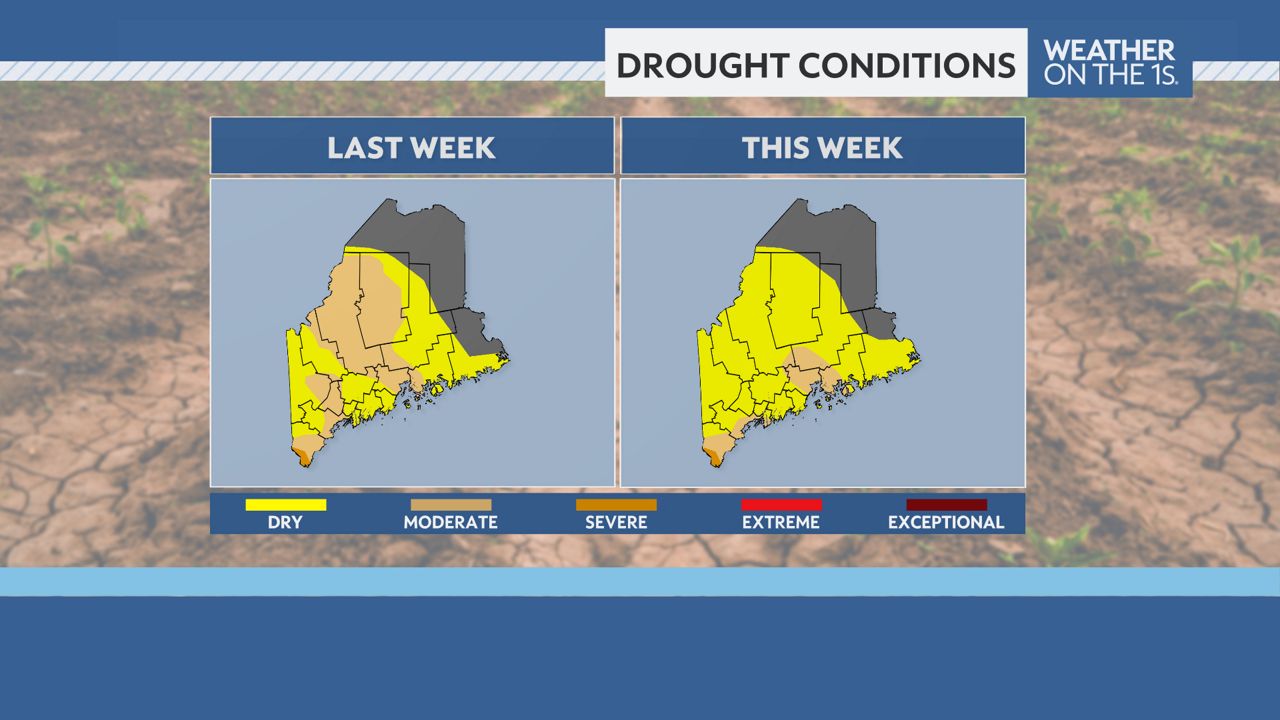
The recent rain in Maine is easing the drought that parts of the state have been experiencing since the fall.
Scott Dean, a Spectrum meteorologist, said much of Maine has been at least “dry” for several months. Parts of the state, including Portland, Bangor and Bar Harbor, are under a “moderate” drought.
Much of the country is also experiencing a drought, Dean added. The Southeast is seeing extreme levels of drought, and the West coast has been under a drought for years. There are many factors that go into this, including climate change, weather patterns like El Niño and La Niña and other factors.
And, when an area does experience drought, it can become a feedback loop. With less moisture in the ground and atmosphere, the drought can “feed upon itself,” Dean said.
Advertisement
“It takes a while to get into a drought and it also takes a while to get out of one,” Dean said.
But, the rainy days in Maine have been alleviating the drought, Dean said. And, the trend is likely to continue — the forecast is predicting above average levels of precipitation for the next three to four weeks.
“Hopefully, we are continuing to head in the right direction as the drought has eased in these areas,” Dean said.
In fact, if these rains do continue, Maine could come out of the drought sometime this summer.
STANDISH – Craig J. Ahlemeyer, 48 of Standish, passed away unexpectedly, Saturday, June 13, 2026.A memorial service will be held at 1 p.m., Saturday, June 27 th at Standish Congregational Church, 25 Oak Hill Road in Standish. A reception will follow.To see Craig’s full obituary, share a memory or leave the family an online condolence, please visit http://www.athutchins.com.