Maine
Maine grower is changing the state's fruit tree landscape


The Fameuse apple originated in Canada in the 1600s, but its role in Maine’s apple history was epic.
It’s thought to be a parent of the state’s popular McIntosh, which has been a staple for hundreds of commercial and private orchards around the state for more than 200 years.
The Fameuse and other old varieties like it, such as the Black Oxford, Cherryfield and Chenango Strawberry apple, almost disappeared but were revived and now thrive across Maine.
Their tales often go back to early settlers who brought the trees from overseas to plant on new homesteads and farms. Black Oxford, a Maine original, was discovered on the farm of an Oxford County nailmaker in the 1790s; a Hallowell tree planted in 1799 is still alive. Cherryfield was developed in that Down East town more than 150 years ago, then rediscovered by residents. The Chenango Strawberry apple was originally called Frank after the first name of a New York man who introduced it; others know it as Zepherus Chernogous.
By the 1970s, many such Maine trees were near the ends of their lifespans. Their fields were overgrown, the farmers who planted them forgotten. When Palermo resident John Bunker started rediscovering them, they were mostly “mysterious, anonymous gifts from the past.”
These apples, their histories and their abilities to thrive in Maine’s weather could disappear forever if someone didn’t take action soon, he realized. That led him to create the first Fedco Trees mail-order in 1984: a two-page handout, including 17 apple types, stapled to the Clinton-based Fedco Seeds cooperative catalog.
Over the next 40 years, Bunker’s hobby grew into a business that has changed the state’s fruit tree landscape on homesteads and small farms, saving and spreading these varieties that could have been lost otherwise, along with other unique fruits, trees and ornamentals.
Though heritage apples are familiar to many Mainers, Fedco Trees’ current coordinator Jen Ries said there’s still work to do. Until everybody knows about heritage fruit and you can find it at any grocery store, the mission continues, she said.
Popular choices for Fedco customers today include the Black Oxford; Baldwin, one of New England’s oldest apples with origins in 1740s Massachusetts; and Northern Spy, an all-purpose from Connecticut first planted from a seed more than two centuries ago.
Estimates vary, but the United States likely had more than 7,000 such cultivars in the 19th century and probably has less than half that many today as commercial production focuses on favorites such as Granny Smith and Honeycrisp. More genetic diversity in plants means more resilience from weather, disease and pests, which disappears with extinction, according to numerous researchers, including the U.S. Department of Agriculture.
Back in the early 1980s, local resources for Maine gardeners focused on vegetable production, according to Bunker. He thought people should have access to fruit education and tree stock too — plus, he had questions about their history.

He uncovered fruit names, history and characteristics through books, conferences, a booth at the Common Ground Country Fair, tracking down experts, finding mentors and, occasionally, knocking on a stranger’s door after driving by an interesting tree. Bunker estimates he’s spent hundreds of hours in orchards, botanical gardens and arboretums in Maine, Boston and New York.
He decided early on to make the catalog intelligent, honest, educational and focused on what he knew best — cold-hardy varieties growing in Maine.
If someone from Texas read it, he hoped they’d be inspired to start their own locally focused project. Heritage apple nurseries and preservation orchards exist across the country with a scattering of other “fruit detectives,” working independently and together in groups such as the Historic Fruit Tree Working Group.
The catalog grew, and a physical community did too around an annual in-person spring sale of discounted extra stock. That event was an equalizer, Bunker said, drawing businesspeople alongside homesteaders.
By 1994, his hobby had grown into a full-time job. Ries started working with him 22 years ago and took the lead at the tree division around 2020.
This year’s catalog has 170 apples and 650 listings, from cherries to groundcover plants to asparagus. Popular choices include the Madison Peach, Montmorency Cherry, Purple Heart Plum, American Elms and American Chestnuts, according to Ries, plus lilacs and cold-hardy heritage roses. The division sold more than 100,000 plants and trees last year.
Small local farms grow about three-quarters of this stock with mentorship from the company. Some have started their own nurseries.

Fedco also grows trees from farther south, such as the Chestnut Oak, with a native range from Georgia to southwestern Maine that’s now surviving farther east, and American Sycamore, which previously grew in the southern states and the central Midwest.
That’s in response to the way climate change is shifting growing conditions and bringing new pests, according to Ries. People are starting to plant southern species here to prepare for a warmer climate, a process called assisted migration.
The company also added a refrigeration system to keep its trees dormant through the winter, which they need to survive cold temperatures and grow successfully. In the past, it stayed cold enough to store them outside.
Things have changed on the commercial side of Maine’s apple landscape too, according to Renae Moran, a tree fruit specialist with the University of Maine. Twenty-five years ago, McIntosh, Red Delicious and Golden Delicious were dominant.
Honeycrisp, a patented fruit first sold in the late 1990s, is the focus for growers and the university’s research farm now, she said, along with other trademarked cultivars that growers are trialing themselves.
The university doesn’t have data for hobby growers, though she noted an increasing interest in hard cider. Moran said many farmstands carry heritage or antique apples, but sales are limited in comparison to commercial types.
Every year, Ries sees new customers be surprised by the variety of fruit that exists. She’s also seeing more new gardeners and people growing food in cities or suburbs, using the trees to feed their families, serve as memorials or mark life events.
Forty years in, Bunker comes across apple trees he sold that have grown large enough for grandchildren to climb on.
“It’s very personal for people to plant a tree,” Ries said.



Many Maine municipalities will open cooling centers this week with the National Weather Service issuing a variety of heat advisories covering the next few days.
The Maine DEP also issued an air quality alert for Wednesday with ground-level ozone expected to reach levels that are unhealthy for sensitive groups.
All of York County, interior Cumberland and Androscoggin counties, and the southern half of Oxford County will fall under an extreme heat warning from 11 a.m. Wednesday to 8 p.m. Friday.
The warning calls for “dangerously hot conditions” that could feature heat index values of up to 110 degrees, with overnight lows only expected to fall into the 70s, according to the weather service’s office in Gray.
The rest of the state — save northern Aroostook, Piscataquis and Somerset counties — falls under a heat advisory from 11 a.m. to 8 p.m. on Wednesday. However, the weather service has also placed much of the state under an extreme heat watch for Thursday.
Heat index values, which measure how hot it feels to the human body when relative humidity is combined with the air temperature, are expected to reach up to 104 degrees during the heat advisory period, the weather service warns. They could reach 110 degrees Thursday, when the extreme heat watch is in effect.
Northern Oxford and Franklin counties, and central Somerset County, can expect a heat index value of up to 99 degrees Wednesday, according to the weather service.
The weather service advises people to drink plenty of fluids, stay in air-conditioned rooms when possible, avoid extended periods in the sun and check up on relatives and neighbors. It also warns not to leave young children and pets in unattended vehicles, as “car interiors will reach lethal temperatures in a matter of minutes.”
Cooling Centers
The Maine Department of Environmental Protection has also issued an air quality alert from 10 a.m. to 11 p.m. on Wednesday along the coast from Kittery to Acadia National Park. The agency warns that ground-level ozone concentrations are expected to reach levels that are unhealthy for sensitive groups.
Ozone levels may reach “moderate levels” further inland, according to the Maine DEP, including in all of Androscoggin and Kennebec counties, as well as parts of Cumberland, Knox, Lincoln, Penobscot, Sagadahoc, Waldo, Washington and York counties.
Elevated ozone levels can pose a risk to children, older adults and people suffering from respiratory or heart diseases, according to the Maine DEP. Anyone exerting themselves outdoors may also experience health effects, which could include coughing, shortness of breath, throat irritation and mild chest pain.
Ozone levels were already climbing in southern New England on Tuesday, according to the Maine DEP, and winds are expected to bring those conditions to Maine on Wednesday.
The Maine DEP recommends that vulnerable populations avoid strenuous outdoor activities, keep windows closed, and circulate indoor air with fans or air conditioners. Those with asthma are also advised to keep quick-relief medication handy.
Particle pollution levels are also expected to be moderate across the state on Wednesday due to wildfire smoke, the Maine DEP said in its announcement Tuesday. Wildfires in Colorado, which have claimed the lives of three firefighters, had burned nearly 90,000 acres as of Tuesday, according to the Denver Post.
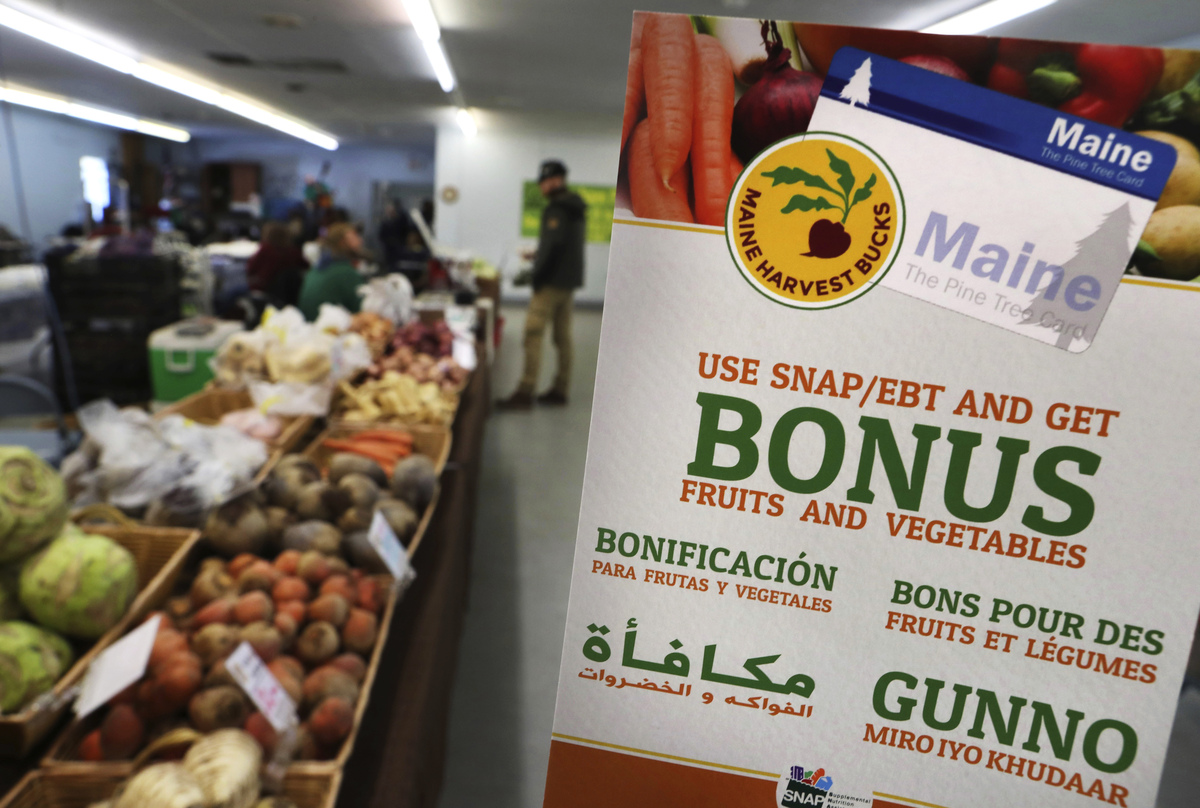
Maine could face up to $50 million in penalties next year due to errors in its payments for federal food benefits under the Supplemental Nutrition Assistance Program.
Newly released data from the U.S. Department of Agriculture find that Maine’s error rate last year was nearly 11%, the bulk of which were overpayments. That’s in line with the U.S. average. But starting in October of next year, states with error rates above 6% must cover a portion of the SNAP benefits.
Anna Korsen, executive director of Full Plates, Full Potential, said the overpayments aren’t fraud — they’re human error. She said this new cost-shifting policy enacted last year under the Trump administration further complicates the SNAP application process.
“Instead, we could make this program more accessible and more efficient,” Korsen said. “And that would reduce the number of errors and also ensure that Mainers who are eligible for SNAP have access to it.”
She’s urging Congress to delay or reverse the policy under the farm bill that’s currently under consideration.
Maine’s Department of Health and Human Services said it’s taking steps to reduce the error rate, including modernizing its systems and hiring an additional 40 eligibility specialists.
This story appears through a media partnership with Maine Public.
-
 Lifestyle18 minutes ago
Greetings from London, where Banksy’s flag man is a warning cry
-
Education22 minutes ago
This Little Robot Cleans Windows
-

 Technology27 minutes ago
Comcast’s split could make or break Peacock
-

 World34 minutes ago
State Department congratulates Keiko Fujimori as Peru’s president-elect following razor-thin vote count
-

 Politics36 minutes ago
Mamdani ripped for claiming victory over capitalism after NYC’s multi-billion dollar taxpayer funded bailout
-

 Health42 minutes ago
American vaccines that transformed public health over 250 years: ‘Outweighs harm’
-

 Sports49 minutes ago
Ex-NFL reporter Dianna Russini interaction with police officer to dodge traffic ticket comes to light
-
 Business56 minutes ago
Joby Aviation creates a joint venture with Toyota to build air taxis

