Maine
‘It absolutely happens here’: Labor trafficking in Maine

This is part one of a two-part series in honor of Human Trafficking Awareness Month.
What industries run Maine’s economy? The farmlands full of blueberries and potatoes, the seafood processing centers on our coasts, or the hospitality services that accommodate visitors all year round?
Those are only some of the many employment fields in the state, and across the country, where people are subjected to labor trafficking.
What is it?
Labor trafficking is using fraud, force, or coercion to secure involuntary labor. Many who end up in environments where their labor is being exploited can’t leave due to external factors, such as poverty, lack of housing, and unstable immigration status, among other things, according to Hailey Virusso, director of anti-trafficking services at Portland’s Preble Street.
The key distinction is the use of coercion within the job environment to keep people from leaving. According to the United Nations’ International Labour Organization, an estimated 27.6 million people were trafficked worldwide in 2021, 77% of whom were victims of forced labor.
There are no such statistics for Maine, which Virusso said is not for lack of occurrence but because most funding is used to research sex trafficking.
“One of the biggest misconceptions, specifically here in Maine, is the mentality that it doesn’t happen here. It absolutely happens here, and that is why our program is in existence,” she said.
Since 2013, Preble Street’s anti-trafficking division has been working across Maine to support all ages, genders, sexualities, races and immigration statuses, whether they are actively being trafficked or have experienced it in the past. The organization helps an average of 100-150 victims of both labor and sex trafficking every year, a third of which are under the age of 18 either then or when the trafficking occurred.
Virusso said these numbers have grown over the past year as new resources have allowed Preble Street to expand its outreach programs to rural areas where information is harder to come by, most recently Down East. This includes providing training to different sectors, placing awareness posters in public places, and going to schools to educate young people.
The realities of trafficking
There are sectors where labor trafficking is more likely to occur: Professions that see higher exploitive practices due to fewer regulations or oversights; ones that employ large migrant workforces or immigrants who may lack a lawful presence – although it’s a misconception that most forced labor victims are in the U.S. illegally, as the National Institute of Justice found that 71% of victims enter the country on lawful work visas. Meanwhile, most people Preble Street encounters are survivors of domestic servitude: forced labor within a private home.
When identifying possible victims of trafficking, the organization shies away from using physical descriptors or behaviors that may perpetuate stereotypes and instead takes a needs-based approach.
“Trafficking certainly can be folks being held against their will, but I would also argue that the conditions that perpetuate trafficking are structural. When people don’t have their needs met, they’re at higher risk of being victimized so without housing, without food, without health care, without social connection,” explained Virusso.
This also means minority groups that are statistically more likely to have unmet social needs are also at an increased risk of being trafficked, such as Indigenous men and women who experience violent crime at rates higher than the national average or LGBTQ youth who account for a disproportionate number of runaways and minors experiencing homelessness.
Preble Street endeavors to target the systematic issues that make people vulnerable to trafficking, like offering transitional and rapid rehoming services as 90% of the people they serve, both adults and youth, identify lack of stable housing as a main issue. Providing these resources allows people to remove themselves from harmful cycles where they could potentially be revictimized.
In addition to social factors, Virusso also identified forced criminality as a tactic used by traffickers to control victims: forcing them to work in illicit environments (such as unlicensed marijuana growing or harvesting sites), transport or possess drugs, write false checks or do other illegal activities.
The web can be hard to disentangle as these victims are often misidentified as criminals when there is coercion occurring. This becomes harder with juvenile offenders. In cases of sex trafficking, anyone under 18 who is induced to perform a commercial sex act is considered a victim, regardless of whether they were forced or coerced. This isn’t true for youth victims of forced criminality who need to prove external pressure, but Virusso said this requirement doesn’t take into account that children are socialized to listen to adults.
“There’s no more powerful force than to leverage a crime that somebody’s committed over them,” she said.
What can be done?
One of the main components of Preble Street’s outreach program is providing training to help different sectors identify signs of trafficking, particularly in the healthcare industry as 68% of victims are seen by a healthcare professional while being trafficked. Some indicators could include being repeatedly treated for the same injuries or frequent STIs.
Virusso also advises people to vote for policies that increase access to social services and immigration relief as ways to alleviate trafficking and labor exploitation.
Above all else: Listen to survivors. They know what they need better than anyone else.
“We want to make sure that anytime somebody is seeking to exit a situation, they have their resources to do so, but we don’t believe in a rescue mentality. Survivors are savvy, resilient, smart people who are making decisions for themselves daily about what they need, and what they don’t need, to make sure that their situation is as safe as possible,” said Virusso.
Preble Street will host an event in honor of Human Trafficking Awareness Month at the Healing Center, 55 Portland St., Portland on Jan. 22, 3-5 p.m. All are welcome.
Resources
National Human Trafficking 24/7 Hotline: 1-888-373-7888, Text: 233733
Preble Street: (207) 775-0026. Not sure if you’re experiencing exploitation or trafficking? Take the online self-identification on Preble Street’s website.



Many Maine municipalities will open cooling centers this week with the National Weather Service issuing a variety of heat advisories covering the next few days.
The Maine DEP also issued an air quality alert for Wednesday with ground-level ozone expected to reach levels that are unhealthy for sensitive groups.
All of York County, interior Cumberland and Androscoggin counties, and the southern half of Oxford County will fall under an extreme heat warning from 11 a.m. Wednesday to 8 p.m. Friday.
The warning calls for “dangerously hot conditions” that could feature heat index values of up to 110 degrees, with overnight lows only expected to fall into the 70s, according to the weather service’s office in Gray.
The rest of the state — save northern Aroostook, Piscataquis and Somerset counties — falls under a heat advisory from 11 a.m. to 8 p.m. on Wednesday. However, the weather service has also placed much of the state under an extreme heat watch for Thursday.
Heat index values, which measure how hot it feels to the human body when relative humidity is combined with the air temperature, are expected to reach up to 104 degrees during the heat advisory period, the weather service warns. They could reach 110 degrees Thursday, when the extreme heat watch is in effect.
Northern Oxford and Franklin counties, and central Somerset County, can expect a heat index value of up to 99 degrees Wednesday, according to the weather service.
The weather service advises people to drink plenty of fluids, stay in air-conditioned rooms when possible, avoid extended periods in the sun and check up on relatives and neighbors. It also warns not to leave young children and pets in unattended vehicles, as “car interiors will reach lethal temperatures in a matter of minutes.”
Cooling Centers
The Maine Department of Environmental Protection has also issued an air quality alert from 10 a.m. to 11 p.m. on Wednesday along the coast from Kittery to Acadia National Park. The agency warns that ground-level ozone concentrations are expected to reach levels that are unhealthy for sensitive groups.
Ozone levels may reach “moderate levels” further inland, according to the Maine DEP, including in all of Androscoggin and Kennebec counties, as well as parts of Cumberland, Knox, Lincoln, Penobscot, Sagadahoc, Waldo, Washington and York counties.
Elevated ozone levels can pose a risk to children, older adults and people suffering from respiratory or heart diseases, according to the Maine DEP. Anyone exerting themselves outdoors may also experience health effects, which could include coughing, shortness of breath, throat irritation and mild chest pain.
Ozone levels were already climbing in southern New England on Tuesday, according to the Maine DEP, and winds are expected to bring those conditions to Maine on Wednesday.
The Maine DEP recommends that vulnerable populations avoid strenuous outdoor activities, keep windows closed, and circulate indoor air with fans or air conditioners. Those with asthma are also advised to keep quick-relief medication handy.
Particle pollution levels are also expected to be moderate across the state on Wednesday due to wildfire smoke, the Maine DEP said in its announcement Tuesday. Wildfires in Colorado, which have claimed the lives of three firefighters, had burned nearly 90,000 acres as of Tuesday, according to the Denver Post.
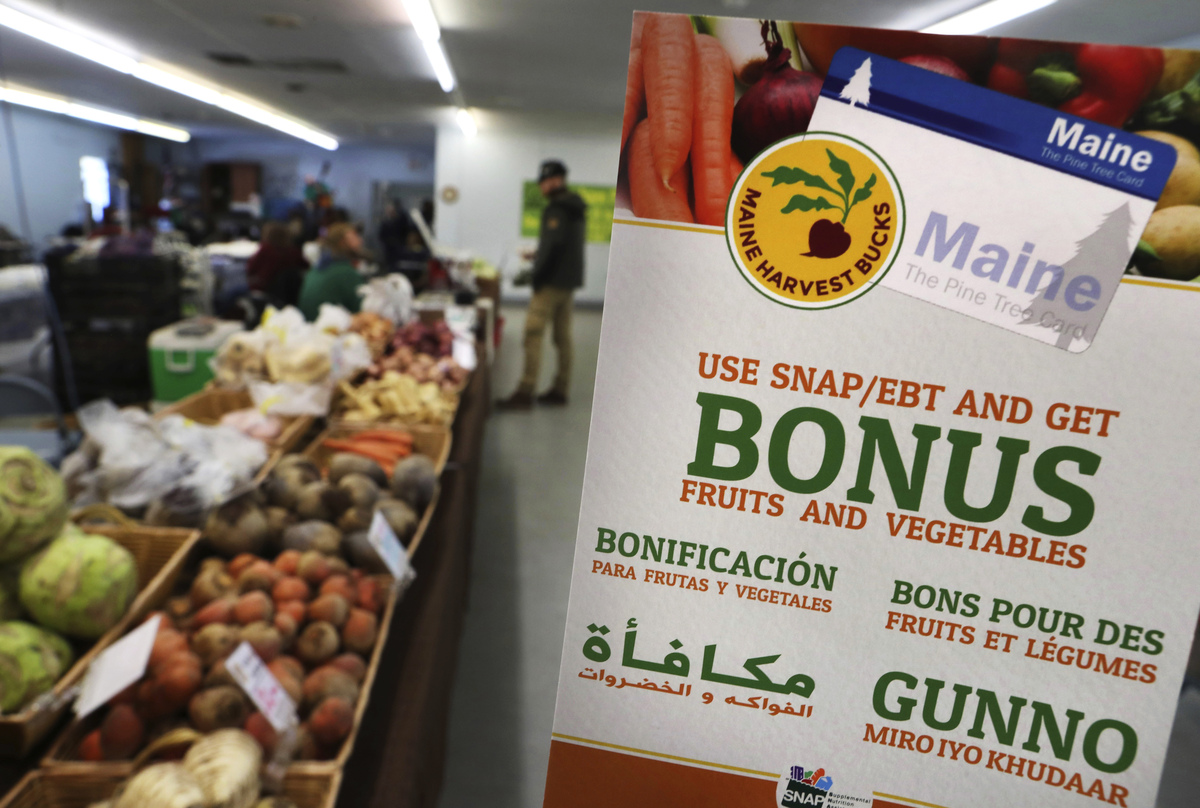
Maine could face up to $50 million in penalties next year due to errors in its payments for federal food benefits under the Supplemental Nutrition Assistance Program.
Newly released data from the U.S. Department of Agriculture find that Maine’s error rate last year was nearly 11%, the bulk of which were overpayments. That’s in line with the U.S. average. But starting in October of next year, states with error rates above 6% must cover a portion of the SNAP benefits.
Anna Korsen, executive director of Full Plates, Full Potential, said the overpayments aren’t fraud — they’re human error. She said this new cost-shifting policy enacted last year under the Trump administration further complicates the SNAP application process.
“Instead, we could make this program more accessible and more efficient,” Korsen said. “And that would reduce the number of errors and also ensure that Mainers who are eligible for SNAP have access to it.”
She’s urging Congress to delay or reverse the policy under the farm bill that’s currently under consideration.
Maine’s Department of Health and Human Services said it’s taking steps to reduce the error rate, including modernizing its systems and hiring an additional 40 eligibility specialists.
This story appears through a media partnership with Maine Public.
-
 Lifestyle17 minutes ago
Greetings from London, where Banksy’s flag man is a warning cry
-
Education20 minutes ago
This Little Robot Cleans Windows
-

 Technology25 minutes ago
Comcast’s split could make or break Peacock
-

 World32 minutes ago
State Department congratulates Keiko Fujimori as Peru’s president-elect following razor-thin vote count
-

 Politics35 minutes ago
Mamdani ripped for claiming victory over capitalism after NYC’s multi-billion dollar taxpayer funded bailout
-

 Health40 minutes ago
American vaccines that transformed public health over 250 years: ‘Outweighs harm’
-

 Sports47 minutes ago
Ex-NFL reporter Dianna Russini interaction with police officer to dodge traffic ticket comes to light
-
 Business55 minutes ago
Joby Aviation creates a joint venture with Toyota to build air taxis

