Maine
Gulf of Maine, Oregon offshore wind lease sales proposed


May 1, 2024

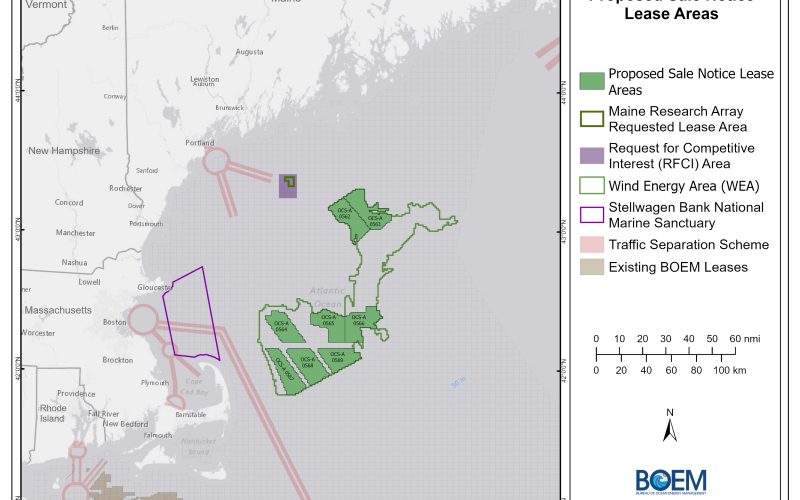
The Interior Department moved ahead April 30 proposing the first offshore wind energy auctions in the Gulf of Maine and off Oregon, moving the Biden administration’s renewable energy drive into the realm of deeper waters and floating wind turbines.
The Gulf of Maine proposed sale would include eight lease areas off Maine, Massachusetts, and New Hampshire, covering nearly 1 million acres with potential for turbine arrays with a maximum rated output of 15 gigawatts, according to the federal Bureau of Ocean Energy Management.
(The actual average generation from wind turbines being built in the northwest Atlantic off the U.S. East Coast has been estimated at around 42% to 45% of maximum potential, often referred to as nameplate rating, according to industry sources and the U.S. National Renewable Energy Laroratory.)
BOEM narrowed the lease offering areas from its last wind energy area mapping in the gulf, a process the agency says “prioritized avoidance of offshore fishing grounds and identification of vessel transit routes, while retaining sufficient acreage to support the region’s offshore wind energy goals” of 13 GW to 18 GW.
The Oregon lease offerings are two areas: the Brookings Wind Energy Area of 133,792 acres, about 18 miles from shore, and the Coos Bay Wind Energy Area of 61,203 acres 32 miles offshore. Together the two areas could have potential for up to 3.1 GW of power output rating.
The move to lease areas for floating wind turbines is another level from BOEM leasing on the shallow East Coast outer continental shelf for turbines on foundations in the sea floor. The technology will have its own new issues with anchoring, cables and environmental impact.
Oregon tribes and commercial fishing groups pressed Gov. Tina Kotek trying to block BOEM leasing, and New England fishing advocates have been skeptical of the Gulf of Maine planning process.
BOEM Director Elizabeth Klein said the agency is continuing to work with interest groups: “As we move forward with offshore wind energy in Oregon and the Gulf of Maine, the Bureau of Ocean Energy Management remains dedicated to close collaboration with our government partners and key stakeholders.”
BOEM worked with the National Oceanic and Atmospheric Administration’s National Centers for Coastal Ocean Science to use NOAA ocean resource information when analyzing wind energy areas. BOEM says the process “prioritized avoidance of offshore fishing grounds and identification of vessel transit routes, while retaining sufficient acreage to support the region’s offshore wind energy goals.”
In the Gulf of Maine, BOEM proposes simultaneous auctions for each of the eight lease areas using multiple-factor bidding. In the public comment period before the sales, is proposing bidding credits to wind companies that commit to supporting workforce training programs or supply chain development, or a combination of both, as well as a credit for a fisheries compensatory mitigation fund.
Other potential lease stipulations could focus on vessel transit and baseline environmental monitoring.
In Oregon, BOEM likewise proposes lease stipulations “to create good-paying union jobs and continue robust engagement with Tribal governments, the fishing industry, affected communities, and other ocean users. Potential stipulations for the proposed Oregon sale include providing bidding credits to bidders that commit to supporting workforce training programs for the floating offshore wind energy industry, developing a domestic supply chain for the floating offshore wind industry, or a combination of both.”
Wind companies could gain bidding credits with community benefit agreements with “Tribes, local communities, ocean users, or stakeholder groups expected to be affected by potential impacts from activities resulting from lease development,” according to BOEM.



Are you up for a Maine food challenge, or are your eyes bigger than your stomach?
A Waterville staple, Buen Apetito has a monster burrito just waiting for someone to eat it down to the very last bite.
This thing is a beast, literally called La Bestia, and it’s definitely a mighty task for a fearless foodie.
Take on the Buen Apetito La Bestia Food Challenge in Waterville, Maine
According to Buen Apetito, if you can finish a super-sized burrito in 30 minutes or less, you’ll get the $60 meal for free, a La Bestia champion shirt, and a picture on the wall of fame. That’s not to mention the bragging rights of dominating a task few will be able to conquer.
Wondering what’s in the burrito?
The Mexican restaurant shared in a Facebook comment on a post that the burrito is filled with “grilled chicken, chorizo, and tender shredded beef or pork. Built on a layer of seasoned rice, refried beans, and French fries, it’s melted together with a shredded Mexican cheese blend and a drizzle of creamy cheese sauce, sautéed peppers and onions, green salsa, pico de gallo, sour cream, creamy guacamole, and a bed of shredded lettuce all wrapped in three extra-large tortillas fused into one epic wrap.”
Let’s just say that this thing is packed full.
The first La Bestia contender took up his fork and knife in December 2025, but despite coming close, he couldn’t come out with the win.
As of March 2026, the challenge has remained undefeated. But you never know, someone is bound to come out victorious.
Just note that you can only try your hand at this food challenge on Wednesday and Thursday.
Buen Apetito Has Been a Longstanding Waterville, Maine, Restaurant
First opened in 1999, Buen Apeitito has been around for nearly 30 years.
Centralmaine.com reported that the Mexican restaurant was originally located at the Railroad Square complex off Chaplin Street before moving to 99 West River Road in 2023.
A little over a year later, in 2024, Buen Apetito shared on Facebook that it was passing on the torch to new owners, including Dalia, “the heart and soul of [the] kitchen for twenty years,” her daughter, Norma, and Norma’s husband, Shawn.
READ MORE: Famous Maine Restaurant Buen Apetito Adds Powerhouse New Owner to Crew
And it seems like not only are things still going strong, but new additions like La Bestia food challenge are only enhancing the spirit of big flavor and delicious Mexican food at the Waterville staple.
So, you think you’re up for the task of taking down a beast of a burrito at Buen Apetito? Good luck.
You Know You’re From Maine If You’ve Tried All 19 of These Foods
Here’s a number of foods associated with Maine. How many of them have you had?
Gallery Credit: Sean McKenna
The New York Time’s Best Restaurant Lists Feature These 7 Maine Spots
Gallery Credit: Sean McKenna

BANGOR, Maine (WABI) – Monday’s telethon held by WABI in partnership with Penquis and Heart of Maine United Way Monday raised money for the heating of homes, something so basic, yet so significant in a state like Maine.
Danielle Hewes, Penquis contributor and volunteer, says some people might not even know that they qualify for heating assistance.
“I think there’s this misconception that you can’t get that if you’re working. Like that’s just for people on general assistance. The truth of the matter is this is for the people that are maybe not able to work, but also for the people that are working. They’re making ends meet,” she said.
For Danielle, that’s what makes events like the telethon so special: it’s making a real difference in the community with people who need the help the most.
Speaking about Penquis in particular, she said, “You learn about all of the other things they do and how they help the community and you can’t help but want to be a part of that.”
If you weren’t able to donate Monday, donations are still being accepted.
You can go to homeunitedway.org/heat.
You can also call 941-2800.
Copyright 2026 WABI. All rights reserved.

PORTLAND, Maine (AP) — Maine Democrat Graham Platner has picked up another high-profile endorsement in his bid to flip a key Senate seat blue, marking another sign of the oyster farmer and combat veteran’s political resiliency even as he continues to face controversy throughout his campaign.
Arizona Democrat Ruben Gallego announced Monday that he was backing Platner, saying that the first-time candidate “reflects the grit and independence that defines Maine.”
“Graham Platner is the kind of fighter Maine hasn’t seen in a long time, someone who tells you exactly what he thinks, doesn’t owe anything to the special interests, and wakes up every day thinking about working families,” said Gallego, who won a Senate seat in Arizona in 2024 by more than 2 points while Trump carried the state by nearly 6 points.
Platner has previously been endorsed by Vermont Sen. Bernie Sanders, an independent who caucuses with Democrats, and New Mexico Sen. Martin Heinrich, a Democrat.
However, Senate Minority Leader Chuck Schumer has endorsed Platner’s main opponent, Maine Gov. Janet Mills.
Both Platner, 41, and Mills, 78, are hoping to unseat Republican Sen. Susan Collins, 73, a five-term incumbent who announced last month that she was running for another term. A victory in Maine is crucial for Democrats’ efforts to take back control of the Senate. The Democratic Party needs to net four seats to retake the Senate majority, and they are aiming to do that in Maine, North Carolina, Alaska and Ohio.
READ MORE: Maine’s Graham Platner thinks voters will overlook his past to support a new type of candidate
Platner has gained traction with his anti-establishment image and economic equality message. He’s pressed forward despite controversies over old social media posts and a tattoo resembling a Nazi symbol, which he recently had covered up.
Gallego is among the Democrats named as possible 2028 presidential contenders. Last fall, he stumped in New Jersey, Virginia and Florida, where he campaigned for Democrats who went on to win their elections.
“I have an immense amount of respect for him and I’m looking forward to joining him as a fellow Marine and combat infantryman in the U.S. Senate,” Platner said in a statement.
Kruesi reported from Providence, Rhode Island.
A free press is a cornerstone of a healthy democracy.
Support trusted journalism and civil dialogue.

Seattle police arrest man accused of throwing rocks at cars and buses, injuring two

Scripps Oceanography granted $15M for deep sea, glacier science

Milwaukee Common Council opposes We Energies’ data center rate plan

2 arrested in deadly drive-by shooting of 7-year-old Atlanta girl, police say

Whitefish council creates proclamation in solidarity with city, citizens of Minneapolis

Florida High School Football Rankings: Top 25 teams – Oct. 21

Cleary's 21 help Le Moyne down Central Connecticut State 69-64 in OT

How old is Bo Nix? What to know about Oregon quarterback ahead of 2024 NFL Draft

99th annual Pony Swim held in Virginia

Indiana Members Credit Union announced as new anchor tenant at Bottleworks District

Fraud-plagued Minnesota sues Trump admin for withholding $243M in Medicaid payments

Is Iran expanding attacks to target energy and civilian sites in the Gulf?

Trump claims US stockpiles mean wars can be fought ‘forever’; Kristi Noem testifies before Congress – US politics live

War in the Middle East: Iran’s broad retaliation in the Gulf • FRANCE 24 English

Trump sends official notification to Congress on strikes against Iran
-

 World6 days ago
Exclusive: DeepSeek withholds latest AI model from US chipmakers including Nvidia, sources say
-

 Massachusetts6 days ago
Mother and daughter injured in Taunton house explosion
-

 Denver, CO6 days ago
10 acres charred, 5 injured in Thornton grass fire, evacuation orders lifted
-

 Louisiana1 week ago
Wildfire near Gum Swamp Road in Livingston Parish now under control; more than 200 acres burned
-

 Oregon4 days ago
2026 OSAA Oregon Wrestling State Championship Results And Brackets – FloWrestling
-

 Florida3 days ago
Florida man rescued after being stuck in shoulder-deep mud for days
-

 Technology1 week ago
Arturia’s FX Collection 6 adds two new effects and a $99 intro version
-

 News1 week ago
Video: How Lunar New Year Traditions Take Root Across America