Maine
Former Afghan Air Force pilot fights to revive his aviation career in Maine

During the war against the Taliban, it’s estimated that the United States spent tens of billions of dollars to train and equip Afghanistan’s security forces, including the thousands of pilots that flew supply planes, fighter jets, and attack helicopters, in addition to mechanics and ground crew.
When the U.S. withdrew its forces in 2021, most of these aviation professionals went into hiding. The few pilots that have managed to get to the United States have largely remained grounded, unable to afford certification. But one former helicopter pilot now living in Auburn is fighting to get back in the air, with help from some American military veterans.
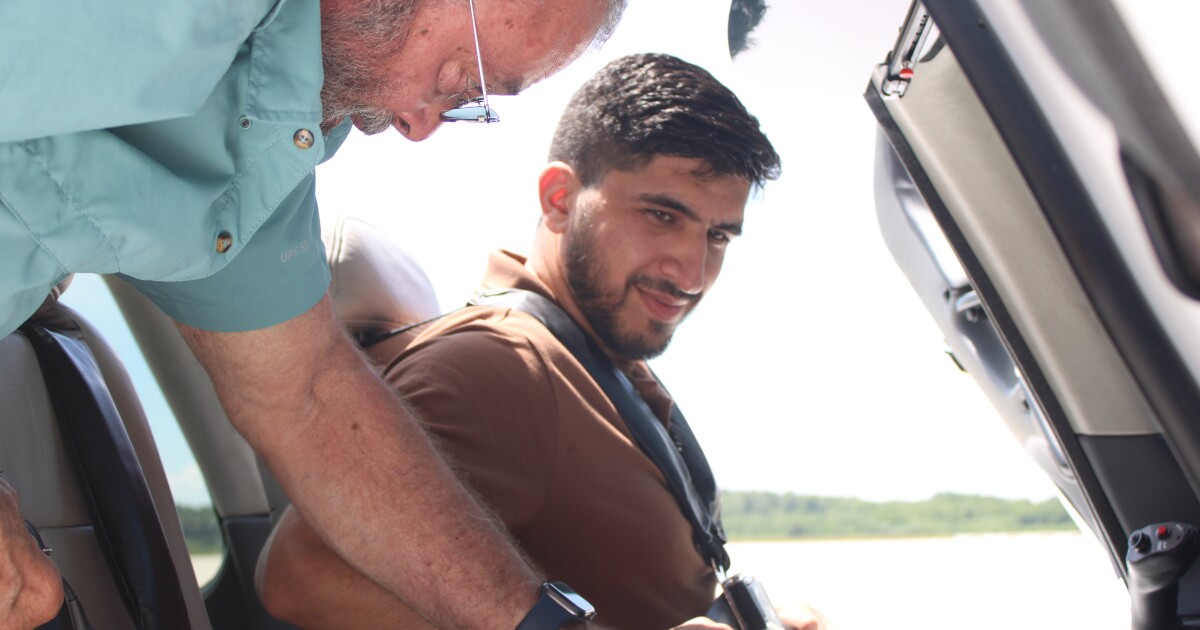
At the New England Aviation Academy in Brunswick, flight instructor Tony Alves is helping 26 year-old Farooq Safi get situated in the cockpit of a small propeller plane.
This will be Safi’s first time piloting an aircraft in the U.S., but he is no stranger to the skies. Growing up in Kabul, Safi said his childhood dream was to become a pilot. He went on to graduate from the Afghan Air Force academy and trained to fly Black Hawk helicopters.
Ari Snider
/
Maine Public
But shortly after completing his training, the U.S. withdrew from Afghanistan. As the government collapsed and the Taliban stormed Kabul, Safi said he and fellow Air Force service members decided their best hope for survival was to take one of the planes and flee to neighboring Uzbekistan, and hope for the best.
“One of my friends was taking the plane, trying to go towards Uzbekistan without knowing anything,” Safi said.
With the help of the U.S. government, Safi eventually resettled in the Lewiston Auburn area, alongside several other Afghan Air Force veterans.
Safi said he wanted to restart his flying career, but ran into a major roadblock.
“First of all, you need a lot of money,” he said.
At least $40,000, to be precise, which Safi said he didn’t have.
Then, he met Jen Fullmer, a retired colonel who flew for 24 years in the U.S. Air Force.
“He reminded me of myself when I was 26 years old,” Fullmer said, of Safi. “And I just knew we needed to help him.”
Fullmer, who lives in Biddeford, started applying for grants and raising money through a GoFundMe. Her goal is to come up with the money to cover the training and flight hours Safi needs to get his private pilot’s license. It’ll cost even more for Safi to get a commercial license.
Fullmer, who flew dozens of missions over Afghanistan, said helping Safi is personal. Especially after seeing how the U.S. withdrawal hurt many of the Afghans she’d served with.
“We were over there supporting our Afghan allies for 20 years, me personally, it was, like 15 years. And I’ve seen the anguish and and of their lives just being completely torn apart,” she said.

Ari Snider
/
Maine Public
Brunswick flight instructor Tony Alves, a retired Marine, said he too was angered by how the withdrawal was handled.
“I mean, you know, our ethos is we never leave anybody behind,” Alves said.
Alves said the flight school covered the cost of Safi’s classroom instruction, and is providing today’s introductory flight lesson for free.
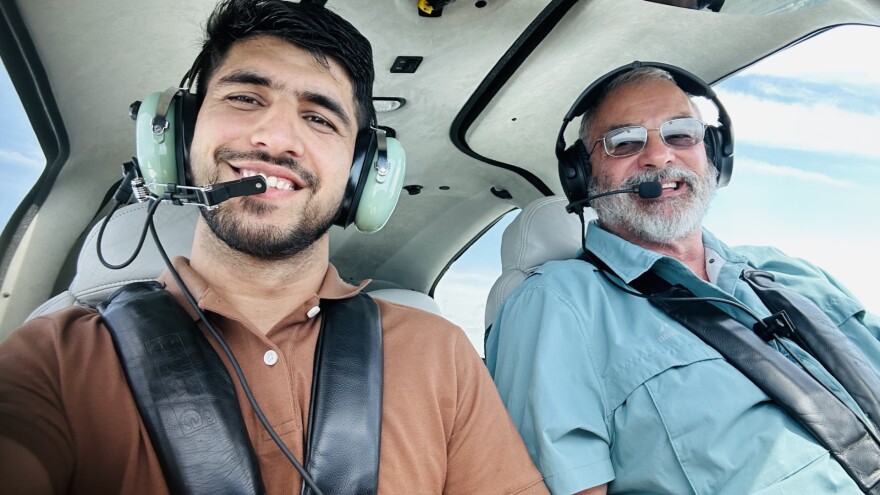
After taxing out to the runway, Safi and Alves lifted off into a stiff breeze, then banked left and buzzed out of sight.
Safi is among hundreds of Afghan pilots, mechanics, and ground grew who’ve resettled in the U.S. since the fall of Kabul, according to the Afghan American Development Group, a nonprofit formed to help these aviation professionals restart their lives and careers.
Russ Pritchard, the group’s CEO, said a few have gotten jobs flying for FedEx and UPS feeder airlines, jobs for which he said they are eminently qualified.
“You stack them up against some of the other employees that they’ve hired for the same positions, and this guy literally has thousands of hours more airtime under combat, under duress,” Pritchard said.
But Pritchard said the cost of training, the day-to-day challenges of resettlement, and the urgent need to send money to family back home have kept most Afghan aviators grounded.
As his organization tries to raise enough money to cover those training costs, Pritchard said he’d like to see some American defense contractors pitch in.
“There’s a lot of companies that made a lot of money in Afghanistan, like Raytheon, Sierra Nevada Corporation, I mean, they made huge money,” he said. “And I’d love for them to say, hey, disgorge, some of those profits back to the people you made money off of because they’re trying to survive.”

Ari Snider
/
Maine Public
At the former Naval Airbase in Brunswick, Safi and Alves bring the plane back to the hangar after the introductory training flight.
After years of flying helicopters, Safi said his first time at the controls of a fixed wing aircraft wasn’t too difficult.
“It was good,” he said. “It was so nice.”
Still, even if everything goes smoothly, he is still potentially years away from his long-term goal of becoming an airline pilot.
But Safi said he doesn’t care how long it takes.
“As I say, it’s a dream,” he said. “When you want to reach that dream, you have to work for it and to try to get it.”


Many Maine municipalities will open cooling centers this week with the National Weather Service issuing a variety of heat advisories covering the next few days.
The Maine DEP also issued an air quality alert for Wednesday with ground-level ozone expected to reach levels that are unhealthy for sensitive groups.
All of York County, interior Cumberland and Androscoggin counties, and the southern half of Oxford County will fall under an extreme heat warning from 11 a.m. Wednesday to 8 p.m. Friday.
The warning calls for “dangerously hot conditions” that could feature heat index values of up to 110 degrees, with overnight lows only expected to fall into the 70s, according to the weather service’s office in Gray.
The rest of the state — save northern Aroostook, Piscataquis and Somerset counties — falls under a heat advisory from 11 a.m. to 8 p.m. on Wednesday. However, the weather service has also placed much of the state under an extreme heat watch for Thursday.
Heat index values, which measure how hot it feels to the human body when relative humidity is combined with the air temperature, are expected to reach up to 104 degrees during the heat advisory period, the weather service warns. They could reach 110 degrees Thursday, when the extreme heat watch is in effect.
Northern Oxford and Franklin counties, and central Somerset County, can expect a heat index value of up to 99 degrees Wednesday, according to the weather service.
The weather service advises people to drink plenty of fluids, stay in air-conditioned rooms when possible, avoid extended periods in the sun and check up on relatives and neighbors. It also warns not to leave young children and pets in unattended vehicles, as “car interiors will reach lethal temperatures in a matter of minutes.”
Cooling Centers
The Maine Department of Environmental Protection has also issued an air quality alert from 10 a.m. to 11 p.m. on Wednesday along the coast from Kittery to Acadia National Park. The agency warns that ground-level ozone concentrations are expected to reach levels that are unhealthy for sensitive groups.
Ozone levels may reach “moderate levels” further inland, according to the Maine DEP, including in all of Androscoggin and Kennebec counties, as well as parts of Cumberland, Knox, Lincoln, Penobscot, Sagadahoc, Waldo, Washington and York counties.
Elevated ozone levels can pose a risk to children, older adults and people suffering from respiratory or heart diseases, according to the Maine DEP. Anyone exerting themselves outdoors may also experience health effects, which could include coughing, shortness of breath, throat irritation and mild chest pain.
Ozone levels were already climbing in southern New England on Tuesday, according to the Maine DEP, and winds are expected to bring those conditions to Maine on Wednesday.
The Maine DEP recommends that vulnerable populations avoid strenuous outdoor activities, keep windows closed, and circulate indoor air with fans or air conditioners. Those with asthma are also advised to keep quick-relief medication handy.
Particle pollution levels are also expected to be moderate across the state on Wednesday due to wildfire smoke, the Maine DEP said in its announcement Tuesday. Wildfires in Colorado, which have claimed the lives of three firefighters, had burned nearly 90,000 acres as of Tuesday, according to the Denver Post.

Maine could face up to $50 million in penalties next year due to errors in its payments for federal food benefits under the Supplemental Nutrition Assistance Program.
Newly released data from the U.S. Department of Agriculture find that Maine’s error rate last year was nearly 11%, the bulk of which were overpayments. That’s in line with the U.S. average. But starting in October of next year, states with error rates above 6% must cover a portion of the SNAP benefits.
Anna Korsen, executive director of Full Plates, Full Potential, said the overpayments aren’t fraud — they’re human error. She said this new cost-shifting policy enacted last year under the Trump administration further complicates the SNAP application process.
“Instead, we could make this program more accessible and more efficient,” Korsen said. “And that would reduce the number of errors and also ensure that Mainers who are eligible for SNAP have access to it.”
She’s urging Congress to delay or reverse the policy under the farm bill that’s currently under consideration.
Maine’s Department of Health and Human Services said it’s taking steps to reduce the error rate, including modernizing its systems and hiring an additional 40 eligibility specialists.
This story appears through a media partnership with Maine Public.

PORTLAND (WGME) — The third annual Celebration of America 300 is set for Thursday night at Oxford Plains Speedway.
This race was a favorite of NASCAR star Kyle Busch, who tragically passed away back in May. He was just 41.
Now, a Maine-born driver who worked on Busch’s team is ready to take the 8 car into victory lane.
For the past five years, Windham native Derek Kneeland was Busch’s eye in the sky, working as a spotter for the cup star. Kneeland says his relationship with Busch was like a brotherhood.
“I was fortunate enough where I got to have a personal relationship with him,” Kneeland said. “He came up, and he ran several races with me in late models and stuff at Oxford and Lee Speedway, and we got to do a lot of cool things together.”
Kneeland says dealing with the sudden loss has been both painful and difficult.
“It’s still hard,” Kneeland said. “I’m having a hard time with it. The weekdays are the hardest. At the track is where I’m most comfortable.”
Kneeland will be at the track and behind the wheel Thursday night, competing in the Celebration of America 300, driving the number 8 car.
“You know, a few days after everything went down, his dad called me, and his dad is a man of very few words, and I said, ‘You know, I’m thinking about running the 8 or 51 as long as I have your guys’ blessing, I would like to do that.’ And he said, ‘Short track world knows him as 51, but the world knows him as 8,’” Kneeland said.
Kneeland says it will be an emotional race, but he’s confident he’ll have a special co-pilot leading the way.
“Hoping he’s going to be on my shoulder and give me the guiding way and but to win it for Kyle, I think that would put the stamp on it,” Kneeland said.
-

 North Dakota4 minutes ago
June ND severe weather recap: 5 tornadoes, damaging winds impact numerous towns
-

 Ohio7 minutes ago
‘Pure evil’: Adults arrested after 16 children found in deplorable conditions in Ohio home
-

 Oklahoma12 minutes ago
Oklahoma Lottery Mega Millions, Pick 3 results for June 30, 2026
-

 Oregon19 minutes ago
What the Supreme Court’s transgender sports ruling means for Oregon
-

 Pennsylvania22 minutes ago
10-year-old stabbed Dollar Tree employee during robbery in Pennsylvania, police say
-

 Rhode Island27 minutes ago
Three generations killed during driving lesson after car plunges into river
-

 South-Carolina34 minutes ago
South Carolina Lottery Mega Millions, Pick 3 results for June 30, 2026
-

 South Dakota37 minutes ago
Vermillion’s Reuvers commits to South Dakota

