Northeast
House oversight probe puts Minnesota elections under scrutiny over noncitizen voting concerns

NEWYou can now listen to Fox News articles!
EXCLUSIVE: House Administration Chairman Bryan Steil sent oversight letters to election officials in 10 states, including Minnesota, seeking details on voter roll maintenance and safeguards against noncitizen voting.
The move puts Minnesota’s election system under renewed scrutiny as Republicans press states for compliance with federal election law.
Steil, R-Wis., wrote to both red and blue states — including Minnesota, Illinois, Maine, Indiana, Tennessee, Kansas, California, Ohio and Florida, noting that his committee has broad oversight of federal elections — and that public confidence in such elections is a “compelling interest of Congress and the states.”
“When illegal aliens are found on state voter rolls, it significantly undermines Americans’ confidence in our elections,” Steil told Fox News Digital Thursday.
TEXAS SENDS VOTER ROLLS TO DOJ TO LOOK FOR INELIGIBLE REGISTRATIONS
“I will continue to seek answers on how frequently this happens and what states are doing to address the issue. American elections are for American citizens only.”
Such concerns made national headlines when illegal immigrant Ian Roberts, serving as a high-paid school superintendent in Iowa, was found to be allegedly fraudulently registered to vote in Maryland.
Steil said at the time that Annapolis, Maryland, failed to provide him complete answers on the matter and left serious concerns unresolved, including whether Roberts ever received a live ballot or if the Old Line State drew the line with new protocols to verify citizenship.
In his letter to Minnesota Secretary of State Steve Simon, Steil wrote that his panel will be conducting oversight to review the state office’s compliance with federal election laws and potential legislative reforms.
OREGON ELECTION SYSTEM FACES SCRUTINY AS STATE MOVES TO ADDRESS 800,000 INACTIVE VOTERS: ‘ASTOUNDING’
Steil noted Simon previously said that Minnesota’s elections are “free, fair and secure,” but that the state’s “driver’s license for all” initiative may belie that.
He gave Simon, and the other secretaries of state, a two-week deadline to provide a series of datapoints to aid in the congressional investigation, including how often the states conduct general voter list maintenance, sources used to identify ineligible voter registrants, whether they utilize free data provided to states by United States Citizenship and Immigration Services known as the “systematic alien verification for entitlements database,” and whether they have data-sharing agreements with other states as an added safeguard.
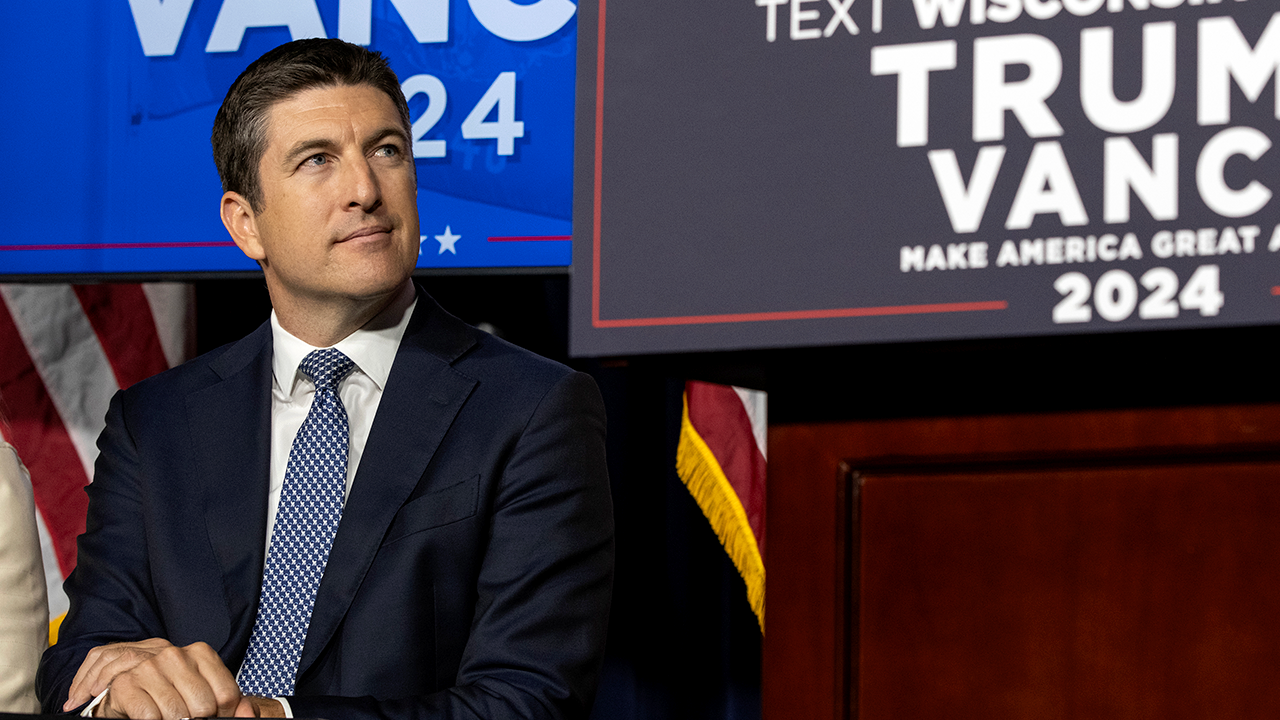
Rep. Bryan Steil sits at a Trump rally in Wisconsin. (Jim Vondruska/Getty Images)
The chairman’s letters also demanded information on how states remove deceased and relocated registrants to prevent fraud, and how they notify ineligible registrants already on the rolls.
A carbon copy of each letter was also sent to House Administration Committee ranking member Joe Morelle, D-N.Y.
Minnesota’s voting system also came under scrutiny over its “vouching” policy, which allows a registered voter to “vouch” for up to eight other people seeking same-day registration.
CLICK HERE TO DOWNLOAD THE FOX NEWS APP
An official in Simon’s office told Fox News Digital that the vouching policy has been intact for “more than 50 years.”
Simon deputy communications director Cassondra Knudson said at the time that several measures are in place to help keep the election system in Minnesota secure under the vouching policy, and that “vouching can only be used to provide proof of a potential voter’s residence in the precinct.”
Read the full article from Here



A handful of mostly unknown Democrats, including a retired art teacher, a candidate’s husband and a finance executive, will soon have unprecedented influence over the U.S. Senate race.
Maine Democrats are slated to host a 600-member convention this month, with roughly 500 of those members selected by the party’s 16 county apparatuses. Being a county chair is usually a low-key position. After Graham Platner’s Wednesday announcement that he will leave the race following sexual assault allegations, they are suddenly in a position of power.
Here are the 16 people tasked with creating a delegation to pick who will face off against Republican Sen. Susan Collins.
Joseph Zamboni: Cumberland County
As Maine’s most populous county, Cumberland will have the largest delegation at the coming convention. Its party chair is health policy and law professor and pro-vaccine advocate. He currently serves as the chair of Portland’s zoning board and previously worked for the state and the federal Department of Health and Human Services.
Kathie Purdy: York County
York, the southernmost county, is the state’s second most populous. Its delegation will be led by Kathie Purdy, a former candidate for the state Legislature. She is a business owner in Saco and a bar manager in Ogunquit, according to her LinkedIn profile.
Harry Sanborn: Penobscot County
Alton resident Harry Sanborn is involved in local government, serving as a member of both the planning board and budget panel. He also serves as the town’s sexton. His wife, Laura, a former lawmaker and county commissioner, is a school board member for Regional School Unit 34.
Joanne Mason: Kennebec County
Kennebec’s Democratic Party chair is Joanne Mason, a nonprofit leader and the wife of Sheriff Ken Mason. According to her LinkedIn, she is president of the Family Violence Project, an Augusta-based nonprofit.
Carl Wilcox: Androscoggin County
From his social media history, Wilcox appears to be on the left of the party. In response to a white nationalist rally in DC last week, he posted that “billionaires control the media and the government sets the rules to funnel ever greater sums to the billionaire class,” echoing Platner’s anti-billionaire language. He hiked the entire Appalachian Trail in 2016.
Alison Willette: Aroostook County
Willette has relatively little online presence, but the Aroostook County Democrats downplayed the chair’s role in a Thursday Facebook post, writing, “the process is still being hashed out, but I assure you all counties have representation involved and it is NOT a ‘cherry picked by the chair’ process!”
Aroostook’s delegation, likely to be the seventh-largest, could be a source of support for former Senate President Troy Jackson, an Allagash native who is running to replace Platner in his populist mold.
Bruce Bryant: Oxford County
Oxford is one of the only counties with a chair that served in the state Legislature. Bruce Bryant was a Senator between 2002 and 2010. In 2024 he ran for state senate again, but lost to Republican Joseph Martin. On social media he voiced support for Troy Jackson when he was running for Governor.
Marcia Myers: Hancock County
Myers is a former news editor who now lives in Deer Isle. Her social media history shows posts invoking independent socialist Sen. Bernie Sanders and attending “No Kings” protests. She told MS NOW in June that Democrats in Hancock were “laser-focused on issues like healthcare and cost of living.”
Lise Ragan: Somerset County
Ragan is an Anson resident and former teacher who describes herself on Facebook as a “patriotic, very concerned American.” She told the Bangor Daily News she is “confident” the party can move forward with a new candidate for U.S. Senate.
Greg Marley: Knox County
Rockland resident Greg Marley is married to the city’s former mayor and current state Rep. Valli Geiger, a Platner ally running to replace him. In response to a post by The Midcoast Villager about Valli’s interest, Marley posted that he “stand[s] beside this extraordinary woman every step of the way.” Geiger had been a close ally of Platner, who she says encouraged her to run.
Marley is a clinical director of suicide prevention at Maine’s chapter of the nonprofit National Alliance on Mental Illness.
Stanley Paige Zeigler: Waldo County
Zeigler is a former merchant mariner and state representative. He represented part of Waldo County between 2016 and 2024. He has been involved with environmental organizations like the Sierra Club and the Maine Bike Coalition.
Keith Mestrich: Lincoln County
Lincoln County’s chair is set for one of the smallest delegations, but he may have something that other party leaders lack and that many party voters have shunned over the course of Platner’s campaign — money and connections.
Keith Mestrich got his start in labor organizing and eventually became CEO of Amalgamated Bank, a union-owned financial institution. He is now a founding partner of Percapita, a financial tech firm providing an employee benefit platform for low-income workers. He also serves as the chair of the National Trust for Local News, whose Maine arm owns The Portland Press Herald and sister papers.
Lisa Marin: Washington County
Washington County Democrats are led by a retired art teacher who worked at the Moosabec Community School District in Jonesport. The Downeast resident’s Facebook history shows that she has attended “No Kings” protests. She recently wrote a Press Herald op-ed condemning Republican gubernatorial nominee Bobby Charles.
Wayne Kinney: Franklin County
Kinney represents Farmington on the RSU 9 school board. His online presence is limited.
Deb Dagnan: Piscataquis County
Dagnan will lead the smallest county delegation. She had expressed skepticism about Platner after The New York Times published a story in June detailing claims of abuse by his ex-girlfriends. She told PBS ahead of the primary election that people were “waiting for the other shoe to drop after he gets the nomination.”
“Then what do we do?” she asked.
Daniel O’Connor is a Report for America corps member who covers rural government as part of the partnership between The Maine Monitor and the Bangor Daily News, with additional support from BDN and Monitor readers.

A vehicle crashed into a hair salon in Danvers, Massachusetts, leaving three people injured on Thursday.
Police said the crash happened shortly before 3:30 p.m. at Beijo Beauty on Newbury Street.
Three people inside the business suffered injuries that are believed to be non-life-threatening, police said. All three were taken by ambulance to local hospitals.
A fire official at the scene said the three patients’ injuries are considered minor. The building was evacuated after the crash.
One customer told NBC10 Boston she stood with an injured person while someone called 911, adding that her own car had been damaged.
“I was done, I was just about to get up. If I had been in my car, I would have gotten really hurt,” she said. “My car got totaled.”
Police did not say whether the driver would face any charges.
The cause of the crash is under investigation.
-

 Connecticut2 minutes ago
Marian Katz Obituary
-

 Delaware5 minutes ago
DE health officials ‘on pins and needles’ after measles cases in PA
-

 Florida10 minutes ago
Florida man accused of driving drunk, causing head-on crash and seriously injuring 2
-

 Georgia17 minutes ago
Georgia cops’ alleged misuse of Flock license plate tracking data fuels privacy concerns
-

 Hawaii20 minutes ago
3 candidates to be considered for District 18 seat
-
 Idaho25 minutes ago
“We won’t insure you”: Robie Creek homeowners struggle to get home insurance due to wildfire risks
-

 Illinois32 minutes ago
After recent Illinois lightning strikes, officials share safety tips
-

 Indiana35 minutes ago
Kelsey Mitchell winner completes Fever comeback against Mercury, without Caitlin Clark

